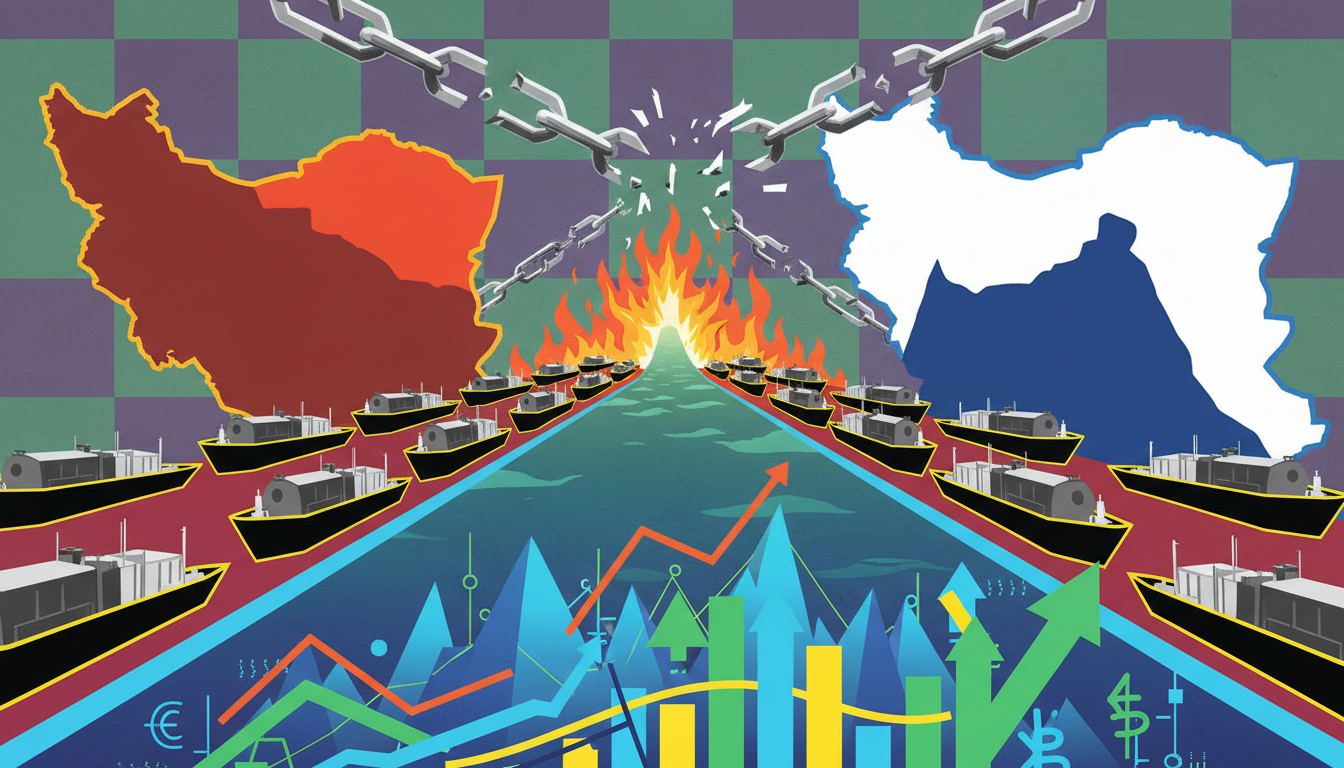
On April 18, 2026, Iranian Islamic Parliament Speaker Ghalibaf issued a stern warning via social media, clearly targeting the United States' blockade of Iranian ports. His key statement is: if the United States continues to block Iranian ports, the Strait of Hormuz will "no longer be open," emphasizing that "the U.S. has not won wars through lies and will gain nothing in negotiations." This is not a mere diplomatic complaint, but directly includes one of the world's most critical energy corridors within the scope of deterrence. Once the Strait of Hormuz is obstructed, the global crude oil and natural gas transport chain will face severe impacts, forcing a rewrite of oil prices, transport rates, and the pricing of risk assets. This article will trace how the "sanctions and counter-sanctions" narrative drives the energy corridor game to elevate risk-averse sentiment, penetrating traditional markets and cryptocurrency asset pricing logic.
Iran's Tough Talk: The Strait is No Longer a Default Option
Ghalibaf's public statement contains two key assertions: first, accusing the U.S. of "not winning wars through lies and being destined to gain nothing in negotiations," elevating the current U.S. policy on Iran to a narrative framework of dual failure in both war and negotiation; second, issuing a clear warning that "if the U.S. continues to block Iranian ports, the Strait of Hormuz will no longer be open," escalating the vague "consequences will be borne" into a direct threat on a specific corridor. The first statement targets the legitimacy of the U.S. in public opinion and negotiation, while the second delineates the geopolitical boundaries of sanctions and counter-sanctions.
What can be confirmed is that the U.S. is implementing a blockade and restrictions on Iran's ports and energy exports through financial and administrative means, but the brief does not provide details such as the degree of the blockade or specific enforcement methods, clearly requesting to avoid fictional representations at the execution level. Therefore, at the factual level, we can only say that Ghalibaf is publicly pressuring against the backdrop of a blockade, using the "closure" of the Strait as a countermeasure. Unlike previous statements that more abstractly spoke of "retaliation threats," this time, Iranian high-level officials explicitly named the crucial chokepoint of the Strait of Hormuz, shifting the discourse from diplomatic language to a clear risk warning for global energy infrastructure.
This change in tone reflects Iran's attitude shift of tying its predicament to global energy security. As long as the Strait remains open, the global market can consider Iranian sanctions a "regional issue"; once Iran starts to publicly discuss the possibility of "the Strait no longer remaining open," the event escalates from a bilateral game to a global risk. Ghalibaf, as the Speaker of Parliament rather than simply a hardline religious figure, makes it more difficult for outsiders to interpret his words as "marginal voices," but rather as a significant move formally released by the state.
What Happens When the Global Crude Artery is Choked?
The Strait of Hormuz has long been regarded as the "throat" of global energy. Although the brief did not provide specific proportions, the general market consensus is that a significant amount of Middle Eastern crude oil and liquefied natural gas must flow through this narrow channel to Asian and European and American terminal markets. Anyone focused on oil and gas prices knows that the smoothness of this corridor is almost equivalent to the pulse curve of global energy flow.
If the Strait is completely closed, or if military risks and skyrocketing insurance costs significantly limit transport capacity, the chain reaction will spill over along three paths: First, the supply expectations for crude oil and natural gas will be rapidly downgraded, and long-term contracts in the futures market will be promptly repriced, possibly leading to a "gap-up" spike in oil prices; secondly, maritime freight rates and insurance costs will soar, with many shipping companies demanding additional risk premiums, further pushing up landed costs; lastly, energy flows from the Middle East will be forcibly rearranged, compelling European, American, and Asian buyers to scramble for alternative resources, and the reallocation of supply chains itself will create new price shocks.
In extreme cases, core oil-producing countries in the Middle East will face a dilemma: on one hand, their export lifelines are severely choked, putting pressure on fiscal revenues; on the other hand, if they get entangled in direct confrontation with the U.S. and Iran, they may also pay a price in terms of security and relationships with allies. For Asian import countries highly reliant on Middle Eastern energy, if the Strait of Hormuz no longer remains "open by default," it is not just a matter of increased energy bills, but a need to reassess strategic reserves, supply diversification, and the pressure on local currency exchange rates, among a whole set of risks. Although European and American energy markets have increased their buffer through shale oil and gas and post-Russia-Ukraine conflict rebalancing in recent years, under the overall upsurge of global spot prices, the costs for end industries and residents are also hard to escape.
From Russian Oil Exemptions to Iranian Fury: The Sense of Imbalance in the Time Lag
Notably, around the time Iran released its tough signals regarding the Strait of Hormuz, the U.S. Treasury's exemption for Russian oil sales was noted to be valid until May 16. This timeline comes from a singular source but at least provides a limited timeframe: under the backdrop of the Russia-Ukraine conflict, the U.S. chooses to provide a degree of "operational space" for Russian oil sales during a specific window while maintaining a high-pressure blockade stance against Iran.
This comparison creates a temporal dislocation: on one side, there is an exemption for Russian oil sales under certain conditions, while on the other side, pressure continues on Iranian ports. For Iran, which has long been sanctioned and sees itself as a regional power, it is easy to create a narrative within public opinion and internal politics of being "systematically marginalized"—why is treatment so different for energy exporting countries also sanctioned by the West? Such questions may not make it into official communiqués, but they do ferment in various internal settings and media.
Against this psychological and political backdrop, Iran's decision to place the Strait of Hormuz on the table at this moment feels more like a "reverse constraint" against the U.S. energy and sanctions strategy. The U.S. hopes to maintain some balance in global supply and prices amidst the delicately managed exemptions for Russian oil, whereas Iran, by raising the possibility of "the Strait no longer being open," introduces new uncertainties to that balance. In other words, Iran is attempting to tell the world: you cannot continue to calculate the Russian oil issue while assuming the Strait will remain unaffected when sanctions against Iran escalate.
Therefore, this apparent verbal tussle surrounding the blockade of ports and threats to the Strait points to the deeper issue: in a multipolar energy game, who can truly control the "last mile." The time anchor of the Russian oil exemption overlapping with the rhythm of Iranian statements has further elevated the stakes in this geopolitical game.
Risk-Averse Sentiment Rising: Capital Seeking Outlets Under Geopolitical Shadows
Geopolitical tensions will not solely remain in the headlines of diplomatic news; capital is the most sensitive audience. The research brief mentions that the cryptocurrency fund Asymmetric experienced huge withdrawals, seen as a concrete signal of a sharp decline in market risk appetite. For these funds that mainly target high-beta assets, substantial withdrawals often mean investors collectively lose patience with "high-risk gambles" in a short time, turning instead to prioritize capital safety and liquidity.
In the realm of traditional assets, once the risks at critical nodes like the Strait of Hormuz are recalibrated, common capital pathways involve: withdrawing from high-valuation growth stocks, high-leverage credit products, and highly volatile emerging market assets, with some flowing into U.S. dollar cash, short-duration government bonds, and even gold and some long positions in commodities. Cryptocurrency assets find themselves in a somewhat awkward yet highly sensitive position—during periods of liquidity easing and strong risk appetite, they often act as "beta amplifiers"; however, when geopolitical and energy uncertainties overlap, cryptocurrency assets first feel the chill of "de-leveraging" rather than the halo of "digital safe-haven assets."
Under the current circumstances, increasing "oil route risks" will prompt investors to re-examine all assumptions related to global growth, liquidity, and risk premiums: if the energy price center is forced higher, will it erode corporate profits, raise inflation expectations, thus making it harder for central banks to continue easing monetary policy? If the answer leans towards "yes," then the risk premium demands for high-valuation tech stocks, altcoins, and highly leveraged derivatives naturally rise. In this process, capital does not flee risk assets in a one-size-fits-all manner but balances more finely between "volatility that can bear withdrawal" and "extreme tail risks," and Asymmetric's withdrawal is merely an amplified sample in this structural migration.
Behind the Verbal Duel: The U.S. and Iran are Approaching but Not Crossing the Red Line
On the information boundary, one point needs to be repeatedly emphasized: the outside world currently does not know, nor can it reliably ascertain the substantive progress of any specific negotiations between the U.S. and Iran, nor is there authoritative information regarding the actual timetable for the closure of the Strait of Hormuz. The research brief makes it clear that there is a prohibition against any fictionalization regarding the negotiation process or closure implementation scheme for either side, thus all analysis can only remain at the level of public statements and visible behaviors.
From Iran's perspective, strong statements serve both security considerations and political needs. Prolonged sanctions and security threats lead its decision-makers to lean towards "demonstrating resolve" to raise the opponent's game costs; while within domestic public opinion and the institutional structure, appearing weak externally often translates into a loss of internal political capital. Ghalibaf's appearance as Speaker conveys authority and a strong stance, sending an internal message that "we will not be crushed by the blockade."
For the U.S., domestic public opinion and political mechanisms similarly push towards an externally tough posture. On one hand, the U.S. needs to prove that its sanctions against "problem countries" like Iran still hold deterrent power and cannot appear overly conciliatory on the Iranian issue after expending too much political capital on complex matters like the Russia-Ukraine conflict and exemptions for Russian oil; on the other hand, whether in the presidential election cycle or congressional battles, foreign policy finds it hard to exhibit complete flexibility, and tough rhetoric becomes, to some extent, a form of "minimum cost" political expression.
What is more likely to play out between real war and total compromise is a series of "gray escalations" involving multiple rounds of pressure and probing:
● One end may involve strengthening local military postures, such as military exercises, adding troops for escort, and upgrading intelligence warfare, to demonstrate resolve to opponents and allies while intentionally avoiding triggering the critical point of full conflict.
● The other end might involve slight adjustments to economic and financial sanctions, such as expanding lists, adjusting exemptions, and intensifying port inspections, preserving pressure while leaving room for potential "step-down" measures in the future.
In this gray area, both the U.S. and Iran are approaching the red line yet trying not to cross it. The frequent mention of the Strait of Hormuz is a visible manifestation of this game entering a highly sensitive zone.
A Preview of the Financial Storm on Energy Routes
The risks associated with the Strait of Hormuz are evolving from a seemingly distant geopolitical event into a variable that cannot be ignored in market models and asset pricing. As long as Iranian high-level officials continue to link the "openness of the Strait" with U.S. blockades, global traders must reserve a mental space regarding a "disruption of energy channels" when evaluating oil prices, inflation, monetary policy, and risk asset valuations. This tail risk may not necessarily materialize, yet it is sufficient to alter today's risk premium demands.
In the coming weeks, several signals will be particularly crucial: first is the trajectory of diplomatic language—whether statements from Iran, the U.S., and related Middle Eastern countries are shifting towards de-escalation or continuing to intensify the Strait issue; second is military deployments and security dynamics, including escort fleets, military exercise rhythms, and security announcements, whether any noticeable upgrades occur; the third is the volatility patterns in energy prices and related assets, especially the shape of oil and gas futures curves, shipping and insurance rates, and the performance of highly correlated emerging markets and risk assets, which will all be immediate feedback from the market re-pricing of the "Hormuz variable."
For investors in cryptocurrencies and broader risk assets, a more rational stance is: manage tail risk, rather than bet on extreme outcomes themselves. This implies that in terms of position and leverage management, one should reserve buffers for the combination scenario of "oil route disruption + renewed inflation + tightening liquidity," rather than betting everything on whether the Strait will definitely close or definitely remain open. Moderately reducing leverage, increasing vigilance toward single sources of liquidity, and diversifying excessively concentrated high-beta exposures are often more practical than trying to short or go long on some extreme geopolitical event. After all, what truly destroys asset portfolios is often not day-to-day volatility, but that one "throat-lethal thunder" that arrives unprepared.
Join our community to discuss and become stronger together!
Official Telegram Community: https://t.me/aicoincn
AiCoin Chinese Twitter: https://x.com/AiCoinzh
OKX Benefits Group: https://aicoin.com/link/chat?cid=l61eM4owQ
Binance Benefits Group: https://aicoin.com/link/chat?cid=ynr7d1P6Z
免责声明:本文章仅代表作者个人观点,不代表本平台的立场和观点。本文章仅供信息分享,不构成对任何人的任何投资建议。用户与作者之间的任何争议,与本平台无关。如网页中刊载的文章或图片涉及侵权,请提供相关的权利证明和身份证明发送邮件到support@aicoin.com,本平台相关工作人员将会进行核查。