Original source: VELA
1. Current Status of the Traditional DeFi Industry: A Fragmented "Patchwork Financial System"
Although the current DeFi has constructed an infrastructure system covering trading, lending, and derivatives, its underlying structure is still in the stage of "patchwork finance." Taking the Solana ecosystem as an example, users often need to complete transactions on Raydium, acquire leverage on Solend, and then route liquidity through Jupiter. This multi-protocol operation not only significantly increases interaction complexity but also continuously erodes capital utilization with each path hop, ultimately forming a typical "liquidity fragmentation." More importantly, this structure exposes risks outside the system. Current mainstream leverage mechanisms rely heavily on oracles; once there are severe market fluctuations, the delay between price changes and liquidation execution often directly evolves into liquidation and bad debt risks. At the same time, traditional AMMs have limited support for complex transaction instructions, requiring users to bear extra slippage losses at the opening stage, putting trades at a disadvantage from the very start. Ultimately, the current issue of DeFi is not a lack of performance but a structural imbalance: liquidity, execution, and risk control are separated from each other, making the entire system more like an inefficiently operating "financial factory." Against this backdrop, the real breakthrough direction for the industry is no longer single-point optimization, but moving toward a higher level of unified execution and atomic integration.
2. PinPet: Solana's Innovative Atomic Finance Engine, Reconstructing the DeFi Execution System
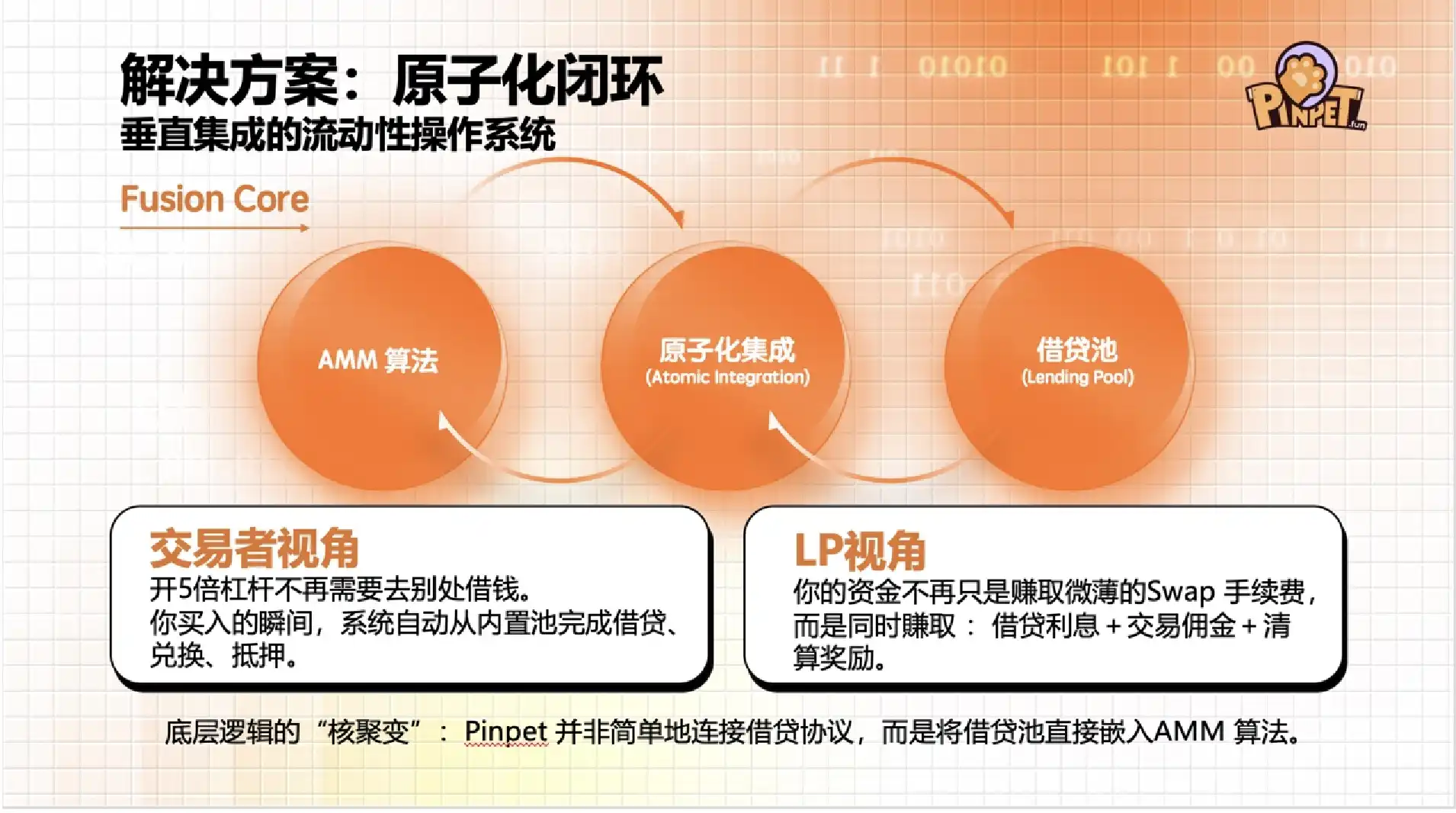
In response to the structural problems of traditional DeFi marked by fragmented execution paths and low capital efficiency, PinPet has proposed a more fundamental solution idea, reconstructing the financial execution system through "atomic integration." As a next-generation decentralized trading protocol built on Solana, PinPet is not merely stitching together AMM and lending modules but deeply coupling automated market makers (AMM) and automated lending pools at the underlying protocol level to form a vertically integrated liquidity operating system. Under this architecture, users no longer need to perform multi-step operations across protocols but can synchronize the entire closed loop of asset exchange, leverage opening, fund borrowing, and real-time liquidation in a single transaction. This "atomic execution" mechanism ensures that all operations either succeed completely or roll back entirely, fundamentally eliminating uncertainties brought about by intermediate states.
From the user's perspective, trading and leverage are no longer two separated operations; at the moment of opening a position, the system can automatically complete lending, exchange, and collateralization; from the liquidity provider (LP) perspective, funds are no longer limited to acquiring a single Swap fee, but can also participate in the distribution of lending interest, trading commissions, and liquidation profits simultaneously. The core lies in that PinPet is not merely "connecting" different financial modules; it directly embeds borrowing capabilities into the AMM algorithm through the Fusion Core, completing trading, leverage, and risk control within the same logic. This transformation from "combination" to "fusion" allows PinPet to significantly shorten execution paths and enhance capital utilization efficiency while truly constructing an atomic finance engine that unifies various financial links.
3. Core Barriers and Business Closure: PinPet's Structural Advantages and Value-Capturing Ability
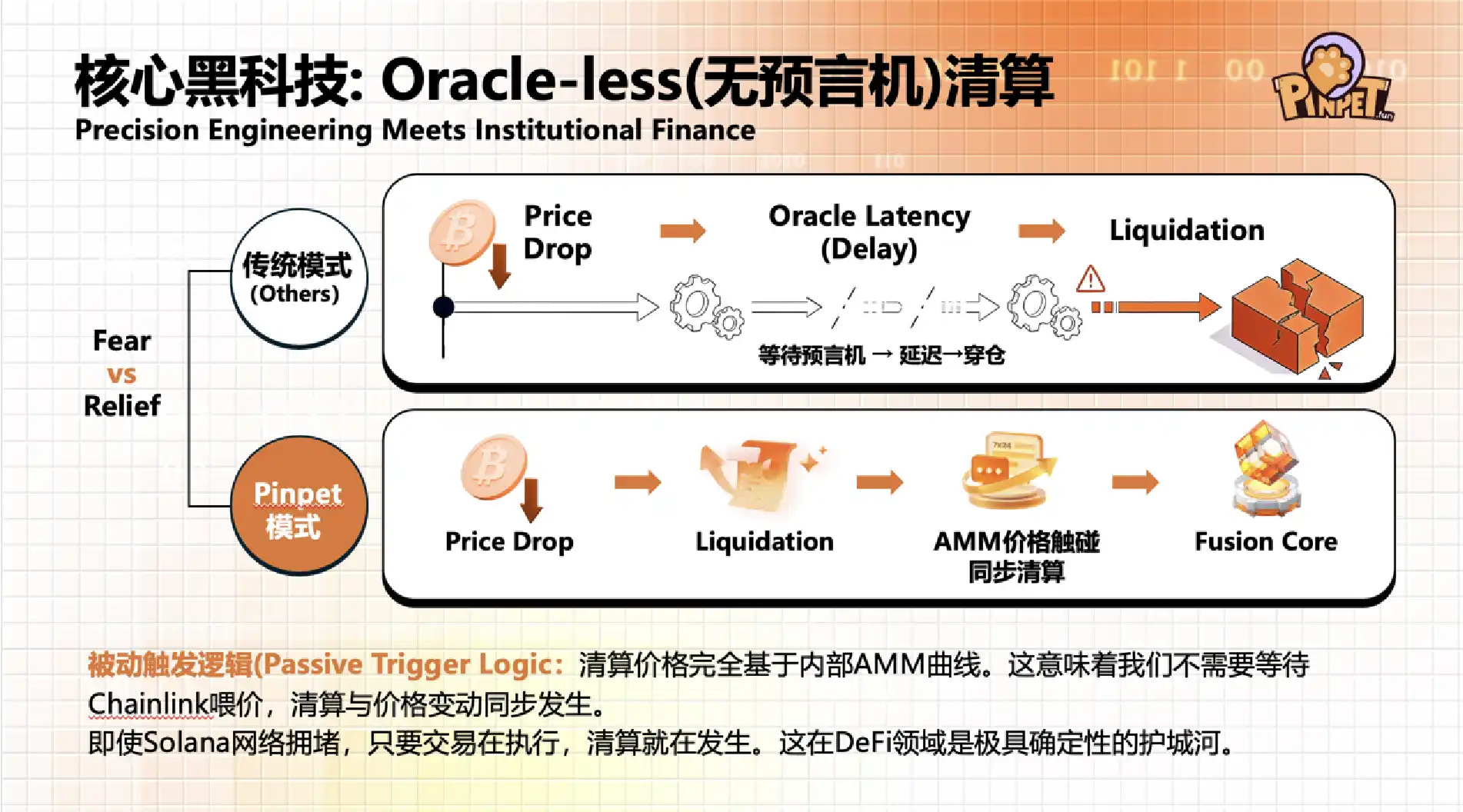
PinPet's core competitiveness lies not just in "atomic execution" but in the structural advantages formed under the unity of execution certainty, system performance, and value-capturing ability. First, in terms of risk control mechanisms, PinPet achieves collateral liquidation without oracles, embedding the liquidation logic directly into the AMM curve, enabling simultaneous execution of "price touch and liquidation," compressing the traditional DeFi process of "price update—judgment—execution" into a single step. This mechanism not only eliminates the liquidation risk brought about by oracle delays but also transforms liquidation from an external response to an endogenous system capability, maintaining certainty even in extreme markets and network congestion, thereby building a "mathematically-based" risk control moat.
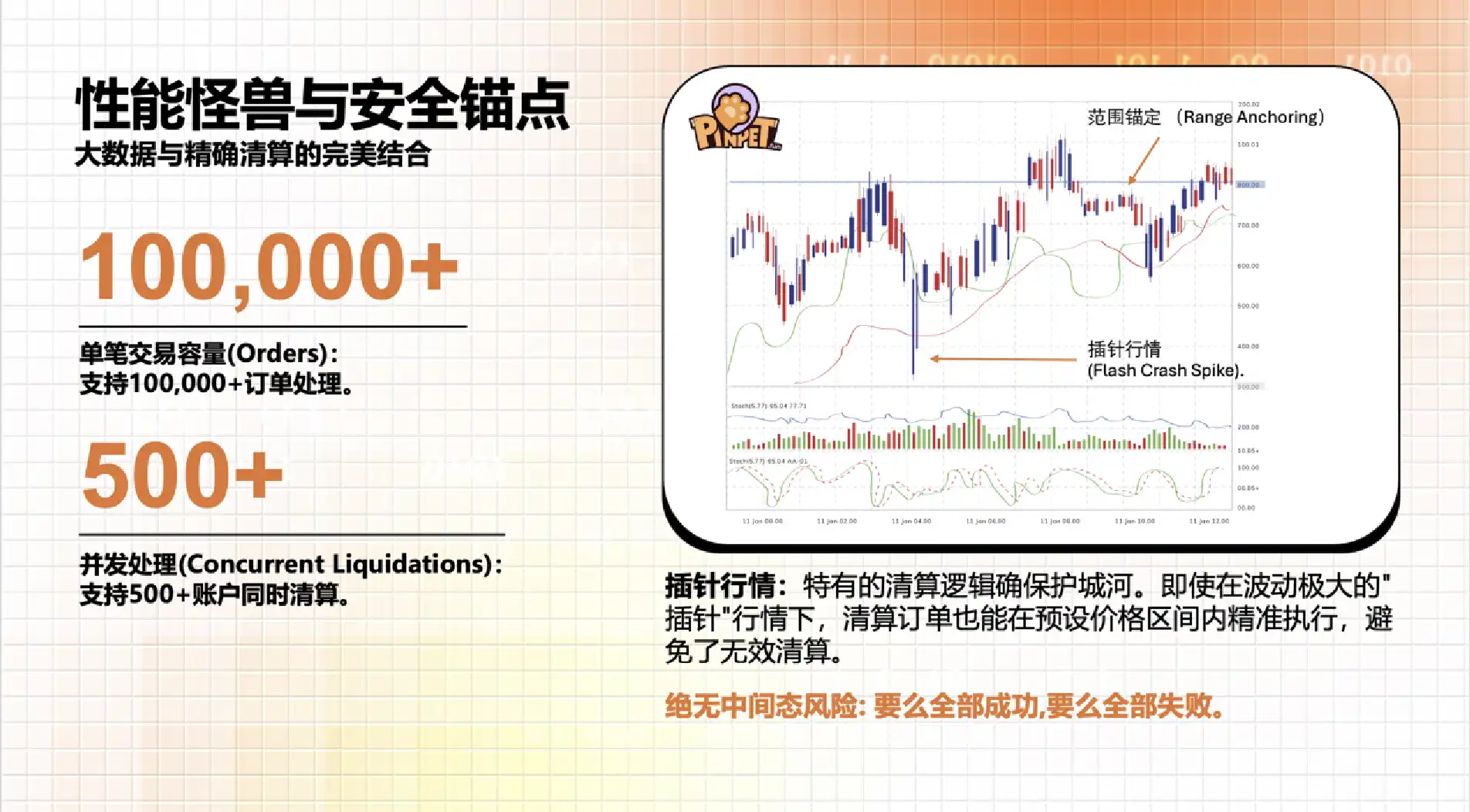
Basing on this, its performance architecture further strengthens the system's advantages. PinPet supports high-concurrency order handling and multi-account synchronous liquidation, ensuring effective liquidation during volatile markets through interval anchoring mechanisms. At the same time, under the atomic execution model, there are no intermediate state risks; all operations either fully succeed or roll back entirely, giving it a natural advantage in high-frequency and leveraged trading scenarios.
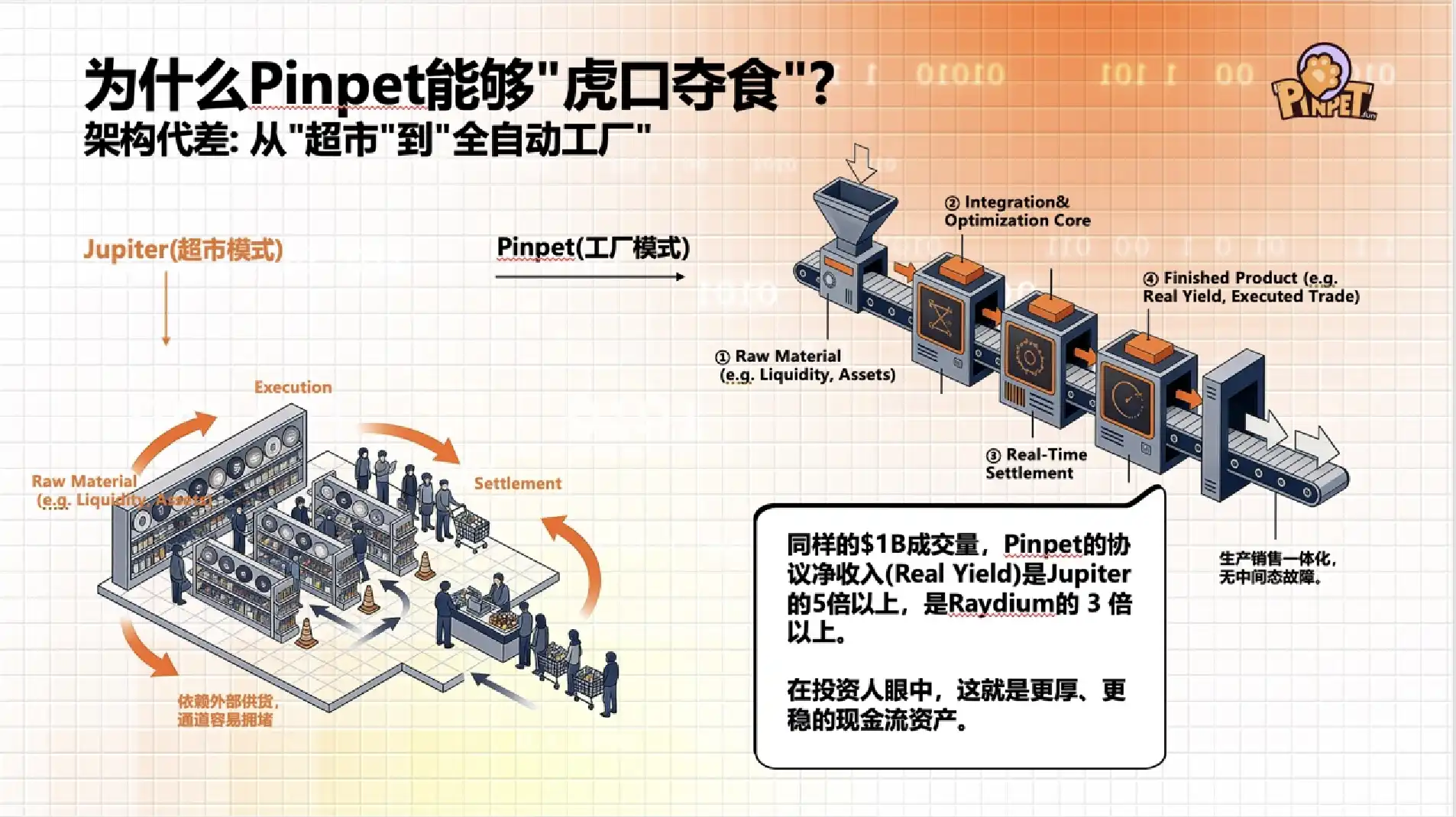
Compared to mainstream protocols like Jupiter and Raydium, PinPet completes trading, lending, and liquidation within the same system through atomic closed-loop transactions and oracle-free liquidations, significantly shortening execution paths while forming advantages in capital efficiency and risk control. More importantly, this architecture translates directly into improvements in the business model — by covering the entire process of trading, lending, and liquidation with a 1% full-chain fee rate, PinPet captures the value of the asset's entire life cycle, forming a multi-source cash flow structure with stronger profitability and valuation support at the same transaction scale.
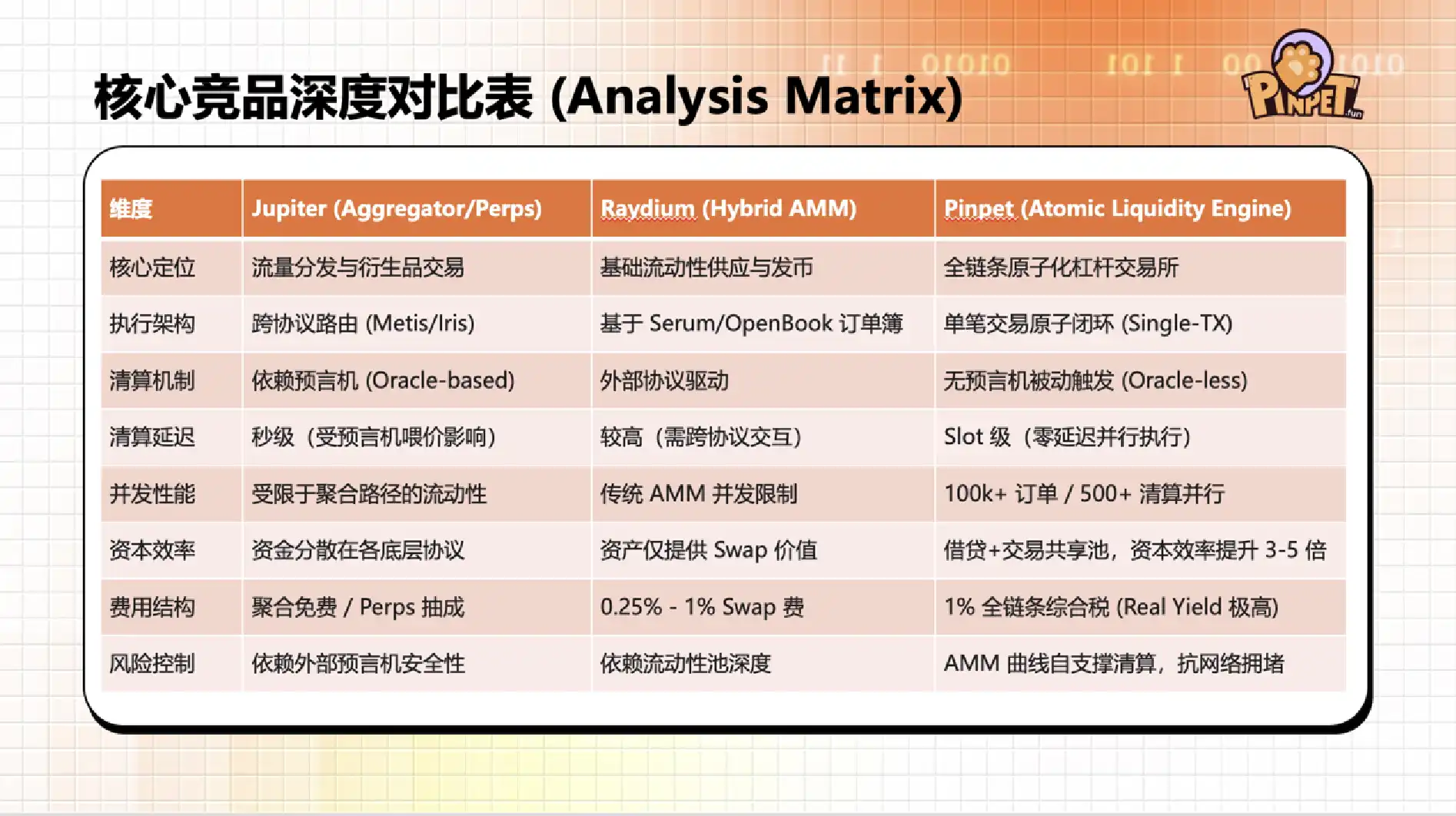
Essentially, this difference marks a paradigm shift in architecture. Jupiter is more like a "supermarket" for liquidity, while PinPet is closer to a "fully automated financial factory," completing the entire process from liquidity integration to trade execution and financial settlement internally. It is this transition from "path optimization" to "value production" that has allowed PinPet to establish an unreplicable structural barrier.
4. VELA: A Native Yield Hedging Protocol, Reconstructing the On-Chain Yield Logic
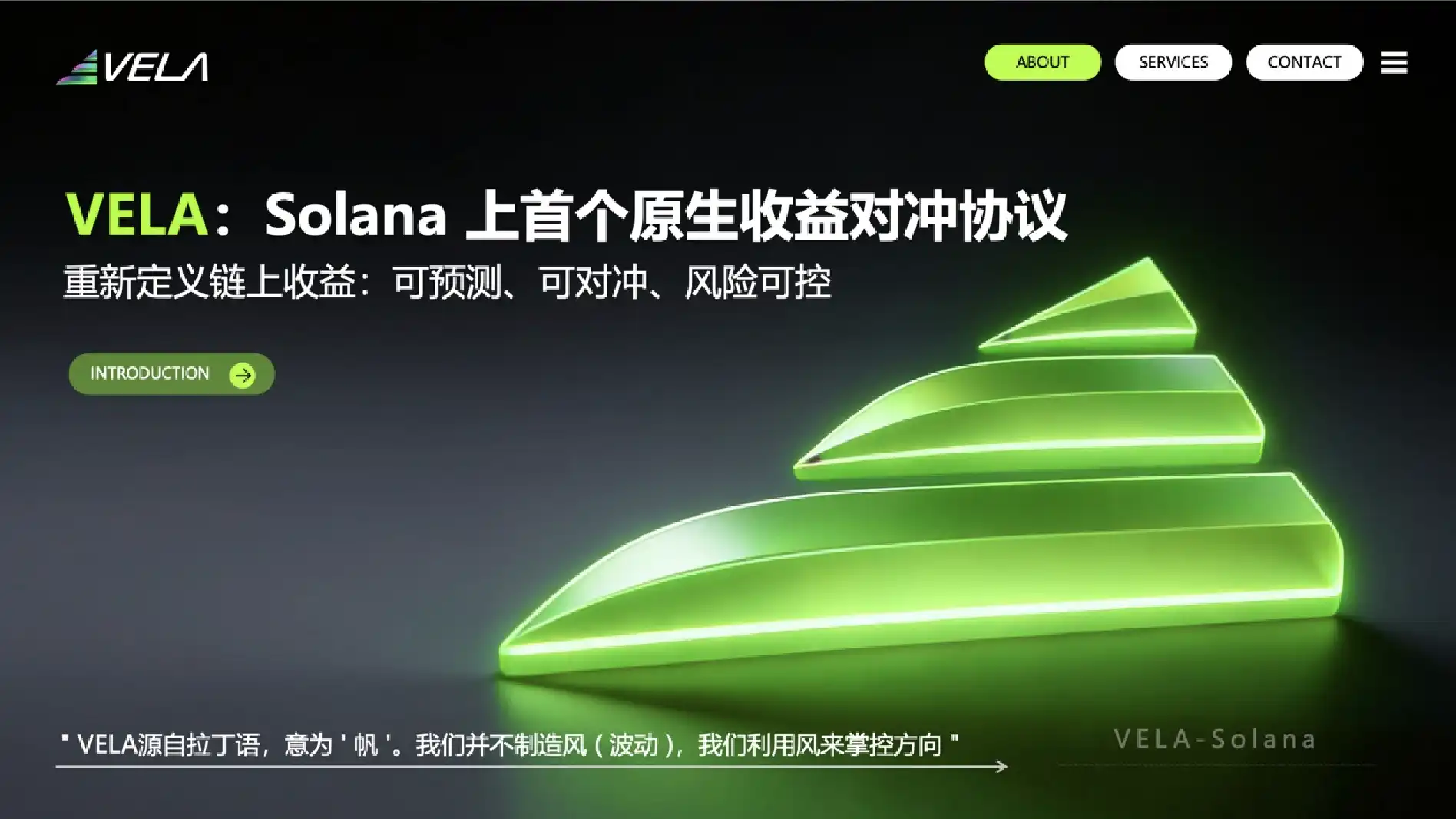
VELA derives from Latin, meaning "sail." A sail moves forward with the wind, controlling direction and navigating through uncertain fluctuations. In the crypto market, price rises and falls are like the wind; fluctuations cannot be eliminated but can be utilized, guided, and hedged, and VELA is built on this logic to construct its yield system. As a native yield hedging protocol built on Solana and also the first leading project of the PinPet ecosystem, VELA focuses not on "how to obtain higher yields" but on the true sources and sustainability of on-chain yields.
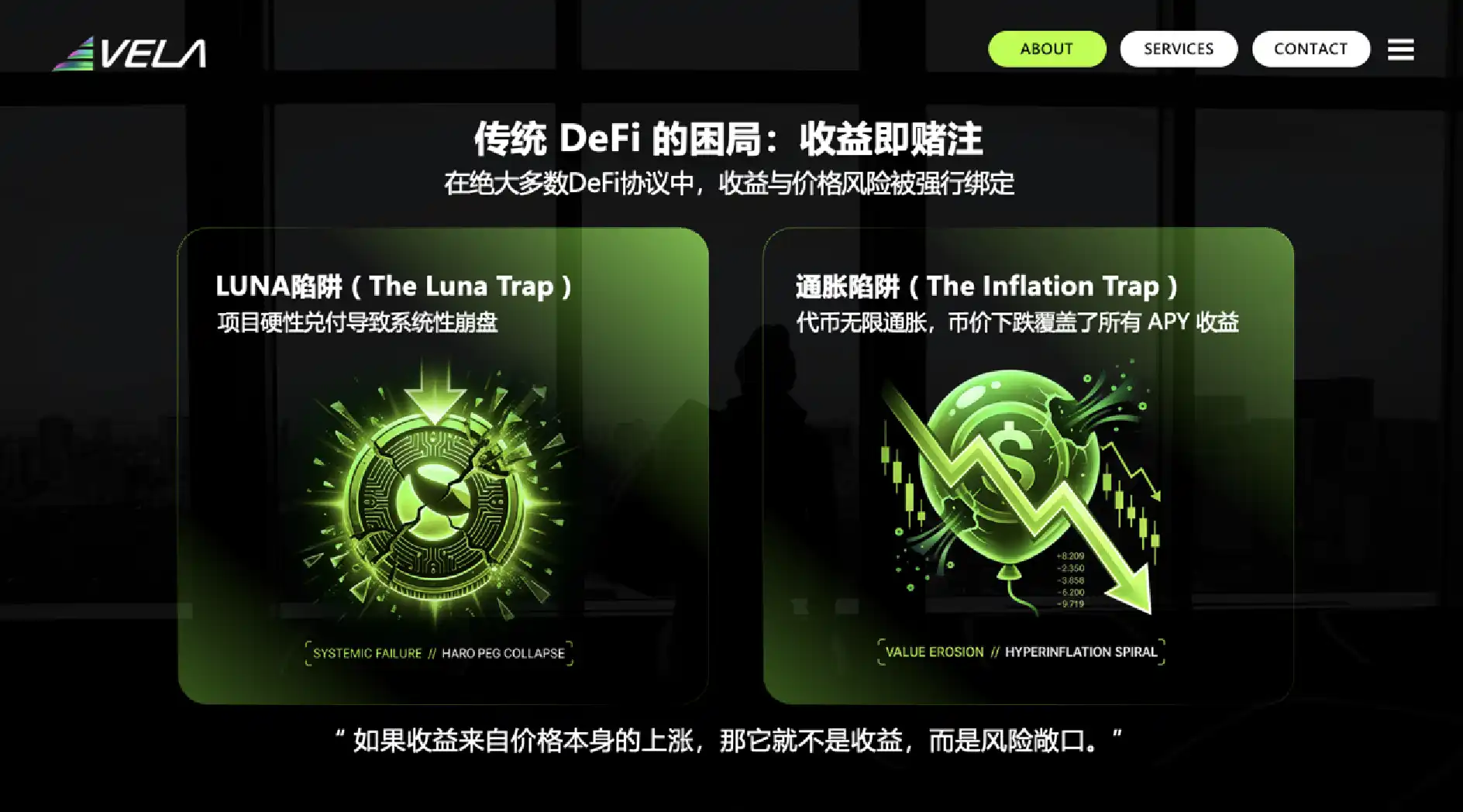
In traditional DeFi, yield and price risk have long been intertwined, with the vast majority of APY essentially being implicit bets on market direction. Once the market reverses, the so-called yield quickly turns into risk. Whether a systemic collapse or an inflation model, the root lies in: yield is just an unexpressed risk exposure. In other words, if yield depends on price increases, it is not true yield.
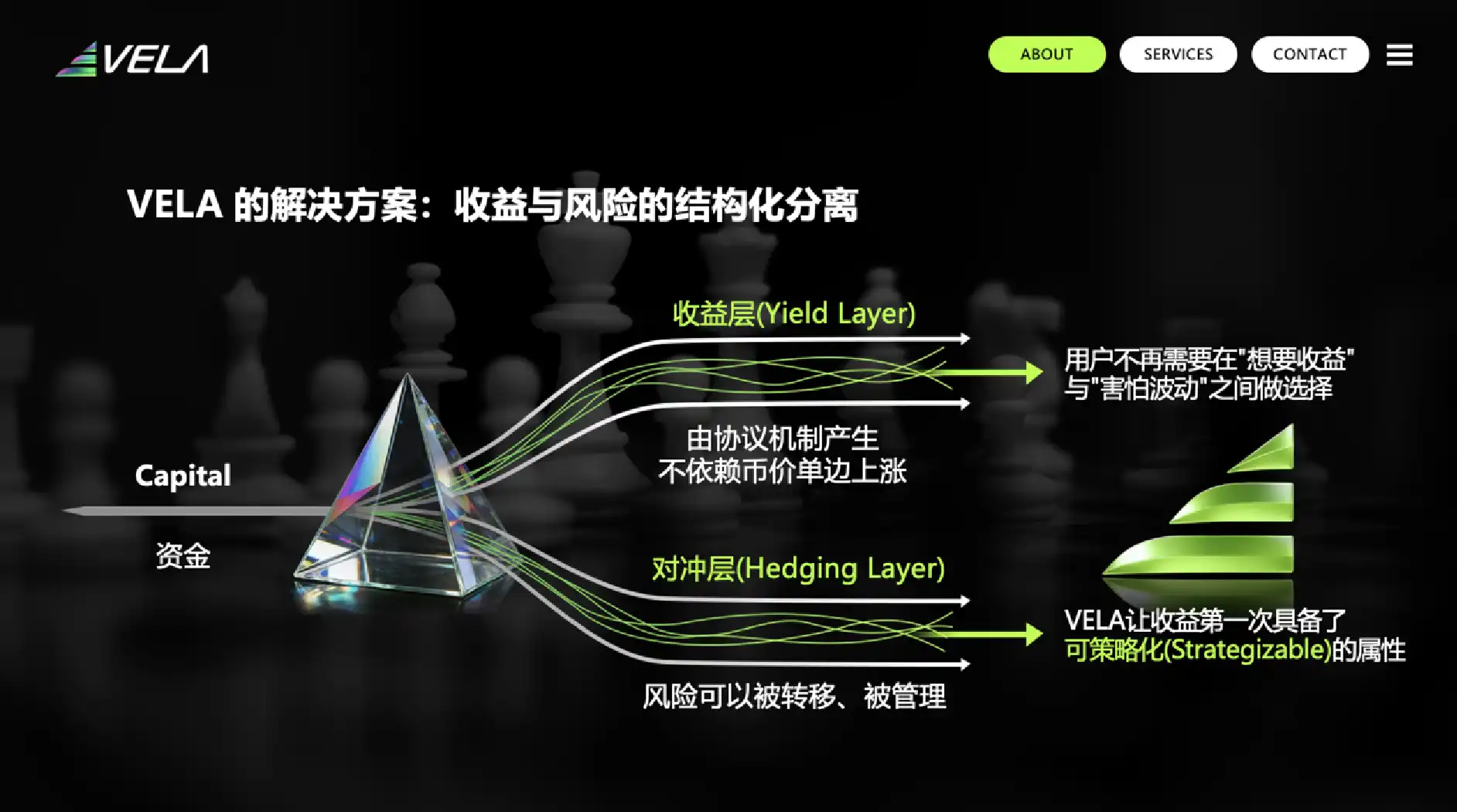
The core of VELA lies in structurally splitting yield from risk. Through the design of the Yield Layer and Hedging Layer, yield is generated by the protocol without relying on unilateral market trends, while price risks can be transferred and managed, allowing yield to possess properties of strategization and control for the first time. Its establishment relies on the underlying atomic execution capability, which allows for yield generation, hedging, and liquidation within the same system, and this is the infrastructure provided by PinPet.
Essentially, VELA is not just a simple yield product; it serves as the "yield hub" above PinPet, with its value transforming fluctuations from uncontrolled variables into manageable resources. As the market shifts focus from chasing APY to caring about yield quality, the structured yield model represented by VELA also signifies that DeFi is moving from "yield dependent on market conditions" to "yield managed" in a new stage.
5. How to Participate: Entering the VELA Ecosystem and Seizing Yield Hub Opportunities
From the perspective of participation pathways, VELA provides a relatively clear entry method. Users can participate in its yield model by depositing coins and receive stable interest returns over different periods, with yield calculated daily on simple interest terms and principal returned at maturity. The core of this mechanism lies in the fact that yields originate from the protocol's structure rather than solely relying on price increases, thereby enhancing predictability to a certain degree. At the same time, VELA controls the pace of fund inflow through dynamic throttling and single-address caps to avoid monopolization by large holders in the early stages, while collaborating with phased output reduction models to gradually converge yields and form long-term value support. Moreover, the node system and community incentive mechanisms provide users with a higher-level participation pathway, allowing them to not only earn yields but also engage in ecosystem growth.
Essentially, participating in VELA is not just about obtaining interest; it is about entering the "yield hub" of the PinPet ecosystem. As the underlying trading and liquidation scale expands, the value that VELA bears will also amplify correspondingly, providing structural opportunities for early participants.
6. Conclusion: Value Space in the Early Stages
From the current progress, since its launch on April 7, the participation enthusiasm in the VELA ecosystem has continued to increase, and the market has formed a preliminary validation of its yield model. Additionally, PinPet and VELA have completed a CertiK Skynet audit, which has enhanced the system's security and stability to a certain extent.
More crucially, the entire PinPet ecosystem is still in its early stages. In comparison, the most representative launch platform on Solana, Pump.fun, has achieved cumulative yields amounting to several billion dollars, with its leading assets in the ecosystem once reaching a market value of around four billion dollars. In contrast, as the leading token of the PinPet ecosystem, VELA currently has a market value of only about 40 million dollars, indicating a significant mismatch between valuation and future value-capturing capability before the underlying trading scale and ecosystem potential are fully unleashed.
With the ongoing development of Solana's innovative atomic trading engine, the PinPet ecosystem, as the first project launched within this ecosystem, VELA is expected to gain more focus in terms of funding and traffic, and its value will gradually be realized along with ecosystem growth.
CertiK Skynet Audit: https://skynet.certik.com/zh-CN/projects/vela
PinPet: https://pinpet.fun
Vela Ecosystem: Vela.vip
This article comes from submissions and does not represent the views of BlockBeats
免责声明:本文章仅代表作者个人观点,不代表本平台的立场和观点。本文章仅供信息分享,不构成对任何人的任何投资建议。用户与作者之间的任何争议,与本平台无关。如网页中刊载的文章或图片涉及侵权,请提供相关的权利证明和身份证明发送邮件到support@aicoin.com,本平台相关工作人员将会进行核查。


