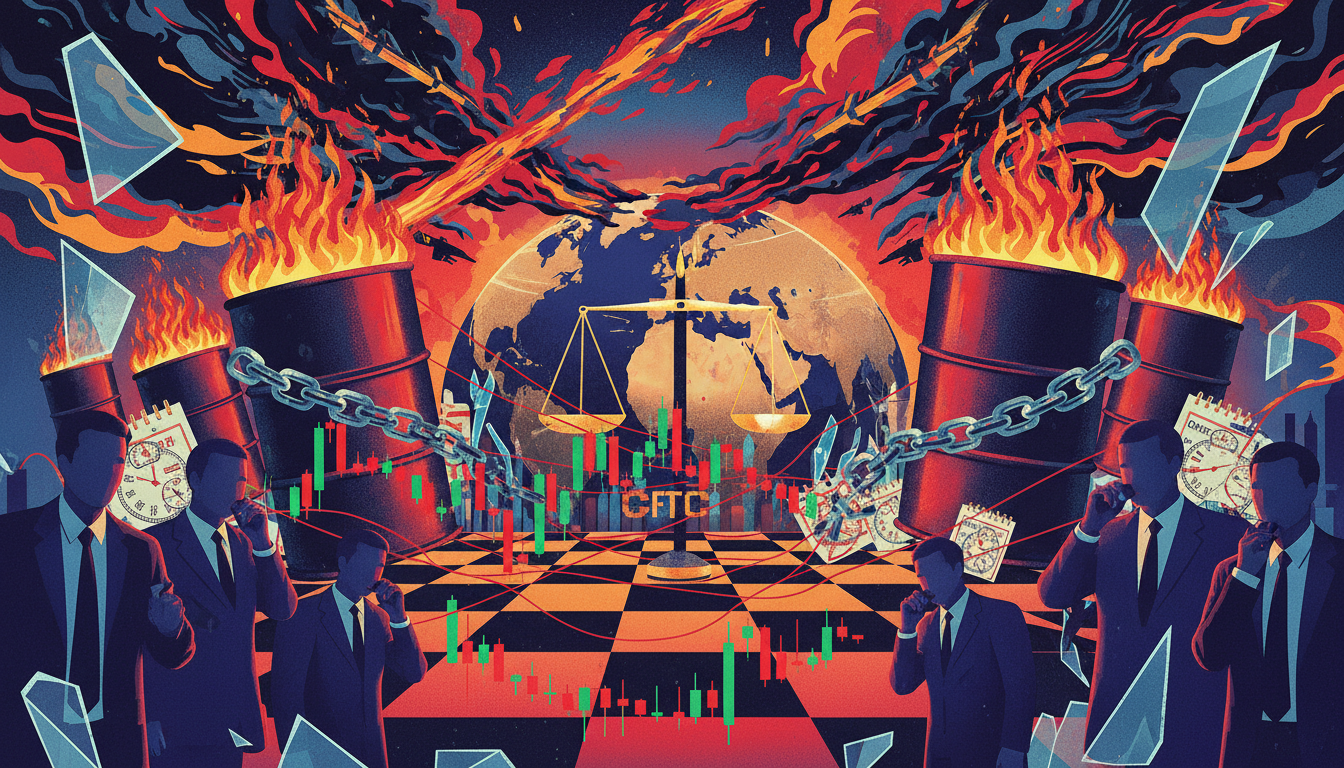
On April 15, 2026, the indirect negotiations between the US and Iran regarding a ceasefire framework were officially revealed through Pakistan: on one side was the Trump negotiation team composed of Vance, Witkoff, and Kushner, and on the other side was the Iranian Foreign Ministry, with both sides fiercely tugging over nuclear issues, security commitments, and regional influence within the ceasefire draft. Compared to the technical wording on the table, the more striking aspect was the verbal conflict: Trump declared in a Fox interview that "the war is nearing its end," while the Iranian Foreign Ministry publicly denied the US proposal, stating it "lacks negotiation logic." In this context of high-profile optimism and tough rebuttals, the prediction market and cryptocurrency prices began to bet early on "de-escalation of geopolitical risks," but there remained significant disagreements over the outcome's path and pace. A question that cannot be avoided in this round of ceasefire negotiations is: how much will it lower the Middle Eastern risk premium, and how will it reshape sentiments and fund direction within the crypto sphere?
Pakistan as a Mediator: The Behind-the-Scenes Mediation and Ambiguous Boundaries
Based on currently verifiable information, this negotiation is not a traditional face-to-face meeting, but rather Pakistan playing the intermediary role, with the US Trump team and the Iranian Foreign Ministry exchanging ceasefire draft proposals indirectly through it. Vance, Witkoff, and Kushner represent a combination of interests from the Trump camp concerning foreign affairs, security, and a pro-Israel approach; they need to find a "marketable" ceasefire framework that balances domestic electoral narratives with Middle Eastern realities, while the Iranian side seeks to maintain a balance between a security buffer and a dignified exit. This communication line connecting Islamabad to Washington and Tehran itself reflects both sides' sensitivity in not wanting to expose their negotiation standpoints directly.
The core of the conflict centers on the nuclear program: the US demands that Iran make substantive, verifiable commitments on its nuclear plans in exchange for easing sanctions and reducing regional military pressure; meanwhile, Iran publicly states that the US proposal "does not conform to negotiation logic," essentially rejecting one-sided concessions. Iran is well aware that once hard terms are signed on nuclear issues, the bargaining chips available for future negotiations will significantly decrease, thus preferring to endure short-term military and economic pressure to retain future strategic maneuverability. This difference in the perception of "commitment" has left the ceasefire draft at a stalemate on key terms.
Pakistan's role is both prominent and deliberately ambiguous. Public information shows that its army chief led a delegation to Tehran, signaling its status as a "key mediator" but lacks any verifiable details regarding its specific roles in plan design, information transmission, or security guarantees. This state of "confirmed participation but undisclosed details" indicates, on one hand, that Islamabad is indeed threading the needle to ease tensions, while on the other hand, reminds the outside world that it remains to be verified whether it provides security guarantees or participates in enforcement oversight. It can be confirmed that negotiations are indeed taking place and that Pakistan is one of the channels, while the role of the military at the final bargaining table remains a cautious question mark, avoiding treating rumors as structural facts.
Trump's Optimism and Iran's Rebuttal: A Dual Track of Public Opinion and Negotiation
On the public opinion front, Trump chose to convey a strong optimistic signal through Fox Business Channel: internally proclaiming that "the war is nearing its end," while also emphasizing that he will continue to prevent Iran from acquiring nuclear weapons. For the market and bulls, this is a clear signal—if the marginal risks of escalation in conflict are declining, the previously accumulated security premium on risk assets, including cryptocurrencies, is likely to see a temporary retracement. In the context of the election campaign, this narrative of "I am ending the war but not giving up the hard line" can also maximize domestic support and ally confidence.
In stark contrast is the Iranian side's public response: the Foreign Ministry, through domestic media, stated that the US proposal "does not conform to negotiation logic." Behind this statement is Iran's necessary bottom line to maintain: on one hand, not appearing to yield to the US's rhythm in core issues such as nuclear and security, and on the other hand, managing domestic expectations among its people and hardliners to avoid the image of "being forced to concede." For Tehran, prematurely releasing optimistic rhetoric could not only weaken its negotiating chips but also risk undermining the regime’s credibility if the agreement were to collapse.
Thus, both sides' release of information through media appears to be exceptionally meticulous. The US is aimed at both domestic voters and global financial markets, needing to construct a narrative of "nearly successful, just still negotiating," to stabilize asset prices and ally confidence; whereas Iran seems to focus more on expectation management: acknowledging there are contacts but insisting the proposal is "unreasonable" and "illogical," allowing for potential limited concessions, while keeping explanations ready for possible negotiation failures. In this dual structure of "external optimism, internal tugging," a more realistic path appears to enter a phased de-escalation zone—the probability of escalation is decreasing, but the journey towards "permanent peace" still requires long-term institutional and mutual trust building, making it more suitable for the market to view this round of events as "risk reducing from a high fever to a low fever," rather than a conclusive peace dividend.
Expectations of Geopolitical Risk De-escalation: Shipping Lanes, Energy, and Cryptocurrency Pricing
To understand why this ceasefire game rapidly captured global asset prices, it is essential to return to the transmission chain between geopolitical conflict and macro pricing. Tensions in the Middle East first transmit through oil supply expectations and the safety of critical shipping lanes to inflation and growth expectations. Once the market fears oil exports might be hindered, upward pressure on oil prices will elevate global inflation expectations, forcing central banks to maintain a tighter monetary environment, thus suppressing valuations of risk assets including stock markets and cryptocurrencies.
Within this chain, the Strait of Hormuz is always viewed as a potential point of contention—although the specifics regarding control rights and past friction details await further verification, as long as the market perceives the possibility of disruption in this crucial passage, the risk premium for energy and shipping costs will be amplified. Simply put, even if an actual blockade does not occur, as long as expectations fall within "the possibility exists," funds will pay for that uncertainty.
Cryptocurrency has shown a complex and contradictory performance in past rounds of Middle Eastern or energy crises. On one hand, major assets like Bitcoin are often narratively positioned as "digital safe-haven assets," attracting some funds to hedge against fiat currency and geopolitical risks during localized conflict escalations; on the other hand, when conflicts push inflation expectations higher and force major central banks to tighten policies, overall liquidity tightening will conversely pressure the valuations of high-volatility assets, including cryptocurrencies. Therefore, at the macro level, the crypto market often bears the tug of two opposing forces: "safe-haven demand" and "liquidity discount."
At this current juncture, the US-Iran negotiations have not led the market to believe that "total peace" is just around the corner, but they are sufficient for some investors to begin pricing in risk premium declines: as long as the worst-case scenarios for oil and shipping lane security are temporarily suppressed, there is room for marginal easing of inflation and tightening expectations. It is precisely in this delicate context that the sentiment in the crypto sphere appears more akin to betting on "risk returning from extreme levels to manageable levels," rather than betting on "completely resolving Middle Eastern conflicts," planting seeds for the subsequent evolution of predictive markets and on-chain sentiment.
Predictive Markets' 60 Percent Bet and Early Bets on On-Chain Sentiment
Among traceable financial indicators, Polymarket provides a reference line worth noting but must be treated with caution: its contract regarding "reaching a permanent peace agreement by the end of May 2026" is currently described by a single source as having about a 60% probability. This figure itself still needs cross-validation from more channels and lacks finer granular odds and historical market structure support, but it suffices to indicate one thing—among some speculators' worldviews, the scenario that "negotiations will not completely collapse" is already worth paying to bet on.
From a behavioral finance perspective, participants in predictive markets are more willing to pay a premium for vague scenarios like "the framework is generally established and will not flip on the table immediately" rather than placing precise bets on specific ceasefire dates and terms. This is because the former provides greater narrative elasticity: as long as there is no clear escalation in conflict and both parties are still interacting, contract holders can claim they have correctly predicted the "direction"; however, once bets are placed on a specific time point or detailed terms, they can more easily be deemed "failed" due to slight adjustments in negotiation rhythm or changes in wording.
The crypto market's feedback on de-escalating geopolitical tensions often manifests through leverage and sector rotation: when the market feels that "the worst-case scenario is temporarily boxed in," risk appetite in the futures and options markets tends to recover ahead of spot markets, leveraged bulls become active again, and funding shifts from more defensive assets to high-beta tokens, with on-chain and over-the-counter volatility trading heating up once again. This emotional warming does not mean fundamental risks have vanished; it merely indicates that funds are willing to pre-position for the next narrative.
One should be cautious that the probability given by a single platform often mismatches the complexity of real-world negotiations. The ceasefire negotiations involve multiple interests such as regime security, regional allies, military-industrial considerations, and energy, and their path is far from linear. If the market misreads "approximately 60% probability" as "basically set in stone," it may easily trigger exaggerated "expected failure trades" in subsequent negotiations stumbling or battlefield tensions escalating—prices are not directly responding to the events themselves, but are correcting against previously overly optimistic pricing. For cryptocurrency investors, recognizing such deviations between expectations and reality is pivotal in managing positions and leverage risks.
From Gunpowder Smell to Computing Power: How Funds Shift Between Hedge and New Infrastructure
It is worth noting that under this geopolitical shadow, technology capital has not collectively shied away from risk but rather continued to ramp up investments in key tracks. Research briefs indicate that AlphaNet has just completed around 10 million USD in seed funding, serving as a typical case of current capital still willing to bet on new technological narratives. Whether it’s AlphaNet or similarly mentioned 0G Labs, both are positioned at the cutting edge of the AI and blockchain intersection, symbolizing a collective imagination for "next-generation infrastructure."
From a broader perspective, the continued investment in AI and blockchain tracks within a high-uncertainty environment is not unusual but rather a logical extension. Geopolitical risks have amplified countries' interest in "sovereign-neutral computing and asset forms": when traditional finance and computing infrastructure are seen as frontline assets in potential geopolitical games, multinational capital tends to seek targets that possess stronger migratory capabilities and lower political affiliation. AI computing networks, decentralized data, and on-chain infrastructure are being repackaged as candidates for "medium to long-term secure asset allocation."
This stands in a temporal misalignment with the short-term hedging premium receding due to geopolitical talks: at the front end, ceasefire news reinforces the sentiment that "it’s appropriate to slightly reduce hedges and increase risk exposure"; at the backend, long-term uncertainty drives funds to seek new infrastructure targets that are less connected to sovereignty and geopolitical factors. Thus, the same global capital may buy into major cryptocurrencies to hedge systematic risks during peak conflict phases, while gradually shifting towards betting on AI + Crypto infrastructure during de-escalation periods, converting geopolitical fluctuations into a new technological cycle layout.
For investors, this provides a navigable narrative framework: during geopolitical tensions, moderately increase the weights of high-liquidity hedge coins and defensive sectors in the portfolio; as the situation calms and risk premiums recede, gradually ramp up investments along the "computing power—data—on-chain infrastructure" chain for projects likely to benefit from long-term de-nationalization demands. The crux lies not in betting on which ceasefire or conflict escalation is next but in using a relatively stable asset allocation logic to navigate these unpredictable news nodes.
Peace Discounts and Risk Premiums: How the Crypto Sphere Prices in the Gray Area
In summary, the current US-Iran negotiations are more akin to a "temporary cooling, highly uncertain" risk event, rather than being treated as an established peace dividend. Pakistan is threading the needle, Trump is relaying optimism, and Iran is publicly pushing back, forming a reality puzzle of multiple parties testing the waters and negotiating while fighting: while the marginal risks of conflict escalation are declining, core contradictions related to nuclear, sanctions, and regional influence remain unresolved.
Nevertheless, the market has begun to price in this "pressure relief": from the predictive market's 60% bets to the localized recovery of leverage and high-beta tokens, indicating a willingness to believe "it won't be worse than before." Meanwhile, the pricing retains a "discount factor" for negotiation reversals and unexpected friction—no one dares to view the Middle Eastern situation over the coming months as entirely controllable, which also means that no single peace advancement is enough to sustain a continued bubble market.
For crypto investors, a more pragmatic perspective is to actively distinguish between short-term sentiment trading and medium to long-term structural trends: the former revolves around ceasefire news and battlefield developments, with more focus on expectation differences and liquidity feedback; the latter requires magnifying the focus towards new infrastructure tracks like AI and on-chain infrastructure that "grow under geopolitical shadows," using longer-term evaluations to assess the increasing weight of computing power, data, and cross-chain assets in global asset allocation.
In an age of narrative flood, there is also a layer of responsibility on information producers: throughout the writing of the event, it is crucial to continuously mark the boundaries of information sources and the content that needs verification— for instance, clearly stating that the 60% probability from Polymarket comes from a single source, the ceasefire timeframe and the specific role of the Pakistan military are still lacking, and the details of the Strait of Hormuz dispute remain to be confirmed, to avoid packaging predictive figures as certainties. Only by cognitively allowing space for uncertainty can the market potentially avoid the emotional amplifications and collapses of expectations that occur repeatedly in terms of price.
Join our community to discuss together and grow stronger together!
Official Telegram community: https://t.me/aicoincn
AiCoin Chinese Twitter: https://x.com/AiCoinzh
OKX Welfare Group: https://aicoin.com/link/chat?cid=l61eM4owQ
Binance Welfare Group: https://aicoin.com/link/chat?cid=ynr7d1P6Z
免责声明:本文章仅代表作者个人观点,不代表本平台的立场和观点。本文章仅供信息分享,不构成对任何人的任何投资建议。用户与作者之间的任何争议,与本平台无关。如网页中刊载的文章或图片涉及侵权,请提供相关的权利证明和身份证明发送邮件到support@aicoin.com,本平台相关工作人员将会进行核查。