Written by: Lawyer Shao Jiadian
Recently, the AI circle is very lively, with terms like OpenClaw, Claude Code, models, Agent, MCP frequently trending. However, amidst all the excitement, the real challenge of turning AI into a business ultimately boils down to a very practical question: if in the future, AI truly assists in finding information, adjusting tools, purchasing data, and running services, how will the payments be made?
The reason why x402 is worth discussing separately now is not that it is a new concept, but because it has reached a stage where the results can be reviewed. The more pressing question now is not “what does x402 want to do,” but whether it has evolved from an idea into a product and from a protocol into an ecosystem.
Ultimately, what x402 aims to solve is not complicated: it wants to make an API call, allowing for results to be obtained and payments to be completed seamlessly. In the past, accessing an API typically required registration, account setup, credit card binding, package purchasing, and acquiring an API key, leading to a lengthy process; what x402 aims to do is streamline this process. Looking at it today, the issue isn't whether this idea is innovative, but how far it has progressed.
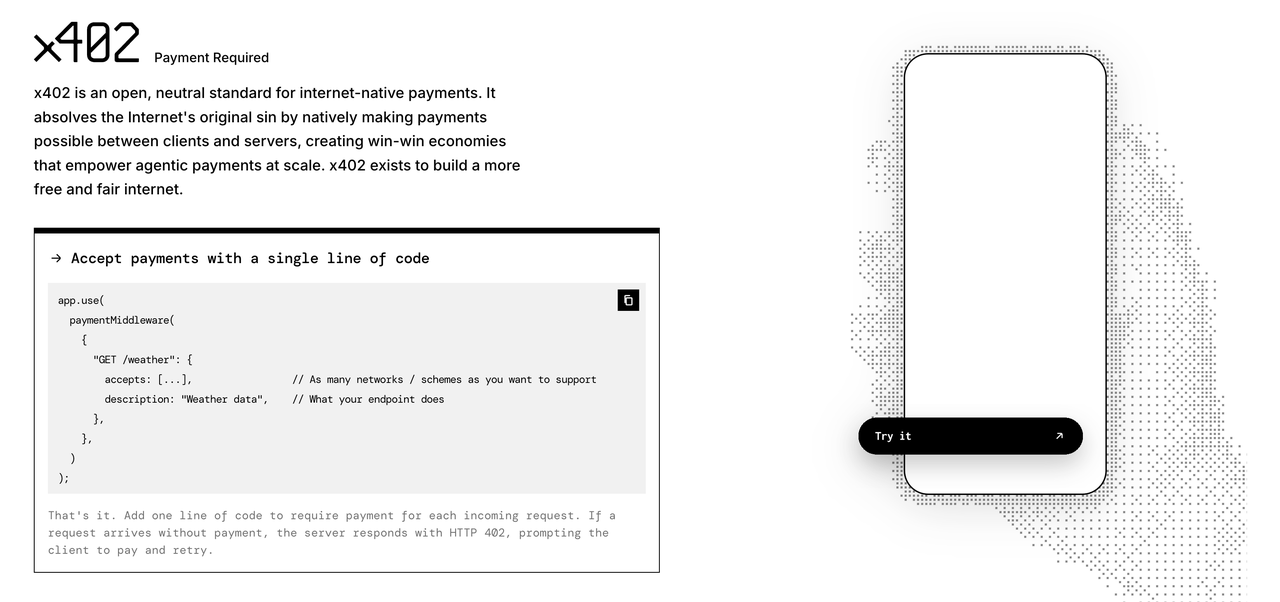
The above image is from the x402 official website screenshot
It is no longer the phase of “telling stories.”
When evaluating the development of a foundational protocol, it’s not enough to only listen to the vision; it is essential to see if it has genuinely undergone engineering. x402 is a product launched by Coinbase in 2025, essentially a technical activation of the HTTP 402 (Payment Required) status code, which was reserved but underutilized in the early days of the internet. At present, x402 has started moving from a rough payment concept to a more complete solution: how payments are initiated, how identities are recognized, and how to ensure compatibility across different chains and payment methods; these issues are gradually being addressed.
This step is crucial. Many protocols initially focus on future visions, but the real challenge is whether they can continuously iterate, develop tools, and gain real adoption. x402 has at least passed that phase of “only concept, no engineering.” You don’t need to rush to judge whether it will become mainstream in the future, but it can no longer be viewed as just a story stuck in a PPT.
An ecosystem has indeed started to develop, and it’s not only being pushed by Coinbase itself.
What’s most worth noting about x402 now is not what Coinbase is saying, but whether others have begun to engage with it. The answer to that question is: yes, and there aren’t just a few.
Now, those engaged in x402 activities are no longer just Coinbase itself. Some projects are using it for paid APIs, others are leveraging it for AI tool calls, and some are experimenting with having AI agents directly purchase services, data, and functions. In other words, x402 is gradually transforming from “a protocol” into “an infrastructure that has users, applications, and businesses built around it.”
Another important detail is that many similar initiatives in the past, despite claiming to be open, actually had key components held by a single company, leaving others with no choice but to follow. x402 has at least begun to extend outward; it is not just Coinbase providing capabilities, but third-party tools, payment intermediaries, compliance layers, and supporting services have started to emerge. Whether something can grow often depends on whether it is limited to one player. Looking at it now, x402 has at least begun moving towards a direction where “it is not only Coinbase that can participate.”
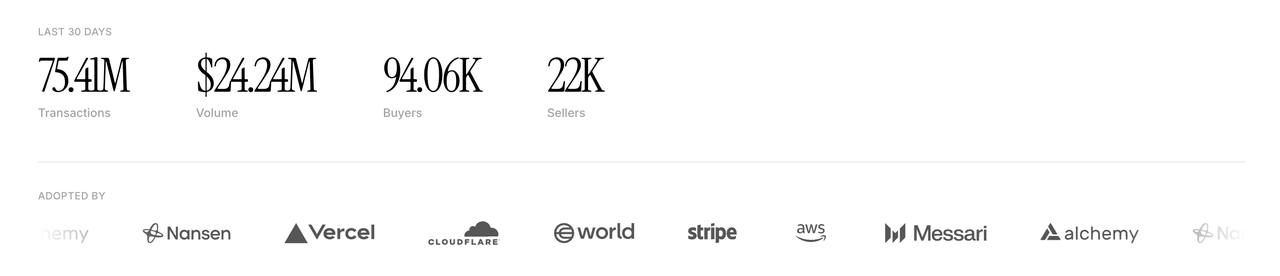
The above image is from the x402 official website screenshot
What really deserves attention is that Cloudflare and Google are also starting to explore this.
If x402 were merely an internal developer product pushed by Coinbase, its significance would actually be limited. What truly grabs attention is that major companies like Cloudflare and Google are also starting to head in this direction.
The implication behind this is not complicated. The big companies may not be directly endorsing x402, but their willingness to incorporate “AI automated payments” into their frameworks indicates that this demand is genuine. For the layperson, it is not necessary to understand all the protocol details; just knowing one point is sufficient: when such solutions start to be integrated into development tools, cloud services, and agent frameworks by major platforms, it no longer remains a mere experimental product of a small circle.
Google is in a similar situation. Its focus is not on a single protocol but on a broader agent payment framework; Coinbase aims to introduce a more concrete payment layer into this world. While the paths of both may not be entirely the same, they ultimately address the same question: how AI will pay more naturally among themselves or to various online services in the future.
From a legal perspective, the most noteworthy development is not who collaborates with whom, but how payments are transitioning from “user confirmation” to “system automatic execution.” Historically, many payment rules defaulted to assumptions like “the payer is a person,” “authorization actions are clear and visible,” and “the responsibility chain is relatively fixed”; however, as we enter the world of agents, these assumptions will become flexible. In the future, more complex issues may not be about whether payments can be executed, but about who is authorized, who is responsible, and who is accountable. Thus, you find that while technology companies see this as an efficiency issue, attorneys view it as a matter of responsibility distribution.
So, does x402 count as having emerged?
If I were to answer in one sentence, I would say: it has taken shape, but it is far from the time when “the winner is already determined.”
What does its current state resemble? It is like a new road has been built, and vehicles are starting to drive on it, but we are still some distance away from a bustling flow of traffic where everyone defaults to using this road.
Why do I say this? Because those adopting x402 right now are mostly in developer tools, paid interfaces, AI services, and research data scenarios. In other words, the first users are still primarily from the tech community and early startups. This is normal because such individuals are most likely to encounter demands for “high frequency, small amount, automated payments.” Conversely, this also indicates that x402 has not yet truly integrated into a broader array of internet products.
Therefore, looking at x402 today, the most appropriate judgment is not “it has already succeeded,” nor “it has no future,” but rather: it has proven itself to be substantive, but it has not yet demonstrated that it will become the final standard.
The true value of x402 lies not in how new the technology is, but in its focus on a very practical need.
Many people, upon seeing such protocols, easily focus all their attention on the technical terms, becoming increasingly confused. In fact, removing those terms, the core value of x402 is not difficult to understand.
In the past, internet charging often involved “first opening a membership, then slowly using it”; what x402 aims to promote is “you use it once, I charge you once.”
Previously, payments often required human confirmation; what x402 aims to promote is “in the future, many small transactions can be completed automatically by the system.”
In the past, charging methods for APIs, tools, and data services were often awkward; what x402 aims to promote is “to make all these fragmented machine labor naturally turn into income.”
What it truly wants to achieve is not to equip AI with a wallet, but to build a toll road for future machine transactions.
Moreover, from the intersecting perspectives of law and business, this demand is indeed very tangible. Because as long as AI agents begin to significantly access external services, three key questions will inevitably arise: first, how to charge; second, how to authorize; third, who is responsible when issues occur. Today, many people are focused on the first question, but the latter two are equally important. Whether a protocol can grow does not only depend on how smoothly it makes transactions, but also on whether it can clarify responsibility boundaries sufficiently.
So, returning to the initial question: how is Coinbase’s x402 ecosystem developing now?
My view is simple: it is no longer a small concept that can be brushed aside; it has indeed developed products, tools, integration parties, and real scenarios; however, it is still in the early stages, and true explosive growth will require more “must-have automatic payment” AI scenarios to emerge.
Ultimately, whether this wave of AI enthusiasm can genuinely transform into a large business does not solely depend on how intelligent the models are, but also on who can streamline the chain of “machines doing work—machines charging—machines settling.” What x402 is currently doing is the most foundational and unavoidable step in this process.
免责声明:本文章仅代表作者个人观点,不代表本平台的立场和观点。本文章仅供信息分享,不构成对任何人的任何投资建议。用户与作者之间的任何争议,与本平台无关。如网页中刊载的文章或图片涉及侵权,请提供相关的权利证明和身份证明发送邮件到support@aicoin.com,本平台相关工作人员将会进行核查。


