Written by: Lawyer Xiao Za's Team
From online wallet balances, electronic insurance and financial management, game equipment and other "traditional virtual assets" to cryptocurrencies, NFTs and other "emerging virtual assets," wealth today is increasingly being owned, used, and disposed of in a "non-physical" manner. And when life comes to an end, what will happen to these digital assets stored in the cloud or devices? Can they be inherited? And how will they be inherited? Or further, regarding some "mysterious learning materials" placed in private cloud folders, do the deceased wish for their heirs to inherit them?
Today, the Za team discusses the issue of "new inheritance" in the digital age.
I. The Concept of Digital Inheritance
Before discussing inheritance, we must first clarify what "digital inheritance" is. From a legal practice perspective, it is not a strict legal term, but rather a collective term for various data and rights that exist in digital form with property value or personal attributes left behind after a natural person's death.
From a more general and easily understandable perspective, the Za team believes that "digital inheritance" can be broadly divided into two categories: "digital inheritance" primarily with economic value and "digital inheritance" primarily with personality attributes and emotional value.
(I) Digital Inheritance Primarily with Economic Value
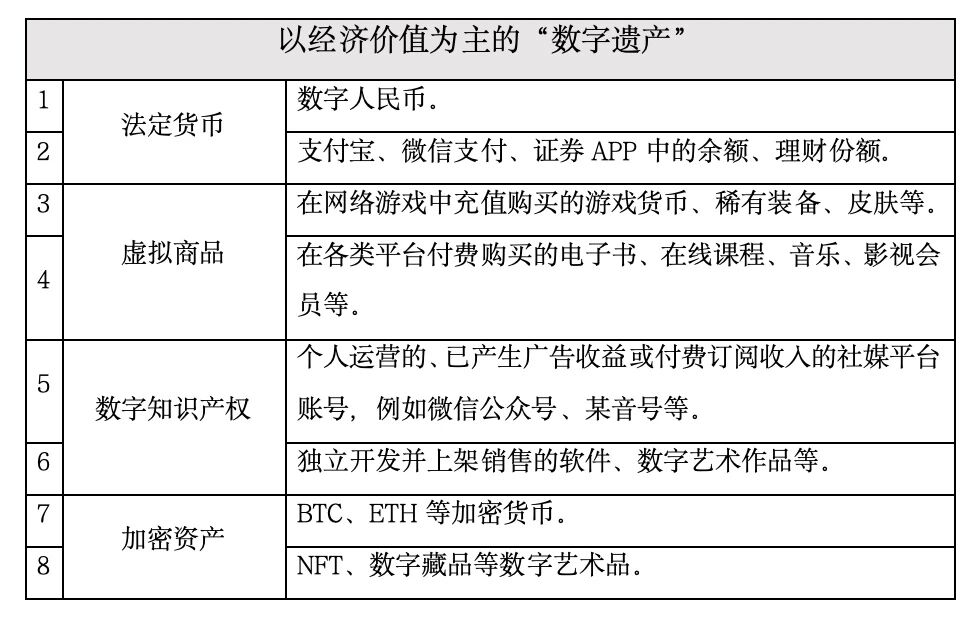
The core characteristic of this type of digital inheritance is that it has a clear and measurable economic value. This attribute essentially aligns with the concept of traditional "virtual property." The value of such digital inheritance can often be directly transacted through legal currency or can be measured in terms of market value using currency as an objective standard, or it may even be in the electronic form of legal currency itself.
Common types roughly include the following:
(II) Digital Inheritance Primarily with Personality Attributes and Emotional Value
This type of asset often does not take the form of money or equivalent, but they carry the deceased's dignity, emotional bonds, and deep social connections, while also embodying valuable memories and emotional support of family heritage. For the heirs, the spiritual significance contained in these assets transcends material value, providing unique and irreplaceable emotional comfort and cultural continuity.
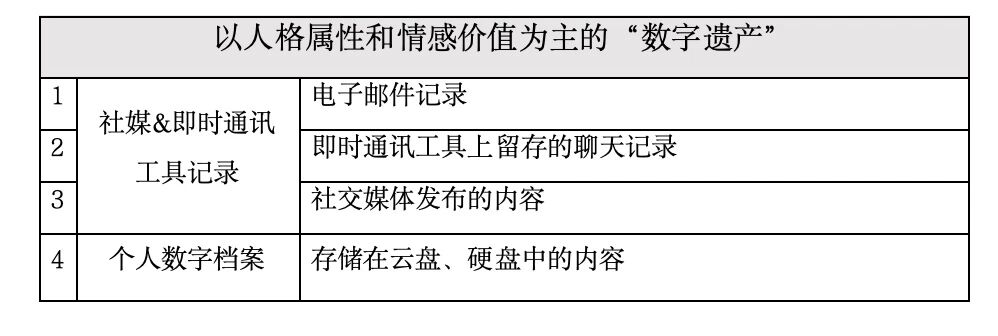
It is crucial to distinguish between these two types of digital inheritance, as their legal nature, the ease of inheritance, and protection focus differ. Digital inheritance primarily with economic value is closer to the traditional concept of "property," while digital inheritance mainly with personality attributes and emotional value cannot be treated simply as "property"; its inheritance involves a greater balance between personal information protection, privacy rights, and inheritance rights.
II. The Legal Nature of Digital Inheritance and the Legal Basis for Inheritance
Can digital inheritance be inherited as an estate? The answer is yes, but the path is not smooth. Current laws in our country do not specifically define "digital inheritance," but the legal basis for its inheritance can be found scattered across various laws and regulations. For digital inheritance primarily with economic value, there are already many precedents in judicial practice, and there are basically no legal obstacles to successful inheritance. However, digital inheritance primarily with personality attributes and emotional value is quite controversial; inheriting some "digital inheritance" may violate the dignity of the deceased, personal privacy, and social reputation and must be treated cautiously.
According to Article 1122 of the Civil Code, an estate is the personal legal property left by a natural person upon death. The key to determining whether digital inheritance falls under "legal property" lies in whether it possesses "property attributes." For the first type of virtual property with direct economic value, its property attributes are evident. Digital assets for which users recharge with real money or create and generate economic benefits through time and intellectual labor should rightly be seen as part of their personal legal property. Article 127 of the Civil Code explicitly states, "Where the law has provisions regarding the protection of data and network virtual property, it shall be implemented according to those provisions." This provides a higher legal basis for the property rights attribute of network virtual property. However, for digital inheritance primarily with personality attributes and emotional value, there are considerable disputes in practice, and there are no clear precedents for reference, apart from cases concerning disputes over the use rights of social media accounts between former employees and companies.
The Za team believes that platform regulations may conflict with the property inheritance rights protected by the Civil Code. When users acquire virtual property through payment or give their accounts property value through intellectual labor, that value should belong to the user's property rights. Clauses in platform agreements that completely prohibit inheritance may be deemed invalid due to exclusion of major user rights and an increase in user responsibilities. However, in practice, heirs still face difficulties such as high litigation costs and long cycles when directly challenging platform agreements based on the Civil Code. Thus, how to communicate with platforms and provide evidence becomes crucial in the practical operation of inheritance.
III. Key Points for the Practical Inheritance of Digital Assets
(I) Evidence Preservation: The Cornerstone of Inheritance Rights
The key to litigation is a complete chain of evidence, and inheriting digital assets is no exception. When heirs discover relevant asset clues, their primary task is to comprehensively and legally preserve the evidence.
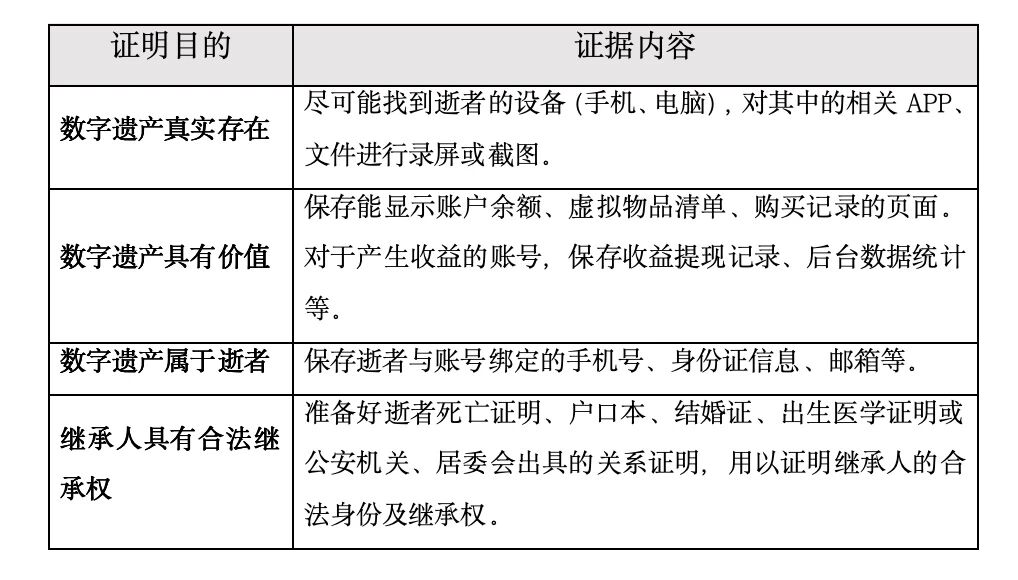
(II) Effectively Use Notary and Blockchain Evidence Storage Tools
Notarization plays an irreplaceable role in the inheritance of digital assets. According to Article 11 of the Notary Law, inheritance and evidence preservation are within the statutory business scope of notary agencies. For evidence that is inconvenient to notarize or has a risk of rapid loss, it may be considered to use blockchain evidence storage tools.
Notarization is the most commonly used method; heirs can apply to the notary office for on-site notarization of the entire process of operating the deceased's device, logging into relevant accounts, and viewing asset content, creating a notarial certificate. For clearly owned virtual property with defined value (such as Alipay balance), under complete material circumstances, heirs can attempt to apply to the notary office for inheritance rights notarization and request platform assistance for asset transfer based on the notarization certificate. However, in practice, many notary offices hold a cautious attitude toward the notarization of virtual property inheritance due to a lack of clear operational guidelines.
Blockchain evidence storage is gradually being applied and popularized in judicial litigation, with its core value being to provide tamper-proof and traceable timestamp proof for electronic data through distributed ledger technology. In the context of inheriting digital assets, heirs can upload key evidence—such as account login records, asset balance screenshots, communications with platform customer service, and chat records regarding asset disposal by the deceased—onto compliant blockchain evidence storage platforms.
The Za team specifically notes that blockchain evidence storage is not a substitute for notarization but rather a complementary relationship. According to the "Regulations of the Supreme People's Court on Several Issues Concerning the Trial of Cases by Internet Courts," when electronic data submitted by parties is stored through technology such as blockchain and can prove its authenticity, the internet court should acknowledge it. However, in traditional litigation procedures, evidence stored on the blockchain still needs to go through the evidence verification process, and its strength depends on the qualifications of the storage platform, the normative process of storage, and the corroboration degree with other evidence. Therefore, for high-value or disputed ownership virtual property, it is advisable to prioritize using notarization to fix evidence; for electronic traces that require immediate preservation, blockchain evidence storage can be conducted first, with subsequent supplementation of notarization or application for judicial appraisal based on the situation.
(III) Communication and Litigation: Two Possible Paths
For "digital inheritance" primarily with economic value, a resolution can be pursued through negotiation plus litigation.
During negotiations, it is helpful to bring death certificates, proof of kinship, heir identification, and already preserved evidence to formally contact the platform's customer service or legal department to present the inheritance request. Clearly and explicitly state the inheritance demands. If the account and virtual assets are inseparable, inheritance rights can actually be asserted over virtual assets with clear economic value within the account (such as balances, virtual goods) to achieve inheritance of the account itself. Some platforms (like certain payment institutions) have relatively mature internal processes for handling balance inheritance after verifying information.
If negotiations yield no results, litigation can be pursued. Here, the choice of jurisdiction court is involved. According to Article 34 of the Civil Procedure Law, litigation regarding estate inheritance disputes is under the jurisdiction of the people's court at the domicile of the deceased at death or the main estate location. For digital inheritance, determining its "location" is contentious. Typically, the court where the deceased resides or the main office of the defendant (i.e., network service platform) can be used as the jurisdictional link.
For "digital inheritance" primarily with personality attributes and emotional value, such as photos, diaries, chat records on social media, the purpose of inheritance is more about preserving emotions and memories. Such claims currently lack a strong legal basis for claims and clear precedents for reference, relying more on the user policies and societal responsibilities of platforms.
The Za team suggests that direct access and download backup through account passwords should be attempted first. If access is not possible, an appeal can be made to the network service provider, providing death certificates, proof of kinship, heir identification, and already preserved evidence, emphasizing that they pertain to important personal emotional records and do not involve commercial utilization. Request the platform to provide a copy of the data based on humanitarian grounds or data export rights.
In Conclusion
Inheriting digital assets is a typical area where law lags behind technological development. Currently, heirs often need to expend significantly more time and effort than inheriting traditional estates. The Za team recommends that partners take the opportunity to create a personal digital asset inventory, including accounts, platforms, approximate values, or descriptions of contents, and inform a trusted family member of the inventory's storage location. At the same time, it is also advisable to reasonably use a will for arrangements; when drafting a will, consider explicitly writing down important and valuable digital assets (especially the wallet keys for cryptocurrencies, passwords for income-generating social media accounts, etc.) and wishes for their handling. Although its execution may still face obstacles, this is undoubtedly the best way to express one's clear intentions to heirs and the court.
Finally, the issue of inheritance related to cryptocurrencies is extremely complex. Due to space constraints, the Za team will provide a detailed interpretation in a dedicated article, incorporating actual cases. That's all for today's sharing, and we are grateful to our readers.
免责声明:本文章仅代表作者个人观点,不代表本平台的立场和观点。本文章仅供信息分享,不构成对任何人的任何投资建议。用户与作者之间的任何争议,与本平台无关。如网页中刊载的文章或图片涉及侵权,请提供相关的权利证明和身份证明发送邮件到support@aicoin.com,本平台相关工作人员将会进行核查。


