Original Title: "Robinhood Has Gained a Batch of New Stock Investors, the Oldest is 1 Year, the Youngest is -3 Years"
Original Author: Azuma, Odaily Planet Daily
On April 6 local time, the U.S. Department of the Treasury officially announced the latest developments regarding "Trump Accounts" — BNY Mellon has been selected as the designated financial agent for the U.S. government, responsible for managing the initial accounts; Robinhood will cooperate with BNY to serve as the broker and initial trustee for the "Trump Accounts."
All parties will jointly support the Treasury's goal to ensure that every eligible American newborn can quickly and easily obtain a "Trump Account."
What is a "Trump Account"?
The so-called "Trump Account," also known as the 530A Account, is a tax-deferred investment account plan established by then-President Trump on June 9, 2025, authorized by the "Big and Beautiful" Act, aimed at creating government-funded savings accounts for children born between January 1, 2025, and January 1, 2029.
The initial funds for the "Trump Accounts" primarily come from government allocations, private donations, and family deposits. Federal certification will provide each account with an initial funding of $1,000; Michael Dell and his wife announced last December a donation of $6.25 billion to open accounts for 25 million children from families with a median income of less than $150,000, with each account funded with $250; parents, friends, and other specified individuals can also deposit into designated accounts, but a maximum of $5,000 can be deposited for each child per year.
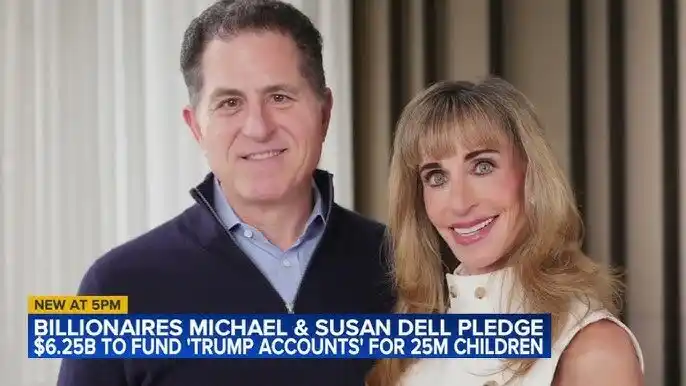
Odaily Note: The Dells' donation of $6.25 billion was deemed by Trump as "one of the most generous acts in American history."
On the investment side, "Trump Accounts" will be limited to low-cost investment funds or exchange-traded funds (ETFs) that track broad stock price indices such as the S&P 500 and cannot be used to invest in specific industry indices or sector indices.
Funds are also restricted in terms of usage; prior to the child turning 18 years old, funds in the account cannot be withdrawn for any reason (unless the child passes away or the funds are transferred to another similar restricted account). Once the child turns 18, the account will be treated similarly to traditional Individual Retirement Accounts (IRAs).
According to current plans, "Trump Accounts" are tentatively set to start accepting initial deposits on July 4, 2026 (the 250th anniversary of the Declaration of Independence). This coincides with the eve of the 2026 midterm elections, which is expected to become an important policy "trump card" for the Republican Party.
What is the Potential Scale?
According to Statista's statistics, the annual birth population in the United States fluctuates around 3.6 million after 2020.
Based on this data, the planned coverage period from January 1, 2025, to January 1, 2029, is expected to reach around 14.4 million American newborns. If the federal government opens a "Trump Account" with $1,000 for each child, this means a massive fund of $14.4 billion;
with the addition of potential private donations and family deposits, this number will continue to grow into tens of billions of dollars;
if the plan can continue as a long-term program beyond 2029, its potential scale will be even more exaggerated.
Due to long-term locks, passive investments, and continuous additions, the "Trump Account" will essentially become a long-term passive fund pool with a potential scale of hundreds of billions of dollars. Compared to pure children's welfare attributes, it resembles establishing a long-term capital transfer channel between fiscal policies and capital markets, directly integrating future generations into the stock market system.
The Biggest Beneficiary: Robinhood?
After the public announcement of the "Trump Account" plan, financial institutions such as JPMorgan, Charles Schwab, and Robinhood began to compete fiercely around related services, and with the U.S. Treasury officially designating Robinhood as the broker and initial trustee yesterday, having secured a "ticket to enter," Robinhood is poised to become one of the most direct beneficiaries of the plan.
The most intuitive benefit is on the user side. According to the current policy coverage estimates, "Trump Accounts" will correspond to millions of newborn accounts, and the interaction entrance for these accounts will be completed through a unified application — in other words, Robinhood will gain a batch of potential users bound to the platform from birth, with the oldest being just 1 year and the youngest not even born yet... More crucially, these users are not one-time traffic but have the potential for a very long lifecycle as customers.
Children's accounts will convert to long-term investment accounts similar to IRAs after they turn 18, meaning Robinhood has the chance to directly take over this batch of users for their investment activities upon reaching adulthood, and further extend to more business scenarios such as ETFs, options, and even crypto assets. From a lifecycle perspective, this is almost the longest user path a brokerage can obtain.
The benefits on the asset side cannot be overlooked either. The funds in "Trump Accounts" have a clear long-term lock-up feature, which means they will hardly flow out before the children reach adulthood, while the investment scope is limited to index funds. Such funds are considered high-quality managed assets for brokerages — low volatility, long retention, and predictable scale.
Moreover, Robinhood's previous core label has been that of a retail trading platform, with growth highly dependent on market conditions and trading activity, while the "Trump Account" introduces low-frequency, long-term, passive investment funds, aligning more closely with the asset characteristics of traditional wealth management businesses. As the proportion of these funds increases, it will somewhat enrich Robinhood's business diversity, making up for relatively short shortcomings.
At the same time, the endorsement at the policy level also has symbolic significance. Participating in the account plan led by the Treasury allows Robinhood to enter the U.S. government's financial infrastructure system for the first time, which not only enhances its institutional credibility but also provides new narrative space for future expansion into retirement accounts, long-term investment, and wealth management businesses.
From a political perspective, "Trump Accounts" are significant policy leverage for the Republican Party in the midterm elections; from a capital market perspective, this plan introduces an institutionalized long-term funding source to the U.S. stock market. Robinhood just happens to be at the intersection of both — as millions of newborns who have yet to enter society have already "automatically opened accounts," this policy design surrounding ballots quietly paves a growth curve for Robinhood that could last over a decade.
免责声明:本文章仅代表作者个人观点,不代表本平台的立场和观点。本文章仅供信息分享,不构成对任何人的任何投资建议。用户与作者之间的任何争议,与本平台无关。如网页中刊载的文章或图片涉及侵权,请提供相关的权利证明和身份证明发送邮件到support@aicoin.com,本平台相关工作人员将会进行核查。


