Direct impact of the war: Energy prices soar due to supply risks, cryptocurrencies benefit from "non-traditional safe-haven" attributes, while traditional stocks and precious metals are relatively pressured.
Since the US-Iran conflict on February 28, 2026:
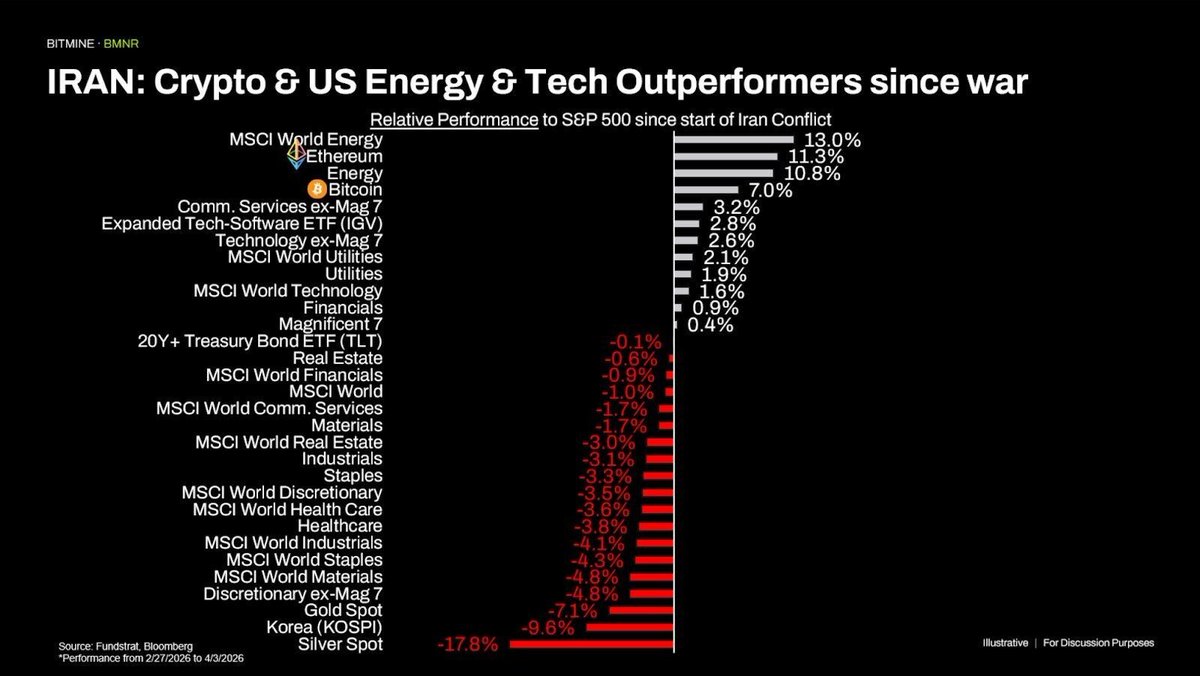
This chart is very typical, and can be compared with some relative performance charts of core assets under geopolitical shocks, with the S&P 500 as the benchmark.
1️⃣1. The most obvious winners: Energy + Cryptocurrency: Bitcoin outperformed the market and gold at the beginning of the conflict, which is not common in past geopolitical crises.
MSCI World Energy leads, with a relative increase of +13.0% compared to the S&P 500.
Ethereum +11.3%,
Energy Sector +10.8%,
Bitcoin +7.0%.
The Iran conflict directly threatens the Strait of Hormuz (the global oil transport artery), causing oil/energy prices to surge, with energy stocks and related assets rising sharply.
Cryptocurrencies (especially BTC and ETH) performed well in this crisis, outperforming traditional safe-haven assets like gold (-7.1%) and silver (-9.6%).
This suggests that the market views cryptocurrencies as "digital gold" or a "safe haven/growth hedge" among risk assets, rather than purely as safe-haven tools.
2️⃣ Technology and communication services also performed relatively strongly.
3️⃣ The losers are very clear: Defensive and cyclically sensitive assets plummeted.
1) South Korea's KOSPI suffered the hardest: -17.8% (possibly due to South Korea's export-oriented economy + sensitivity to geopolitical risks).
2) Silver -9.6%, Gold -7.1% (traditional safe-haven assets did not serve their purpose this time and were overshadowed by energy and cryptocurrencies).
3) Many MSCI World sectors declined: especially real estate, industrial, and raw materials categories.
In summary: at the beginning of the Iran conflict, the market voted with its feet: energy and cryptocurrencies were the biggest winners, while traditional safe havens (gold and silver) and cyclical/defensive sectors were the losers.
Investors' pricing logic regarding geopolitical risks: favoring things that can directly benefit from the energy crisis or are seen as "digital hard assets," rather than classic bonds/gold/defensive stocks.
免责声明:本文章仅代表作者个人观点,不代表本平台的立场和观点。本文章仅供信息分享,不构成对任何人的任何投资建议。用户与作者之间的任何争议,与本平台无关。如网页中刊载的文章或图片涉及侵权,请提供相关的权利证明和身份证明发送邮件到support@aicoin.com,本平台相关工作人员将会进行核查。


