A very harsh reality: in terms of knowledge coverage, execution endurance, and standardized output, it has become quite difficult for humans to compete directly with AI.
In other words, pure knowledge + skill-based jobs can be completely replaced by AI, and AI has almost no fatigue cost.
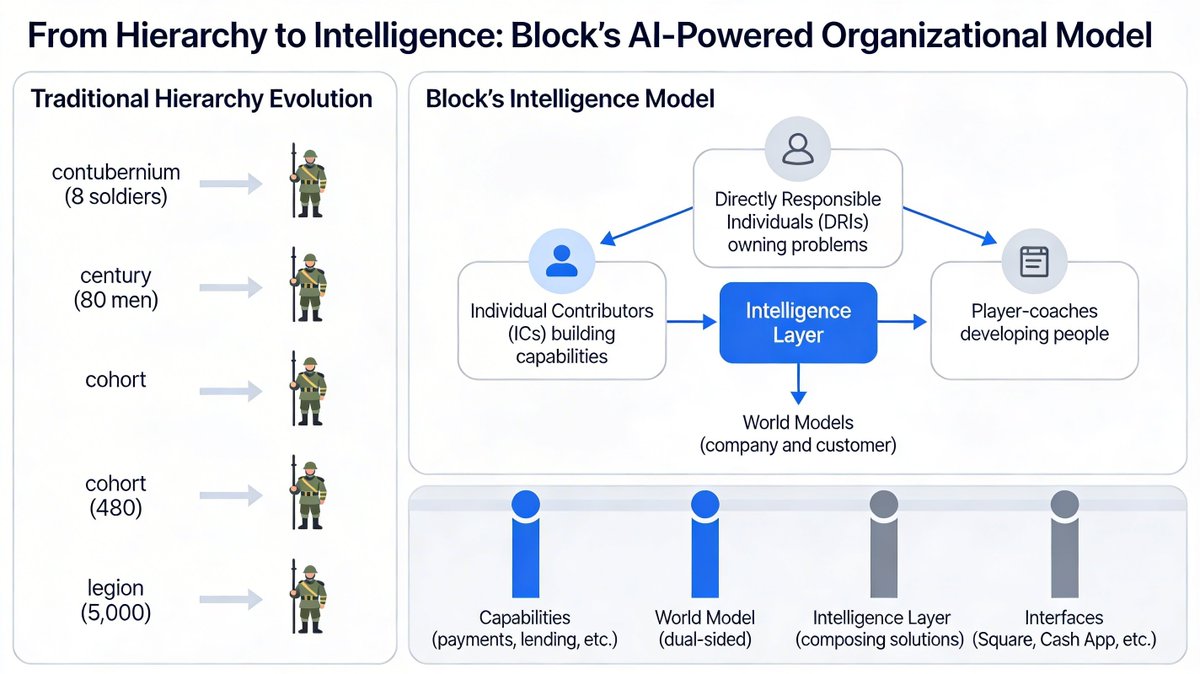
As Jack Dorsey @jack mentioned: in the future, organizations will only need three roles: individual experts, resource providers, and multidimensional talents, with the rest of the coordination work done by systems.
I strongly agree with this view because AI has actually entered a phase of elimination, and currently, only three areas are worth in-depth study:
1⃣ How to verify the results delivered by AI
The strongest aspect of AI is generation. If you do not have the ability to quickly identify logical flaws, information biases, and conclusion risks, then using AI only magnifies mistakes.
2⃣ How to schedule AI to work better
Many people merely treat it as an upgraded version of a search box, falling far short of achieving a qualitative leap. But in reality, the efficiency gap lies in your ability to break down tasks, advance concurrently, and fill in context, allowing AI to output results that align more closely with your true intentions.
3⃣ How to better consolidate your method library
This point is often the easiest to overlook, yet it is the most crucial for establishing an advantage.
Good prompt structures, task processes, verification frameworks, and review habits must be consolidated to become your own method assets.
Models can become increasingly powerful, tools are public, but methods are private.
免责声明:本文章仅代表作者个人观点,不代表本平台的立场和观点。本文章仅供信息分享,不构成对任何人的任何投资建议。用户与作者之间的任何争议,与本平台无关。如网页中刊载的文章或图片涉及侵权,请提供相关的权利证明和身份证明发送邮件到support@aicoin.com,本平台相关工作人员将会进行核查。


