On March 30, 2026, Beijing time, the Iranian Foreign Ministry publicly addressed the situation in the Strait of Hormuz, positioning itself as a "non-responsible party" in the current tense situation. The spokesperson Esmaeil Baghaei emphasized the "implementation of passage management under secure and controllable conditions" and allowed non-hostile vessels to pass. This statement sends a signal to the outside world that "Iran is not intentionally creating risks" while also confirming that Iran is currently managing the transit of vessels conditionally. Uncertainty in shipping and energy quickly spread to the cryptocurrency circle through Chinese media, leading the market to use oil shipping to speculate on electricity price curves, rapidly connecting geopolitical tension with computing power costs and mining narratives.
Iran Clears Responsibility: Strait Control and Ambiguous Boundaries
In terms of wording, Baghaei's remarks on March 30 primarily served to "clear responsibility." He stressed that Iran is not responsible for the current situation, aiming to attribute the tense atmosphere to external forces or broader regional confrontations, while maintaining Iran's image as a "responsible actor." This narrative strategy responds to international concerns about the security of the Strait of Hormuz and leaves room for possible future negotiations or games: Iran is not the igniter, but has the capacity to control the fire.
“Implementing passage management under secure and controllable conditions” is the technical key term in this statement. Passage management is not a simple total blockade or complete opening but involves screening and coordinating vessels within a comprehensive framework of risk assessment, political positioning, and security considerations. Allowing non-hostile vessels to pass means that Iran, in principle, permits normal commercial shipping to continue; however, who defines this "non-hostile" status and whether it will be adjusted dynamically leaves a sufficiently large policy gray area, also providing space for geopolitical premiums.
Information from sources like Golden Finance and Planet Daily shows that a number of vessels have already passed through the Strait of Hormuz after coordination, indicating that the strait has not been substantively "shut down" and the shipping chain is still operational. However, coordination itself entails extra processes, approvals, and potential delays, making it difficult for the outside world to judge whether this state can be maintained long-term, and there is no way to know if standards of passage would tighten quickly in the event of further deterioration. This "uncertain zone between openness and blockade" is precisely the most sensitive area for energy and financial markets.
Energy Lifeline Stretched: Market Amplification of Oil Shipping
The Strait of Hormuz has long been regarded as the vital artery for global oil and gas transportation; despite the current information constraints preventing the provision of specific percentage data, its strategic position is nearly self-evident: a significant amount of oil and gas from the Middle East must be exported through this route, and any interference or disturbance to this maritime lifeline will be viewed as a potential threat to global energy supply stability. For this reason, even a mere verbal statement regarding "passage management" is enough to unlock the market's imaginative space.
The international community's sensitivity regarding energy supply stability lies in the fact that once energy prices spiral out of control, they can penetrate nearly all industries and asset classes. Every movement in the Strait of Hormuz is interpreted as a precursor to possible future restrictions on oil and gas supply, even if there are no immediately visible disruptions. The terms "tension," "blockade risk," and "military exercises" in media headlines amplify such concerns without precise flow and price data, causing risk premiums to emerge before actual impacts.
Currently, discussions within the U.S. government regarding military intervention in Iran remain at the level of speculation in Chinese media, with a confidence assessment for these briefings labeled as medium. There is no official confirmation, nor are there details of any public action plans. However, in the public opinion arena, this type of unverified news is sufficient to boost expectations of geopolitical risk premiums. The market does not wait for all facts to unfold but re-prices based on the possibilities of "worst-case scenarios," quickly triggering hedging and speculative behavior from crude oil, shipping stocks to crypto assets.
From Oil Price Expectations to Electricity Price Imagination: Miners' Computing Power Anxiety
For the cryptocurrency mining industry, what truly influences decision-making is not a single day's oil price but the expected trajectory of electricity costs. Whether mining machines are switched on or off, whether to expand mining fields, and the duration of locked price contracts all point to the electricity price curve over the coming months or even years. When the situation in the Strait of Hormuz is interpreted as a potential tightening of the energy supply chain, the market naturally extends this line to generation costs and industrial electricity quotes, which then reflects as a potential increase in computing power costs.
In this logical chain, the Strait of Hormuz does not directly determine the kilowatt-hour price for Bitcoin mining, but it alters participants' subjective expectations of future energy structures and fuel costs. Whether in fossil fuel-dominated mining areas or mixed areas connected to diversified energy through the power grid, as long as upstream fuel faces uncertainty, downstream electricity price negotiations will become more aggressive. This expectation does not require precise oil shipping and price data to be supported; as long as "tightness" becomes a consensus, risk premiums will be added to the discussion of every long-term electricity contract.
In this context, mining companies and investors will initiate defensive actions proactively. Some operators may accelerate the evaluation of computing power migration plans, shifting new capacity toward regions with more stable energy structures and controllable policy risks; funds holding rights to mining fields in high electricity price regions may face valuation discounts or exit pressures. In new rounds of mining machine procurement negotiations, the importance of electricity price clauses will further rise; locking in long-term electricity costs and striving for more flexible floating mechanisms will become central topics of management discussions, and all of this occurs while the Strait of Hormuz has not yet truly "choked."
Emotionally Self-Reinforcing: The Energy Narrative Relay of Chinese Crypto Media
Along the path of information dissemination, several Chinese cryptocurrency media outlets have almost synchronously followed up on the Iranian Foreign Ministry’s statements. According to cross-verification with Lydon and PANews, related coverage quickly spread in the crypto community, directly introducing the topic of "Hormuz + Iran + passage management," originally macro and geopolitical, into discussions on cryptocurrency assets. This cross-market narrative relay allows information, belonging to the realms of international politics and energy security, to be rapidly repackaged as material regarding "miner's costs" and "hedging properties."
In secondary processing, media often consciously reinforce two main threads: one is the "energy narrative," linking geopolitical conflicts with future electricity prices and rising mining difficulty; the other is the "hedging assets narrative," emphasizing that when traditional markets may be pressured by oil price fluctuations, cryptocurrencies like Bitcoin are expected to take up the role of "digital hedging." In titles and summaries, the tension in Hormuz, possible U.S. intervention, Iran's attitude, and Bitcoin price expectations, along with mining company valuation prospects, are placed on the same screen, creating a natural association visually and psychologically.
In the absence of precise oil shipping and price data, emotions and narratives themselves begin to dominate short-term trading. Retail investors and short-term funds are more easily triggered into emotional buying or selling by narratives like "energy crisis" or "military exercises" rather than making calm judgments based on hard indicators like computing power, on-chain data, or macro liquidity. Each dramatic price fluctuation is again interpreted as a response to "geopolitical signals," forming a self-consistent but not necessarily real cycle: emotions drive prices, prices evidence emotions, gradually diverging from fundamental data.
Rumor and Capital Alignment: The New Puzzle of Stories Under Geopolitical Clouds
Surrounding the tense atmosphere in the Strait of Hormuz, news regarding the U.S. government's internal discussion of military intervention in Iran has become an important link in the narrative chain. According to research briefings, this information currently mainly comes from Chinese media, with a confidence level marked as medium, lacking official confirmation and details of any public operational or intervention plans. Under strict information discipline, such rumors can only be seen as part of risk imagination and not as established facts to forecast military developments or price paths.
Simultaneously, news of blockchain startup Valinor completing a $25 million funding round and Bitget upgrading its AI analysis tools may overlap with the timeline of the Hormuz incident, but there is no direct causal connection. The briefing has made it clear that the specific financing structure, technical indicators, and quantitative impacts of these projects and technological advances are still to be verified. However, at a market narrative level, they can easily be woven into the same picture—“under geopolitical clouds, technology and new projects provide the market with new imaginative space.”
Funds are often adept at utilizing combinations of "geopolitics + new technology + new projects" to package the next round of market stories: emphasizing the vulnerability of traditional assets in face of geopolitical risk while portraying the cryptocurrency industry as a "growth island" amidst high uncertainty, supplemented by AI tools, Layer 2 solutions, or new public chain narratives to absorb incremental attention and liquidity. For most participants, what is actually traded is not necessarily the fundamentals of a specific project, but rather the persuasiveness and dissemination efficiency of this narrative in the current environment.
Computing Power and Tanker Game: How Should the Crypto Market Position Itself
Overall, Iran's statement regarding "passage management" briefly alleviated the most pessimistic shipping expectations on March 30: the strait has not been declared closed, some vessels are still passing through after coordination, and global energy supply has not experienced immediate and visible disruptions. However, this "controllable + selective" state does not completely eliminate market imagination of geopolitical risk premiums; rather, due to its elasticity and ambiguity, it makes future scenarios more diverse and harder to price.
In the absence of constructing specific volume and oil price data, the Strait of Hormuz must be viewed as a medium- to long-term risk factor, rather than an already occurred immediate disaster. It will periodically be surfaced by the market for examination alongside new political dynamics, military rumors, and energy structure adjustments, providing a layer of "background noise" for asset pricing. For the crypto market, more important than guessing the timing of the next tanker incident is understanding how such geopolitical uncertainty slowly reshapes computing power distribution, electricity contract structures, and institutional capital's risk preferences.
For miners and investors, the key strategy lies in reducing dependency on a single energy source and single region:
On the one hand, to lower the catastrophic impact of future electricity price fluctuations on cash flow as much as possible through long-term power contracts, and flexible computing power scheduling; on the other hand, to promote the decentralization of mining sites and infrastructure, avoiding severe impacts from the policies and energy risks of a particular country or region. At the same time, when facing emotionally charged narratives like "geopolitics + energy + hedging," it is essential to remain vigilant—treating them as inputs for risk alerts and scenario analyses rather than as the sole basis for short-term trading.
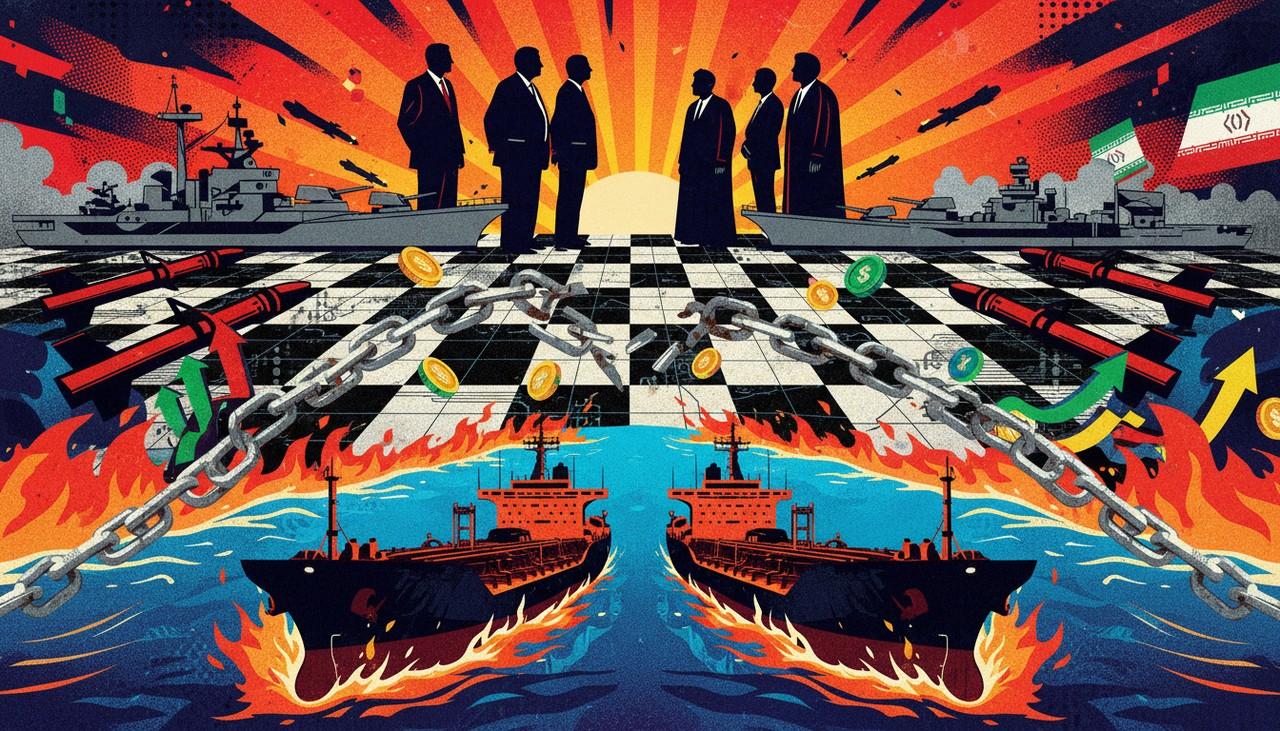
Every tanker in the Strait of Hormuz and every unit of computing power in the network are moving on the same global risk game board. If the crypto market wishes to survive in such an environment, what it truly needs to build is the capability to price uncertainty rather than reflexively chase after the next sensational headline.
Join our community to discuss together and become stronger!
Official Telegram community: https://t.me/aicoincn
AiCoin Chinese Twitter: https://x.com/AiCoinzh
OKX welfare group: https://aicoin.com/link/chat?cid=l61eM4owQ
Binance welfare group: https://aicoin.com/link/chat?cid=ynr7d1P6Z
免责声明:本文章仅代表作者个人观点,不代表本平台的立场和观点。本文章仅供信息分享,不构成对任何人的任何投资建议。用户与作者之间的任何争议,与本平台无关。如网页中刊载的文章或图片涉及侵权,请提供相关的权利证明和身份证明发送邮件到support@aicoin.com,本平台相关工作人员将会进行核查。