Original | Odaily Planet Daily (@OdailyChina)
Author|jk
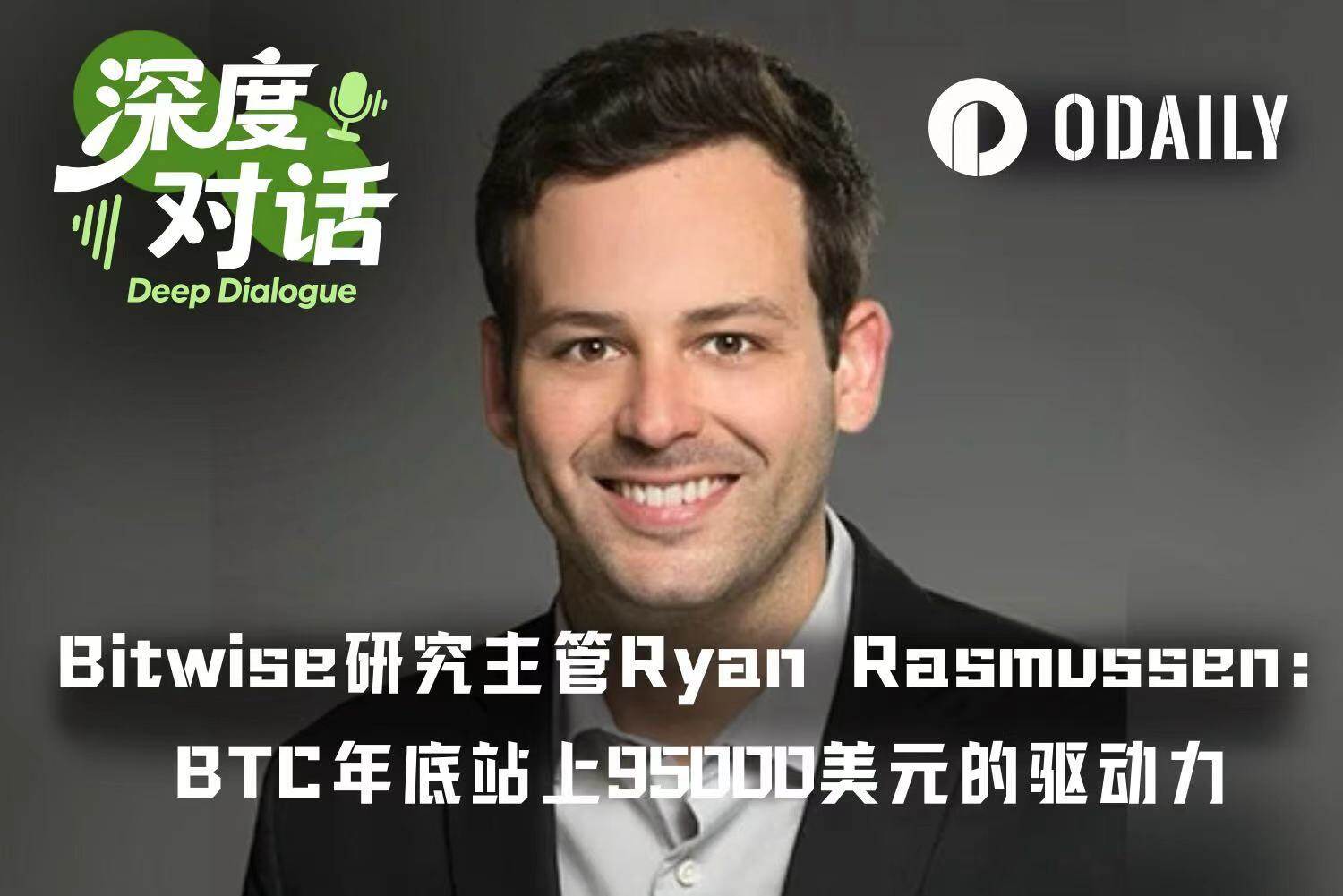
As the price of Bitcoin has halved from its historical high and geopolitical clouds overshadow the global market, is institutional money retreating or quietly accumulating? On March 24, Odaily Planet Daily conducted an on-site interview with Ryan Rasmussen, Head of Research at Bitwise Asset Management, in New York.
Bitwise currently manages approximately $15 billion in assets, making it the largest provider of cryptocurrency index funds globally and a major issuer of Bitcoin, Ethereum, and Solana ETFs. In this interview, he provided the core driving logic for Bitcoin's price in 2026, specific predictions for the end-of-year price, discussed the ongoing "great migration" of positions between retail investors and institutions, and addressed the role of the Asian market in the global cryptocurrency landscape.
Here is the transcript of the interview:
Odaily: Today we are at the DAS summit in New York, and it’s an honor to invite Ryan from Bitwise. Before we begin the questions, could you please introduce yourself and give our Asian audience a brief introduction about yourself?
Ryan: Sure. I am Ryan Rasmussen, Head of Research at Bitwise Asset Management. We are a global cryptocurrency asset management company, primarily providing public and private funds as well as staking solutions for institutional investors. Currently, we manage assets of about $15 billion, with operations in the United States, Europe, and Asia. We are one of the largest issuers in the Solana ETF, Bitcoin ETF, and Ethereum ETF domains, as well as managing various index funds. We have the largest cryptocurrency index fund in the world.
Odaily: What are the biggest factors influencing the price of Bitcoin in 2026, could you rank them and give a rough weighting? For example, the inflow and outflow of structured products from traditional financial institutions in the U.S., comments and policies from Trump and his family, the awakening and selling of long-term whales, the survival pressure on miners, and the follow-up impact of past hacking incidents?
Ryan: The biggest long-term driver of Bitcoin’s price is institutional adoption. The reason is that, for the past fifteen years, most institutional investors globally have been unable to access Bitcoin or other crypto assets. With the launch of the Bitcoin ETF in the U.S. in January 2024 and now the introduction of ETFs such as Ethereum and Solana, we see institutional investors beginning to catch up on Bitcoin investment. But this does not mean that allocations have truly begun: in fact, many investors we have communicated with, whether in the U.S., Europe, or Asia, have not started investing in Bitcoin. So I think the biggest driver is the speed at which institutional investors start to allocate Bitcoin in large quantities. I believe this will start happening in 2026, with more progress in the second half of 2026, which will be a common driving force both in the short and long term, and it comes from the demand of those institutional investors who have yet to enter.
Odaily: Can you talk specifically about the weightings?
Ryan: This is indeed a very interesting topic. Investors who started allocating with us a few years ago initially allocated about 1%, while today, most clients have an approximate allocation of about 5% in crypto assets. What’s most interesting is that those who are starting their initial allocation now are not beginning at 1% but rather at 2% to 3%, while many of our long-term clients are around 5%. So I would say that the typical allocation for new investors is around 2%, while older investors with crypto exposure are about 5%. But when you think of the wealth controlled by global institutional investors, this number is quite substantial—1% to 2% to 5% of $100 trillion in wealth already exceeds Bitcoin's current total market value. This is why institutional allocation will ultimately dominate the price of Bitcoin in the long term, and why this is such an important factor.
Odaily: Is it still possible for Bitcoin to experience significant declines? Could this be the bottom of this cycle?
Ryan: Our view is that we are closer to Bitcoin's bottom and the downward space is less significant now. If Bitcoin remains range-bound for a few more months, I wouldn’t be surprised, as macro factors are really dominating now—conflicts in the Middle East, many happenings in South America, and no one can say what will happen to Cuba in the short term; this year we even saw the situation in Venezuela. So there is a lot of uncertainty regarding macro and geopolitical factors, which puts all risk assets and all financial assets under pressure.
Once macro uncertainty stabilizes and geopolitical uncertainty also stabilizes, I believe we will see Bitcoin and other crypto assets truly begin to accelerate upwards. But I do think that Bitcoin and the crypto market will largely remain range-bound over the next few months. In the second half of the year, we believe we will see a large influx of institutional funds through ETFs, pushing prices higher and closing out the year at a price higher than the beginning of the year, which means Bitcoin will end the year around $95,000, representing about a 40% increase from today’s prices. We believe we are currently in a crypto bear market that has lasted about a year; our judgement is that Bitcoin will end the year higher, and 2027 will be a very positive year.
Odaily: From last year's ATH to this year's price being cut in half, what kind of people do you think are accumulating positions, and what kind are reducing them?
Ryan: What we are observing is a switch from retail investors to institutional investors; this is a one-time switch that is profoundly impacting Bitcoin and the broader crypto market, as institutional investors are entering this market through ETFs and other funds. We see that the regulatory environment in the U.S. and abroad is becoming clearer, making institutional investors feel more at ease when making allocation decisions.
At the same time, retail investors have experienced many cycles of crypto boom and bust. Those early investors who entered Bitcoin when it was $1, $10, or $100 saw it rise to $125,000 and possibly watched it drop back to $70,000, and by now, they are ready to take some chips off the table. This is actually typical of what happens with private companies that eventually go public: early investors finally welcome the IPO, ready to cash out, while new shareholders come in to participate in the equity of the company. I believe this is exactly what is happening in the crypto market now: early investors, primarily retail, are transferring their holdings to institutional investors who have a long-term focus and systematic operations. They are not looking at horizons of one, two, or three years; they are looking at five, ten, or twenty years.
To summarize: currently, those selling are retail investors, while those buying are institutions, and this switch is net positive for the dynamics of the crypto market because institutional investors do not have as strong behavioral biases; they are more systematic and focused on the long term.
Odaily: In the current situation of sudden global changes, Bitcoin has let down some investors' expectations as a safe haven. Compared to traditional assets like gold, silver, and oil, why should people still believe in Bitcoin?
Ryan: I believe that from a long-term perspective, the prospects for Bitcoin have never been as strong as they are now. The largest financial institutions in the world are leaning towards Bitcoin. We are in daily communication with investors, from wealth advisors to family offices to hedge funds, endowments, pension funds, and even sovereign wealth funds; all of them are studying crypto assets and Bitcoin. I believe these are journeys that require years to complete; if one expects Bitcoin to make the leap from a niche asset to a mature global asset in just fifteen years of history, that would be quite shortsighted.
Bitcoin provides the same type of diversification benefits to portfolios as gold, oil, and other commodities: substantial diversification returns with very low correlation to other asset classes. If you look at Bitcoin's role in a portfolio (assuming you add 5% Bitcoin to a traditional mix of stocks, bonds, and commodities), it enhances risk-adjusted returns because it has almost no correlation with other assets and possesses very strong risk-return characteristics in the long term. However, investing in crypto assets must be viewed from a long-term perspective, avoiding emotional biases; only in this way can you truly begin to see the value of crypto assets in a portfolio.
Odaily: Does Bitwise currently have operations in Asia? What are the main ones?
Ryan: Yes, we have operations in Asia. I have personally traveled to Singapore multiple times in the past few years. Our institutional partnership team has also visited Hong Kong, Singapore, and other Asian markets. We have personnel stationed locally who can meet with various institutions such as banks, clients, and family offices to help them gain exposure to crypto assets through private funds, SMAs, public funds, and staking products.
Speaking of staking, we recently expanded significantly into Asia by acquiring Chorus One. Chorus One is one of the world's largest staking service providers. We see a lot of interest and demand in Asia, especially with many family offices proactively reaching out to us for exposure; there are also many banks contacting us to understand how their wealth management and private banking clients engage with crypto assets. We are very excited about the growth prospects and have a team stationed locally. Interested friends are welcome to contact us at any time.
Odaily: Are there any significant differences you can share between Asia and other regions?
Ryan: The differences are quite large. When it comes to perceptions of crypto assets, the U.S., Europe, and Asia are very different markets.
Institutional investors in the U.S. have been lagging in crypto assets because the U.S. has been very oppositional to crypto assets from a regulatory perspective. The previous government's approach from 2020 to 2024, from the White House to every regulatory agency, was actively suppressing the crypto industry at every level. We are now seeing all of this change. This means that institutional investors have been delayed for many, many years because they are concerned about engaging with assets that the government may be attempting to eradicate through regulatory means.
Europe is somewhat different, although institutional investors in Europe are adopting crypto assets at a slower pace compared to Asia.
In Asia, we see a lot of enthusiasm for participation; I believe Asia is actually more forward-looking in adopting and investing in this technology than is recognized externally. This is one of the reasons we find expanding into this market so exciting and attractive.
免责声明:本文章仅代表作者个人观点,不代表本平台的立场和观点。本文章仅供信息分享,不构成对任何人的任何投资建议。用户与作者之间的任何争议,与本平台无关。如网页中刊载的文章或图片涉及侵权,请提供相关的权利证明和身份证明发送邮件到support@aicoin.com,本平台相关工作人员将会进行核查。


