Original | Odaily Planet Daily (@OdailyChina)
Author | Ethan(@ethanzhang_web3)
The crypto market has never lacked deaths, but the ways to die in 2026 are different.
In the past, projects died with a lot of noise: explosions, runaway founders, loss of contact, there were always people breaking down on social media, and a storm worth watching. However, less than 90 days into 2026, Odaily Planet Daily noticed that more than 10 Web3 projects have publicly announced the cessation of operations— their disappearance is unusually quiet: a notice, servers shut down, funds burned out, and then nothing remains.
Games, lending protocols, on-chain tools, infrastructure, almost every major track has seen projects come to a halt during this time, with an average of less than 9 days for a shutdown notice to appear on the timeline. This density feels more like a belated collective settlement rather than an ordinary market clearance. Here are some cases organized by Odaily Planet Daily.
Count of Suspended Projects
Games and Metaverse: The Collective Collapse of Play-to-Earn Model
On February 26, 2026, the highly anticipated fantasy role-playing game GENSO Online regrettably announced that it would shut down all core services on April 30, 2026, including game servers, GENSO marketplace, LAND Viewer, and the dedicated MV wallet.
The team revealed in an AMA that despite a series of scale-down self-rescues, the project’s monthly fixed expenditure still reaches 10 million yen. Among these, cloud infrastructure (3.4 million yen) and labor costs (3 million yen) take up the majority, while maintaining the secondary market liquidity via listings and ROND token buybacks even consumes an additional 1.3 million yen.
In contrast, the total monthly revenue including market fees, in-app purchases, and advertising is only about 2 million yen. Expenses are a full five times the revenue, with no signs of any narrowing. Under this extremely imbalanced cash flow, although the NFTs and tokens held by players (such as MV and ROND) will remain on-chain, their value is nearing zero as the game loses its utility. The official has also clearly stated that, according to the terms of service, no refunds will be offered. This experiment trying to empower traditional games with Web3 was ultimately crushed by server bills.
On January 15, 2026, after struggling for two years in the Ronin ecosystem, the pixel strategy game Pixiland made a difficult and painful decision: indefinitely suspended all Web3 plans and transitioned to a pure Web2 offline model. This means that its token generation event (TGE) has been completely canceled. Even more heartbreaking for the community is that the wPixi points that players accumulated day and night to gain airdrops will never be converted into real crypto assets.
The team admitted that as an independent and self-funded small team, under the dual pressure of severe market fluctuations and regulatory uncertainty, the costs of maintaining on-chain infrastructure and interactions have far exceeded their limits. “Returning to Web2” has become a helpless move for current Web3 games facing high trial-and-error costs.
Similarly relying on the traffic bonus from the Ronin network, the fantasy MMORPG Forgotten Runiverse announced Offline Indefinitely on January 27, 2026.
The official announcement elegantly attributed the shutdown to “compound financial challenges”—to put it plainly, it means the funds have completely run dry. Without the ability to sustainably generate revenue, the team can no longer afford the basic operating expenses necessary to maintain the game. Although the official wording retains some dignity by suggesting the possibility of restarting in the future if resources are obtained, within the industry’s view, this “indefinite offline” has actually become a standard exit strategy for mid-sized projects when funds are exhausted.
DeFi Lending and Derivatives: Liquidity Retreat, Who is Swimming Naked
On February 17, 2026, ZeroLend, once regarded as the leading Layer 2 lending protocol, announced it was entering an “honorable offline” phase, gradually stopping operations. There was a time when ZeroLend was thriving, with its total value locked (TVL) surpassing 250 million USD and daily active users exceeding 100,000, dominating ecosystems like zkSync and Linea.
However, blind multi-chain expansion eventually backfired. As early supported chains like Manta, Zircuit, and XLayer fell into ecological decline, the multi-chain layout brought not scale effects, but severe fragmentation of liquidity. A large amount of assets became trapped in low liquidity environments, turning into difficult-to-maintain “zombie assets.” More critically, oracle service providers halted support, directly draining the foundation for pricing and liquidation within the lending protocol. Coupled with the extremely thin profit margins in the lending market and the long-standing threats of hacker fraud, the protocol fell into irreversible long-term losses.
In the face of this impossible dilemma, ZeroLend chose a rarely seen dignified exit: directly lowered the LTV (loan-to-value) ratios of most markets to 0%, forcibly closing borrowing capabilities, while only retaining withdrawal guidance to allow users to exit safely. To address liquidity depletion issues on some chains, the team upgraded the smart contract for asset redistribution; they even utilized their own LINEA airdrop allocation to partially refund LBTC providers on the Base chain affected by losses. A three-year operation finally concluded with a textbook-like “dignified shutdown.”
On February 14, 2026, the DeFi derivatives protocol Polynomial, which had received 1.1 million USD in seed funding from well-known institutions and industry leaders including Archetype and the founders of Synthetix, announced an orderly shutdown of its business.
The team stated that while the on-chain derivatives market has achieved 100 times growth in recent years, and the track direction is completely correct, they have seriously fallen short on the execution front. In assessing the harsh reality that their products have fallen into a state of “decline”, the team made a decision: proactively halted the originally planned TGE in the first quarter of 2026.
The team believes that forcing token issuance under the circumstance of losing product competitiveness is a valueless risk and shifts the risk onto the community. Instead, they chose to systematically unwind funds and organize the 27 million past transaction data that they had accumulated, in search of a truly defensible product moat. They promised that when conditions are ripe in the future, they would restart the project with the original team, prioritizing involvement of early users. This “no harvesting, no lying flat” attitude preserved the rare bottom line of Web3 entrepreneurs.
On February 24, 2026, the Solana ecosystem veteran DeFi platform Step Finance, which had received 2 million USD in investments from Alameda Research and other institutions, along with its subsidiaries SolanaFloor and Remora Markets, announced an immediate and comprehensive stop to operations.
What crushed this ecosystem veteran was not a competitor, but an extremely low-level yet fatal operational security (OpSec) mistake. At the end of January 2026, a personal device of a Step Finance executive was hacked, leading to the theft of approximately 40 million USD in assets from their treasury. In the following weeks, the team tried various self-rescue measures, seeking financing and mergers, but no one in a liquidity-tight market was willing to take over a mess with such a significant security flaw, and all attempts were in vain.
Though the team ultimately recovered about 4.7 million USD in relevant assets, and promised to partially repurchase STEP holders based on a snapshot before the incident, as well as initiate the redemption process for Remora rToken (currently maintaining 1:1 asset support), it still could not reverse the overall situation. A hacked personal computer instantly destroyed a project painstakingly built over many years, marking a tragic footnote for the Web3 realm between 2025 and 2026 due to poor internal management.
On January 15, 2026, the liquidity staking protocol MilkyWay from the Celestia ecosystem announced its permanent closure and began a gradual cessation of operations.
MilkyWay’s failure is a typical story about “poor execution” and “self-sabotage.” The project initially based itself on the modular ecosystem of Celestia, cutting into the liquidity staking track, and successfully secured 5 million USD in funding led by Binance Labs and Polychain in April 2024. However, the team’s execution fell seriously out of sync: the V1 version and MILK token, originally scheduled for launch in Q4 2023, were severely delayed until the second half of 2024 and even early 2025.
In the fast-changing Web3 market, being late almost equates to being out. When the flagship product WayCard finally began to roll out slowly, it had already missed the initial traffic bonus period of the Celestia ecosystem. Faced with below-expected actual demand and adoption rates, the protocol, relying solely on retaining 10% of the liquidity staking fees, couldn’t generate enough cash flow to support the high daily operational costs. Eventually, even 5 million USD could not save it from the fate of funding exhaustion. As a final farewell, the team proportionately returned the fees gained by the protocol (USDC) back to qualifying MILK token holders, retreating quietly.
Infrastructure and Tools: Some Fail to Compete, Others Fail for "Becoming Unnecessary"
On February 20, 2026, the on-chain analysis tool Parsec regrettably concluded its five-year entrepreneurial journey. The team announced the cessation of all services and began processing refunds and subscription cancellations for users.
This was once a star project born with a “golden key.” Parsec launched in early 2021, just before the DeFi and NFT frenzy erupted, aiming to provide users with highly customizable on-chain data visualization dashboards. With a product concept hitting the pain points, it successfully secured a total of 5.25 million USD in seed and follow-up financing from top institutions like Galaxy Digital, Polychain Capital, Robot Ventures, and Uniswap Ventures.
However, Parsec’s lifecycle happens to span a complete cycle from extreme frenzy to prolonged deep bear market. When the tide recedes and on-chain speculative activities sharply decline, ordinary users' demand for complex on-chain data analysis tools also experiences a cliff-like shrinkage. More critically, it is situated in an intensely competitive red ocean track. Faced with Dune's community ecosystem, Nansen's smart money tags, Arkham's intelligence bounties, and DeFiLlama's free comprehensiveness, Parsec never managed to establish an irreplaceable moat.
In 2026, when venture capital tightened comprehensively, infrastructure projects without sustainable cash flow generation capabilities were doomed to fail. Parsec’s dignified refund shutdown reveals a harsh industry truth: top capital can catalyze a good product, but it cannot buy sustainable survival in a winner-takes-all market.
If Parsec died in brutal commercial competition, then ENS announcing the cessation of development on the proprietary Layer 2 network Namechain on February 7, 2026, is purely due to
In recent years, in order to escape the expensive gas fees on the Ethereum mainnet that often exceed tens of dollars, the ENS team had boldly planned a proprietary L2 network, Namechain, hoping to lower the user’s registration threshold. However, with the successful landing of the Ethereum Fusaka upgrade in 2025, the gas limit on the mainnet was historically raised to 60 million. This breakthrough at the underlying level significantly enhanced Ethereum's transaction processing capability, with ENS's mainnet registration gas costs plummeting by 99% in the past year, with average registration costs directly dropping below 0.05 USD.
Faced with this happy dilemma, ENS core developer nick.eth decisively cut Namechain, announcing that ENSv2 would be directly deployed back to the Ethereum mainnet. This not only saved the enormous costs of developing and maintaining L2, but more importantly, staying on L1 completely eliminated the additional trust assumptions brought by L2 cross-chain interactions, allowing identity domain names—this core digital infrastructure—to continue enjoying the highest level of security provided by Ethereum.
Even Vitalik Buterin personally commented, “This is a wise decision.” Although L2 was abandoned, the optimization roadmap for single-step registration and cross-chain stablecoin payments for ENSv2 remains in place. Namechain did not die from code vulnerabilities, nor did it die from funding breaks, but rather from “becoming unnecessary.” Perhaps in the history of Web3 filled with abandoned projects and runaway founders, this can be seen as an extremely rare, even applause-worthy dignified exit.
Reflection: What Does This Wave of Suspensions Indicate
Putting these cases together, several things become clear.
First, lack of revenue generation capability is the underlying cause of all failures. GENSO Online’s spending is five times the revenue, MilkyWay cannot cover operational costs by retaining 10% of staking fees, and Parsec cannot find a sustainable cash flow source after a decline in on-chain activity. These projects share a common underlying logic: exchanging financing for time, exchanging token incentives for growth, but never establishing a blood-generating mechanism independent of external transfusions.
Second, multi-chain expansion is a repeatedly validated trap. ZeroLend deployed simultaneously across zkSync, Manta, Linea, Zircuit, and XLayer, with TVL once surpassing 250 million USD, appearing to be successful. But the multi-chain layout brought not scale effects, but comprehensive fragmentation of liquidity—each chain is thin enough to collapse, and any ecological decline on one chain directly transfers to the protocol as a whole. In resource-constrained situations, spreading out isn’t as effective as deepening engagement; this reasoning is easy to articulate, but during the peak of the "multi-chain narrative," hardly anyone took it seriously.
Third, security is a human issue, not just a code issue. The 40 million USD lost by Step Finance did not vanish in a precise smart contract flaw, but rather on a poorly managed personal computer. Throughout 2025, the entire Web3 industry saw losses nearing 4 billion USD due to hacker attacks, a significant proportion stemming from social engineering attacks and supply chain vulnerabilities—coming from "human error" rather than "code errors."
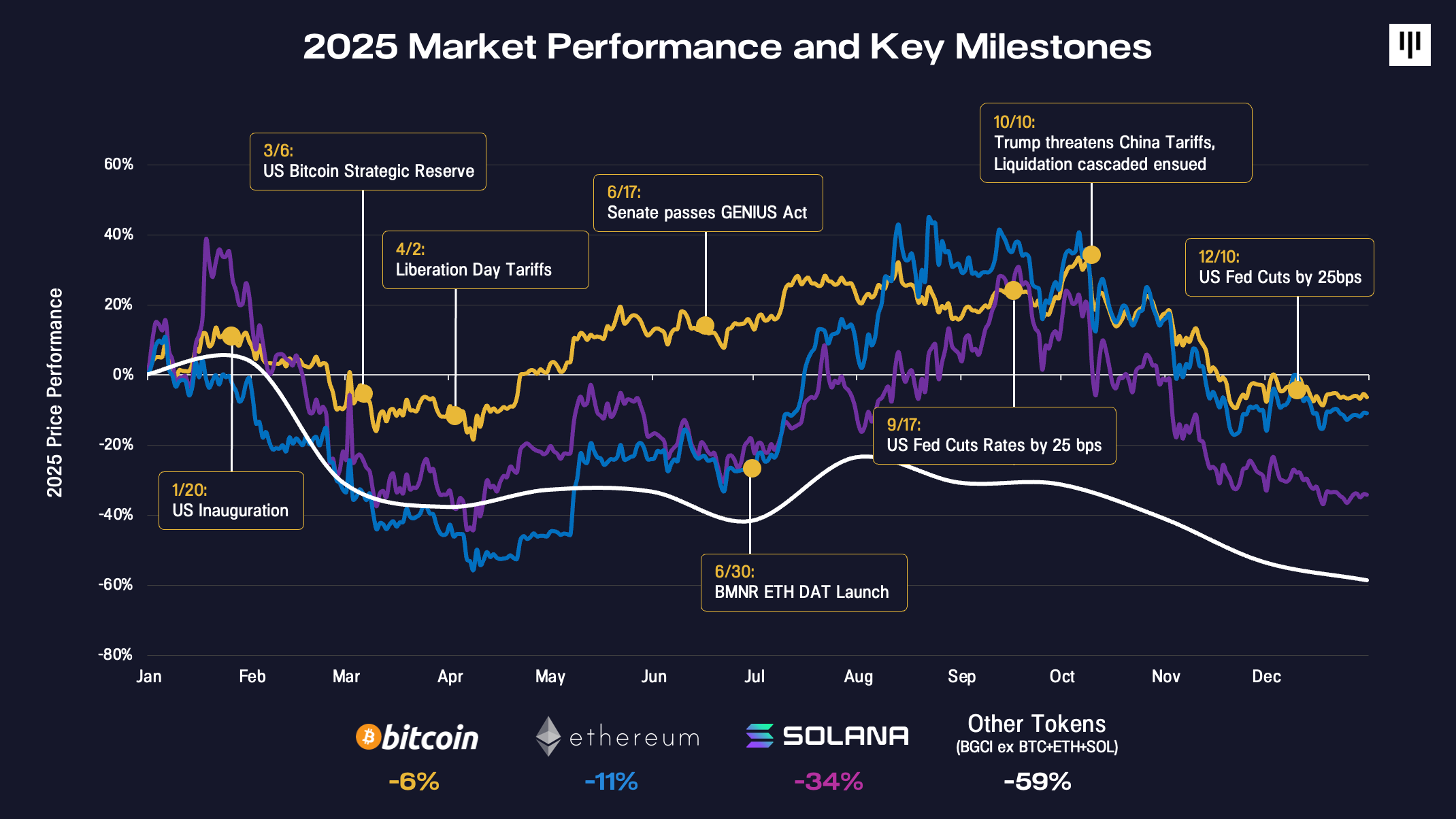
Fourth, funding is accelerating its concentration towards heads with real demand. Stablecoins, RWA, and prediction markets demonstrated clear product-market fit in 2026; BTC, ETH, and SOL related assets continued to attract traditional incremental funding through ETFs. Meanwhile, the regulatory frameworks like the 2025 “GENIUS Act” resulted in further exit of non-compliant marginal projects from the market. According to reliable research data, the liquidity space left for long-tail tokens and projects without real application scenarios is becoming increasingly narrow, with the median decline for altcoins over the past year reaching 79%.
Of course, there is another noteworthy side to this batch of announcements. Polynomial did not forcefully issue tokens, ZeroLend used its airdrop allocation to compensate affected users, and ENS decisively cut Namechain when it lost its necessity—these choices are actually not common in this industry. Clearing out is painful, but it also filters: leaving behind those teams that are truly willing to be responsible to users.
There are still more than nine months left in 2026. This suspension list will likely continue to grow.
What exactly are those who survive relying on? It still needs to be gradually discovered...
免责声明:本文章仅代表作者个人观点,不代表本平台的立场和观点。本文章仅供信息分享,不构成对任何人的任何投资建议。用户与作者之间的任何争议,与本平台无关。如网页中刊载的文章或图片涉及侵权,请提供相关的权利证明和身份证明发送邮件到support@aicoin.com,本平台相关工作人员将会进行核查。