TL;DR
Background: AI Agents are transitioning from "tool-using models" to autonomous economic entities.
Compatibility of Crypto and AI Agents: Readable, writable, verifiable, combinable on the blockchain.
Key Puzzles in AI Agents × Crypto: x402 = settlement layer, ERC-8004 = trust layer.
Ecological Landscape of AI Agents × Crypto: From applications to protocol stacks, the on-chain machine economy is accelerating.
Risks: Security attacks | Financial risk | Data risk | Regulatory ambiguity | Operational risk.
Opportunities: Process-driven | Pay-per-use | Cross-organizational collaboration | Enterprise-level implementation | Open standards.
Conclusion: The window for large-scale applications of AI Agents × Crypto has opened.
I. The Concept and Development Process of AI Agents
A practical definition of "Agentic LLM" in the AI research community is: a language model system that possesses reasoning (reason), action (act), and interaction (interact), incorporating tools, states, and feedback loops. Mechanically, the most commonly seen minimal closed loop for an Agent is: goal decomposition → plan generation → tool invocation/environment interaction → result verification and self-correction → continue execution or delivery.
1.AI Agent's Key Capabilities
In the investment context, the most crucial role of the AI Agent is not "to answer questions," but "to complete tasks." It typically possesses three key abilities:
1) Goals: You provide it with a result-oriented instruction, such as "Maximize returns on 30% of stablecoins in my account within a controlled risk framework over 7 days."
2) Tools: It can invoke external tools— in the crypto world, this includes wallet signing, contract interaction, DEX routing, cross-chain, lending, liquidation, rebalancing, etc. The AgentKit/"Based Agent" trajectory launched by Coinbase/BASE fundamentally uses "on-chain capabilities" as the default toolbox for the Agent, enabling it to perform operations like transfers, swaps, staking, and domain registration using natural language.
3) Closed Loop: It not only "suggests what you should do," but will also break down steps, execute, verify results, and roll back or change plans if necessary (this is the agentic loop).
2.AI Agent Development Timeline: Saying - Doing - Operating
In the past two years, the capability boundaries of AI Agents have undergone three key leaps, pushing "conversational AI" towards "deliverable digital labor."
1) From Text Generation to Tool Invocation: Making Outputs into "Executable Actions"
The value of early models primarily lay in "content generation." The real turning point was connecting the models to tools/systems: searching, code execution, browser operations, invoking business APIs, and writing tickets/forms, enabling the Agent to turn "plans" into "actions."
An example of this stage is OpenAI, which unified "research (reasoning) + action (operation)" into the same experience: ChatGPT agent emphasizes enabling models to perform end-to-end tasks using "their own computer," integrating multi-step reasoning, web operations, file generation, and other capabilities into a usable agent mode.
2) From Monolithic to Multi-Agent Collaboration: "Role Decomposition and Orchestration" for Complex Tasks
As tasks evolve from "writing a piece of copy" to a long chain of "research - decision-making - execution - review," a single agent struggles to simultaneously handle: information gathering, risk control verification, compliance constraints, execution landing, and anomaly handling.
Decomposing problems using multiple "role agents" (researcher/trader/compliance officer/executor/auditor, etc.)
Organizing agents and tool chains into observable processes with an orchestration layer (queues, callbacks, state machines, retries, approval gateways)
This led to a rapid move towards multi-agent architecture in engineering, where agents are no longer just "model response boxes," but rather composable systems.
3) From Demo to Production Systems: Standardized Connectivity + Enterprise Governance + Continuous Resistance
When Agents truly enter production environments, the bottleneck shifts from "can it do" to "can it do so stably, controllably, and securely":
Standardized Connection (MCP): Using a unified protocol to connect models to various tools and data sources, lowering integration costs, and promoting interoperability from “factual standards” to “governance standards.” Anthropic plans to donate MCP to the newly established Agentic AI Foundation (AAIF) under the Linux Foundation by December 2025, emphasizing neutrality, openness, and community governance, revealing its ecological elements (connectors/registry/SDK, etc.) are taking shape.
Enterprise Governance (Frontier): OpenAI launched OpenAI Frontier on February 5, 2026, focusing on "shared context, permission boundaries, feedback learning, deployable and operable," corresponding to real enterprise needs: requires auditing, isolation, control, and continuous iteration.
Ongoing Security Resistance (prompt injection protection): As browser/desktop Agents read and write real web pages and systems, prompt injection has become a long-term adversarial issue. OpenAI stated the ongoing fortification strategy of Atlas as of December 22, 2025: employing automated red teams + reinforcement learning to discover and patch new types of injection attacks, continually iterating defenses.
Systematization of Browser Form (Atlas): On October 21, 2025, OpenAI released ChatGPT Atlas, integrating "browser + ChatGPT + agent mode" into a unified product form, fundamentally advancing the execution interface, context, and permission access of Agents to the user’s most frequently used work scenarios.
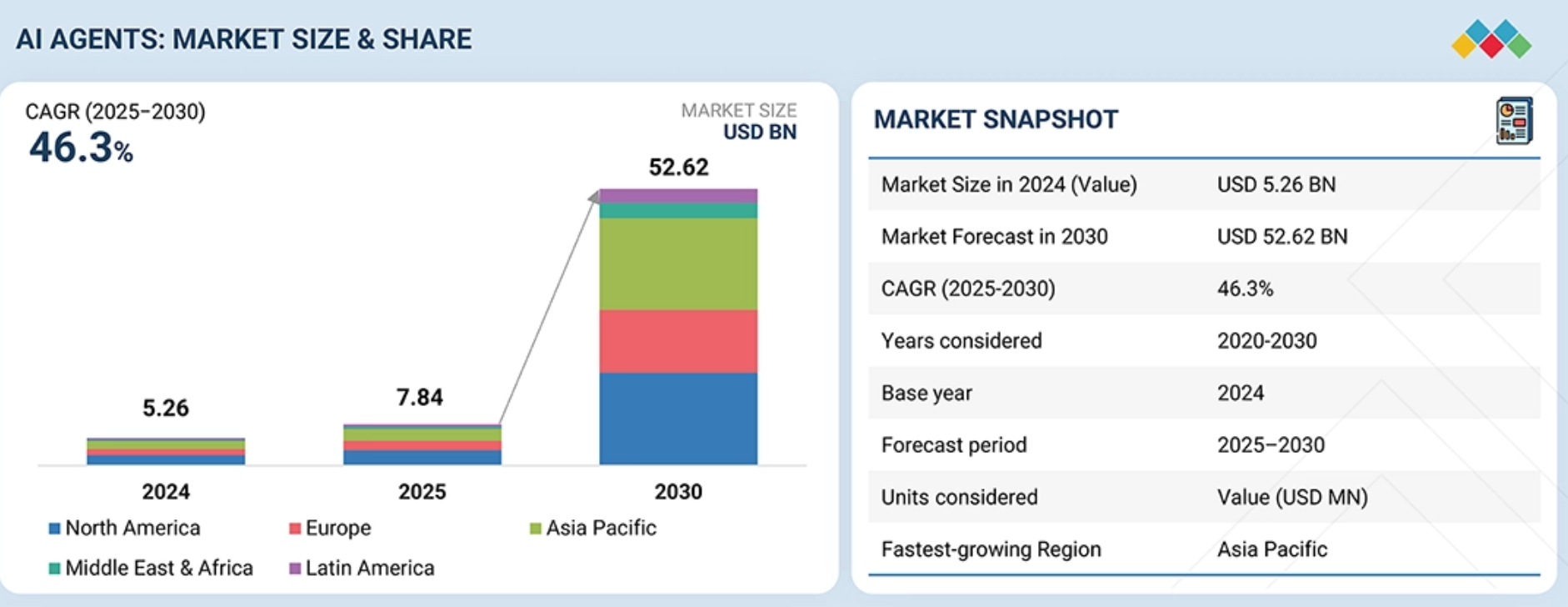
Source: https://www.marketsandmarkets.com/PressReleases/ai-agents.asp
According to MarketsandMarkets research report, the global AI Agent market size is expected to grow from approximately $7.8 billion in 2025 to $52.6 billion by 2030. AI Agents will rapidly land in industries such as finance, healthcare, customer service, and supply chains. By automating repetitive tasks, analyzing vast amounts of data in real time, and assisting with decision-making, they will expand service scale and increase response efficiency without significantly increasing labor costs. Overall, AI Agents are evolving from early auxiliary tools to crucial execution layers in digital operations, becoming an essential component of the future intelligent economy.
II. The Development of AI Agents in the Crypto Industry
For AI Agents to complete tasks, they must traverse organizational permissions, connect systems, and implement processes; this faces numerous obstacles in many traditional industries. The characteristics of blockchain determine the natural coupling of AI Agents and the crypto industry.
1. Compatibility of the Crypto Industry and AI Agents
The crypto industry inherently provides standardized "actionable interfaces" that enable AI to transform from "助手" to "executable主体".
Readable: On-chain states are public and transparent (balances, positions, interest rates, liquidation lines, LP positions, contract events), enabling the Agent to make data-driven decisions.
Writable: Writing states equates to signing/contract invocation, with high standardization and orchestrability.
Verifiable: Transaction receipts, event logs, and fund flows can be audited, ensuring "results" can be machine-verified.
Combinable: The combinability of DeFi allows Agents to stitch protocols together like an "automated assembly line."
For investors, the most noteworthy concern is not "whether Agents will replace traders," but rather which scenarios will first become stable on-chain processes:
The first type is intent-driven DeFi operations. Users provide goals and constraints, and the Agent automatically completes routing, trading, rebalancing, liquidation protection, and reconciliation. Its feasibility relies on "controlled wallets + execution toolboxes + risk strategy engines," not merely on stronger models.
The second type is on-demand procurement for machine economies. Agents, in order to complete tasks, will purchase data, computing power, storage, API calls, content licenses, etc.; this demand is inherently more suitable for "micro-payments on request" rather than "account subscriptions." The emergence of x402 specifically targets this.
The third type is the Agent-to-Agent service market. It is not "I use an Agent," but "Agents hire Agents," forming a closed loop of on-chain orders, custodians, delivery, acceptance, and reputation feedback. ERC-8004 (trust layer) and certain on-chain custodial protocols (such as the ACP system) fundamentally serve this end.
2. ERC-8004 and x402 Standards Promotion: Key Accelerators for the Implementation of Crypto AI Agents
If we abstract "Agents in the crypto industry" into a minimal closed loop, it requires at least two infrastructures:
1) Verifiable Identity and Trust: Who you are, whether you are trustworthy, whether you are recognized by an organization/strategy.
2) Programmable Payments and Settlements: Can you automatically pay for data/computing power/API access, with support for multi-chain and low-friction calls.
ERC-8004 and x402 complete these two aspects, thus pushing the application of AI Agents in crypto from "concept demonstration" to "scalable operations."
1) x402: Transforming "Paid Access" into Native HTTP Capability
x402 was introduced by Coinbase in May 2025, specifically designed for AI agents trading autonomously using stablecoins. x402 uses HTTP 402 (Payment Required) as a semantic anchor, allowing APIs/content/services to inherently request and verify on-chain payments at the HTTP level, enabling clients (including AI Agents) to pay per use without an account system. x402 V2 expands the protocol from "one-time precise payments" to a more agent-suitable form:
Wallet Identity and Reusable Sessions: After one-time verification and payment, subsequent calls do not need to go through the entire process again, reducing friction and costs for high-frequency agent calls.
Automated Discovery (API discovery), dynamic payees, more chains/stronger extensibility, adaption to CAIP-related multi-chain/identity standards: Ensure that "agent finds services – understands pricing – completes payment – gains access" can automatically close the loop.
The promoting effect of x402 on crypto AI Agents can be summarized as:
Making "Payment" the Default Action for Agents: Agents can invoke paid APIs (data sources, risk control engines, on-chain analysis, MEV protection, KYC/AML queries, quotes/matching) just like invoking tools, productizing them as "billable tools."
More Web-Native Pay-Per-Use: Redirecting the business model from subscriptions/account systems back to a more web-native pay-per-use is especially important for the agent ecosystem since agent calls tend to exhibit fragmented, combinable, and long-tail characteristics.
Opening Pathways for "Machine Clients": When the consuming entity is no longer "a person clicking a button," but "an agent calling automatically," the protocol layer needs to support settlement, authentication, and multi-chain extension.
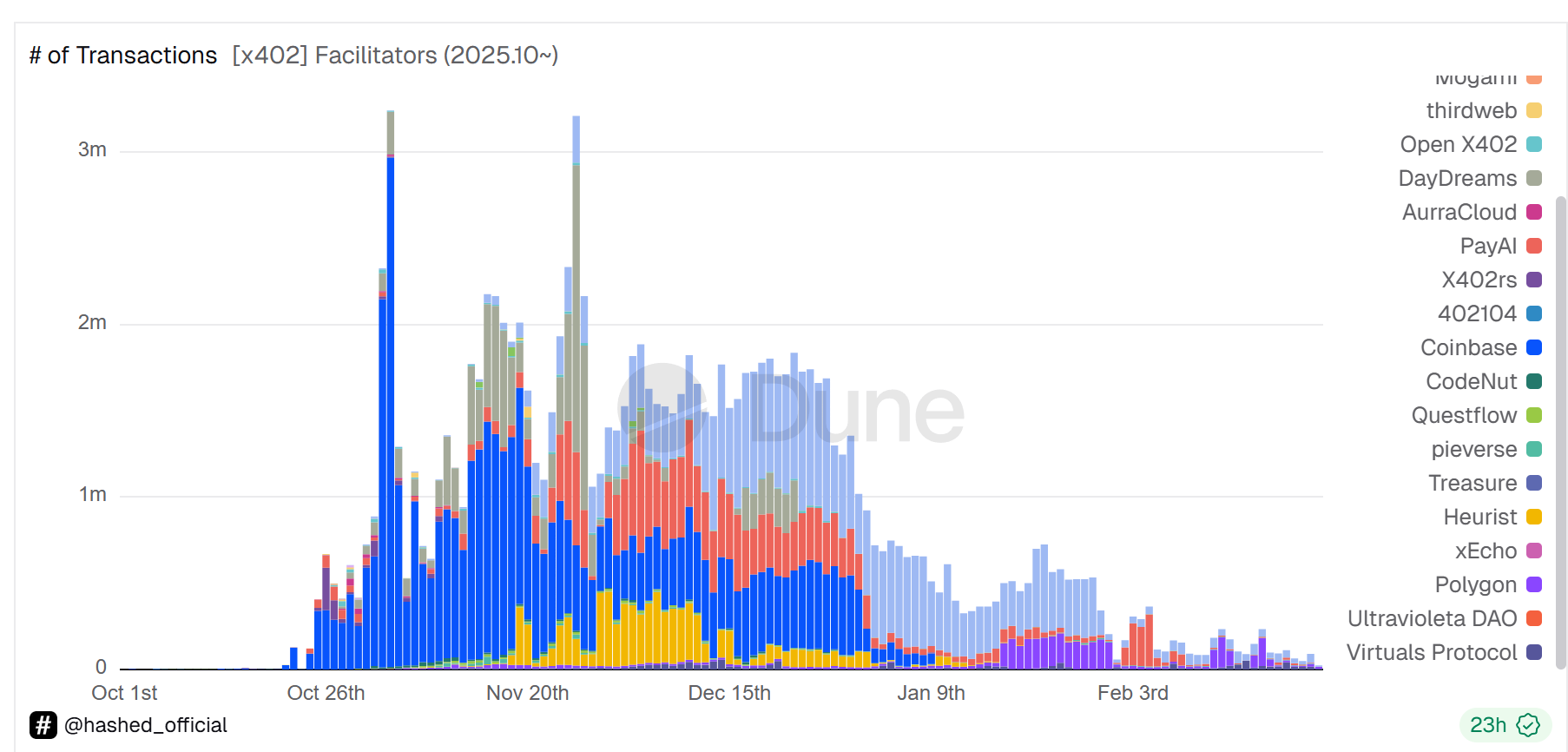
Source: https://dune.com/hashed_official/x402-analytics
According to statistics from Dune Analytics, the adoption of x402 saw a significant explosion in the fourth quarter of 2025. The trading volume of x402 rapidly increased from a near-zero daily trading volume in October 2025, climbing sharply to daily peaks of about 2 to 3 million transactions by mid-November. Subsequently, from December to early 2026, although the overall trading volume experienced a decline, it remained stable at a daily trading scale, primarily led by Coinbase-related infrastructure, gradually forming an ecosystem structure with multi-platform participation.
2) ERC-8004: Standardizing "Identity/Credit/Verification"
On January 29, 2026, the dAI team of the Ethereum Foundation, in collaboration with MetaMask, Google, and Coinbase, deployed the trustless agent standard ERC-8004, creating a unified AI agent identity and reputation system. The goal of ERC-8004 is to allow agents across different organizational boundaries to be discovered, selected, and interacted with without relying on pre-established centralized trust. The core of ERC-8004 is to break down trust into more composable modules (commonly expressed as identity/reputation/verification registry components), allowing the ecosystem to build indices, aggregations, risk controls, and routing layers around a unified interface.
The promoting effect of ERC-8004 on crypto AI Agents mainly reflects in three points:
Discoverability: DApps/markets/routers can more easily "discover" on-chain agents, reading metadata and trust signals in a standardized way (similar to "Agent's DID + reputation profile").
Risk & Compliance by Design: Once agents possess verifiable identities and traceable reputations, protocols can establish rules for "what is allowed" and "what verification is needed": for example, only allowing high-permission operations to be executed by clearing/trading agents recognized by a certain verification registry.
Composable Trust: Different scenarios can choose different validators/reputation systems, rather than being bound by a single platform—this is particularly crucial for cross-protocol, cross-chain, and cross-team collaboration.
In summary, ERC-8004 can provide agents with on-chain "identity/credit/verification" registries, promoting the composability of trust for cross-protocol collaboration. x402 + Agentic Wallets make "machine payments (HTTP 402 semantics) + wallet capabilities" into reusable components, enabling agents to natively complete paid API calls, service discovery, and automated settlements.
III. Representative AI Agent × Crypto Ecological Landscape
The application of AI Agents in the crypto industry is transitioning from "single-point applications" to "protocol stack structures": the upper layer comprises Agent applications and issuance platforms, the middle layer consists of identity/payment/tool connections and governance, while the lower layer features data, computing, storage, and verifiable execution. Key standards/infrastructures like ERC-8004 and x402 are accelerating this process:
1) Agent Issuance and Tokenization Platforms
Transforming Agents into on-chain assets that are issuable, tradable, and shareable in profits is currently the most active mainline.
Virtuals Protocol: Leading AI Agent "social/issuance platform" on Base chain, emphasizing on-chain tokenization of Agents, co-ownership, revenue sharing, and Agent-to-Agent trading, has formed a complete aGDP (Agent GDP) economic cycle.
CLANKER (tokenbot): The most capable AI-driven autonomous issuance platform launched on Base, directly deploying agents/tokens to Uniswap V3 and locking perpetual liquidity, serves as the core infrastructure for DeFAI + agent issuance.
2) Agent Framework / Runtime / Orchestration Layer
Determines whether Agents can stably call tools, be observable, auditable, and reusable.
OpenClaw (formerly Clawdbot/Moltbot): A rapidly growing open-source general AI Agent framework in early 2026, supporting complex tasks like browser automation, email, code execution, etc., achieving autonomous payments in crypto through ClawRouter + x402, but also facing security controversies over prompt injection and permission management risks.
elizaOS: A full-featured Agent operating system supporting persistent personas, multi-platform deployment, and autonomous decision-making.
AgentKit (Coinbase): An official Agent development toolkit deeply integrated with x402 payments and Agentic Wallet, significantly simplifying on-chain interaction development.
Olas (Autonolas): An orchestration layer focused on sustainable, multi-agent services, emphasizing Agent service economies and on-chain collaboration.
3) Wallets, Payments and Service Discovery (Economic Entity Layer)
For Agents to become autonomous "economic agents," they must be able to hold assets, make payments, receive payments, and discover services.
Agentic Wallets (Coinbase): A wallet infrastructure designed for AI Agents launched on February 10, 2026, supporting autonomous trading, transfers, payments, profit realization, and programmable risk control, achieving zero human intervention combined with x402.
Cross-Chain Routing: Chainlink CCIP, LayerZero, Wormhole, etc., serve as the foundation for multi-chain execution of Agents.
4) Identity, Reputation, and Verification (Trust Layer)
The premise for large-scale collaboration among Agents is discoverability, verifiability, and accountability.
DID and Identity Systems: Polygon ID, World ID, Spruce ID, Ceramic/IDX, etc.
Reputation and Anti-Witchhunts: Gitcoin Passport, BrightID, Galxe Passport, etc.
Signature/Proof Protocols: Sign Protocol, Sismo, and zkML related projects.
5) Data, Indexing, Knowledge, and Memory Layer
Agent decision-making relies on high-quality, retrievable, verifiable data and long-term memory.
Oracles: Chainlink, Pyth, RedStone, providing real-time data feeds, supporting x402 autonomous payments.
On-Chain Indexes and Intelligence: The Graph (subgraph querying), Arkham, Nansen.
Knowledge Graphs and Verifiable Data: OriginTrail.
Decentralized Memory Layer: Unibase, designed for long-term memory storage specifically for AI Agents, allowing cross-platform memory persistence and interoperability.
6) Decentralized Computing / Inference / DePIN
Determines the cost structure and decentralization level of Agents.
Bittensor: A decentralized model/subnet economy capable of supporting dedicated Agent inference capabilities.
GPU/Compute Networks: Render, Akash, io.net, Aethir, Gensyn (focused on AI inference).
Storage: Filecoin, Arweave (long-term memory for Agents, model distribution).
7) Agent Social, Content, and Network Effect Layer
Forming network effects and dissemination through Agent-to-Agent interactions.
Moltbook: A social/content platform exclusive to Agents, supporting agent-to-agent content generation, debates, and interactions, commonly integrated with the OpenClaw/CLANKER ecosystem and achieving viral growth on Base.
Other Collaboration Projects: Multi-agent collaboration scenarios supported by Unibase and others.
IV. Risks and Opportunities for AI Agents
The risks of AI Agents do not stem from occasional side effects of "AI becoming stronger," but from structural challenges brought about by "AI being able to execute": the stronger the capability, the larger the attack surface, and the more complex the responsibility chain. However, this does not mean that Agents are unsuitable for entering the crypto industry; on the contrary, these risks reveal crucial opportunities for future protocols and infrastructure.
1. Major Risks
AI Agents have attracted attention in the crypto industry not only because they can "do tasks for people" but also because they can interact with real assets, real permissions, and real counterparties in an on-chain environment. Because of this, the risks for Agents extend beyond the traditional AI risk of "is the answer accurate?" to include "will they be induced to execute, will they act beyond their authority, will they cause irreversible financial and compliance consequences?"
(1) Expanded Attack Surface Due to "Execution Capability": When Agents gain execution permissions for browsers/wallets/system tools, attacks evolve from "tricking you to click a link" to "tricking the Agent itself into executing." Browser-type Agents are particularly vulnerable to being induced to execute transfers, authorizations, or key disclosures by malicious instructions injected into web pages/emails/documents (prompt injection). OpenAI specifically identifies prompt injection as a long-term issue requiring "continuous resistance" in the security documentation for Atlas, continually discovering and patching real-world attacks through automated red teams + reinforcement learning.
(2) Wallet and Financial Risks: Once the Agent is empowered to sign or invoke a wallet, the risk transitions from “information leakage” to “irreversible asset transfer.” This is why the industry is pushing for infrastructure like "Agentic Wallets/x402": productizing capabilities such as payments, authentication, permission ranges, and auditing logs, reducing the rough practice of “giving the main private key directly to the Agent.”
(3) Data and Model Layer Risks: Agent decisions on-chain heavily depend on external data (market conditions, oracles, on-chain intelligence, social media information). Data poisoning, adversarial samples, and seemingly trustworthy but outdated/incorrect information can lead to strategy distortion. Particularly in automated trading, liquidation protection, and risk control tuning scenarios, errors can be amplified into systemic losses by automation.
(4) Ambiguity in Compliance and Responsibility Boundaries: When Agents act as "semi-autonomous economic entities" executing trades, matchmaking, and paying service fees, the legal accountability boundaries become complex: the responsibilities of users, developers, platforms, model providers, and protocol parties are still evolving. This is why enterprises prefer to adopt governance platforms that are "auditable, permissionable, and reversible," rather than treating Agents as "personal toys" to be deployed directly.
(5) Operational Maintainability Challenges: Agent systems often involve "long chains + multiple tools + multi-agent orchestration." Without proper logging, metrics, playback, and approval gateways, it is challenging to locate anomalies, such as operational errors, duplicate charges, cross-chain routing failures, or incorrect API calls for payments.
2. Structural Opportunities
The crypto industry inherently possesses the soil for programmable assets and open protocols, hence the opportunities for Agents are often not singularly "smarter," but rather systemically "more automated, lower friction, and more commercialized."
(1) From "Human-Driven" to "Process-Driven": The core value of Agents is not to recreate a chatbot but to automate the processes of "understanding - decision-making - execution - review," transforming complex on-chain operations (cross-chain, increasing positions, hedging, rebalancing, collecting rewards, etc.) into "goal description → automatic completion," significantly reducing the entry barrier for using crypto products.
(2) New Business Model of "Pay-Per-Use": x402 embeds "payments" within HTTP semantics (Payment Required), enabling Agents to invoke paid resources—data, intelligence, risk control, execution channels, content, computing power, etc., forming a native business model for "machine clients."
(3) A New Paradigm for Cross-Organizational Collaboration: The "identity/reputation/verification" registry approach of ERC-8004 allows Agents to be discovered, assessed, and selected, upgrading private platform judgments to combinable on-chain trust signals, helping form a more open Agent market and routing layer.
(4) Accelerated Enterprise-Level Implementation: Treating Agents as "digital employees" within enterprises: shared context, permission boundaries, feedback learning, auditing, and deployment, solving true enterprise concerns of "controllability and operability," allowing Agents to advance from demo to production systems.
(5) Ecological Prosperity from Open Standards: The MCP donated to the Agentic AI Foundation under the Linux Foundation essentially promotes the connection and interoperability of Agent tools towards a more neutral governance framework, reducing ecological friction and enhancing scalability.
V. Outlook for AI Agents in the Crypto Industry
With risk boundaries gradually clarifying and wallet permissions and tool connection infrastructure becoming more mature, the implementation of AI Agents in the crypto industry is likely to follow a path of "first monetization, then expanding scenarios, and finally platformization": starting with aspects that can directly generate cash flow and have high-frequency reusable demands (trading execution, risk control, operations), subsequently expanding towards cross-protocol collaboration and service networks, ultimately forming a sustainable Agent economic system.
1) Automated DeFi Operations will Scale First: Agents will initially cover rebalancing, yield aggregation, cycle lending, liquidation protection, stop-loss/take-profit operations—strong processes with high repetition—and focus on "verifiable strategies + auditable permissions." A "strategy market" may emerge in the future where users choose different Agent services based on historical performances, risk control levels, and fee structures.
2) On-Chain Trading and Execution Shift from Robots to "Collaborative Execution Agents": Capabilities such as quoting, routing, order splitting, slippage control, and MEV protection will be modularized, combining with account abstractions (session keys, limits, multi-signature approvals) to build a more secure automated execution framework. The competition focus will not be on "being smarter," but rather on "being more controllable, replayable, and auditable."
3) Data and Intelligence Services Become the Second Growth Curve: Agents will gradually assume roles as "research assistants + trading assistants": automatically generating due diligence, risk alerts, address profiling, fund flow analysis, and anomaly warnings, forming a stable cash flow through pay-per-use data/API mechanisms.
4) The Key Commercial Spot is the "Auto-Settling Service Network": Once Agents possess wallet identities and extensible payment protocols, data, risk control, execution, and compliance modules will be commoditized in the form of "tools as a service," forming a closed loop of "service discovery → auto-payment → gaining permissions → continuous usage," propelling Agent-to-Agent Commerce toward scale.
5) Identity and Reputation Will Determine the Upper Limits of Open Ecosystems: As registry frameworks like ERC-8004 advance, the Agent market will trend towards credentialing, stratification, and audibility: identities, qualifications, transferable reputations, and verifiable results will diminish the costs of unfamiliar collaborations and provide a trust basis for open networks across protocols and teams.
Overall, the landing of Agents will not be achieved in one fell swoop by a single "super application," but rather will resemble multiple pathways growing in parallel: Automated DeFi brings the first wave of scale and revenue; data intelligence and execution agents form the second wave of tool-networking; standards for identity, payments, and reputation become the amplifiers for the third wave of cross-ecological collaboration.
Conclusion
Currently, AI Agents have completed a fundamental leap from "intelligent models that can use tools" to "autonomous economic entities that possess on-chain identities, can settle autonomously, and create value." The two standards ERC-8004 and x402 act as if "ID cards" and "credit cards" have been installed on on-chain Agents simultaneously—the former provides standardized, composable identity, credit, and verification registries, while the latter enables HTTP-native micropayments to become an Agent's default capability. Together, they unlock a complete loop of "discoverable, trustworthy, and autonomously settled," allowing AI Agents to truly operate independently of human intervention, making independent decisions, mutually hiring, paying on demand, and forming a sustainable Agent-to-Agent business network.
Despite the ongoing challenges of prompt injection, financial permission risks, and compliance responsibility boundaries, these structural issues are accelerating the construction of safer, auditable, and governable infrastructures. In the context of the eruption of issuance platforms led by the Base chain and the rapid maturation of full-stack ecosystems, DeFi automated operations have already scaled, while data intelligence, execution agents, and cross-protocol service markets are forthcoming, quietly heralding the arrival of a highly automated and highly collaborative on-chain machine economy era. The rise of AI Agents will not simply replace humans, but significantly lower the participation threshold in the crypto world, reshaping the paradigm of value creation. The deep integration of blockchain and artificial intelligence is giving rise to entirely new organizational forms and wealth distribution systems in the history of the digital economy. We are standing at the dawn of this era.
About Us
Hotcoin Research, as the core research institution of Hotcoin Exchange, is dedicated to transforming professional analysis into your practical tools. We analyze market context through "Weekly Insights" and "In-depth Research Reports"; leveraging exclusive column "Hotcoin Selection" (dual filtering by AI + experts) to pinpoint potential assets and reduce trial-and-error costs. Every week, our researchers also connect with you directly through live broadcasts, interpreting trends and forecasting developments. We believe that warm companionship and professional guidance can assist more investors in navigating through cycles and seizing value opportunities in Web3.
Risk Warning
The cryptocurrency market is highly volatile, and investment carries risks. We strongly advise investors to invest only after fully understanding these risks and under strict risk management frameworks to ensure the security of funds.
Website: https://www.hotcoin.com/zh_CN/learn/index/
免责声明:本文章仅代表作者个人观点,不代表本平台的立场和观点。本文章仅供信息分享,不构成对任何人的任何投资建议。用户与作者之间的任何争议,与本平台无关。如网页中刊载的文章或图片涉及侵权,请提供相关的权利证明和身份证明发送邮件到support@aicoin.com,本平台相关工作人员将会进行核查。