Written by: Yokiiiya
A friend sent me a website a couple of days ago, which is a wallet development tool aimed at developers.
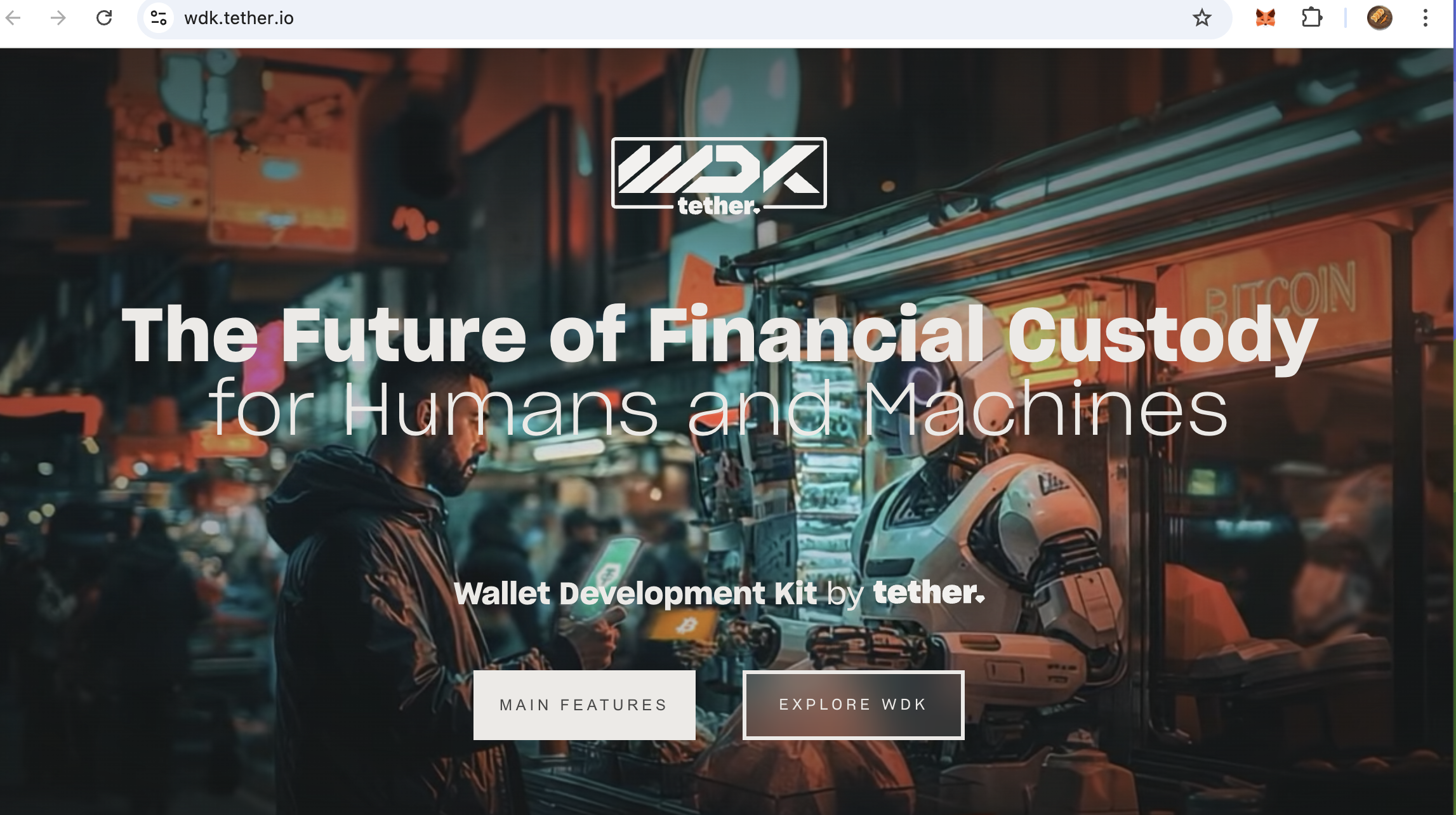
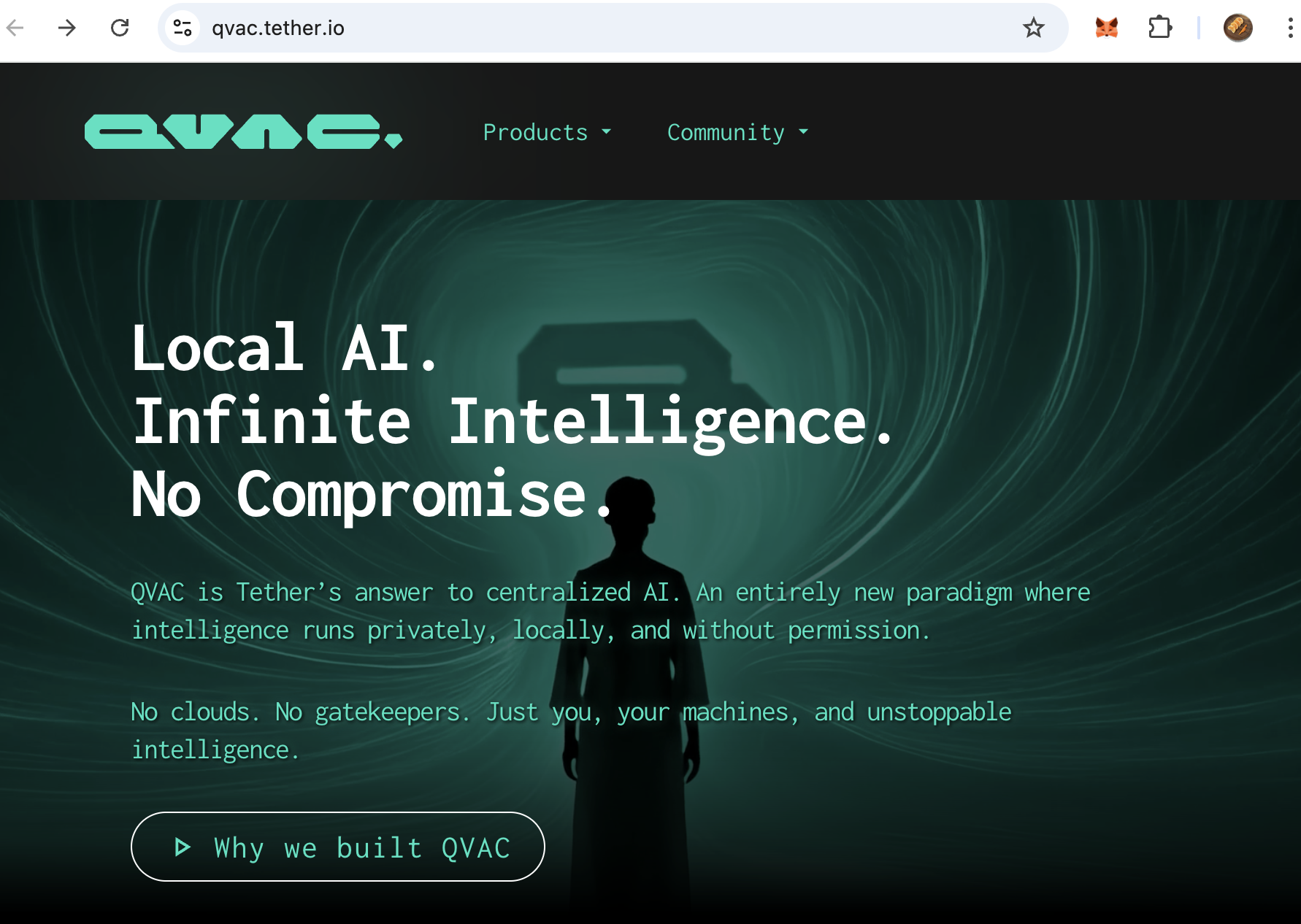
If Tether is understood merely as a stablecoin company, this page seems somewhat "cross-disciplinary." So, I followed the WDK further and found QVAC (local AI runtime) and the training datasets they released. Expanding further, I discovered they also bound a computing power link through Northern Data/Rumble and invested in cross-chain interoperability and embodied intelligence. The information was scattered across different websites, press releases, and announcements, so I first organized them into a panoramic view, and then I will dissect the underlying structure layer by layer.
Panoramic view of Tether AI related layout
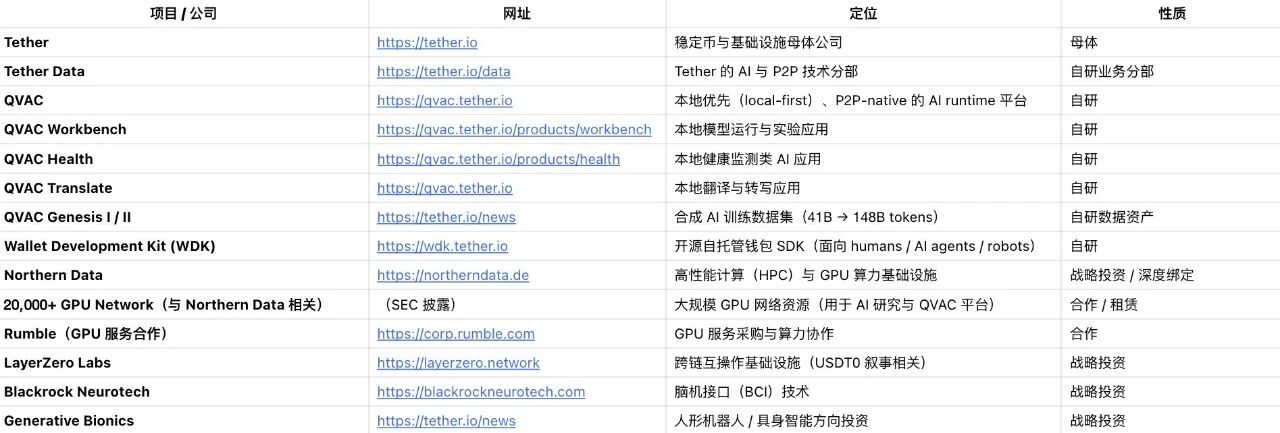
If we decompose the previous panoramic view by layers, a layered structure can be seen:

This six-layer structure forms a bottom-up construction process: USDT provides asset foundation → WDK allows assets to be embedded in applications and Agents → QVAC enables Agents to run locally → Genesis data supports model training → GPU network provides computational support → cross-chain and embodied intelligence extend the system boundaries. This is a layered experiment, not a single-point product innovation.
These six layers do not necessarily form a closed loop. But they at least constitute a clear architectural diagram. The question is — is this a set of decentralized technical layouts or an ongoing infrastructure experiment?
1. USDT, Computing Power, and Agents -- How a Network is Built
Previously, we saw a layered structure. The asset layer, settlement interface layer, operation layer, data layer, and computing power layer exist separately, but layering itself does not imply the establishment of a system.
The real question is: do USDT, computing power, and Agents begin to form a mutually dependent relationship? If they are merely parallel layouts — stablecoins continue to be issued, computing power continues to be invested, and AI projects develop independently — then this is just horizontal expansion. But if the three are prerequisites for one another, a network will emerge.
First is the asset. USDT itself does not create productivity; it provides settlement capability. In the traditional system, the economic entity is humans, and assets exist based on bank accounts. However, if in the future, production entities partially shift to machines and Agents, the form of assets must meet new conditions: programmable, embeddable in systems, no need for bank accounts, globally mobile. Stablecoins technically satisfy these conditions. But assets only become part of the network when they are frequently called upon. This introduces the second variable.
Next is computing power. Computing power is not a financial tool; it is a source of productivity. The operation, inference, and training of models rely on computational resources. Without computing power, Agents cannot run continuously. Without continuous operation, economic behavior cannot occur. Computing power itself does not belong to the financial system, but when value creation comes from algorithms, computing power becomes the physical foundation of economic activities. If the asset layer and productivity layer are not connected, they are merely two parallel worlds. What connects them are behavioral subjects.
Finally, there are Agents. Agents are the nodes in this network. They consume computing power, produce actions, and trigger settlement when an Agent calls a model, completes a task, and triggers payment, at which point the asset and computing power truly form a closed loop. Without Agents, computing power is just a technical resource. Without assets, actions cannot be settled. Without computing power, Agents cannot operate. The relationship among the three is not parallel but dependent. If we abstract this network into a path, it can be simplified as:
Computing Power → supports model operation
Model → drives Agent behavior
Agent → triggers asset settlement
Asset → feeds back to the system
When this path occurs frequently, a machine economic structure will emerge. If it only happens occasionally, this structure will not truly establish itself. This means the question is no longer whether Tether has layouted in AI. Instead, it is: do productivity, production entities, and production relations begin to reconnect around Agents?
If we push this question further down, we will find it extends beyond a strategic choice at the company level. It involves a reallocation of productivity and production relations.
2. AI and Web3: Division of Productivity and Production Relations
In the past few years, when discussing the intersection of AI and Web3, a general statement often arises: AI releases productivity, and Web3 reconstructs production relations. This statement is not a strict theoretical proposition, but as a structural observation, it has explanatory power. If we abstract that network from the first section, we can see a clear division of labor.
AI enhances productivity. The core role of AI lies in efficiency. Models reduce the marginal cost of content production, code writing, and decision analysis. The combination of computing power and algorithms greatly expands the scope of automated execution. From an economic perspective, this belongs to the enhancement of productivity — the ability to create value in a unit of time increases. Repetitive labor is replaced by machines. High-frequency decisions are made by algorithms. In this sense: computing power is the new production equipment. The model is the new tool system. Agents are the new executing subjects.
When Agents can run continuously, make consistent decisions, and take continuous actions, they are no longer just software tools but begin to possess the characteristics of economic participants. However, the enhancement of productivity will not automatically change the economic structure. Efficiency can improve, and rules can remain unchanged. The issue lies in whether the production relations still fit when the production entities change.
Web3 provides a new framework for production relations. The efficiency determined by production relations is not the main concern; rather, it is about the participation rules. Who can own assets, who can enter the network, and who can complete settlements? The traditional financial system is built on the identities of humans and bank accounts. Accounts depend on national identity, and assets depend on legal entities. But machines have no nationality. Agents do not have natural person identities. Models cannot sign contracts.
When productivity expands to the machine level, while production relations remain in the human account system, structural misalignment will occur. What Web3 offers is not a faster payment experience but programmable assets and embeddable settlement rules.
Stablecoins allow assets to exist independently of bank accounts. On-chain settlements allow rules to be executed in code form. Embedded wallets make assets a part of the internal logic of systems rather than external interfaces. In this framework: computing power represents productivity. USDT represents production relations. Agents represent production entities. When the three begin to appear simultaneously, the question is no longer "whether to do AI", but: whether productivity and production relations are starting to realign around machine entities.
This division of labor is not a given fact. There is only one condition for it to establish: will Agents become real economic participants? If AI remains merely a human tool, traditional production relations can continue to support it. If machines begin to independently complete high-frequency economic activities, the structures of assets and settlements must adapt. This is also the key coordinate for understanding Tether's experiment. It does not necessarily build the strongest models. But it is testing whether a structure can possibly be established.
3. What is Tether's AI Financial Experiment Actually Doing
Tether's layout is not concentrated in a single lane. It does not attempt to be the largest model company, nor does it directly enter the consumer-level AI application competition. It is more like testing a hypothesis about infrastructure: if machines become economic entities, does the financial structure need to be rewritten?
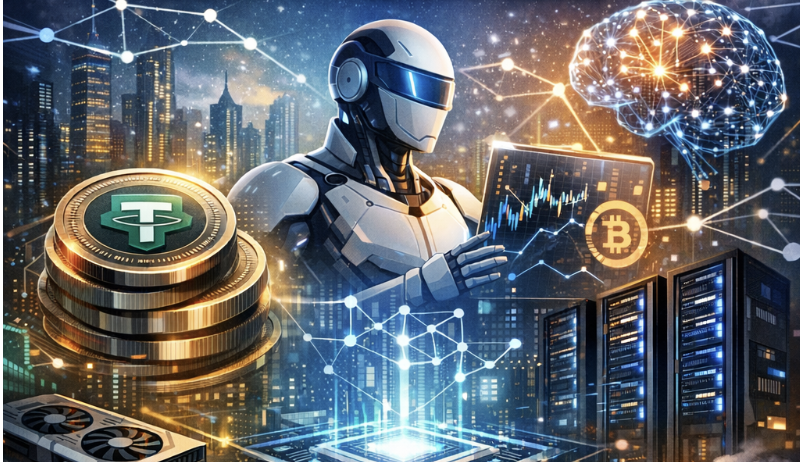
From the current layout, this experiment contains validation on at least three levels.
1. Can machines become asset holders? The traditional financial system's default premise is: economic entities are humans or legal persons. However, stablecoins and embedded wallets provide another possibility — assets can exist independently of bank accounts, accounts can be embedded within the system, and settlements can be triggered by programs. If Agents can directly hold, call, and settle stablecoins, machines then possess asset participation capabilities for the first time. This does not mean the machine possesses legal entity status, but it indicates that machines can become nodes for executing economic behaviors. This is an experiment on the level of production relations.
2. Will computing power become part of the financial structure? In traditional systems, financial infrastructure is built around capital, banks, and clearing systems. Computing power is not a financial variable. But when value creation comes from model inference and algorithm execution, computing power becomes the physical foundation of production activities. Through the layout with Northern Data and GPU networks, Tether is actually attempting a vertical integration — incorporating productivity and settlement capabilities into the same structure. If the AI economy scales in the future, computing power may no longer just be a technical resource but become part of the financial structure. This is an experiment on the level of productivity.
3. Can Agents form high-frequency economic behaviors? The core variable of this experiment is not the scale of computing power, nor is it the market value of stablecoins. Rather, it is: will a large number of autonomously operating Agents emerge, producing high-frequency, settleable economic behaviors? Only when the following conditions are met simultaneously will the network be established: Agents run continuously, Agents trigger real value exchange, settlement is completed on-chain, and this process has scalability and high frequency.
If Agents are merely auxiliary tools or if all economic activities are still triggered by humans, then this structure will not form a true closed loop. This is also the most uncertain part of the entire experiment. This is a structural experiment; from an external perspective, these layouts are scattered across multiple domains: stablecoins, computing power, AI runtime, data, and cross-chain. But from a structural perspective, they point to the same question: will the machine economy become a real economic form? If the answer is negative, this is merely a diversified layout. If the answer is affirmative, then it is paving the interfaces for financial infrastructure in the machine era ahead of time. This experiment currently has no results. However, it at least poses a direction worth observing: when production entities begin to change, will finance change along with it?
Conclusion: An Unfinished Experiment
The real issue Tether faces is not whether to "venture into AI." But whether to participate in an experiment regarding the future financial structure. Computing power represents productivity, USDT provides asset and settlement interfaces, and Agents may become new production entities. Whether these three will form a stable closed loop is still unknown.
Stablecoins are already mature. Computing power is expanding. Large models are being embedded into more and more systems and devices. The real uncertainty lies in whether the production entities will change.
If AI remains just a tool for humans, the traditional financial system can continue to support it. If Agents begin to participate continuously and frequently in economic activities, then the financial structure must adapt to machine entities. As models gradually become infrastructure, the way humans interact with systems is changing. More and more behaviors are no longer triggered one by one by humans but are automatically completed by algorithms. This does not mean machines replace humans. But it means machines are beginning to take on part of the economic execution rights. In light of this possibility, Tether’s layout resembles advance preparation. It may not be constructing a complete AI financial system. But it is testing whether the financial interface needs to be rewritten when production entities change.
This experiment does not yet have an answer.
免责声明:本文章仅代表作者个人观点,不代表本平台的立场和观点。本文章仅供信息分享,不构成对任何人的任何投资建议。用户与作者之间的任何争议,与本平台无关。如网页中刊载的文章或图片涉及侵权,请提供相关的权利证明和身份证明发送邮件到support@aicoin.com,本平台相关工作人员将会进行核查。


