No money, no money, still no money! Sell-off, sell-off, still sell-off!! Rebound or reversal??
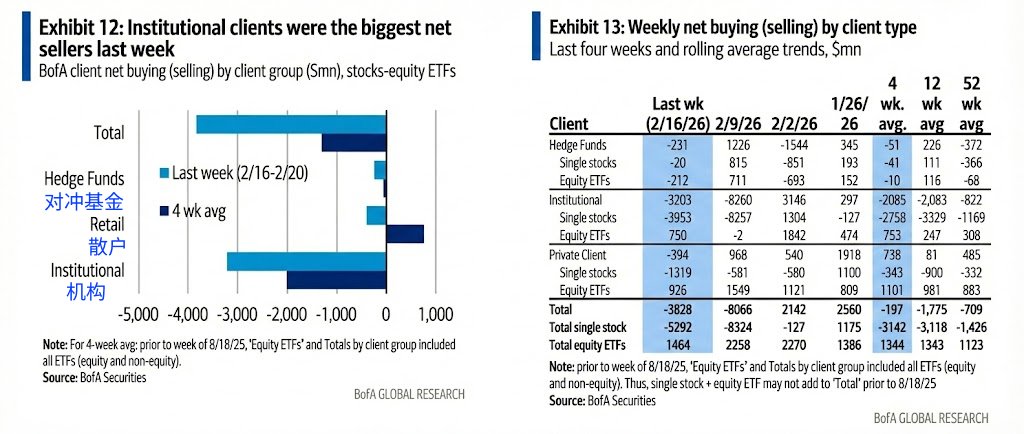
The latest customer fund flow data from American Bank updated weekly for February 16 to February 20 is basically consistent with last week's judgment, but the situation has not improved; instead, it has worsened.
Last week, while institutional users were selling, retail investors and hedge funds still showed a desire to buy. However, this week it is obvious that although institutional selling has weakened, hedge funds and retail investors have also been selling. Except for the average buying of retail investors in the last four weeks, everything else has been sell-offs.
More critically, although institutions are not selling as aggressively this week as last week, the overall sell-off is likely due to a decline in the overall market's risk appetite. Even hedge funds, which typically love trading volatility, have begun to take the sell-side position, indicating that the market structure has gradually shifted from "institutions selling, retail picking up" to "everyone is selling."
This week's structure among institutions is also very typical; selling of individual stocks is very obvious, but ETFs are showing net buying. From my personal perspective, the bought ETFs are most likely index ETFs like the S&P and NASDAQ. This does not indicate that the market is bullish; rather, investors are choosing to lower their risk appetite.
This means switching individual stock risks for a more liquid and diversified ETF risk exposure. Institutions are not increasing positions in risk assets but are shifting to indices. Compared to individual stocks, investors are starting to bet on the larger market, likely because index ETFs have better liquidity, lower impact costs, and are easier to exit when needed. The exit from individual stocks aligns with our previous statement that institutions are out of money and can no longer push individual stocks higher.
Previously, it was institutions offloading, retail buying, but now even retail investors are no longer picking up, and hedge funds are starting to exit. Investors feel very pessimistic about the current environment; if the stock market is like this, one can only imagine how much worse it is for cryptocurrencies and $BTC, even harsher, with lower liquidity.
Moreover, even with ETFs being bought, it does not change the fact that overall funds are still net flowing out. The total amount is still flowing out, indicating that the “money” in the market has not returned; at most, funds have only been transferred from higher risk to lower risk.
For risk assets, this means two things:
First, there may be a short-term rebound, but the height will be limited. Because institutions are selling individual stocks and buying indices, they are essentially managing risk rather than driving direction; what is still lacking in the market is new incremental funds willing to leverage. In other words, liquidity is still insufficient.
Second, the structure will become increasingly differentiated. While the overall market may not look so bad, small and mid-cap stocks, theme stocks, and high-volatility assets will feel more pain, as they correspond to the part of risk exposure that institutions cut first. Bitcoin is also within this scope.
This is why I have always emphasized that “no money” is the core issue. It’s not that everyone suddenly gave up, but that liquidity is too poor, and investor cash positions are still very low. Institutions need to control drawdowns while also ensuring liquidity, so the result is naturally continued sales, continued contraction, and continued risk reduction until capital or liquidity is replenished.
Some might ask, didn’t the market rise very well yesterday? Doesn’t this mean the market should reverse? It is important to know that today’s Bitcoin and yesterday’s Bitcoin are essentially the same, and market liquidity will not fundamentally change because of $CRCL's earnings report; it’s more likely a rebound driven by sentiment and suppressed low prices.
Of course, Nvidia's good earnings report may continue to drive tech stocks up, and $BTC, which has a high correlation with tech stocks, should also have an opportunity to rise. However, whether it is CRCL or Nvidia, what they bring is more of a sentiment improvement, a continued frenzy about AI, while what BTC and cryptocurrencies need is still tangible liquidity; they still need more easing from the Federal Reserve.
Therefore, before this funding structure changes, I do not expect the market to reverse on its own merely based on sentiment. What genuinely changes the rhythm are monetary policy and interest rate reduction pathways, which provide an opportunity for liquidity to return. Otherwise, even if retail investors want to step in, they cannot absorb the size of institutions, and retail buying could become the liquidity exit for institutions.
PS: Because the data from American Bank has a lag, what we see is already occurred; the current data will not be available until next week, but this data still tells us that institutions have no money, investors have no money, and everyone is selling. Short-term, at most, there will be a rebound, but the probability of reversal is low, and reversal will still require waiting for signals from monetary policy.
@bitget VIP, lower fees, better benefits
免责声明:本文章仅代表作者个人观点,不代表本平台的立场和观点。本文章仅供信息分享,不构成对任何人的任何投资建议。用户与作者之间的任何争议,与本平台无关。如网页中刊载的文章或图片涉及侵权,请提供相关的权利证明和身份证明发送邮件到support@aicoin.com,本平台相关工作人员将会进行核查。


