Written by: Nishil Jain
Translated by: Block unicorn
Introduction
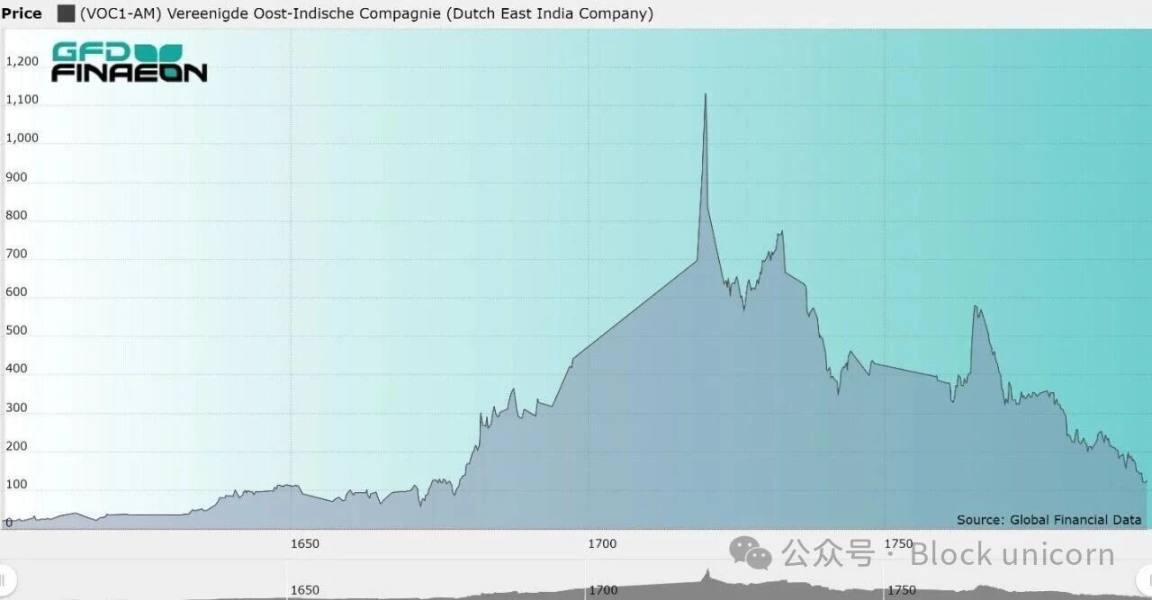
In 1602, the Dutch East India Company introduced the limited liability company, completely changing everything. It invented a way of financing where holding shares allowed one to profit from the company's profits. This separated ownership of the company from its actual management.
Today, we can clearly see the division of power in large publicly traded companies like Microsoft or Apple. Shareholders hold a share of the company's assets and profits; board members approve budgets on behalf of the shareholders; while the CEO is responsible for the company's day-to-day operations.
However, this structure took decades to form. Before companies existed, if you wanted to trade spices in India, you had to personally build an entire ship out of your own pocket. If the ship sank, you would go bankrupt. Creditors could even seize your house or send you to prison.
In 1602, the Dutch East India Company changed the investment landscape. Investors no longer funded single voyages but instead bought "shares" of the company itself. This created the limited liability system: if the company went bankrupt, you would only lose the money you invested. Your home and belongings would remain safe.
At that time, there were no written laws to protect investors' interests. Thus, as railroads spread around the world and companies grew larger, "corporate raiders" and "robber barons" emerged. They often deceived investors, printed false stocks, and even misappropriated corporate funds for personal use. Shareholders ultimately suffered losses while company owners lived in lavish mansions.
This led to distrust among shareholders and a stock market crash. The stock market crash of 1929 was a turning point. Governments realized that if people did not trust the financial system, the economy would collapse. This led to the creation of the U.S. Securities and Exchange Commission (SEC) and the establishment of modern fiduciary duty systems.
Today, rules are in place to protect you.
Transparency: Public companies must release audited financial statements annually (10-K).
Anti-fraud: Lying to shareholders to inflate stock prices is a federal crime.
Assessment rights: If a company is sold at an unusually low price, shareholders can sue for the "fair value" of their shares.
Did Aave really hide 10 million dollars?
On-chain governance is currently at some stage between 19th-century corporate fraud and legal protection of shareholder rights.
Particularly within Aave DAO, participants are engaged in ongoing discussions and proposals trying to answer questions that on-chain DAOs have never been able to address: Who owns the protocol, and who controls it?
Theoretically, this is a simple question, but coordinating people with different interests often complicates straightforward matters.
The trigger for the Aave governance debate was a sum worth 10 million dollars. For years, Aave DAO and Aave Labs maintained a coexisting understanding. The DAO provided funding for the protocol, while Labs were responsible for building the interface.
However, this peace was shattered in December 2025 when members of the DAO realized that the 10 million annual swap fees that should have gone to the DAO treasury had suddenly been transferred to a private wallet of Aave Labs.
Prior to that, Labs had replaced ParaSwap with CoW Swap on the official Aave front end, leading to a change in the value accumulation mechanism from ParaSwap referral fees to CoW Swap front-end fees.
Essentially, interface fees have always been the most obvious profit-making option for teams utilizing the underlying protocol — as can be seen from Uniswap Labs and now Aave Labs.
If a team is perceived to exploit public resources (user liquidity) for profit without rewarding users, it can harm token holders' view of that entity. Token prices can plummet overnight as users have no reason to continue holding them.
Conversely, a team that continually sells its governance tokens to incentivize developers and manage its operating expenses indicates its willingness to relinquish control of the protocol in exchange for a longer operational cycle.
This disconnect between governance rights and incentive mechanisms is precisely why interface fees have become popular in significantly scaled-up protocols.
The technical reasoning from Labs is that since they developed the front end, they should retain the front-end revenue. But no one had formally defined this boundary before. Token holders have always believed that all intellectual property and brand value of Aave, along with the associated interface revenues, belong to the DAO. Labs believed that operating the interface was their responsibility. Surprisingly, these two assumptions coexisted for several years.
By the end of December, DAO members proposed two proposals. One from the former CTO of Aave Labs, Ernesto Boado. He suggested transferring intellectual property and brand ownership to the DAO and allocating all profits received; while Stani presented a vision roadmap for Aave, implying the necessity of maintaining the existing power structure.
Five days after Boado proposed, Aave Labs upgraded it to a snapshot version without his knowledge or consent and scheduled voting from December 22 to 25, with voting concluding on Christmas Day. Boado publicly condemned this action and urged supporters to abstain. The voting ultimately ended with 55% opposition and 41% abstentions — only 4% voted in favor. By this point, the price of AAVE had already dropped by 25%, evaporating approximately 500 million dollars in market value.
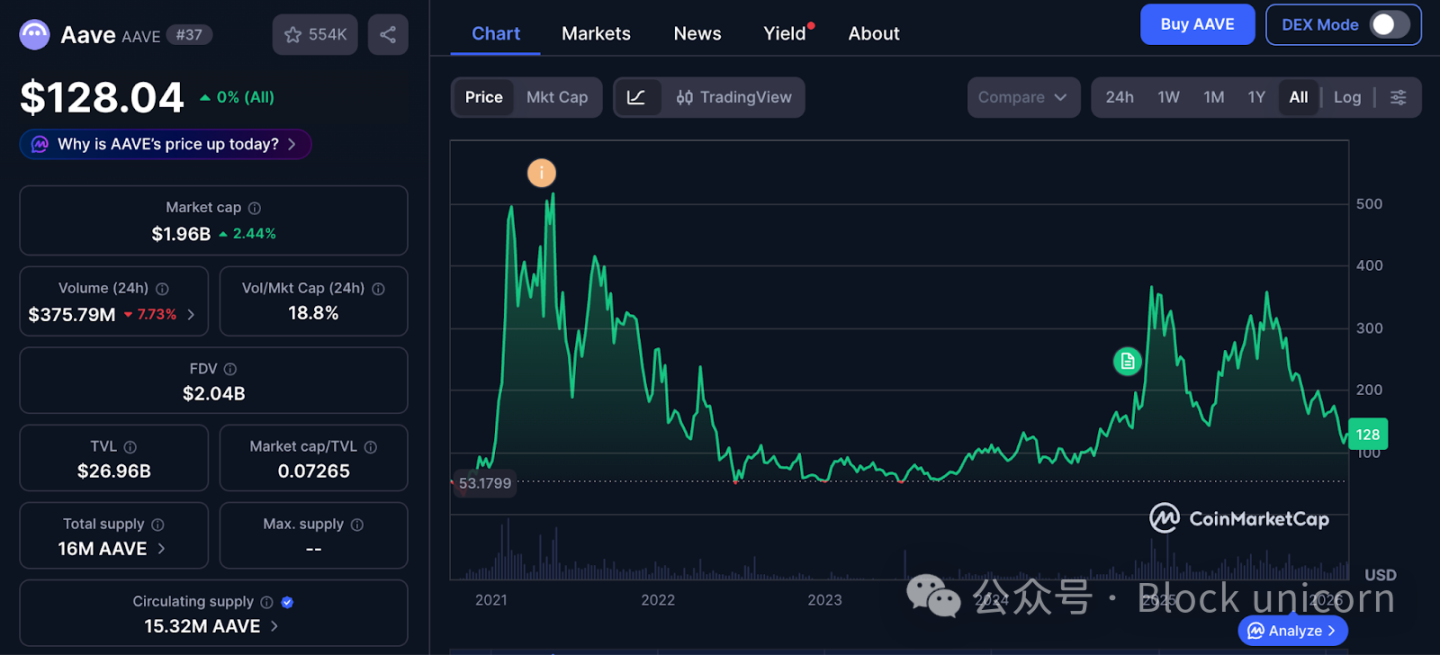
Price fluctuations are caused by the uncertainty of the underlying token's value. If Stani and his team could influence the DAO, then what is the real value of that token?
The Aave protocol has developed into a project worth 2 billion dollars but has failed to answer some fundamental questions. Does the DAO own the Aave brand? Do Labs serve the token holders, or do they work with them?
Both sides have valid arguments. Labs built the interface and have dealt with a four-year investigation by the SEC while bearing ongoing operating costs. Token holders funded development work, paid for rebranding, and provided liquidity that added value to the brand. The protocol is open source; anyone can build a similar interface. But users choose aave.com due to the brand recognition helped by the DAO.
The issue is that both positions are fundamentally aligned. Traditional corporate law has spent decades building a framework to address the dilemma of ownership and control. DeFi has skipped this process, and the governance collapse we observe now is exactly the price we pay for it.
Different protocols are trying to solve the same fundamental issue using different methods.
The Governance Problem in DeFi
Hyperliquid directly eliminated governance issues. 97% of transaction fees are directly used for HYPE token buybacks through an aid fund. For over a year, the protocol has completed more than 700 million dollars in token buybacks. At the same time, the team has complete operational autonomy. The codebase is closed-source. The buyback mechanism is not regulated by the DAO.
However, token holders do not need to trust the intentions of management, because the value-sharing mechanism is encoded into the protocol itself. While token holders do not participate in the governance strategy formulation or own the underlying protocol, they can automatically benefit from the platform's growth, and this mechanism currently seems to work well.
Uniswap has also faced many setbacks. The team spent five years avoiding the issue of alignment of interests among token holders. Although the fee switch mechanism has been present in the codebase since 2020, it was never truly activated.
The "UNIfication" proposal in December 2025 addressed this ambiguity: 100% of protocol fees are now directed towards burning UNI, Labs waived their interface fees, and they retroactively burned 100 million UNI to make up for missed value accumulation over the years.
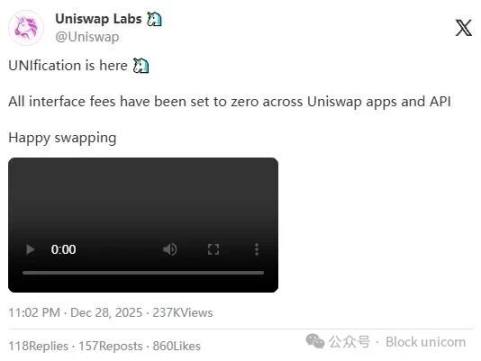
Uniswap Labs owns the brand and intellectual property and is responsible for product development; meanwhile, the DAO owns the smart contracts and controls the revenue and underlying funds.
Jupiter attempted community governance from mid-2024 to mid-2025, but ultimately the team decided to pause. For months, debates about airdrop allocations and team fund distribution led to a suspension of DAO voting in mid-2025, citing "trust collapse" and a "continuous cycle of FUD (fear, uncertainty, and doubt)" hindering product development.
The "Green Transition" framework for 2026 narrowed the scope of community decision-making while implementing a token-holder-friendly economic model through net-zero emissions and reduced dilution. This aligns with the direction of Hyperliquid, where token holders can benefit from the protocol's earnings, but the brand ownership and control remain with the team.
Most of these teams pursue alignment of economic interests with token holders while the ownership and control of the interface still belong to the protocol team.
Will Aave (Labs) Prevail?
The "Aave Will Win" framework released by Aave in February 2026 seeks to carve out a more forward-looking path — balancing economic benefits based on brand intellectual property. The protocol promises that all revenue — including product revenue, transaction fees, interface revenue, and institutional services income — will flow into the DAO's treasury.
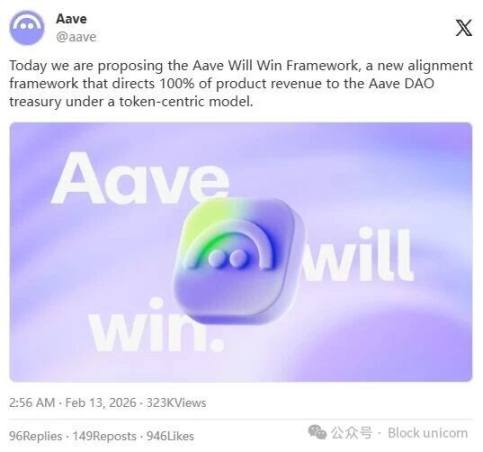
In exchange, Labs will receive 42.5 million dollars in stablecoins (25 million dollars for initial funding, 17.5 million dollars for milestone payments), 75,000 AAVE tokens, and authorization to develop V4. Meanwhile, the Aave Foundation will hold the brand intellectual property and be subject to DAO oversight.
DAO members see this as a costly move, and their concerns are not unfounded. The amount raised through stablecoins alone accounts for 42% of the DAO's non-AAVE reserves. The total raised amount of approximately 50.7 million dollars constitutes 31.5% of the entire treasury. Additionally, the 75,000 AAVE tokens will increase Labs' voting power, although the specific share remains unknown.
Aside from funding sources, the proposal is vague regarding the ownership structure of the Aave Foundation and whether it has independent decision-making power from Labs. Even the 100% revenue distribution remains unclear and assumes that all parties trust Labs to provide accurate and complete revenue information.
In summary, this proposal reflects significant trust in Aave Labs. Given the series of events leading to it, trust is becoming increasingly scarce in the relationship between the DAO and Labs.
The reasonableness of the proposal depends on the value proposition that governance tokens were meant to provide. If its value proposition is "trust-based fairness," then Aave's framework can achieve that.
If the value proposition is "achieving community control over the protocol's intellectual property through enforcement measures, thereby achieving fairness," then that framework falls short of the goal.
Looking Ahead
A trend forming within DeFi protocols is that the manner in which economic interests are realized is changing, with token holders' main interest no longer being governance rights, but the way economic benefits are realized.
Hyperliquid's buyback, Uniswap's fee-burning mechanism, Jupiter's pause on governance while maintaining economic consistency, and Aave's proposed trust-based income redirection scheme — each represents a shift from active governance to passive value accumulation.
This is reminiscent of traditional corporate governance models. Shareholders do not directly run the company but elect a board to vote on significant transactions. At the same time, they can receive dividends, and if they disagree with management, they can sell their shares. Operational control always remains in the hands of management.
The evolution of corporate law into this separation was due to the alternative of shareholders making operational decisions being infeasible beyond small partnerships.
DeFi is shortening the traditional timeline.
The question is whether the DAO model can withstand the test of ownership issues, as it must answer questions it has been avoiding since its inception. Aave is drafting the first draft of that answer.
免责声明:本文章仅代表作者个人观点,不代表本平台的立场和观点。本文章仅供信息分享,不构成对任何人的任何投资建议。用户与作者之间的任何争议,与本平台无关。如网页中刊载的文章或图片涉及侵权,请提供相关的权利证明和身份证明发送邮件到support@aicoin.com,本平台相关工作人员将会进行核查。


