Tariffs are torn apart: Why did Bitcoin surge first and then hesitate?

CN
3 hours ago

On February 20, 2026, in the Eastern Standard Time Zone, the U.S. Supreme Court ruled to cancel a package of tariff measures from the Trump administration with a vote of 6 to 3. This institutional confrontation between the highest judicial authority and key figures of the previous executive power quickly became the focus of global financial and political discourse. After the ruling was announced, the price of Bitcoin surged in a short period, with data from a single source indicating a rapid increase of about 2%, briefly breaking above 68,000 USD, before retreating to around 67,000 USD within a few hours. The judicial rejection of executive power was not limited to legal and political realms, but swiftly transmitted to the crypto market through the chain of “inflation expectations - dollar assets - risk assets,” becoming a typical case of a macro event triggering synchronized testing of Bitcoin's sentiment and price.

Tariffs Overturned: Political Weight under a $130 Billion Cloud

● The tariffs themselves are not only a tool of U.S. economic policy but also an important symbol of Trump's political brand, representing his narrative of “hardline abroad and manufacturing return domestically.” Therefore, being overturned by the Supreme Court with a ruling of 6 to 3 signifies a systemic denial of the previous administration's policies, carrying political weight far beyond a typical trade dispute, effectively slamming the brakes on global trade and U.S. foreign strategy.

● In market discourse, there have been claims that “the ruling may compel the refund of 130 to 200 billion USD in tariffs” (to be verified/@CryptoPulse). If traders view this numerical range as a signal for potential liquidity release, it could easily be interpreted as a medium- to long-term positive expectation for global trade and corporate profits. Although there are currently no authoritative channels confirming the scale and timeline, the very notion of “not excluding large refunds” can provide the fuel for short-term speculative trading.

● Vice President Vance reportedly described the ruling on social media as “lawless” (to be verified/@Cointelegraph). This public condemnation from high-ranking officials within the administration amplified perceptions of the rift between the judiciary and the executive, quickly escalating what could have been seen as a technical trade dispute into a power confrontation event. In interpretations from within the crypto community, it is more easily reconstructed as a risk signal indicating “rising uncertainty within the system.”

Surge and Retreat within Two Hours: Bitcoin's News Trading Trajectory

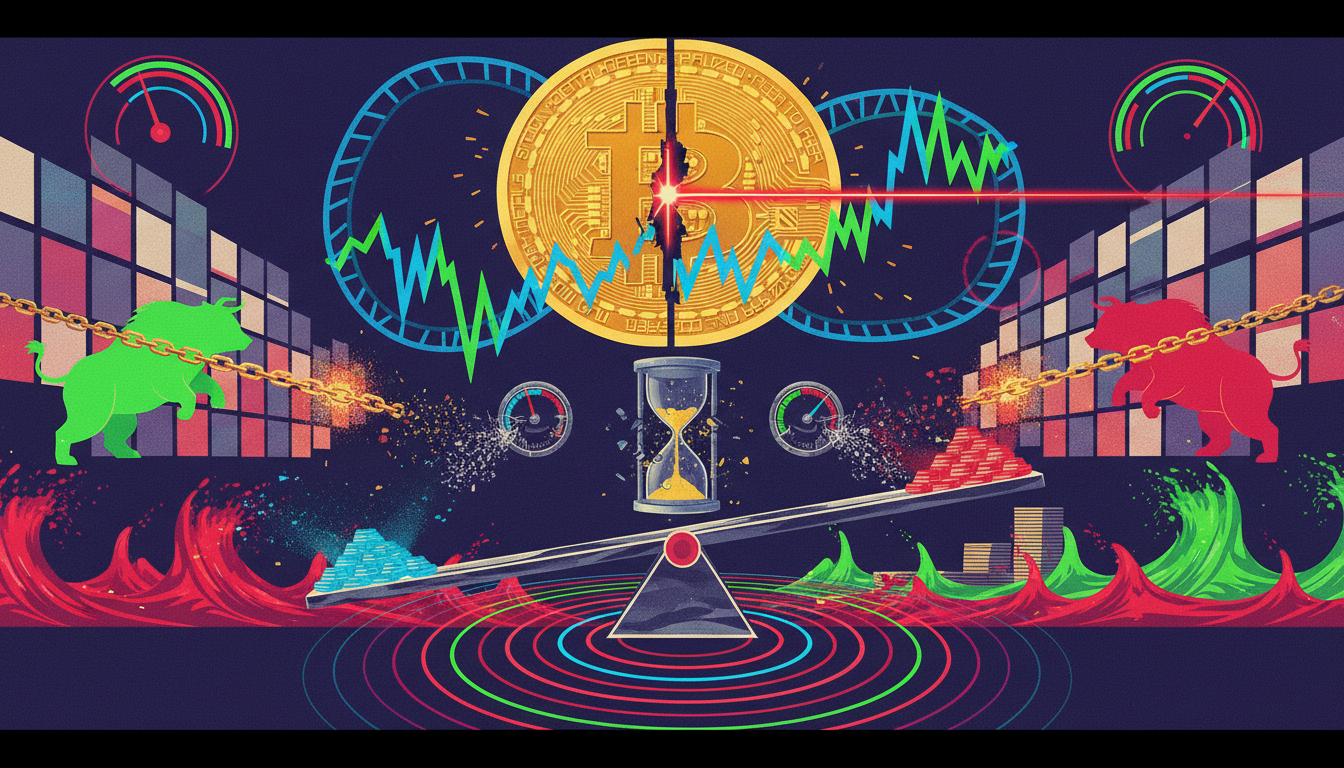
● Retracing the timeline, after the Supreme Court announced the 6 to 3 vote to negate Trump’s tariffs on February 20, Bitcoin's price accelerated upward in the brief window following the news, with single-source data showing a quick surge of about 2%, peaking above the 68,000 USD mark. Subsequently, both bulls and bears engaged in a standoff at the high levels, and the price failed to stabilize effectively, quickly retracing most of the gains and settling around 67,000 USD, forming a short-term price structure resembling an “upper shadow.”

● This rhythm of moving from the news release to a swift peak and then having most of those gains erased resembles a typical “news trade” rather than a trend reversal: certain liquidity positions price in risks and changes in expectations ahead of time during macro events, but face profit-taking and waiting pressure after prices break critical levels, leading to price movements primarily driven by sentiment and technical levels rather than systemic shifts due to long-term funding structures and fundamental understandings.

● Due to the current lack of public information regarding transaction volume, settlement scale, implied volatility of options, and other specific data, it is impossible to accurately assess whether the recent surge and retreat stem from emotional gaming among existing chips or from a large inflow and outflow of new leveraged funds. We can only cautiously categorize it based on price patterns and amplitudes as a limited-intensity event-driven fluctuation rather than a high-certainty trend starting point.

From Tariffs to Coin Prices: How Traditional Impacts Reflect on the Chain

● For some macro traders, the overturning of Trump’s tariffs is first factored into the repricing of inflation and global trade expectations: If high tariff pressures ease, it is expected that global supply chain costs and trade frictions may marginally alleviate, which would construct a positive revision to the medium- to long-term outlook for corporate profits and trade volume. At the same time, divergent views on the strength of the dollar and the U.S. inflation trajectory will emerge, and this renewed discourse on “the future purchasing power of the dollar and the global risk premium” naturally extends into risk asset pricing frameworks, including stocks and Bitcoin.

● When macro and political uncertainties are amplified, Bitcoin is often seen by certain funds as a “decentralized safe haven” experimental allocation tool: on one hand, it is not directly constrained by a single sovereign's fiscal and monetary policies; on the other hand, chain-based assets can serve as alternative risk exposures when cross-border capital flows are restricted or regulatory expectations fluctuate. Therefore, when the judiciary and executive clash intensely over tariffs, short-term funds attempt to hedge against the uncertainty of the institutional pathway by accumulating Bitcoin, which may not be firm but is enough to push prices upward temporarily.

● Since 2026, Bitcoin has repeatedly shown sensitive volatility at nodes such as macro policy statements, unexpected inflation data, and changes in regulatory expectations. While we do not break down each rise and fall, the recurrent scenes of “macro events—immediate Bitcoin reactions” within this year have led the market to gradually view it as an asset class highly sensitive to policy noise. This repeatedly validated transmission mechanism also solidifies the narrative basis for why this tariff ruling was quickly reflected in Bitcoin prices.

Judicial Suppression of the Executive? Decentralized Narratives in Power Struggles

● From an institutional perspective, the Supreme Court's ruling of 6 to 3 to negate Trump’s tariffs is a typical case of judicial checks on executive power within the U.S. constitutional structure: the court, under the guise of constitutional review, effectively limited the executive branch's expansion space in trade and tariff matters. In interpretations within the crypto community, this power struggle within the system is often magnified, viewed as “an instability factor within traditional institutions,” thereby reinforcing discussions about chain-based assets being “outside the system.”

● There are also rumors circulating in the market that “Trump may use alternative legal authority to reinstate tariffs” (to be verified/@Polymarket). If this path materializes, it would mean that policies could undergo a rollercoaster-like reversal of “negation—reinstatement” in a short period, further exacerbating market concerns regarding the boundaries of rules and policy continuity. This expectation of “not excluding a reversal” makes the trading strategies of some risk assets more inclined towards quick trades, naturally positioning Bitcoin as one of the highly elastic targets in this game.

● In the realm of crypto narratives, this tug-of-war between the judiciary and the executive is interpreted as yet another dramatization of Bitcoin’s storyline of “decoupling from traditional power structures”: the rules on the chain are written in code, not in elections or courts. However, from the current price performance, a larger component remains emotional volatility and event-driven dynamics, rather than a deep reassessment of the long-term fundamentals of Bitcoin—such as adoption rates, reserve asset roles, and regulatory frameworks. The one-day fluctuation between 68,000 USD and 67,000 USD resembles a rapidly dissipating emotional pulse.

Safe Haven or Emotional Valve: What This Market Movement Tells Us

The recent short-term surge and subsequent decline triggered by the Supreme Court ruling indicate that at the current stage, Bitcoin acts more like a highly elastic emotional valve under macro political risk impacts: at the moment the news lands, funds elevate prices to release expectations and anxieties, but after emotions settle, prices swiftly return to their previous ranges, rather than being an “ironclad safe haven” that unconditionally attracts one-way flows.

The specific scale and timeline of tariff refunds remain within the realm of unverified rumors in the “130 to 200 billion USD” range, and whether new tariffs will reemerge through alternative legal paths is equally unclear. These massive and ambiguous variables imply that in the coming weeks, macro narratives surrounding inflation, trade, and the dollar's status may continuously reshape market pricing for risk assets. The current round of volatility appears more like a rehearsal than an endgame.

Looking ahead, traders need to continuously track developments on three levels: first, whether Trump and his team attempt to utilize new legal authorizations to restart tariffs; second, whether Congress and the Supreme Court engage in a new round of power boundary disputes and release clearer signals; third, whether Bitcoin can differentiate itself from the “surge and retrace” pattern in the next policy shock and exhibit clearer mid-to-long-term funding entry and pricing logic. Only when price responses are no longer limited to short-term news trading can Bitcoin truly complete its transition from an emotional valve to a stable safe haven and allocation tool.

Join our community to discuss and grow stronger together!
Official Telegram community: https://t.me/aicoincn
AiCoin Chinese Twitter: https://x.com/AiCoinzh

OKX Welfare Group: https://aicoin.com/link/chat?cid=l61eM4owQ
Binance Welfare Group: https://aicoin.com/link/chat?cid=ynr7d1P6Z

免责声明:本文章仅代表作者个人观点,不代表本平台的立场和观点。本文章仅供信息分享,不构成对任何人的任何投资建议。用户与作者之间的任何争议,与本平台无关。如网页中刊载的文章或图片涉及侵权,请提供相关的权利证明和身份证明发送邮件到support@aicoin.com,本平台相关工作人员将会进行核查。

Share To
APP

X

Telegram

Facebook

Reddit

CopyLink