Text | Sleepy.txt
The Spring Festival of 2026 brought a strong sense of déjà vu.
The giants are once again throwing money around during the Spring Festival, with a total amount exceeding 4.5 billion. This figure is more than twice the total subsidies of Didi and Kuaidi during the most insane taxi wars in 2014, nine times the 500 million spent during the WeChat red envelope surprise attack on Pearl Harbor in 2015, and surpasses the peak of Baidu’s lavish 1 billion at the Spring Festival Gala in 2019.
This time, all players are doing the same thing: enabling you to pay with just a single phrase.
This is quite unusual. The payment process has already been effectively resolved with QR codes. Take out your phone, unlock it, open the APP, aim at the QR code, and ding. If you want to make payments even faster, you can swipe a card or tap with NFC. Why are AI companies insisting on using a more complex technology to replace an action that is already sufficiently simple?
What are they really competing for?
To answer this question, we must first discuss an accident that occurred in the winter of 2025.
The Suffocated Doubao Phone
On December 1, 2025, the Doubao phone was launched. It was jointly created by ByteDance and ZTE, ambitious in its aim to become a super AI steward.
In its vision, users no longer need to open any APPs; they simply need to speak to the phone, and the AI can operate everything on their behalf, such as ordering food delivery, booking taxis, transferring money, and reserving flights. It aimed to become the central nervous system unifying all services.
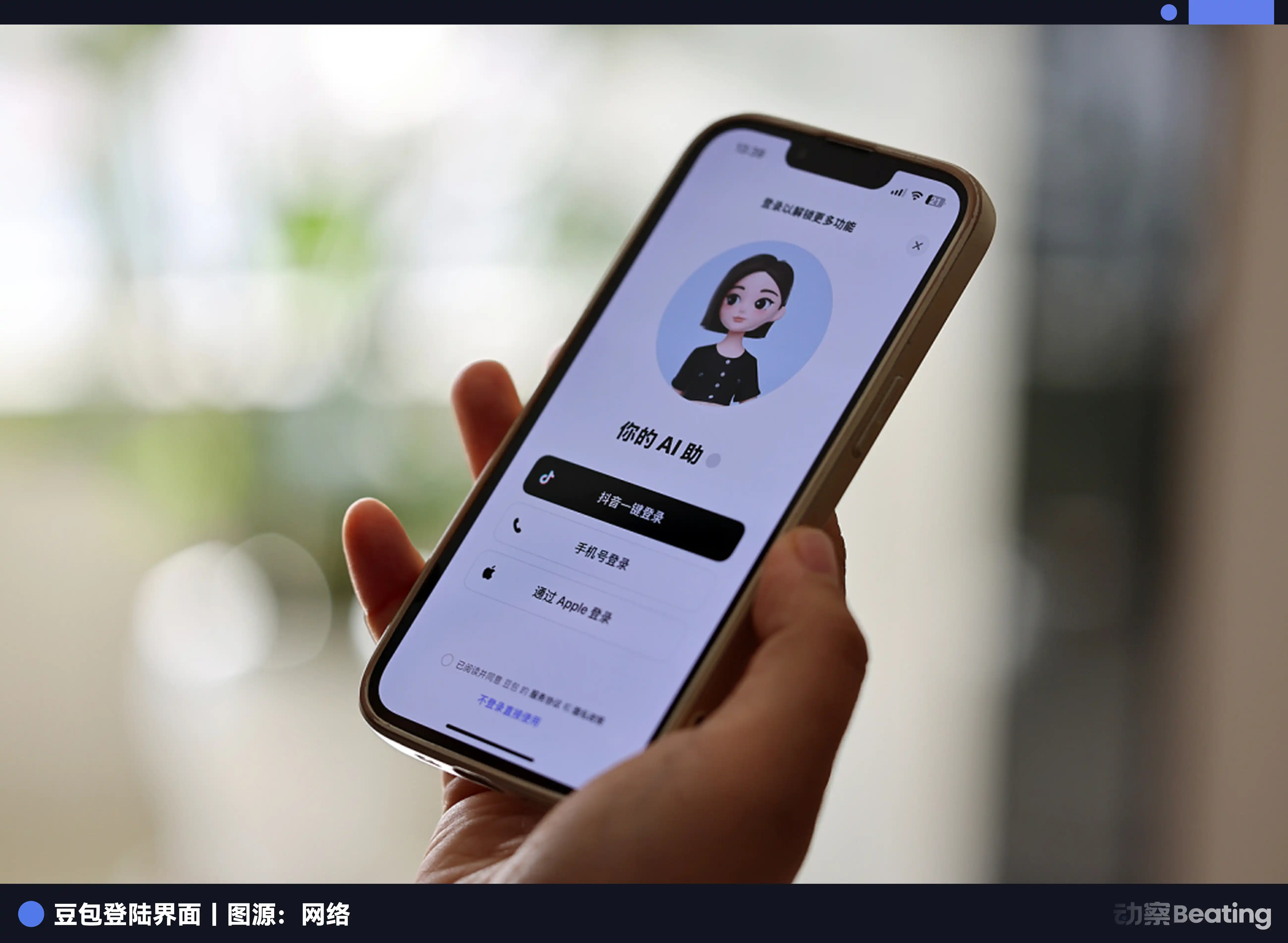
However, a storm soon swept in.
Shortly after its launch, many users reported that when they tried to log into WeChat using the Doubao phone, they received pop-up windows preventing their login, and some accounts were temporarily banned.
Subsequently, Alibaba’s applications collectively began to "deny service." Taobao, Xianyu, and Damai all shut their doors to the Doubao phone.
The flames of conflict spread to the financial sector. Apps from several banks, including China Construction Bank and Agricultural Bank, would pop up security warnings and forcibly exit when detecting the AI assistant of the Doubao phone running.
In just a few days, a highly anticipated AI phone was expelled by the entire internet.
What did the Doubao phone do wrong? It merely aimed to make things more convenient for users; why did it encounter such harsh blockades?
Because it broke a decade-old iron rule: traffic must be closed-looped within my ecosystem.
From the launch of WeChat Pay in 2013 to 2023, China's internet has experienced a golden decade of the super APP era. During these ten years, WeChat, Alipay, Taobao, Meituan, and others built seemingly impenetrable digital empires through fierce land-grabbing campaigns.
They are the public squares of life and also prisons of information. You can enjoy all the conveniences within the castle, but moving things from one place to another? No, that's not allowed.
Taobao's product links still cannot be opened directly in WeChat, and Douyin's videos cannot be shared to Moments; these are the most intuitive manifestations of this digital city wall.
In stark contrast to the fate of the Doubao phone, Alibaba's Qianwen completed 120 million orders calmly over six days during the Spring Festival because it exists within a closed, massive ecosystem.
Qianwen's Privileges and Alibaba's Internal Revolution
During the Spring Festival, every order you place in Qianwen calls upon Alibaba's own troops; food delivery is handled by Ele.me or Taobao Quick Purchase, payments go through Alipay, hotel bookings are managed by Fliggy, and transportation is connected via Amap.
Every step flows seamlessly within Alibaba's vast business system, creating a perfect closed loop.
Alibaba has strung together all its business lines accumulated over the past twenty years—such as e-commerce, payment, logistics, local life, maps, and entertainment—like pearls on a string using AI, creating a unified, seamless super Agent. Users no longer need to jump between Taobao, Fliggy, and Amap; they just need to interact through the single entrance that is Qianwen.
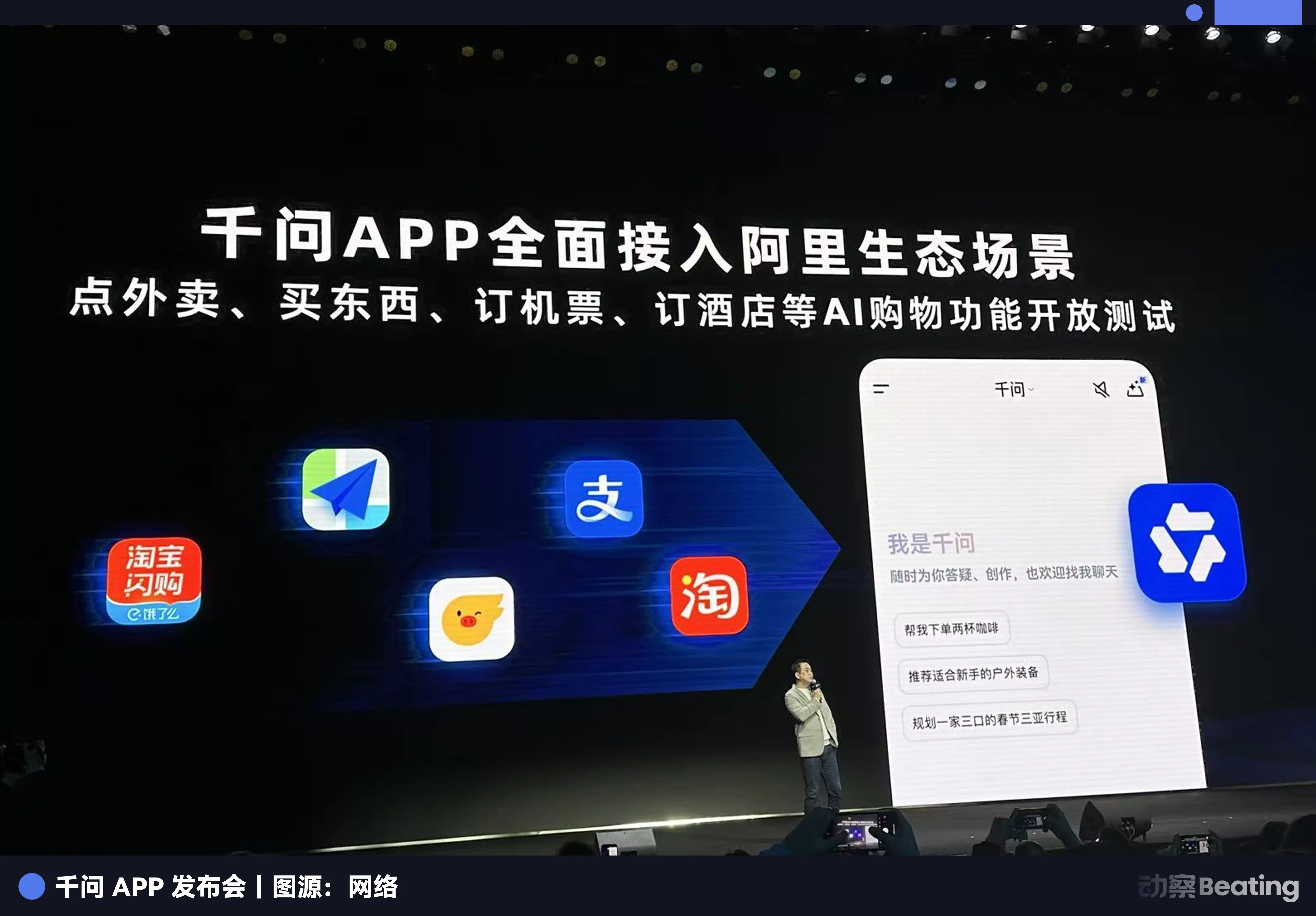
Wu Jia, president of Qianwen's C-end business group, admitted in an interview that Qianwen's unique advantage lies in the combination of its "Qwen strongest model" and "the richest ecosystem of Alibaba."
He also revealed that Qianwen plans to integrate the entire Alibaba ecosystem within six months and will continue to plan for the incorporation of third-party partners in the future.
Note the wording here, "continue planning."
This implies that in the foreseeable future, Qianwen will still prioritize meticulous cultivation within its own territory. The so-called openness is more like a polite phrase written for a distant future.
In contrast to the Doubao and Qianwen, Doubao wanted to horizontally connect, allowing one AI to access all giant services. Qianwen aims for vertical integration, enabling one AI to access all services within its ecosystem.
The former is a challenger, attempting to establish a new order; the latter is a defender, optimizing efficiency within the old order.
This reminds one of the PC internet era of the 1990s. When Netscape tried to challenge Microsoft's operating system dominance, Microsoft killed this former king by bundling the IE browser with Windows.
In the face of absolute ecological advantages, any effort to unify the market may be seen as an ambitious endeavor that must be stifled in the cradle.
So, the question arises: if each giant is developing AI Agents within its own walls, what is the difference between the super APP era ten years ago and now? Is it just a matter of swapping a bunch of APPs for an AI entrance?
From Land Grabbing to Fish Farming
The difference lies in the granularity of competition.
During the super APP era, from 2013 to 2023, the core of competition was land grabbing, seizing users' phone screens and making them live within my APP.
WeChat dominated social, Taobao occupied e-commerce, and Meituan took control of food delivery. Each APP is a digital territory, with users migrating between different domains. The giants are fighting for your time, to keep you as long as possible within their domain.
In the AI era, the core of competition shifts to fish farming, meaning to capture users' "intent" and have them think within my AI.
Users no longer need to open APPs; they simply need to express their intent, and the AI will execute on their behalf. Competition evolves from fighting for usage duration to a more ruthless contest over decision-making power.
Let’s return to the most common scenario: ordering a cup of coffee.
In the past, wanting a cup of coffee required a process that, although fluent, remained cumbersome: unlocking the phone, finding the food delivery APP, opening it, typing "coffee" in the search bar, browsing through a myriad of shop listings, clicking into one, selecting flavors and cup size, adding to the cart, then jumping to the cart page, confirming the product, filling in the address, choosing a payment method, and finally clicking confirm order. The whole process requires dozens of clicks.
Now, you simply need to say to Qianwen: "Help me order my usual Americano."
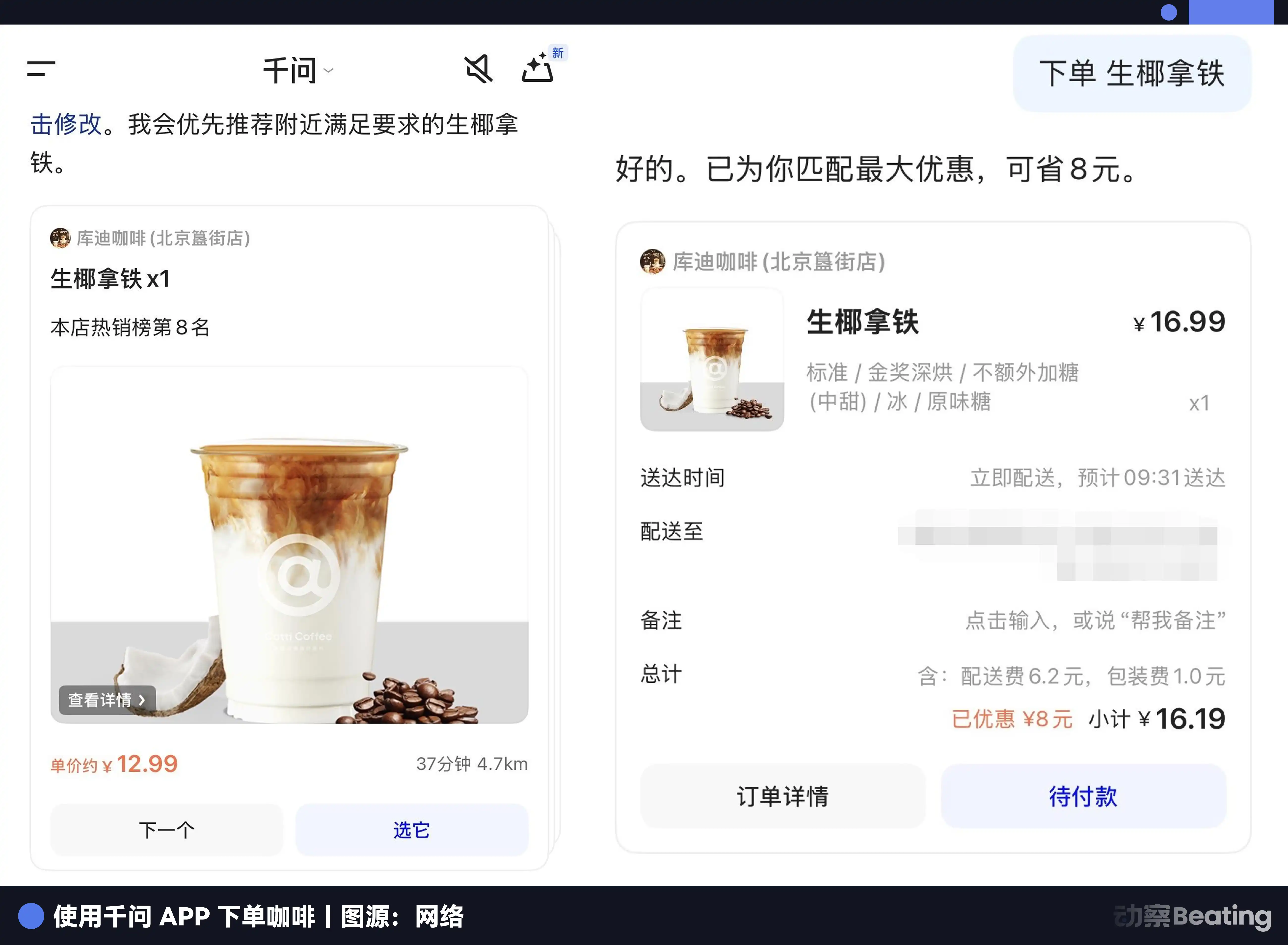
In the following few seconds, the AI will automatically locate your position, recommend your usual brands based on your order history, match the best possible discounts, generate the order, and complete the payment.
You don’t have to do anything; just wait for the coffee to arrive. The difference on the surface lies in steps and time, but fundamentally it is a transfer of decision-making power.
Commercial giants have shifted from enticing you to make decisions to making decisions for you.
In 1937, Nobel Prize winner Ronald Coase posed a fundamental question in his paper "The Nature of the Firm": If the market is the most efficient, why do we still need "firms," which seem bulky?
His answer was: because market transactions have costs, including the costs of finding trading partners, negotiating and signing contracts, and executing and supervising.
A history of commerce is a history of constantly battling with transaction costs. From department stores to chain supermarkets, from e-commerce platforms to mobile payments, each significant leap in business models has occurred because it drastically reduced the transaction costs of a specific link.
The emergence of AI Agents is the first time in history that seeks to compress the transaction costs of all links to nearly zero, especially that most stubborn "decision cost" hidden in our brains.
Pricing Intent
When decision-making power itself can be represented by AI, the endgame of business becomes pricing for users' "intent."
In the past, we paid for products—a cup of coffee for 30 yuan.
Later, we paid for services—food delivery fees of 5 yuan.
In the future, we will pay for "a perfectly satisfied intent"—at 3 PM, when I feel sleepy, enjoying a cup of my favorite flavor at the best price.
What AI sells to you is no longer just a cup of coffee but a perfectly satisfied afternoon.
This seemingly distant future has already begun to take shape during the Spring Festival of 2026. In just six days, users expressed "Qianwen help me" 4.1 billion times, ultimately resulting in 120 million completed orders.
On average, it took 34 expressions of intent to generate 1 transaction. Where did the remaining 33 unsuccessful conversations go? They did not vanish; they were absorbed by the AI as nutrients.
The AI is learning, understanding, and remembering those unmet intents, so it can more accurately capture your desires the next time.
More noteworthy is that 1.56 million senior citizens experienced food delivery services through Qianwen for the first time. Behind this number is a massive group forgotten by the mobile internet era. They struggle with complex APPs and don’t understand intricate coupons, but in the face of "dialogue," the oldest form of human interaction, the technological barrier is instantly leveled.
This is the first time technology has actively bent down to reconnect with those forgotten by the times.
Looking back over the history of commercial development, we can find that it itself has been a history of "intent capturing." From 1990s search engines (Google), to 2000s e-commerce platforms (Taobao), to 2010s super APPs (WeChat), and now to today's AI Agents, every revolution deepens our understanding of human intent.
So, in this battle for intent that is destined to reshape future business forms, where will global players head?
Strategic Division of Two Routes
The global development of AI Agents is evolving along two distinctly different paths. There is no superior or inferior, but strategic choices determined by their respective market structures and historical paths.
The first path is a vertically integrated ecological fortress.
Represented by giants like Alibaba and Tencent, with complete "model + scene + transaction" closed-loop systems, their core logic is to leverage AI to deeply integrate their massive commercial ecosystems (e-commerce, payments, social, transportation, entertainment) and create a seamless experience with closed data loops.
Users, within a single AI entrance, can mobilize the forces of the entire group army. The strategic advantage of this model lies in its extremely smooth user experience, the strongest data flywheel effect, and a complete business closed loop. In a mature, intensely competitive stock market, this is an inevitable choice to strengthen the moat by leveraging its own advantages.
The second path is a horizontally standardized open federation.
Represented by giants like OpenAI and Google, which possess powerful model capabilities but lack a complete commercial closed loop, their core logic is to establish a set of generic technological standards or protocols (such as Agent Payments Protocol) that allow AI to access third-party services across platforms and ecosystems, forming a loose federation.
The strategic advantage of this model theoretically lies in breaking ecological barriers to provide users with broader choices, but it faces powerful practical resistance. Ecological giants instinctively resist such external calls due to concerns over protecting their own commercial interests and data security, as evidenced by the fate of the Doubao phone.
Vertical integration seeks extreme efficiency and control, like Apple's iOS ecosystem—smooth experience but a closed system. Horizontal standardization seeks broad compatibility and choices, much like the early Android ecosystem—mixed experiences but full of possibilities.
From the browser wars of the 1990s to the instant messaging wars of the 2000s and the mobile payment wars of the 2010s, every time, the side with a more complete commercial closed loop and stronger control often enjoys an advantage in competition.
The internet is not becoming more open; it is becoming more closed. Only the unit of closure has upgraded from APPs to AI.
Conclusion
Now, we can return to the initial question: when the payment act itself becomes redundant, what are the giants really fighting for?
The answer is that they are vying for the priority processing of intents.
During the Spring Festival of 2026, this 4.5 billion subsidy is not buying "payment" but is purchasing "intent." Every time you speak to the AI, every time you express a need, it is an exposure of intent. Whoever can capture more intents and satisfy those intents more efficiently will hold absolute initiative in the commercial wars of the future.
This is a war about the commercial entry points of the next decade.
Just like the red envelope war during the Spring Festival of 2014, when WeChat turned 500 million in red envelopes into the huge entrance for mobile payments; during the Spring Festival AI war of 2026, the giants using 4.5 billion in subsidies are leveraging a deeper, more foundational entrance to intent.
The Spring Festival of 2026 is merely the beginning of this war. In the next five years, we will see more AI islands springing up and more Doubao phones wandering outside the walls. The walls of the internet will not collapse; they have been raised another ten meters.
免责声明:本文章仅代表作者个人观点,不代表本平台的立场和观点。本文章仅供信息分享,不构成对任何人的任何投资建议。用户与作者之间的任何争议,与本平台无关。如网页中刊载的文章或图片涉及侵权,请提供相关的权利证明和身份证明发送邮件到support@aicoin.com,本平台相关工作人员将会进行核查。


