Original Title: "Has the Ethereum Foundation Changed Personnel Again? E Guardian: Used to It"
Original Author: bootly, Bitpush
The Ethereum Foundation (EF) once again stands at the crossroads of personnel upheaval.
Tomasz Stańczak, the co-executive director of the Ethereum Foundation, announced that he will resign at the end of this month. This comes just 11 months after he and Hsiao-Wei Wang took over from the long-serving Aya Miyaguchi to form a new leadership core last March.

His successor will be Bastian Aue. There is very little public information about him; his X account has been registered for just eight months and he has hardly any record of speeches. He will continue to co-manage this organization that controls the core resources and direction of the Ethereum ecosystem with Hsiao-Wei Wang.
This seemingly sudden personnel change is, in fact, an inevitable result of the intertwining internal conflicts, external pressures, and strategic transformations within the Ethereum Foundation.
Facing Challenges: A Turbulent Year
To understand Stańczak's departure, one must first return to the context when he took office.
At the beginning of 2025, the Ethereum community was in a state of anxiety. At that time, following the U.S. elections, the cryptocurrency market was on an upward trend, Bitcoin was reaching new highs, and competing chains like Solana were gaining ground, while Ethereum's price performance was relatively weak, which made the Ethereum Foundation a target of criticism.
The criticism was directed squarely at then-executive director Aya Miyaguchi. The developer community complained that the foundation was severely out of touch with front-line builders, that there were conflicts of interest in strategic direction, and that the promotion of Ethereum was insufficient. Some questioned whether the foundation was too "laid back," and in taking a gentle stance as "coordinators" rather than "leaders," Ethereum was losing its first-mover advantage.
As Ethereum's "central bank," the foundation was expected not to be passive but to take strong action.
Amidst this whirlwind of public opinion, Miyaguchi retreated behind the scenes to join the board of directors. Stańczak and Wang were called into action and pushed to the forefront.
Stańczak was not a parachutist. He is the founder of Nethermind, a company that is one of the execution clients at the core of the Ethereum ecosystem and plays a key role in infrastructure building. He understands technology, has entrepreneurial experience, and has a firsthand understanding of community pain points.
In his own words, the directive he received at the start of his tenure was very clear: "The community is calling out — you are too chaotic; you need to centralize a bit and speed up to cope with this critical period."
What was accomplished this year?
The combination of Stańczak and Wang did indeed bring visible changes.
First of all, there was organizational efficiency. The foundation laid off 19 employees, streamlined its structure, and attempted to shed the label of bureaucratization. The strategic focus shifted back from Layer 2 to Layer 1 itself, clearly stating that it would prioritize the expansion of the Ethereum mainnet instead of allowing L2s to govern themselves. The pace of upgrades noticeably quickened, and the promotion of EIPs became more decisive than ever.
Secondly, there was a posture adjustment. The foundation began to release a series of videos on social media, proactively explaining Ethereum’s technical roadmap and development direction to the public. This "going out" communication style stands in contrast to the relatively closed and mysterious image of the past.
In terms of strategic layout, Stańczak pushed the exploration of several new directions: privacy protection, responses to quantum computing threats, and the integration of artificial intelligence with Ethereum. In particular, regarding AI, he clearly stated that he saw the trend of "agent-like systems" and "AI-assisted discovery" reshaping the world.
Financially, the foundation began to discuss more transparent budget management and fund allocation strategies, attempting to respond to external doubts about the efficiency of its treasury usage.
Vitalik Buterin's assessment of Stańczak was: "He has greatly improved the efficiency of several departments in the foundation, making the organization more agile in responding to the outside world."
The Implicit Meaning Behind the Resignation Statement
After less than a year, why leave?
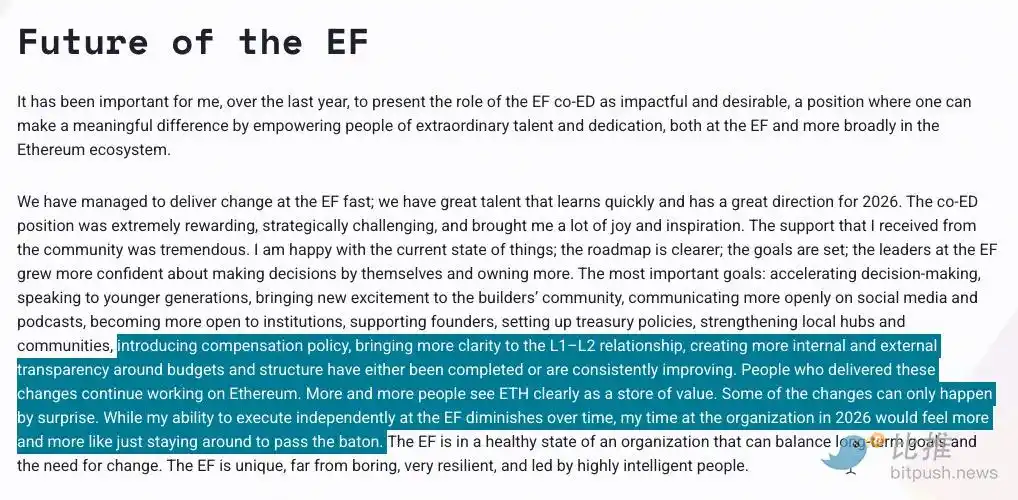
Stańczak's resignation statement was quite sincere and somewhat thought-provoking. He provided several key points:
First, he believes that the Ethereum Foundation and the entire ecosystem are "in a healthy state." It is time to pass the baton.
Second, he wants to return to being a "hands-on product builder," focusing on the integration of AI and Ethereum. He said that his current mindset is similar to when he founded Nethermind in 2017.
Third, and perhaps the most intriguing statement: "The leadership of the foundation is increasingly confident in making decisions and taking control of more affairs. Over time, my ability to execute independently in the foundation has weakened. If I continue to stay, by 2026, I would be more like 'waiting to pass the baton'."
This statement reveals two layers of meaning: one, the new leadership team has formed a driving force and no longer needs him to intervene in everything; two, his actual power space may be shrinking: for someone used to personally stepping in and who has a strong entrepreneurial temperament, this sentiment evidently does not fit him anymore.
He also mentioned, "I know that many current ideas about agent-like AI may not be mature, or even useless, but it is precisely this game-like experimentation that defined the innovative spirit of early Ethereum."
This statement carries a hint of subtle criticism of the current situation: as the organization becomes more "mature" and decision-making more "robust," will the wild growth experimental spirit be lost?
Stańczak's departure, on the surface, is a personal choice, but behind it lies the long-term dilemma faced by the Ethereum Foundation.
From the moment of its birth, this organization has been in an awkward position. Theoretically, Ethereum is decentralized, and the foundation should not become the power center that issues orders. However, in reality, it controls a large amount of funding, core developer resources, and ecological coordination discourse, objectively bearing the dual roles of "central bank" and "development committee."
This identity paradox leads the foundation to be in a long-term dilemma: if it does too much, it gets criticized for being centralized; if it does too little, it gets accused of inaction. Miyaguchi's era leaned towards a "coordinator" position and was criticized for weakness; Stańczak attempted to shift towards an "executor" role, which did indeed improve efficiency, but the distribution of power within the organization naturally became more concentrated.
Stańczak's resignation statement precisely exposes this tension: as the organization becomes more efficient and decision-making more decisive, the personal space for members of the founding team is compressed. For an ecosystem that needs to balance "decentralized spirit" and "market competition efficiency," this internal friction is almost unavoidable.
What kind of person is Bastian Aue, who will succeed Stańczak?
Very little public information is available about him. His own description on X is that he previously handled "hard-to-quantify but crucial work" for the foundation: assisting in management decision-making, communicating with team leaders, budgeting considerations, strategic sorting, and priority setting. This low-key style contrasts sharply with Stańczak's prominent entrepreneurial temperament.
Aue stated in his succession statement: "The basis for my decision-making is a principled commitment to certain attributes of what we are building. The foundation's mission is to ensure that truly permissionless infrastructure — at its core is the cypherpunk spirit — can be established."
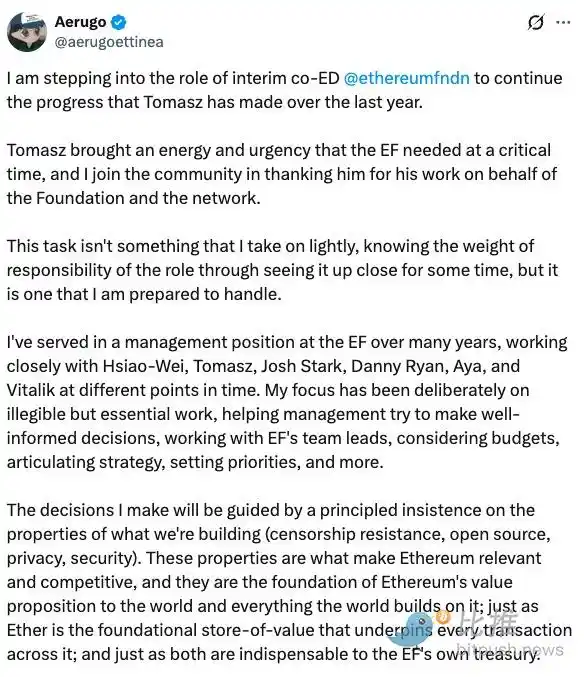
This statement sounds more like the language style of the Miyaguchi era: emphasizing principles, emphasizing spirit, emphasizing coordination rather than dominance.
Does this mean that the foundation will rebalance its direction, pulling back from "radical execution" to "principled coordination"? It remains to be seen.
The Confusion of Ethereum
Stańczak's departure comes at a time when Ethereum is discussing a series of significant proposals. According to him, the foundation is about to release several key documents, including detailed proposals for "Lean Ethereum," future development roadmaps, DeFi coordination mechanisms, etc.
The “Lean Ethereum” proposal has been dubbed the "weight loss era of Ethereum" by some community members — aiming to simplify the protocol, lighten the burden, and enable the mainnet to operate more efficiently.
These directional documents will profoundly impact the evolution path of Ethereum in the coming years. The current change in core executive leadership undoubtedly adds uncertainty to the implementation of these proposals.
On a more macro level, Ethereum is facing challenges from multiple fronts: competition from high-performance chains like Solana, the fragmentation problem of Layer 2, a new narrative window for the integration of AI and blockchain, and the impact of overall market sentiment fluctuations on ecological funds and attention.
On the same day that Stańczak announced his departure, ETH briefly fell into the $1800 range. If it continues to drop below this threshold, an awkward fact will surface: the comprehensive returns for holding ETH may fall below the dollar cash interest rate.
To put it more starkly: in January 2018, ETH first reached $1400. That $1400, adjusted for U.S. CPI inflation compounding, would be approximately $1806 by February 2026.
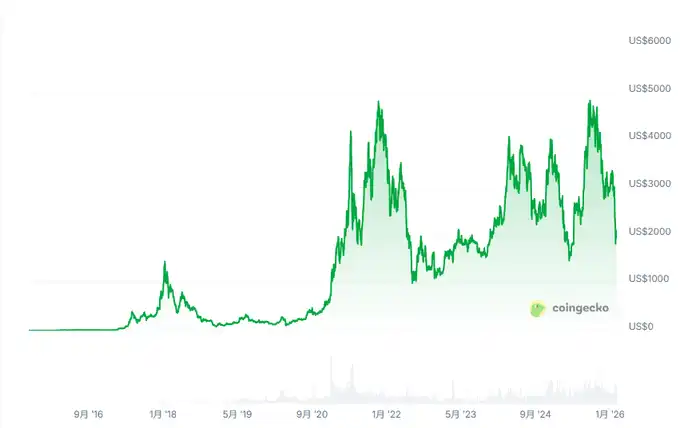
In other words, if an investor bought ETH back in 2018 and held onto it without ever participating in staking, eight years later, not only did he not make any money, but he even lost out compared to leaving his dollars in a bank earning interest.
For the "E Guardian" who has believed all along, the real question may not be "who won the ideological battle," but rather: how much longer can we hold out?
The only thing that is certain is that this core organization, which controls one of the most important ecologies in the crypto world, is still searching for its position in a rapidly changing industry, and this road is bound to be anything but calm.
免责声明:本文章仅代表作者个人观点,不代表本平台的立场和观点。本文章仅供信息分享,不构成对任何人的任何投资建议。用户与作者之间的任何争议,与本平台无关。如网页中刊载的文章或图片涉及侵权,请提供相关的权利证明和身份证明发送邮件到support@aicoin.com,本平台相关工作人员将会进行核查。


