Original Title: "Everything You Need to Know About ERC-8004"
Original Author: KarenZ, Foresight News
From daily trivialities to professional scenarios, AI agents are flooding into our lives. An era of "agent economy," where agents autonomously collaborate, has transitioned from concept to reality.
However, behind the excitement lies a critical question that remains unresolved: how can trust be established when two AI agents that have never interacted before need to collaborate? Just like hiring a stranger contractor, where one checks references, reviews past evaluations, and verifies qualifications, interactions between AI agents also require a reliable trust mechanism.
In this context, the ERC-8004 standard has emerged. Defined as a "trustless agent" technology standard, it builds a unified "trust infrastructure" for the chaotic world of AI agents, transforming them from mere code programs into accountable and trustworthy economic participants.
What is ERC-8004?
In simple terms, ERC-8004 is a technology standard running on Ethereum, with the core goal of creating a cross-platform, verifiable "identity + reputation + validation" system for AI agents.
The core leading members of this standard include Marco De Rossi, head of MetaMask AI, Davide Crapis, head of AI at the Ethereum Foundation, Google software engineer Jordan Ellis, and Coinbase engineering director Erik Reppel. They collected feedback from over 80 teams during the draft phase, consolidating a consensus across the industry.
The core design of ERC-8004 is straightforward, relying on three on-chain "registries" (agent identity, reputation, and validation) to support the entire trust system. All three registries are "singleton contracts"—meaning only one instance is deployed on each blockchain, and all AI agents share the same set of rules, ensuring the standard's uniformity. We can think of these three registries as the AI agent's "digital ID," "credit profile," and "skill certification report," working together to address the core trust issues in AI agent interactions.
Identity Registration: The AI Agent's "Digital ID"
When each AI agent registers, a unique "Agent ID" is generated, which is essentially an ERC-721 NFT, equivalent to the AI agent's "digital ID."
This "ID" contains key information—recorded through a metadata file called "agent card," detailing the AI agent's name, capabilities (such as "managing DeFi investments" or "automatically writing copy"), how to contact it (supported communication protocols), its payment wallet address, and identity systems like DID/ENS.
Conveniently, this identity is portable; no matter which platform the AI agent works on, as long as it carries this NFT, its identity information can be quickly recognized. Moreover, the ownership of the NFT can be transferred, fully controlled by the agent's owner, ensuring security and flexibility.
Reputation Registration: The AI Agent's "Credit Profile"
Having an identity is not enough; the ability to perform tasks and reliability are key.
Reputation registration acts like the AI agent's "credit profile," permanently recording every work performance on-chain, making it immutable and undeletable.
How does it work? After you assign a task to an AI agent, you can submit an evaluation, including metrics like uptime, success rate, response quality, and tags like "efficient" or "precise," along with links to detailed off-chain evaluations. All feedback will be permanently linked to that AI agent's identity, and anyone can publicly query it.
Validation Registration: The AI Agent's "Skill Certification Report"
For some low-risk tasks, such as checking the weather or writing short copy, a reputation record may suffice. However, for high-risk scenarios, such as managing large DeFi assets or assisting in medical diagnoses, good reviews alone are not enough; more authoritative "endorsements" are needed—this is the role of validation registration.
This registration allows third-party organizations (such as professional validation nodes or oracles) to independently verify the AI agent's work results and record the validation results on-chain. There are various validation methods, such as using zero-knowledge proofs (zkML) to verify the correctness of the AI's computation process, employing trusted execution environments (TEE) to ensure computational security, and introducing cryptoeconomic penalty mechanisms.
In short, with this "skill certification report," the credibility of AI agents in high-risk scenarios will significantly increase. However, this registry has not yet been deployed on the Ethereum mainnet. As the final link in the trust loop, it will promote the realization of "agents willing to take orders, users willing to pay," ensuring mutual trust.
Why is ERC-8004 Crucial?
Some may ask, with so many AI agent platforms already available, why is there a need for a standard like ERC-8004?
The answer is clear: without a unified standard, the AI agent economy will always be "fragmented," unable to achieve true scalability and autonomy. Its importance is primarily reflected in the following aspects:
· Building a Decentralized "Trust Layer": ERC-8004 can promote the establishment of a public trust market, constructing a decentralized trust system from multiple dimensions such as "agent attributes," "past performance," and "task completion accuracy," addressing the trust issues in interactions;
· Promoting the Development of "Agent-to-Agent" and "Human-to-Agent" Economies: By enabling discoverable and transferable reputations, AI agents developed by different companies and organizations can discover, hire, and make instant payments to each other without permission, breaking down collaboration barriers.
In addition, ERC-8004 will help make Ethereum the "financial layer" for AI: with the explosive growth in the number of AI agents, their high-frequency micropayments will generate significant transaction volumes. ERC-8004 ensures that these economic activities occur within the Ethereum ecosystem, greatly increasing the network utility of ETH.
Overall, the importance of ERC-8004 lies in its transformation of AI from "isolated tools" into "economic participants," not only granting AI agents identity and reputation but also providing standardized infrastructure for the upcoming trillion-dollar AI agent economy.
ERC-8004 Ecosystem Overview: Who Are the Players?
ERC-8004 will go live on the Ethereum mainnet by the end of January 2026 and has already been launched on networks such as Polygon, BNB Chain, Base, Monad, Scroll, Arbitrum, Mantle, Taiko, Gnosis Chain, Avalanche C-Chain, Celo, and MegaETH (launched on February 10). The entire ecosystem has covered various fields, including agent frameworks, browsers, validation infrastructure, identity queries, and DeFi.
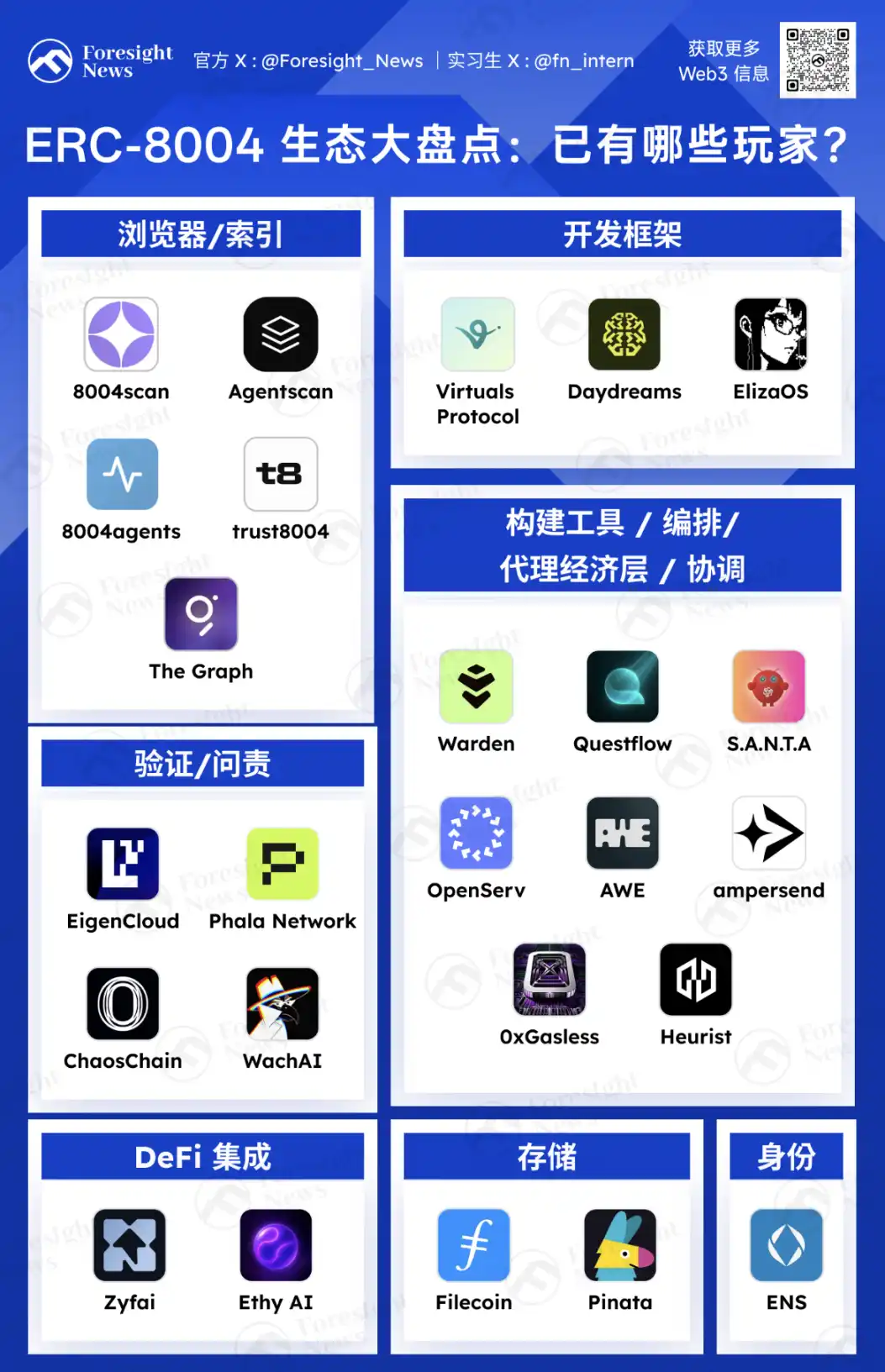
Browsers / Indexes
These tools serve as the core search entry of the ERC-8004 ecosystem, providing basic services such as agent discovery, information queries, and reputation data aggregation.
8004scan
8004scan is a tool for discovering ERC-8004 ecosystem AI agents and token reputation data, supporting searches across the entire registry by agent name, description, skills, agent ID, or 0x address. The search results are presented in a structured manner, displaying ratings, feedback, validation information, and more.
https://www.8004scan.io/
Agentscan
Agentscan is an agent discovery and tracking tool built by the Web3 identity portal Alias. Alias was previously selected for the YZi Labs MVB Season 8 Accelerator Program and utilizes zero-knowledge proof technology, integrating self-discovery, AI models, and identity currency.
https://agentscan.info/
8004agents
8004agents is a comprehensive tool that combines ecosystem news aggregation with agent discovery.
https://8004agents.ai/
trust8004
trust8004 is also an open-source browser for ERC-8004 AI agents.
https://www.trust8004.xyz/
The Graph
The Graph released ERC-8004 subgraphs across 8 chains in early February, creating a unified cross-chain trust directory. For example, agents on Base can immediately verify the reputation of agents on Arbitrum by querying the subgraph.
Storage
These projects focus on file storage and hosting, supporting on-chain or IPFS storage for agent registrations, metadata, and more.
Filecoin
Filecoin Pin stores ERC-8004 agent registration and validation files on Filecoin Onchain Cloud, accompanied by cryptographic proofs. Ethereum agent-building communities can use Filecoin Pin to store agent identities, reputations, and metadata on-chain.
Pinata
Pinata is a cryptographic file storage project whose IPFS API supports uploading files to public or private IPFS and simplifies the process of hosting agent cards and registration files on IPFS.
https://pinata.cloud/
Development Frameworks
These projects provide developers with standardized tools for agent development, deployment, and operation, lowering the entry barrier for adopting the ERC-8004 standard and promoting the large-scale implementation of ecosystem applications.
Virtuals Protocol
Virtuals Protocol integrates ACP with ERC-8004, aiming to transform verifiable agents into true economic participants, enabling on-chain hosting, inter-agent transactions, and real-time registration of daily transactions by agents. All agents that have completed Virtuals ACP certification will automatically register on-chain through ERC-8004.
https://app.virtuals.io/
Daydreams
Daydreams.Systems focuses on building autonomous agents and applications on the x402 payment track, with major tools in the ecosystem including the open-source agent framework Daydreams, Daydreams Router (which achieves smart routing of AI model requests through instant USDC settlement), and the autonomous agent operation platform LUCID, as well as the agent-native search engine XGATE.
In this context, the open-source Agent Commerce Kit in LUCID builds agents using composable modules, supporting x402, A2A, ERC-8004, and related business protocols. This stack is designed for building agents that participate in task markets, enabling communication between agents and facilitating payments and receipts through x402. XGATE allows operators to quickly discover agents.
https://x.com/daydreamsagents
ElizaOS
ElizaOS is an open-source decentralized AI Agent framework (formerly ai16z). Currently, ElizaOS is building Eliza Cloud as the operational infrastructure for the agent economy, supporting the construction, operation, and scaling of autonomous agents. ElizaOS is also implementing decentralized discovery and coordination between agents through ERC-8004, relying on the x402 protocol for low-friction payments.
https://x.com/elizaOS
Verification / Accountability
EigenCloud
EigenCloud supports ERC-8004 agents with verifiable execution (TEE), inference verification, and x402 payment capabilities.
https://x.com/eigencloud
Phala Network
Phala Network is a decentralized computing network focused on TEE (Trusted Execution Environment). Phala provides AI Agent templates that allow developers to deploy agents compliant with the ERC-8004 standard with one click. Phala utilizes TEE technology to provide cryptographic proofs (Attestation) for the ERC-8004 "validation registry," demonstrating that the agent's code runs in a secure environment and has not been tampered with.
https://github.com/Phala-Network/erc-8004-tee-agent
ChaosChain
ChaosChain is an accountability layer for AI agents, introducing a comprehensive system called "Proof of Agent (PoA)" to measure and reward agent contributions, providing each agent with a verifiable on-chain identity, process integrity, and adjudication results.
ChaosChain is launched in collaboration with Ethereum ecosystem developer Nethermind, decentralized AI science protocol Hetu, and Web3 AI cloud company Hyperbolic.
https://x.com/Ch40sChain
WachAI
WachAI transforms the ERC-8004 registry into a dynamic, accountable agent workflow system.
https://x.com/Wach_AI
Identity
ENS
An open agent standard requires open identity, which is an important step for autonomous agents to be discoverable, verifiable, and composable within the ENS domain system.
https://x.com/ensdomains
Building Tools / Orchestration / Agent Economy Layer / Coordination
Warden
Warden is an AI agent infrastructure protocol that completed a $4 million strategic round of financing at a $200 million valuation in January 2026, with participation from 0G, Messari, Venice.AI, and others.
Warden states that its Warden Studio, launched in January, supports creators in building, publishing AI agents, and profiting within a minute, integrating ERC-8004 for identity verification and x402 for payments, creating a verifiable, trustless infrastructure.
https://x.com/wardenprotocol
Questflow
Questflow focuses on building the orchestration layer for multi-agent economies, allowing AI agents to autonomously research, execute actions, and earn rewards on-chain, supporting multi-agent collaboration, cross Web2/Web3 service integration, and facilitating payments and monetization between agents through the x402 protocol.
https://x.com/questflow
S.A.N.T.A
S.A.N.T.A is a network of autonomous task agents launched by Questflow, using A2A, ERC-8004, and x402 protocols to build the x402 Facilitator Router. Agents can coordinate with each other, trigger real transactions, and achieve trustless cross-chain interactions.
https://x.com/santavirtuals
OpenServ
OpenServ supports faster agent application development with the SERV engine, a visual agent builder, native x402 and ERC-8004 integration, and its proprietary inference framework BRAID.
https://x.com/openservai
AWE
AWE is an AI multi-agent large-scale collaboration infrastructure, recently launching the analytics center AgentBeat designed specifically for ERC-8004 agents. As agents operate on-chain and earn fees, AgentBeat displays real activities, verifications, and decentralization status.
https://x.com/awenetwork_ai
ampersend
ampersend is a control layer for the agent economy, building a wallet for agents and a dashboard for users. The control panel allows users to set rules and budgets, automatically recharge agents daily, control each agent and their spending, and monitor activities. ampersend is built on the latest open protocols and on-chain standards (such as x402 and A2A) and integrates ERC-8004. ampersend is currently in closed testing.
https://www.ampersend.ai/
0xGasless
0xGasless is a financial layer for AI agents, supported by InfraBuidl and the Avalanche Foundation in June 2025. The 0xgasless/agent-sdk provides a toolkit for developers looking to integrate agent identity, reputation management, and the latest verification standards (ERC-8004), enabling agents to interact with paid APIs and services through the x402 protocol.
https://0xgasless.com/
Heurist
Heurist is building a full-stack AI infrastructure, including Heurist Cloud (accessing AI models via simple APIs), Heurist Mesh (agent marketplace), and Heurist Chain (ZK Layer-2 for agent payments). Mesh agents were launched in the ERC-8004 registry at the end of January.
https://x.com/heurist_ai
DeFi Integration
Zyfai
Zyfai is a DeFi solution for agents, where agents autonomously adjust portfolios to achieve the highest risk-adjusted returns. Each rebalancing generates a zero-knowledge proof to confirm correct execution, stored in the ERC-8004 validation registry.
https://x.com/ZyfAI_
Ethy AI
Ethy AI is an automated trading tool that also operates an agent and workflow marketplace, where users can discover, reuse, and combine agents created by others. Ethy AI has implemented native payments and incentive mechanisms between agents in workflows using Virtuals ACP and x402. By integrating ERC-8004, the Ethy marketplace evolves into a trust-based agent market, with reputation built through actual use and directly reflected in the products.
https://x.com/ethy_agent
Summary
The launch of ERC-8004 provides the core trust infrastructure for the decentralized development of the AI agent economy.
Of course, ERC-8004 itself does not handle payments; it only addresses "who is this, and is it reliable." For a true closed-loop economy to form between agents (discovery → collaboration → payment → feedback updating reputation), an efficient machine-to-machine micropayment layer is also needed. The community and infrastructure projects generally view ERC-8004 + x402 as a complementary closed loop for the agent economy.
With the completion of multi-network deployments and the continuous rollout of ecosystem projects, a new era of digital economy driven by trustworthy AI agents autonomously collaborating and co-creating value is accelerating. However, there are still some key challenges to be addressed on the road to a mature agent economy.
免责声明:本文章仅代表作者个人观点,不代表本平台的立场和观点。本文章仅供信息分享,不构成对任何人的任何投资建议。用户与作者之间的任何争议,与本平台无关。如网页中刊载的文章或图片涉及侵权,请提供相关的权利证明和身份证明发送邮件到support@aicoin.com,本平台相关工作人员将会进行核查。


