Let me talk more about the operation methods overseas.
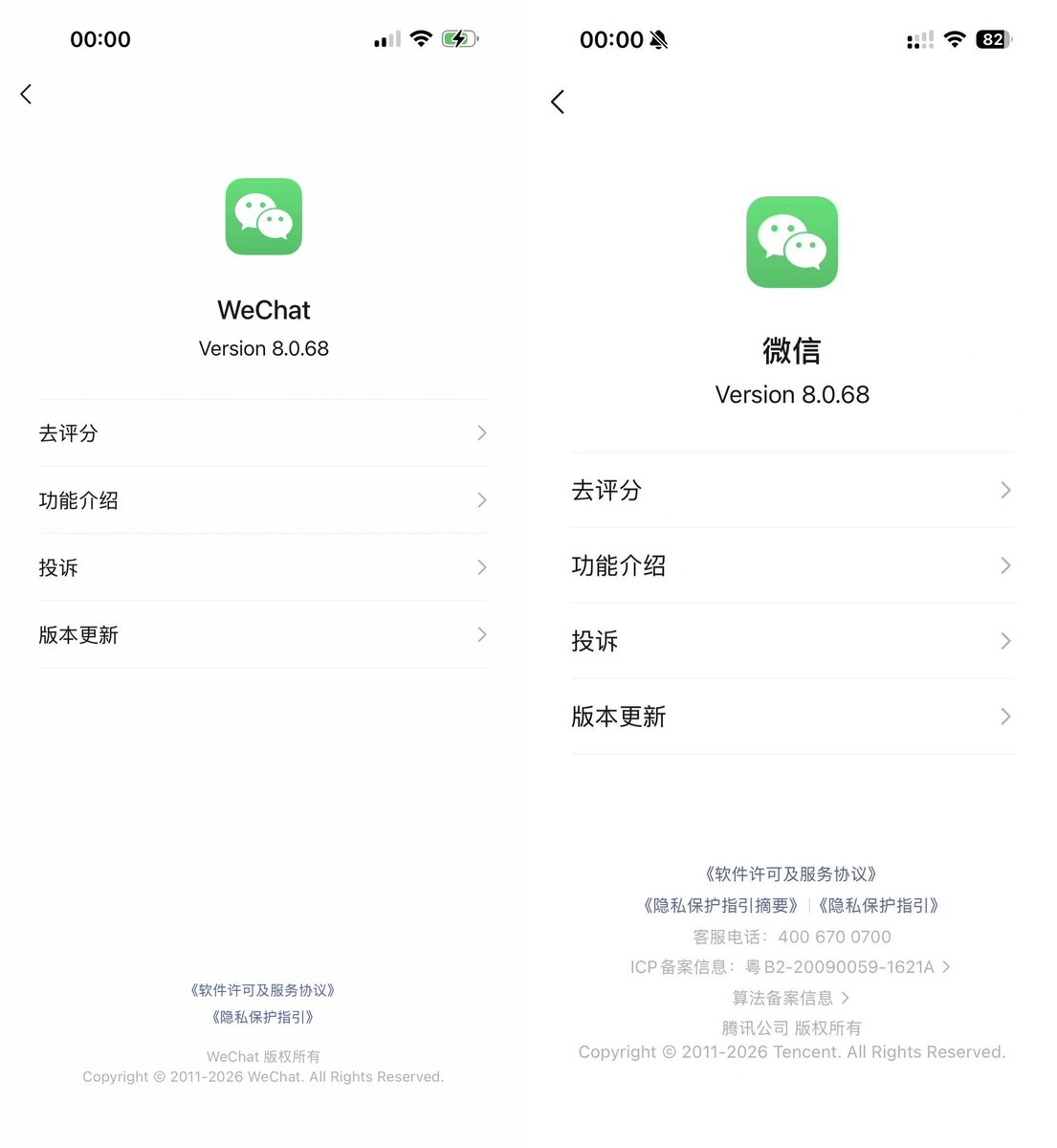
When I first lived in Singapore, an older brother told me to change the Chinese phone number linked to my WeChat to a local Singapore number. I followed his advice, and then my WeChat became Wechat. Coincidentally, I still had another WeChat linked to a domestic number, which allowed me to see some differences.
Of course, there are many detailed differences. The essence of changing the number is that 86 is more clearly influenced by mainland rules and content governance, rather than 86 its privacy, terms, and storage, which will be completely different.
For example, the simplest case is that Wechat's information does not exist within mainland China. Of course, the absence of it in the mainland does not mean that it cannot be accessed or used within China, but in many scenarios, it will be "privileged," such as account risk control and the degree of sensitivity in openness.
For instance, one of my friends, before changing his number, often posted political content and frequently had his account banned. After changing, more of his content in groups became invisible to others, and he almost never faced account bans himself.
So many times, changing the "device" may not significantly enhance one's security, but it will improve the tolerance for being controlled. In recent months, my friends have gradually transitioned from Wechat to Whatsapp.
Now, let's talk about mobile cards in different countries or regions.
I have a Hong Kong card, a local Singapore card, a China Unicom card from Singapore, and an eSIM card based in France. I started using the Hong Kong card in 2020, which initially cost 368 HKD per month, offering unlimited 4G data locally in Hong Kong and 10 GB usable in mainland China. After using up the 10 GB, it would switch to unlimited 3G. Later, I switched to a Greater Bay Area plan, which is now 158 HKD per month, but it is almost unused.
This card was my main card for a long time, especially since its roaming fees in other countries are very cheap. So before I had a French card, this card was my primary travel card. The biggest issue with the Hong Kong card is that it cannot use ChatGPT and Gemini.
In Singapore, I mainly use the local Singapore card, which costs about 15.5 SGD per month. There are actually cheaper options, but I am too lazy to change for now. In Singapore, you can switch numbers at any time, and local data is almost unlimited, but KYC is required, and one identity (ID) can only register five cards. This card can be used directly in Thailand and Malaysia.
Then there is a China Unicom card from Singapore. The biggest advantage of this card is its low cost; under the same data plan, it costs less than 10 SGD. It shares 10 GB of data in Hong Kong, Malaysia, Indonesia, Thailand, Brunei, Australia, and New Zealand, while in Singapore, it is almost unlimited, and it can have 20 GB in mainland China. Most importantly, it can have two numbers on one card, directly linking the original domestic card to this card.
I hardly use this card now, mainly because I can use the Hong Kong card in mainland China, as I need to keep the number and pay monthly fees. When going to other countries, I can use the French card.
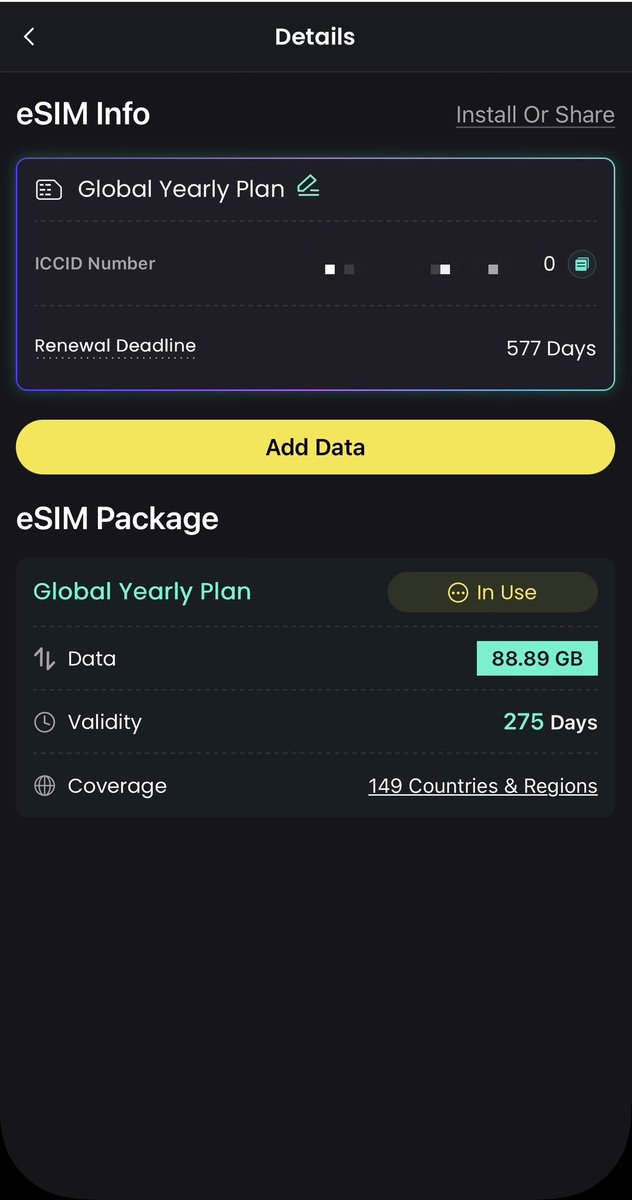
I know many friends are quite interested in the French card, so I won't elaborate too much. There are many such cards now, which do not require KYC and can be used with simple registration. A 100 GB data plan can last for one year, supporting 149 countries, and it can also increase data. For me, this is already sufficient. There are many of these cards, with prices ranging from over 100 USD to over 300 USD, depending on your choice.
Using an overseas phone card within China does not bypass Chinese operators, as China has not yet opened up overseas telecom operations. However, there will be markings, meaning that the overseas card may use the Unicom network but is not subject to Unicom's restrictions within the country. Sorry, I don't know the professional terminology, but the general idea is that you can normally access all websites, such as Google and X, and YouTube and TikTok are also fine. AI software will depend on restrictions; for example, the Hong Kong card cannot access it.
In other words, when you use an overseas phone card, you are considered a "foreigner" in China's telecom network. Again, this won't make you more secure, but it can reduce some troubles. Your tolerance for risk control will be slightly higher.
Additionally, if the overseas card is not a pure data card and has a phone number that can receive SMS, it is very helpful for registering some accounts. Using an iOS system or an overseas Android system is completely to avoid having things downloaded secretly in the background; in this regard, the closed system of iOS is somewhat better.
That's all.
@bitget VIP, lower rates, better benefits
免责声明:本文章仅代表作者个人观点,不代表本平台的立场和观点。本文章仅供信息分享,不构成对任何人的任何投资建议。用户与作者之间的任何争议,与本平台无关。如网页中刊载的文章或图片涉及侵权,请提供相关的权利证明和身份证明发送邮件到support@aicoin.com,本平台相关工作人员将会进行核查。


