Original Title: "Escaping Leviathan: Epstein, Silicon Valley, and the Sovereign Individual"
Original Author: Sleepy.txt, Dongcha Beating
For the past century, super-rich individuals have been searching for the same thing: a lawless territory that allows money to completely escape the scrutiny of sovereign states.
In the early 20th century, they found Swiss bank accounts.
The 1934 Swiss Banking Law stipulated that banks must keep client information confidential, and those who leak it would face criminal prosecution. The wealthy could store their assets in accounts known only to a few senior bank employees, evading taxes and legal scrutiny from their home countries.
This system operated for 74 years until 2008, when the IRS issued a "John Doe subpoena," ordering UBS Group to provide account information for approximately 52,000 American clients.
The following year, UBS paid a $780 million fine and handed over part of the client list.
When underground safes were no longer secure, capital quickly shifted, flooding into sunny tax havens.
In the mid-20th century, offshore centers in the Caribbean began to rise. The Cayman Islands, Bermuda, and the British Virgin Islands, scattered across the blue ocean, became havens for multinational companies and the wealthy to register shell companies and hide wealth, thanks to zero tax rates and loose regulations.
This system lasted for about 50 years until 2014, when the OECD released the Common Reporting Standard, requiring global financial institutions to automatically exchange account information for non-resident clients. By 2024, over 170 million accounts were forced to be disclosed, involving assets up to €13 trillion, making them fully visible in the tax authorities' systems.
Sunlight penetrated the coconut groves of the Caribbean, illuminating the treasures hidden in the shadows.
Each generation of offshore havens has a shorter lifespan. Swiss banks lasted 74 years, Caribbean offshore centers 50 years. The regulatory net is tightening, and the wealthy urgently need a new hiding place.
In August 2019, Epstein died in a Manhattan jail cell. Compared to the mystery of his cause of death, the legacy he left behind resembles a specimen of an era, precisely showcasing how the wealthy switched to another ship.
In the physical world, he owned Little Saint James Island. This island, equipped with a port, airport, and independent power grid, is a typical old-fashioned refuge, a tangible lawless territory. He indeed turned himself and many others into outlaws on this small island.
In the digital world, he had already begun a new layout. From funding Bitcoin developers to investing in infrastructure and lobbying for regulatory policies, Epstein extended his reach into cryptocurrency. Clearly, in his eyes, this virtual refuge was worth betting on more than that physical island.
The Bitcoin crisis of 2015 and the tightening of regulations in 2026. Everything that happened in these 11 years is the latest round of this century-long cat-and-mouse game.
Dirty Money
In April 2015, the Bitcoin Foundation, once regarded as the central bank of the Bitcoin ecosystem, admitted in an open letter that it had effectively gone bankrupt.
Founded in 2012 by a group of early Bitcoin believers and evangelists, including Satoshi Nakamoto's "successor," chief scientist Gavin Andresen, and later known as "Bitcoin Jesus," Roger Ver, its mission was to fund the salaries of core developers, organize conferences, and promote technology, providing some form of official endorsement for this wildly growing digital currency.
However, this centralized organization in a decentralized world fell apart within just three years due to corruption, infighting, and mismanagement.
Its founding board member, Mark Karpeles, CEO of the then-largest Bitcoin exchange Mt. Gox, was imprisoned due to the exchange's collapse and the disappearance of 850,000 Bitcoins; the foundation's vice chairman, Charlie Shrem, was sentenced to two years in prison for involvement in money laundering.
With the foundation's collapse, the livelihoods of five core developers became a major issue. The code they maintained supported a market value of hundreds of billions, yet in reality, they were not receiving salaries.
In April 2015, just as the Bitcoin community was worried about this, the MIT Media Lab announced the launch of the "Digital Currency Initiative." They quickly acted, recruiting the three core figures: Gavin Andresen, Cory Fields, and Vladimir van der Laan. This interdisciplinary lab, founded in 1985 and known for its forward-looking research and close collaboration with business and the wealthy, became the "white knight" for Bitcoin developers.
But the money of this white knight was not clean.
At the time, the director of the MIT Media Lab was Joi Ito, a renowned Japanese investor who had made waves in Silicon Valley and had early investments in Twitter and Flickr.

According to a 2019 investigation by The New Yorker, it was Joi Ito who decided to use Epstein's money to fund this "Digital Currency Initiative."
Between 2013 and 2017, Epstein directly donated $525,000 to the MIT Media Lab. But this was just the tip of the iceberg. According to Epstein himself, he helped MIT raise at least $7.5 million from other wealthy individuals, including $2 million from Bill Gates. This funding was cleverly marked as anonymous, completely hiding Epstein's influence in it.
This money should not have come in. Due to a 2008 sexual assault case, Epstein was already blacklisted by MIT. But Joi Ito used a "gift fund" to create a backdoor, bypassing the school's layers of scrutiny and laundering the dirty money in. He even specifically emailed colleagues ordering that this money must remain anonymous.
Joi Ito understood the leverage of power too well; in another email to Epstein, he pointed out the Achilles' heel of Bitcoin's power: although it claims to be decentralized, the power of life and death over the code is actually in the hands of five people. MIT not only entered the game but also recruited three of them in one go.
Epstein's reply was short but meaningful: "Gavin is a smart guy."
The implication was that he had chosen the right people. By controlling the people, they quietly completed the control over the code.
This is the magic of top institutions; they can gild the dirtiest money with the brightest gold. A convicted sex offender transformed into the behind-the-scenes financier of the Bitcoin core circle. That "visiting scholar" disguise allowed him to enter the top laboratory smoothly, mingling with the world's smartest minds.
In 2014, Epstein also invested $500,000 in the Bitcoin infrastructure company Blockstream, founded by Adam Back, Gregory Maxwell, and Peter Wuille, among other Bitcoin core developers.
Technology can be decentralized, but funding always has a source. To survive, the decentralized utopia had to accept centralized support, but after all, one is short-handed when taking money from others.
Epstein's logic was simple: first, let Bitcoin survive, then let it develop in the direction he wanted.
By funding the salaries of core developers, he not only saved a technology on the brink of collapse but also bought influence over its development direction. Joi Ito used his money to persuade three developers to join MIT; in other words, Epstein's funding effectively controlled the majority vote on Bitcoin's technical decisions.
With influence comes the power to define.
When Satoshi Nakamoto designed Bitcoin, he emphasized technical decentralization—independence from banks and central servers.
But when people like Peter Thiel and Epstein got involved, it was imbued with a more radical ideological color, not just a technological innovation but a challenge to the power of nation-states, a tool for the "sovereign individual" to escape constraints.
When you fund the people who maintain the code, you gain the power to define what this technology "is." The technology itself is neutral, but whoever holds the discourse power can decide for whom it serves.
So, what exactly was Epstein betting on with cryptocurrency?
Silicon Valley's Secret Dinner
Epstein was not just making venture capital; he was more like searching for kindred spirits. He keenly sensed the larger network beneath the surface, a small circle composed of top elites. In August 2015, at a private dinner in Palo Alto, California, the outlines of this small circle finally surfaced.
This dinner was arranged by LinkedIn co-founder Reid Hoffman, and the attendees were star-studded: Jeffrey Epstein, Joi Ito, Elon Musk, Mark Zuckerberg, and Peter Thiel.
At that moment, it had only been a few months since MIT used Epstein's money to recruit Bitcoin developers. This group would all become believers in cryptocurrency without exception. Clearly, this was no ordinary social gathering.
In this circle, Peter Thiel was undoubtedly the spiritual leader. As a co-founder of PayPal, Facebook's first external investor, and the founder of big data company Palantir, he had long been a legendary figure in Silicon Valley.
In 2017, when Bitcoin's price was still hovering around $6,000, Peter Thiel's Founders Fund had quietly entered the market, investing between $15 million and $20 million. By the time the crypto bear market hit in 2022, this investment had brought about $1.8 billion in astonishing returns for the fund. In 2023, he again placed a $200 million bet, purchasing Bitcoin and Ethereum. Each of his moves precisely landed on the eve of a bull market.
Making money was just a byproduct; what Peter Thiel was truly fascinated by was the political metaphor behind Bitcoin. In his view, this was the true successor to PayPal, finally realizing that wild dream of creating a new world currency free from government control.
The roots of this thought can be traced back to a book published in 1997, later revered as a bible by Silicon Valley elites, "The Sovereign Individual."
Co-authored by James Dale Davidson and William Rees-Mogg, the core argument is that the information age will mark the twilight of nation-states. The true "cognitive elite" will completely shake off the constraints of geographical boundaries, evolving into "sovereign individuals" that transcend nations. It not only accurately predicted the emergence of "digital, encrypted currencies" but also directly sentenced state power to death, asserting that such currency would completely undermine the state's right to mint money.
For Peter Thiel, this is his spiritual totem. He once confessed to Forbes that no book has reshaped his worldview like "The Sovereign Individual." In 2009, he wrote in an article: "I no longer believe that freedom and democracy can be reconciled."
Since he no longer believed in the existing system, the only option was to completely escape. This obsession explains why Thiel is so fascinated by all tools that can escape state power.
Before embracing Bitcoin, he had heavily funded the "Seasteading" project. This project, initiated by the grandson of Nobel laureate Milton Friedman, aimed to establish floating cities on the high seas, creating a utopia completely free from national jurisdiction, allowing people to freely choose laws and governments like shopping in a supermarket. Although it sounded like a pipe dream, Thiel unhesitatingly invested $1.7 million. However, the project ultimately stalled due to technical bottlenecks, funding shortages, and local protests.
Since they couldn't build a Noah's Ark in the physical world, they could only seek a new continent in the digital world.
In 2014, through an introduction from Reid Hoffman, Epstein met Peter Thiel. In 2016, Epstein invested $40 million in Thiel's other venture capital firm, Valar Ventures.
That same year, Peter Thiel took a risky step by publicly supporting Trump at the Republican National Convention. This gamble thrust him directly into the core circle of power transition. Overnight, he transformed from a Silicon Valley investor into a key bridge connecting the tech world with the White House.
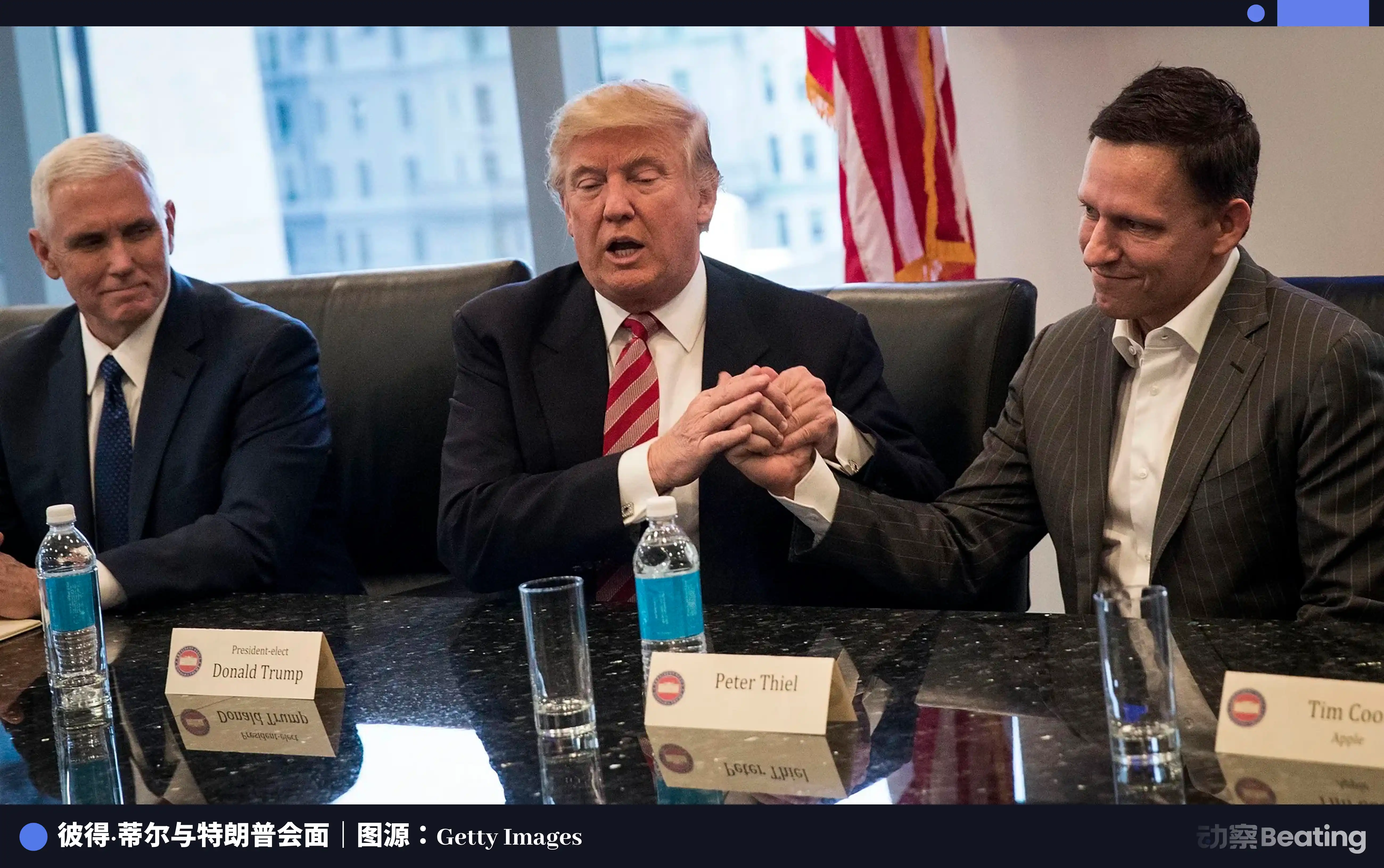
The orchestrators behind these dinners and investments are a mysterious organization called the Edge Foundation.
Founded by John Brockman, this nonprofit organization plays a typical circle game. In a leaked email list from 2011, Epstein's name appeared alongside Bezos, Musk, the Google duo (Brin and Page), and Zuckerberg.
Under the guise of scientific and intellectual exchange, it brought together the world's top minds. But in reality, it was an exclusive elite club. Members exchanged intelligence through private emails and offline gatherings, coordinating interests and unifying positions away from public view.
If Davos is a show for the world, then the Edge Foundation is the backstage. All technological bets and political positions were internally communicated here long before they were made public. In their eyes, Bitcoin is not just an asset but a weapon.
Sovereign Fantasies
Whether it's a private island or Bitcoin, they essentially represent the same ideology manifested in different dimensions: escaping the constraints of democratic nations. The former creates a lawless territory in physical space, while the latter constructs a sovereign domain in digital space.
From Swiss bank accounts to Bitcoin public key addresses, the wealthy have always sought new digital codes to hide their wealth. The privacy of Swiss bank accounts is protected by banking confidentiality laws and professional ethics, while the anonymity of public key addresses is secured by cryptography and decentralized networks. Both promise to protect privacy, yet both ultimately get caught up in regulation.
The "freedom" that Peter Thiel speaks of has nothing to do with you and me.
According to the World Inequality Report released at the end of 2025, the wealth controlled by the world's richest 0.001% (less than 60,000 people) is three times that of the poorest half of the global population (about 4 billion people). By 2025, the wealth of global billionaires grew by 16%, three times the average growth rate of the past five years, reaching a record total of $18.3 trillion.
This is the truth behind the "freedom" they pursue: a world where wealth and power are infinitely concentrated in a few "sovereign individuals," leaving billions behind. They champion Bitcoin not to improve the lives of ordinary people but to free themselves from any form of social responsibility and wealth redistribution.
This narrative of framing technology as a "tool against government" rather than a "tool for public good" is widely circulated in Silicon Valley's libertarian circles.
In fact, blockchain technology could have had a different life. It could serve as a mirror to scrutinize how government budgets are spent and how votes are cast. But when these elites treat it as their private backyard, this technology, which should benefit the public, is hijacked into a privilege for the few.
However, reality soon dealt them a blow; complete escape is impossible. Whether hiding in international waters or buried in code, the gravitational pull of the real world always exists. These smart individuals quickly realized that since they couldn't run away, they should change their strategy: instead of evading the rules, they could directly buy off those who set the rules.
In February 2018, an email sent to Steve Bannon sounded the charge.
Steve Bannon, the former "White House strategist," although just out of Trump's inner circle, still wielded significant influence in Washington.
Epstein approached him without any pretense, directly pressuring him in the email: "Will the Treasury respond or do we need to find another way?"
Epstein was so urgent because he had thrown out a seemingly cooperative yet secretly subversive proposal: a voluntary disclosure form.
On the surface, he claimed it was to help the government "catch bad guys," leaving criminals nowhere to hide; but in reality, it was a get-out-of-jail-free card tailored for the elite. He hoped that by voluntarily declaring income and paying back taxes, the massive amounts of dirty money hidden in cryptocurrency could be legally pardoned.
In another email, Epstein wrote in panic: "Some bad stuff. Very bad."
He knew better than anyone how many unsavory transactions were buried beneath the wealth of himself and this circle. He urgently needed a "voluntary disclosure" ticket to complete the final laundering for himself and his friends before the regulatory guillotine fell.
This tactic was not new in Washington. After the UBS case in 2009, the IRS launched an offshore voluntary disclosure program. This program allowed taxpayers with undeclared offshore accounts to avoid criminal prosecution by voluntarily declaring, paying back taxes, and paying a fine. Between 2009 and 2018, about 56,000 taxpayers participated in this program, recovering approximately $11.6 billion in taxes for the IRS.
Epstein's plan was to transport this logic of paying to launder money directly into the crypto space. His voluntary disclosure proposal aimed to use tax payments as leverage to legalize dirty money. This is precisely the game that the elite class excels at; as long as they can deal with the rule-makers, any dark history can be washed into a whitelist.
Peter Thiel's level is clearly higher; he treats Washington like a Silicon Valley company to invest in.
In 2016, he bet $1.25 million on Trump, successfully placing his protégé Michael Kratsios in the White House as Deputy Chief of Staff for Technology Policy.
In 2022, he doubled down with another $15 million, getting Vance into the Senate. This newly elected senator is not only Thiel's ally but also holds millions in Bitcoin.
Do you understand? This has long surpassed ordinary political donations; these tech elites who believe in the "sovereign individual" are systematically placing their own people in core positions, step by step completing the takeover of the state machinery.
However, the regulatory iron fist ultimately came down.
On New Year's Day 2026, a "global manhunt" targeting the crypto space was officially launched with the "Crypto Asset Reporting Framework." More than 50 countries initiated it simultaneously, with over 20 more following suit. It directly turned trading platforms and wallets into informants for tax authorities. They would collect detailed customer information and report it to the tax authorities in their respective countries. Tax authorities across countries would then exchange this information automatically with the tax residence country of the customers.
A global net targeting tax issues related to crypto assets was thus laid out.
Epilogue
From Swiss banks to Bitcoin, this nearly century-long cat-and-mouse game has finally hit a wall under the iron curtain of global regulation.
With the escape routes in digital space blocked, where will the new sovereign fantasies sprout?
This time, their ambitions are even greater. Peter Thiel is funding anti-aging and life extension technologies, attempting to escape the ultimate constraint of death. Elon Musk dreams of colonizing Mars, betting humanity's future on a brand new planet.
These seemingly fantastical dreams are rooted in the same prophecy as "The Sovereign Individual." They want to create a new world that transcends nation-states and democratic systems through technology. Whether it's immortality or interstellar colonization, they are the latest versions of the "escape plan."
Epstein's story is merely a footnote in this grand narrative, a dirty yet incredibly real footnote. It reveals how, when technology is stripped from the public good and reduced to a tool for a few to pursue absolute freedom, it bears the most evil fruits.
In the present, we must confront this harsh reality: when the blueprint for the future is drawn up at private dinners where we don't even have the qualifications to dine, all the rules will be irrelevant to us.
When a small group of elites, who need not be accountable to anyone, can define our money, our society, and even our lives solely based on the capital in their hands, what do we really count for?
This is the true question that this story leaves us with. An unanswered question, but one that each of us must ponder.
免责声明:本文章仅代表作者个人观点,不代表本平台的立场和观点。本文章仅供信息分享,不构成对任何人的任何投资建议。用户与作者之间的任何争议,与本平台无关。如网页中刊载的文章或图片涉及侵权,请提供相关的权利证明和身份证明发送邮件到support@aicoin.com,本平台相关工作人员将会进行核查。