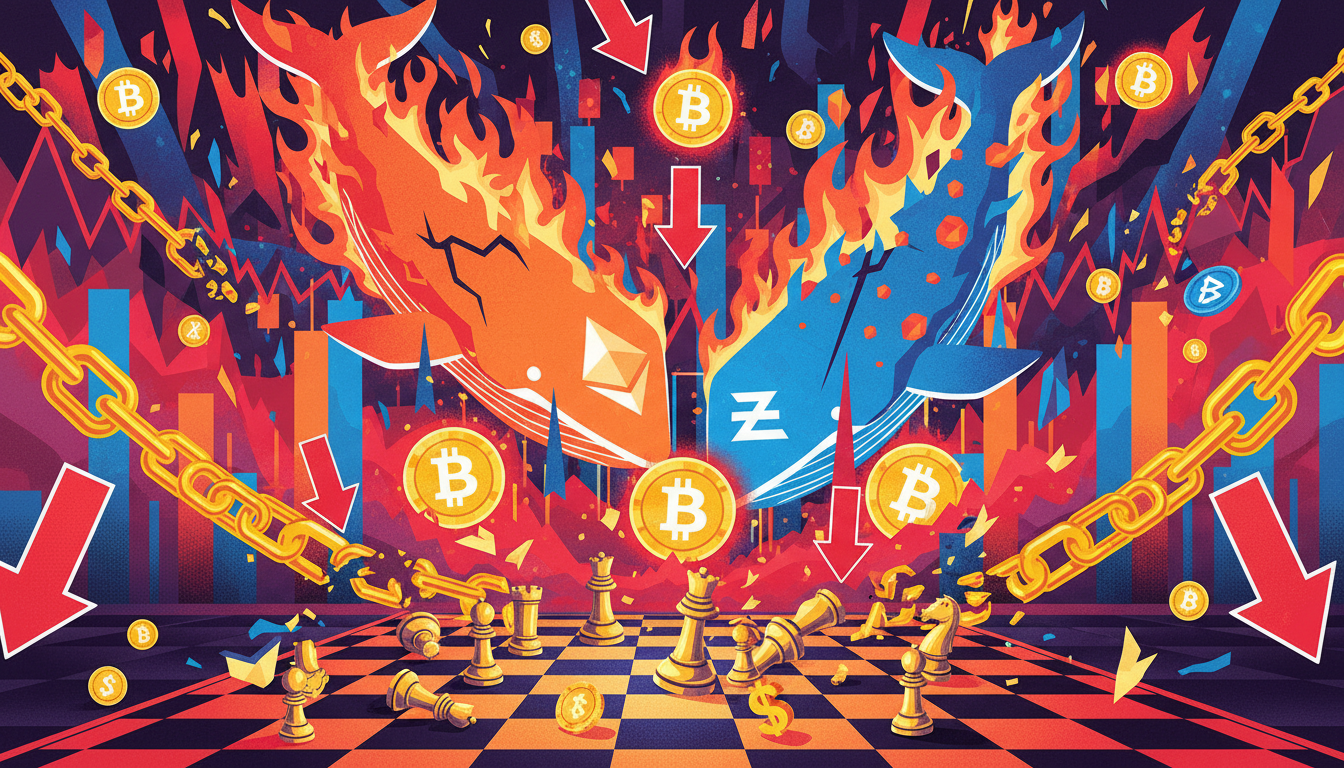
This week, under the backdrop of rising global risk sentiment, the cryptocurrency market has once again experienced a systemic decline. Multiple assets have synchronized in their pullback, volatility has surged sharply, and high-leverage long positions have faced intense liquidation. In this round of market activity, the crypto whales regarded as "smart money," Garrett Jin and Huang Licheng ("Brother Maji"), both suffered significant blows to their long positions, with on-chain and exchange data indicating substantial unrealized losses and passive liquidation. A sharper question arises around the liquidation cases of these two high-profile whales: when macro liquidity tightens and the market slides into a liquidity vacuum, why do those whales relying on high leverage for profit expansion collectively falter in the same downturn?
Whales Forced to Exit: The Chain Liquidation of High-Leverage Longs
● Liquidation Context: From the market performance perspective, this round of systemic decline is not a singular asset flash crash, but a continuous pullback under pressure on global risk assets and rising risk aversion. The volatility in the cryptocurrency market has been significantly amplified. In such an environment, the positions of high-leverage long whales like Garrett Jin and Huang Licheng have repeatedly touched risk zones during the price's stepwise decline, showing signs of multiple passive liquidations and suspected liquidations, forming a negative feedback loop of "drop - liquidation - further drop."
● Data and Scenarios: According to a single on-chain and exchange tracking source, the unrealized loss of Garrett Jin's associated address's ETH long position is reported to reach approximately $84 million, while Huang Licheng's long position on Hyperliquid has been recorded as a daily loss of around $2 million. These figures have yet to receive authoritative third-party cross-verification and can only be viewed as reference samples, but they are sufficient to illustrate the impactful liquidation scenario of severe net value withdrawal in a short time under high leverage.
● Emotional Reversal: Both individuals have previously been labeled as "smart money" and "whale leaders" due to their precise bets and large capital volumes. However, the rumors of unrealized losses and liquidations in this round have quickly spread within the community, triggering an emotional shift from "follow buying" to "questioning judgment." The market begins to reflect: when even the deified whales cannot escape systemic liquidation, does the so-called "smart" come from foresight or is it merely a survivor bias amplified in favorable cycles?
From Increasing Positions to Deep Traps: Garrett Jin's ETH Faith Test
● Unrealized Loss Data: Discussions surrounding Garrett Jin center on core data from a single on-chain monitoring account: his associated address's ETH long position has an unrealized loss of approximately $84 million. It is important to emphasize that this figure currently lacks multi-source verification from authoritative institutions, making it impossible to accurately correspond to his overall position or rule out statistical discrepancies. However, as a sample, it is sufficient to present the extreme risk exposure that can be amplified by heavily investing in ETH under high leverage.
● Position Rhythm Narrative: A narrative circulating in the community suggests that he has been continuously increasing his ETH long position since January 28, and has passively fallen into a deep trap during the subsequent systemic decline. This claim is also pending verification, with no official or exchange disclosures fully corresponding. Regardless of the specific rhythm of increasing positions, the market impression of "continuously increasing long positions" can easily be interpreted as a typical path of increasing leverage against the trend in hopes of bottom-fishing a rebound during this downturn.
● Logical Misalignment: From an asset selection perspective, the logic of heavily investing in ETH is not difficult to understand: Ethereum holds a foundational infrastructure position in the long-term narrative, with deep liquidity and institutional participation, making it the top chip that many whales believe can withstand pressure. However, when this long-term value judgment is combined with high leverage, short-term price volatility, and liquidity contraction, the risks originally dispersed over time are compressed into a short-term concentrated exposure. The result is that the "faith in long-term value" is forced to convert into a pressure test of a massive unrealized loss amid a technical downturn.
Brother Maji's High Dive: Severe Pullback on Hyperliquid
● Large Positions and Losses: On the other side, on the derivatives platform Hyperliquid, Huang Licheng has opened large long positions, resulting in notable unrealized losses during this round of volatility. According to a single data source, his long position's unrealized loss on a particular trading day is approximately $2 million. This figure has also yet to receive authoritative third-party confirmation but is sufficient to serve as "high dive" material in community narratives, making the capital withdrawal under high leverage a tangible risk case.
● The Backlash of the "Dare to Go All In" Image: Huang Licheng has been viewed by the community as a typical figure who "dares to go all in," with each high-profile position opening and public call amplifying follower emotions. During this round of extreme volatility, when market prices continuously dipped and the net value of Hyperliquid accounts appeared to plummet sharply, the contrast between this "all-in persona" and actual unrealized losses provided a strong visual and psychological impact for onlookers: what was originally seen as a dramatic and entertaining adventurous style was quickly hammered by the reality of risk during a systemic decline.
● Remaining Positions and Opacity: There are also claims circulating in the community that he still holds about 2,500 ETH long positions, but it should be clearly noted that this information is also pending verification, with no publicly transparent data available to fully depict his current position structure. This information asymmetry makes the outside world particularly sensitive to his subsequent actions—every suspected increase or decrease in positions is over-interpreted, yet lacks sufficient evidence, further reinforcing the unease of "whales gambling in the dark while retail investors sway with emotions."
Even Smart Money Can Flip: Shared Fate Under Liquidity Tightening
● Viewpoint Anchor: A quote from Planet Daily has circulated widely in the community—"Even whales regarded as 'smart money' cannot escape during periods of liquidity tightening and amplified volatility." This not only reflects the current market state but also serves as a narrative anchor for understanding this round of whale liquidations: no matter how sharp individual judgments may be, when overall liquidity is withdrawn, one can still be swept away in technical sell-offs and chain liquidations.
● The Same Liquidation Pool: The cruelty of systemic declines lies in the fact that price drops are no longer solely determined by the emotions of individual entities but are shaped by the leverage structure and liquidity depth of the entire market. When high-leverage positions are forced to reduce during price declines, triggering chain liquidations, both whales and retail investors will be systematically pushed out of the market in the same "liquidation pool." Individual judgments about trend reversals often become fragile at this moment because what truly matters is the collective stampede driven by panic and insufficient margin across the entire market.
● Samples Rather Than Judgments: In the absence of precise leverage multiples, liquidation points, and multi-source data verification, it is difficult for outsiders to make rigorous assessments of Garrett Jin or Huang Licheng's specific strategies. A more reasonable attitude is to view these liquidation and severe unrealized loss events as typical samples of high-leverage risk exposure, rather than a simple judgment of individual intelligence or character. Shifting attention from "who flipped" to "what kind of leverage structure is most prone to flipping in this environment" is more helpful for truly understanding the systemic significance of this round of events.
New Highs in Gold and Stagnation Clouds: The Macro Background of Whale Misjudgment
● Flight to Safe Assets: The recent decline in the cryptocurrency market is not isolated from the larger financial environment. Research data shows that as global financial market volatility intensifies, gold prices have risen above approximately $5,330 per ounce, which itself is an intuitive signal of rising risk aversion. When funds concentrate on traditional safe-haven assets like gold, high-volatility risk assets represented by cryptocurrencies naturally face valuation compression and liquidity withdrawal.
● Political Uncertainty: At the same time, the U.S. federal government is once again facing partial shutdown risks, adding a layer of political and policy uncertainty to global market sentiment. Such events often reinforce the instinctive reaction of "withdrawing cash first, then assessing the situation," driving funds away from marginal risk assets and exacerbating selling pressure in the cryptocurrency market. In this context, even whales must race against the liquidation line in a tighter liquidity environment.
● Dislocated Signals of Localized Frenzy: In stark contrast to systemic risks, the OTTO token on the Base chain ecosystem has seen a daily increase of over 730% in extreme market conditions. During the same time window when the broader market is under pressure and risk aversion is rising, localized small-cap tokens are experiencing a "localized frenzy." This dislocation can easily lead some participants to misjudge the rhythm of risk—misinterpreting a brief structural surge as a warming of overall risk appetite. For whales, if these localized stories are seen as signals of market recovery, they may overestimate the upside potential and underestimate macro pressures, thus stepping on the timing of systemic pullbacks when increasing leverage.
Before the Next Crash Arrives: Lessons for Whales and Retail Investors
The recent whale liquidation events reveal commonalities that are not new: first, there is a clear lack of sensitivity to macro volatility and liquidity contraction, maintaining or even amplifying single-direction leverage in an environment where gold is hitting new highs and the U.S. faces shutdown risks; second, there is an overestimation of their own leverage safety boundaries, mistakenly believing that capital size and past performance are sufficient to withstand extreme market conditions, while ignoring that in systemic declines, individual sizes do not have immunity against the overall liquidation tide.
In the absence of precise leverage multiples, liquidation points, and complete balance sheets, outsiders are destined to be unable to restore the full logic behind every transaction. We also cannot and should not deify individual on-chain addresses as absolute signal sources of "guaranteed profits." A more realistic approach is to extract lessons from risk management and leverage usage habits: when macro uncertainties amplify, actively reduce leverage and diversify asset directions, rather than blindly trusting that a whale's bet represents a "margin of safety."
Looking ahead, macro-level uncertainties have not dissipated, and geopolitical risks, policy expectations, and liquidity turning points may continue to impact the market repeatedly in the near future. Each large position increase and decrease by whales will still be amplified by emotions, becoming triggers for retail investors to follow or panic. In such an environment, the most concerning aspect is not the next move of a particular whale, but whether one unconsciously treats the addresses of "smart money" as shortcuts for alternative thinking, using others' positions as excuses for their own leverage decisions.
Join our community to discuss and grow stronger together!
Official Telegram community: https://t.me/aicoincn
AiCoin Chinese Twitter: https://x.com/AiCoinzh
OKX Benefits Group: https://aicoin.com/link/chat?cid=l61eM4owQ
Binance Benefits Group: https://aicoin.com/link/chat?cid=ynr7d1P6Z
免责声明:本文章仅代表作者个人观点,不代表本平台的立场和观点。本文章仅供信息分享,不构成对任何人的任何投资建议。用户与作者之间的任何争议,与本平台无关。如网页中刊载的文章或图片涉及侵权,请提供相关的权利证明和身份证明发送邮件到support@aicoin.com,本平台相关工作人员将会进行核查。