On the morning of January 29, Worldcoin (WLD) suddenly experienced an unusual market movement. Within just a few hours, the price quickly surged from around $0.46, reaching a high of $0.64, with intraday gains exceeding 40%. Even after a subsequent pullback, as of the time of writing, WLD remained around $0.55, with a daily increase of about 20%.
This wave of increase was not triggered by technical patterns or liquidity fluctuations. The real catalyst for market sentiment was a rumor about OpenAI. The reason this rumor sparked such a strong reaction was not the "cooperation" itself, but because it hit upon a repeatedly validated real-world issue: how the internet should reconfirm human existence when AI can already mass-produce "human-like" accounts.
Not just another social platform, but an attempt at underlying logic
According to Forbes, citing anonymous sources, there is currently a small team of fewer than 10 people at OpenAI working on a social network project that is still in its early stages. Unlike existing platforms, this product does not attempt to innovate in content form or interaction mechanisms; its core focus is solely on how to re-establish a credible boundary for "real users" in a context where AI is pervasive in cyberspace.
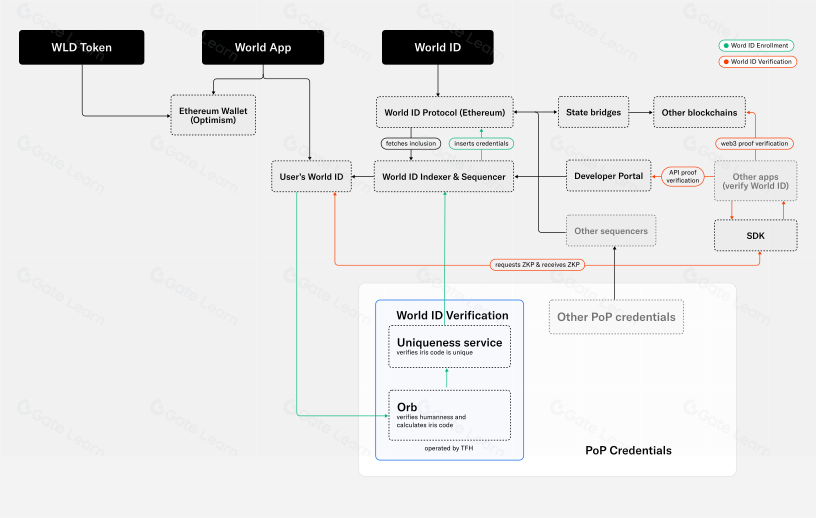
The report indicates that OpenAI is evaluating various "real identity verification" solutions, including Worldcoin's Orb iris scanning device and Apple's Face ID technology. The goal is not traditional real-name systems or account binding, but to verify a more fundamental question—whether the account corresponds to a real and unique human individual.
If this direction is true, it means OpenAI is not just creating a new social application, but is attempting to introduce a completely new underlying premise for social networks in the AI era.
Why Worldcoin is the first entity the market thinks of
Worldcoin is repeatedly mentioned not by coincidence. One of the co-founders of the project is Sam Altman, co-founder and CEO of OpenAI. Although his current focus remains on OpenAI, this connection makes it difficult for the market to view Worldcoin as an "unrelated third-party solution."
From the very beginning of the project design, Worldcoin was not just a token plan, but aimed to build a global "proof of human uniqueness" system. This goal seemed ahead of its time and even radical in the early stages, but after the widespread adoption of generative AI, it has begun to show real significance.
For this reason, when the market interprets this rumor, it is not just concerned with "whether there is cooperation," but whether OpenAI has begun to seriously consider issues of identity, and whether Worldcoin happens to be at the intersection of this issue.
After the proliferation of AI, social networks are losing the boundary of "human"
In the past, fake accounts were mostly low-quality bots or marketing armies, and the cost of identification was not high. However, with the maturity of generative AI, the situation has undergone a qualitative change. Today's fake accounts can simulate emotions, opinions, and behavioral rhythms, participate in public discussions, create the illusion of consensus, and even have a substantial impact on financial markets and public opinion.
The traditional response has been real-name systems or KYC, but the problems with this path are equally obvious. On one hand, it requires users to provide a large amount of private information, and on the other hand, it makes platforms highly centralized data nodes, increasing both privacy risks and regulatory pressures.
In this context, "real human identification" is being re-discussed. It does not attempt to answer who you are, but only verifies one thing: whether you are a real, singular human being.
Differences between iris scanning and Face ID
Worldcoin's Orb device generates a set of irreversible encrypted identifiers called World ID by scanning the iris. The project emphasizes that the original biometric features will not be stored but will be converted into mathematical proofs to ensure "one person, one number."
The advantage of this method lies in its strong uniqueness. The iris structure is highly complex and theoretically almost impossible to replicate, making it more suitable for underlying verification of "human uniqueness."
In contrast, the advantage of Face ID lies in its widespread use. Hundreds of millions of users are already using this technology daily, with a very low barrier to entry. However, the question remains whether it can meet the needs for cross-platform, non-repetitive registration, and serve as a long-term foundational infrastructure for identity.
This is also the core of the divergence behind the two approaches: the trade-off between convenience and uniqueness.
The rise of WLD, what expectations is the market trading?
The rapid rise of WLD is essentially not trading a piece of news, but trading a possibility. If the AI era truly requires a new identity standard, then the solutions adopted by mainstream platforms first will naturally possess strong network effects.
Once digital identity becomes infrastructure, it is difficult to replace. It cannot be easily migrated like ordinary applications, but will form long-term lock-in within the ecosystem.
From this perspective, the market is not betting that Worldcoin will definitely succeed, but whether it has the opportunity to enter the ranks of "standard candidates."
Regulatory and real-world issues still exist
Of course, this path is not easy. Worldcoin is already facing regulatory scrutiny over biometric data in several countries, and some regions have suspended the promotion of the Orb device. The deployment costs, speed, and global coverage capabilities of physical devices are all unavoidable real-world challenges.
For OpenAI, whether it is willing to deeply engage in a global identity layer system also involves complex political, legal, and social considerations.
This rise of WLD may recede as emotions fade, but the issues it points to will not disappear. When AI begins to participate in internet activities like humans, proving "who is a real person" will no longer be a philosophical discussion, but a problem that must be solved.
Whether Worldcoin will become the answer remains uncertain, but it is clear that digital identity is moving from a marginal issue in the crypto world to a core proposition in the AI era.
免责声明:本文章仅代表作者个人观点,不代表本平台的立场和观点。本文章仅供信息分享,不构成对任何人的任何投资建议。用户与作者之间的任何争议,与本平台无关。如网页中刊载的文章或图片涉及侵权,请提供相关的权利证明和身份证明发送邮件到support@aicoin.com,本平台相关工作人员将会进行核查。


