CZ's Davos Speech: The Three Main Lines of Cryptocurrency and the New Game of Regulation

CN
AiCoin
Follow
1 hour ago

Under the spotlight of the Davos Forum, this cryptocurrency giant pointed out that in the next decade, physical banks will sharply decline, while national asset tokenization, crypto payments, and AI autonomous trading will become new pillars of the industry.

On January 22, 2026, Binance founder Zhao Changpeng (CZ) delivered an important speech during the "Financial New Era" panel discussion at the Davos World Economic Forum. He noted that cryptocurrency trading platforms and stablecoins have matured into a large-scale application industry, and the three major directions for the future of the industry are: national-level asset tokenization, cryptocurrencies as "invisible" payment channels, and the use of cryptocurrencies as native currency for AI agents' autonomous trading.

CZ predicted that with the popularization of cryptographic technology and electronic KYC, physical banks will significantly decrease in the next 10 years. He also admitted that due to the vast differences in regulatory policies among countries, establishing a unified global regulatory framework for cryptocurrency faces severe challenges.

1. Future Cornerstone: CZ's Three Strategic Directions

CZ's core assertion in Davos is that the infrastructure of the crypto industry has been validated, and future growth will focus on three areas that are deeply integrated with the real economy.

National asset tokenization is placed at the forefront. CZ revealed that he is in talks with governments from over 12 countries to explore the tokenization of state-owned assets. This process has already made substantial progress, for example, Pakistan has planned to tokenize up to $2 billion of sovereign debt.

On the technical level, the New York Stock Exchange (NYSE) has also confirmed that it is building a platform for trading tokenized stocks and ETFs.

Cryptocurrency payments are moving from the forefront to the background, becoming an "invisible" underlying channel. CZ envisions that cryptocurrencies will deeply integrate with traditional payment methods in the background, driving massive growth in payment businesses. This does not replace existing payment interfaces but enhances their efficiency and breadth in clearing and settlement.

The native integration of AI agents with the crypto economy is a rather sci-fi vision. CZ believes that cryptocurrencies will become the "native currency" for AI agents. In the future, AI agents, after identifying needs and processing tasks, can bypass traditional financial intermediaries and directly use cryptocurrencies for payments and value settlements, achieving a fully automated business closed loop.

2. Banking Reform: Paradigm Shift in Traditional Financial Infrastructure

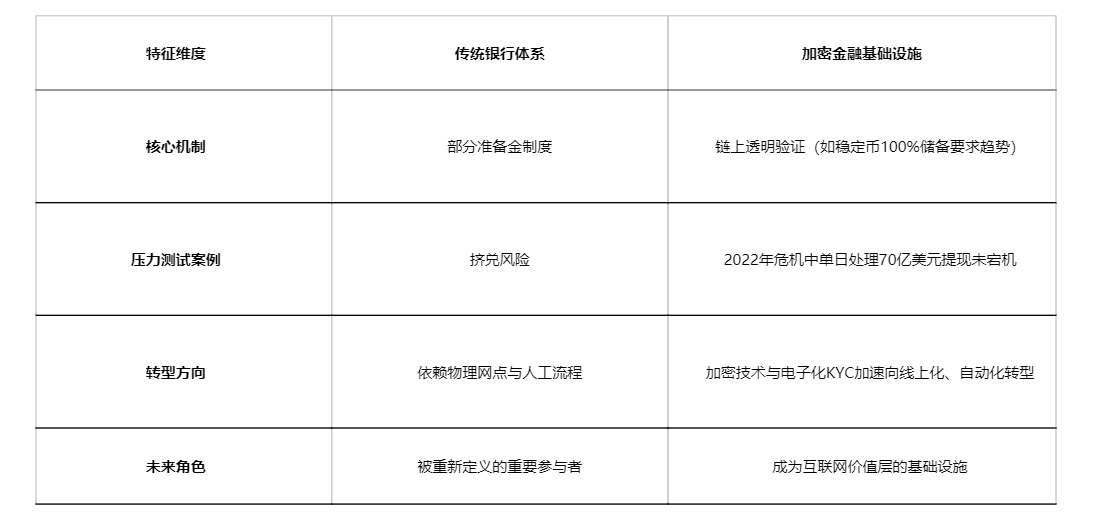
CZ made bold predictions about the future of traditional banks in Davos, with his core argument based on the stress tests that the crypto financial infrastructure has passed.

● He recalled the market panic following the FTX collapse in December 2022. At that time, Binance processed about $7 billion in withdrawals in one day and a total of about $14 billion in a week, during which no issues arose. He cited this as proof of the resilience of crypto institutions.

● CZ attributed the fundamental cause of banking risks to the "fractional reserve system" design. In contrast, he suggested that crypto assets represented by stablecoins follow more transparent reserve rules.

● He predicted that the online banking promoted by ING Bank is just the beginning, and cryptographic technology and electronic KYC will accelerate this transformation. In the next decade, people will increasingly not need to visit physical banks.

This does not mean the disappearance of banks, but rather that the entire industry's form will be redefined. The core ledger system of banks may be upgraded through integration with stablecoins and tokenized assets, achieving a "low-risk innovation path" to support new functions like real-time payments.

3. Regulatory Maze: The Ideal and Reality of a Unified Global Framework

While pointing out the bright prospects of the industry, CZ also candidly acknowledged the biggest systemic challenge currently faced—fragmented global regulation.

● He stated that due to different countries having "different priorities, different agendas, and different considerations," establishing a global unified regulatory body is "quite difficult." This difference manifests in reality as varying regulatory orientations.

● For example, the United States, Hong Kong, and Singapore have formed one regulatory system, while the European Union, Japan, and South Korea have formed another with different focuses. A report by PwC indicated that the global regulatory trend is shifting from rule-making to comprehensive enforcement by 2026, and a clear framework will intensify competition among jurisdictions for the status of crypto hubs.

● Despite the difficulties, CZ still expressed hope for establishing a favorable global regulatory framework for innovation, believing it will greatly simplify the work of industry participants. He is spending a lot of time exploring the shape of this framework and striving to collaborate with governments.

● The industry is also actively adapting. For instance, a Deloitte report pointed out that "asset segregation custody" and strict anti-money laundering (AML) requirements have become the "basic package" for regulating virtual asset service providers (VASPs) in developed economies worldwide.

4. Industry Debate: Meme Coin Frenzy and Rational Future

In Davos, a venue emphasizing global governance and sustainable development, CZ expressed a cautious view on the current meme coin craze, comparing it to the past NFT and metaverse trends.

● He clearly pointed out that such assets carry extremely high risks and are highly speculative. He believes that while meme coins like Dogecoin, which have unique cultural value, may exist in the long term, the vast majority of meme tokens will not be sustainable.

● This statement aligns with the overall judgment of Binance's senior management on industry trends. Binance co-CEO Richard Teng has predicted that 2026 will be a key year for cryptocurrencies to transition from the experimental stage to mainstream financial integration.

● This integration means that market valuations will increasingly shift towards fundamental factors, such as actual application value, sustainable economics, and compliance. The frenzy around meme coins highlights the industry's rational demand to return to value support and practical applications.

5. Trend Resonance: Institutional Reports Confirming Development Lines

CZ's predictions of the three major directions are not isolated; the latest reports from top global investment firms and professional service organizations corroborate the certainty of these trends from different perspectives.

Top venture capital firm a16z, in its released 2026 crypto sector trend outlook, detailed a future scenario that resonates with CZ's views.

● In the payment sector, the report noted that the annual transaction volume of stablecoins has reached about $46 trillion, nearly three times that of Visa, with the core challenge being to connect with the "in-and-out channels" of the daily financial system. A number of startups are working to integrate regional networks through QR codes and real-time payments, allowing digital dollars to be used directly for everyday consumption.

● Regarding AI agents, the a16z report provided profound insights on "from KYC to KYA (Know Your Agent)". The report pointed out that AI agents are currently "ghosts that cannot access the banking system," and in the future, they will need to establish their identity, constraints, and accountability through cryptographic signature credentials, which is a prerequisite for the true operation of the agent economy.

● Deloitte's report revealed another aspect of asset tokenization entering the mainstream from the perspective of accounting and compliance practices. With the passage of the U.S. GENIUS (Stablecoin Innovation) Act, the volume of B2B transactions using stablecoins has "skyrocketed."

● At the same time, how companies recognize and measure crypto assets on their financial statements has become an urgent issue. This seemingly technical detail is precisely a sign that this asset class is being genuinely accepted by the traditional financial system.

When asked about the future of meme coins, CZ gave a calm response in Davos, comparing the current frenzy to past NFT and metaverse waves, clearly stating that the vast majority of meme tokens lacking intrinsic value will be fleeting.

Meanwhile, the New York Stock Exchange is building a platform for trading tokenized securities, and the a16z report envisions AI agents completing value exchanges autonomously on-chain using cryptographic credentials. These two scenarios outline a clear trajectory: the core narrative of cryptocurrencies is shifting from speculative symbols in the retail market to serious tools for reshaping global value transfer and financial infrastructure.

Join our community to discuss and grow stronger together!

Official Telegram community: https://t.me/aicoincn
AiCoin Chinese Twitter: https://x.com/AiCoinzh

OKX benefits group: https://aicoin.com/link/chat?cid=l61eM4owQ
Binance benefits group: https://aicoin.com/link/chat?cid=ynr7d1P6Z

免责声明:本文章仅代表作者个人观点,不代表本平台的立场和观点。本文章仅供信息分享,不构成对任何人的任何投资建议。用户与作者之间的任何争议,与本平台无关。如网页中刊载的文章或图片涉及侵权,请提供相关的权利证明和身份证明发送邮件到support@aicoin.com,本平台相关工作人员将会进行核查。

Share To
APP

X

Telegram

Facebook

Reddit

CopyLink