Original Title: Bitcoin's Strategic Rebound: A Post-CPI Bull Case for 2026
Original Author: AInvest News Editorial Team
Translated by: Peggy, BlockBeats
Editor's Note: Last night, Bitcoin briefly broke through, with a 24-hour increase of 3.91%. This article explains why Bitcoin may still welcome a structural rebound from three clues: first, if the Federal Reserve starts cutting interest rates and QE in 2026, liquidity returning will raise the valuations of risk assets; second, when the market retreats, ETF funds withdraw, but core institutions continue to accumulate during the volatility, positioning themselves for the rebound; third, multiple on-chain valuation indicators show that Bitcoin is approaching its historical "value range," providing a more cost-effective entry window for medium to long-term funds.
The following is the original text:
The cryptocurrency market, especially Bitcoin (BTC), has long been regarded as an important indicator of macroeconomic changes and institutional sentiment. As we move towards 2026, multiple macro-level benefits and the return of institutional funds are converging, laying the groundwork for a strategic rebound in Bitcoin prices. This article will analyze how the Federal Reserve's policy path, cooling inflation, and changes in institutional behavior together form a strong bullish logic for Bitcoin in the coming year.
Macro Trends: The Federal Reserve's Policy Shift and Inflation Boost
The Federal Reserve's decision to start cutting interest rates and implementing quantitative easing (QE) in the first quarter of 2026 marks a key turning point in monetary policy. These measures aim to stimulate economic growth and address the still-present but easing inflation pressures. Historically, such policies have typically favored risk assets, including Bitcoin.
By the end of 2025, core CPI had cooled to 2.6%, alleviating market concerns about long-term high inflation and reducing the urgency for further significant interest rate hikes. In this environment, funds are more likely to be reallocated to alternative assets, and Bitcoin is increasingly viewed as "digital gold," becoming a digital asset option that benchmarks against gold.

The Federal Reserve's QE plan is particularly likely to further amplify liquidity in the financial markets, providing a favorable external environment for Bitcoin price increases. Historically, Bitcoin's average return in the first quarter is about 50%, often accompanied by a corrective rebound from the volatility of the fourth quarter. As central banks gradually shift their policy focus from "controlling inflation" to "prioritizing growth," the macro narrative surrounding Bitcoin is also shifting from a defensive logic to a more constructive bullish framework.
Institutional Return: Continuing Accumulation Amid Volatility
Despite significant capital outflows at the end of 2025, such as the $6.3 billion net outflow recorded by Bitcoin ETFs in November, institutional interest in Bitcoin remains strong. Companies like MicroStrategy continue to increase their holdings: they added 11,000 Bitcoins (approximately $1.1 billion) at the beginning of 2025.
Meanwhile, medium-sized holders further increased their share of the total Bitcoin supply in the first quarter of 2025. This strategic buying during volatility reflects a long-term commitment from institutions and medium-sized funds to Bitcoin as a "store of value."
The divergence between ETF fund outflows and continued institutional accumulation highlights a more subtle structural change in the market: when prices fall, ETF funds driven by retail sentiment choose to withdraw, while core institutional investors seem to be positioning themselves for a rebound in advance.
This trend also aligns with typical patterns in Bitcoin's history: although Bitcoin has generally shown an upward trajectory over the long term, short-term holders often continue to "sell at a loss" during volatility. This can be validated by the Short-Term Holder Spent Output Profit Ratio (SOPR): at the beginning of 2025, this indicator remained below 1 for over 70 days, indicating that short-term holders were generally at a loss when selling.
Such behavior typically signifies that the market is entering a phase of "long-term capital accumulation": when short-term funds are forced to cut losses and exit, it creates a more strategic buying window for long-term investors and provides conditions for institutions to find entry points at lower levels.
On-Chain Indicators: In the "Value Range," but Caution is Needed for Bearish Risks
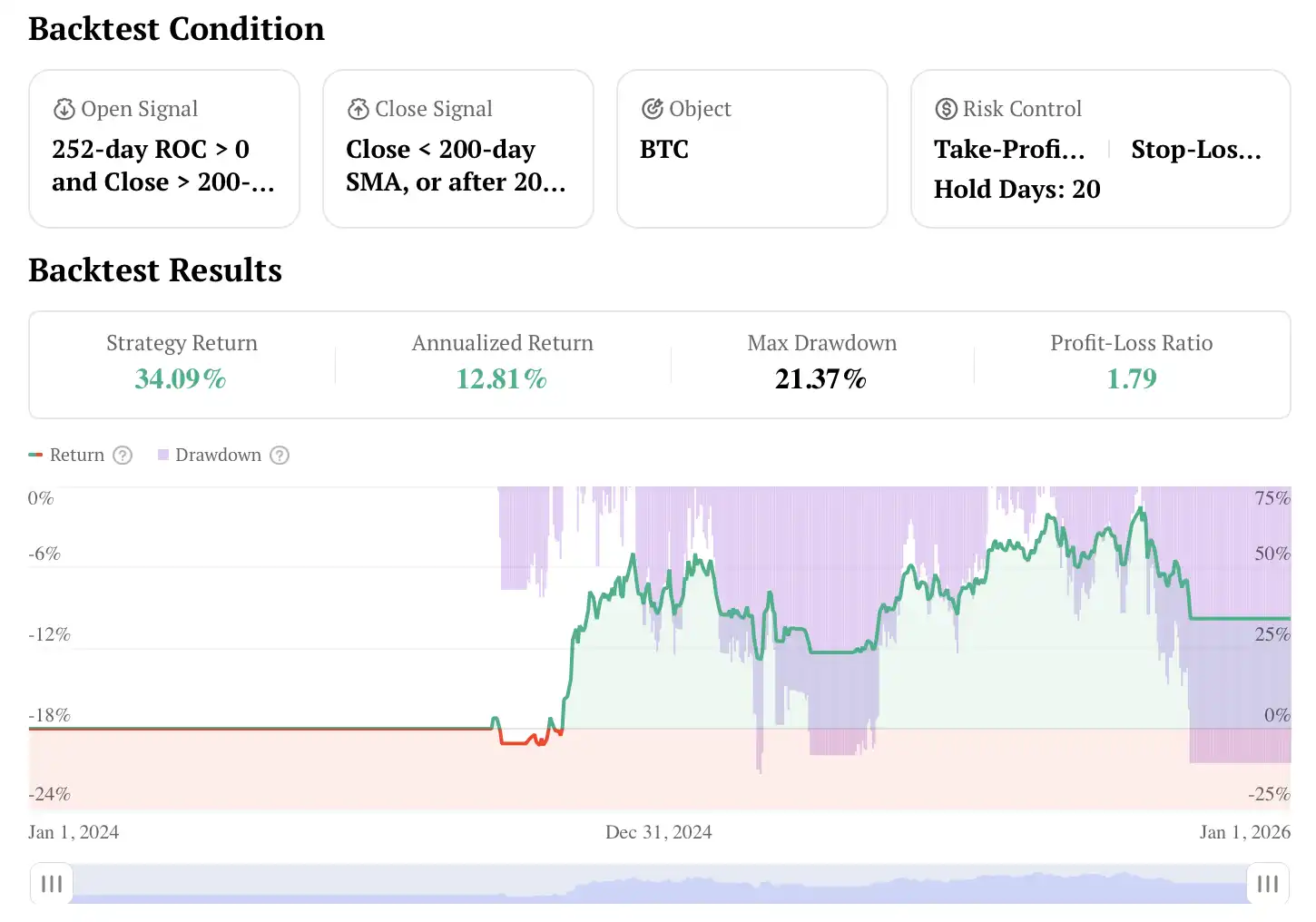
BTC Absolute Momentum Strategy (Long Only)
Go long when the 252-day rate of change is positive and the price closes above the 200-day simple moving average (200-day SMA). Exit when the price closes below the 200-day SMA; or exit when any of the following conditions are triggered: exit after holding for 20 trading days; take profit (TP) +8% / stop loss (SL) -4%.

By the end of 2025, Bitcoin's price trend showed a significant pullback: it fell approximately 6% for the year, with a decline of over 20% in the fourth quarter. Meanwhile, on-chain signals also showed divergence. On one hand, indicators like the "Percent Addresses in Profit" continued to weaken, and the selling behavior of long-term holders increased; on the other hand, indicators such as "Dynamic Range NVT" and "Bitcoin Yardstick" suggested that Bitcoin might be in a historical "value range," similar to the valuation states seen in previous important bottom areas.
This contradiction means the market is at a critical crossroads: the short-term bearish trend continues, but the underlying fundamentals suggest that the asset may be undervalued. For institutional investors, this structural divergence provides an asymmetric opportunity—downside risks are limited, while potential rebound space is considerable. Especially under the potential catalysis of the Federal Reserve's policy shift and Bitcoin's historical performance in the first quarter of 2026, this opportunity is further amplified; meanwhile, the narrative of Bitcoin as an "anti-inflation asset" is regaining market recognition.
Conclusion: The Rebound in 2026 is Brewing
The combination of macro tailwinds and the return of institutional funds is building a more compelling bullish logic for Bitcoin in 2026. The initiation of interest rate cuts and QE by the Federal Reserve, along with gradually cooling inflation, may drive more liquidity towards alternative assets, including Bitcoin; and even amid significant volatility in the fourth quarter of 2025, institutions continued to buy, reflecting their confidence in Bitcoin's long-term value to some extent.
For investors, the core conclusion is clear: Bitcoin's upcoming "strategic rebound" is not just a price-level correction, but a result shaped by changes in the monetary policy environment and shifts in institutional behavior. As the market seeks a new equilibrium during this transition period, those who identify macro and institutional trends aligning early may find themselves in a more advantageous position in the next phase of Bitcoin's market.
免责声明:本文章仅代表作者个人观点,不代表本平台的立场和观点。本文章仅供信息分享,不构成对任何人的任何投资建议。用户与作者之间的任何争议,与本平台无关。如网页中刊载的文章或图片涉及侵权,请提供相关的权利证明和身份证明发送邮件到support@aicoin.com,本平台相关工作人员将会进行核查。