📌 #Binance HODLer Airdrop Project for Issue 60 – Brevis ($BREV) Investment Mining and Price Analysis – The Binance HODLer Airdrop is generally an important signal that the market is starting to warm up.

CN
BITWU.ETH
Follow
3 hours ago

📌 #Binance HODLer Airdrop Project - Brevis ($BREV) Investment Mining and Price Analysis——

The Binance HODLer airdrop is generally an important signal that the market is starting to warm up.

As the first Hodler airdrop project of the year, the emergence of Brevis $BREV has attracted significant attention;

I have been following Brevis @brevis_zk for a long time:

Brevis is essentially a ZK co-processor or computing network, with its core innovation being the ability to perform complex data processing off-chain, only returning verified proofs to the blockchain, thereby reducing the workload on the blockchain.

Vitalik Buterin has publicly praised Brevis's Pico Prism technology, stating that in the tech circle, it represents "orthodoxy."

1️⃣ So what exactly is Brevis doing?

In one sentence: it is truly productizing the concept of "off-chain infinite computing power + on-chain verifiability."

The "verifiable computation" paradigm proposed by Brevis essentially addresses an old problem: on-chain computation is expensive, slow, and repetitive; yet many DeFi/incentive/data judgments must be trustworthy.

Brevis's solution is: perform computations off-chain, then use zero-knowledge proofs (ZK) to bring "I computed correctly" back on-chain, with contracts only doing millisecond-level verification, no longer executing repeatedly.

This is not a new concept, but Brevis is one of the few teams that have reached "production-level scale": Pico zkVM, ZK Data Coprocessor, ProverNet decentralized proof market.

These have already been used by PancakeSwap, Uniswap, Linea, MetaMask, and others.

2️⃣ Zooming out: Has the privacy + ZK line really come to an end?

I see many people in the project comment section saying that the privacy + ZK route has actually run out of options, but if you extend the time dimension, you will discover one thing: ZK has never disappeared; it has just been waiting for the infrastructure to mature.

Privacy, verifiable computation, and off-chain co-processing are inherently "endogenous demands" of Web3, whether it is BNB Chain's layout for the medium to long-term ecosystem or a16z's judgment on the next generation of blockchain architecture,

ZK has been repeatedly mentioned, but its form is changing:

From "Rollup exclusive tools" to "general computing and verification layers," coincidentally, Brevis stands at this turning point.

It is not betting on a specific chain but on the belief that an increasing number of on-chain behaviors will require "verifiable but not completed on-chain."

3️⃣ The design of the airdrop itself is a form of screening.

What I mainly want to discuss about Brevis here is that this airdrop should be noteworthy; first, it has a wide coverage, and second, the returns are decent.

Many people initially had low expectations for this airdrop—

After receiving it, they began to look into: what exactly is this project doing?

This is where I think Brevis has been quite "smart" in that it did not attempt to create FOMO through a scarce airdrop but instead: distributed tokens to as many real users as possible:

Using a method that does not overly stimulate the price, allowing the market to digest, understand, and price this project on its own.

The result is that many people received BREV first and then began to truly read its product logic. From a long-term perspective, this path is much healthier than "airdrop and abandon."

4️⃣ Market and Price Strategy (personal rhythm, not advice)

Not discussing predictions, just talking about rhythm.

From TGE to now, my first impression of Brevis's market is quite stable.

There has been no exaggerated surge; after Binance and then Upbit went live, the price has rebounded somewhat, and there has been no emotional selling pressure; the price movement appears to be completing a turnover within a relatively reasonable range.

This usually indicates one thing: the team is not in a hurry to use price to gain attention, so I have currently set some price points for this project.

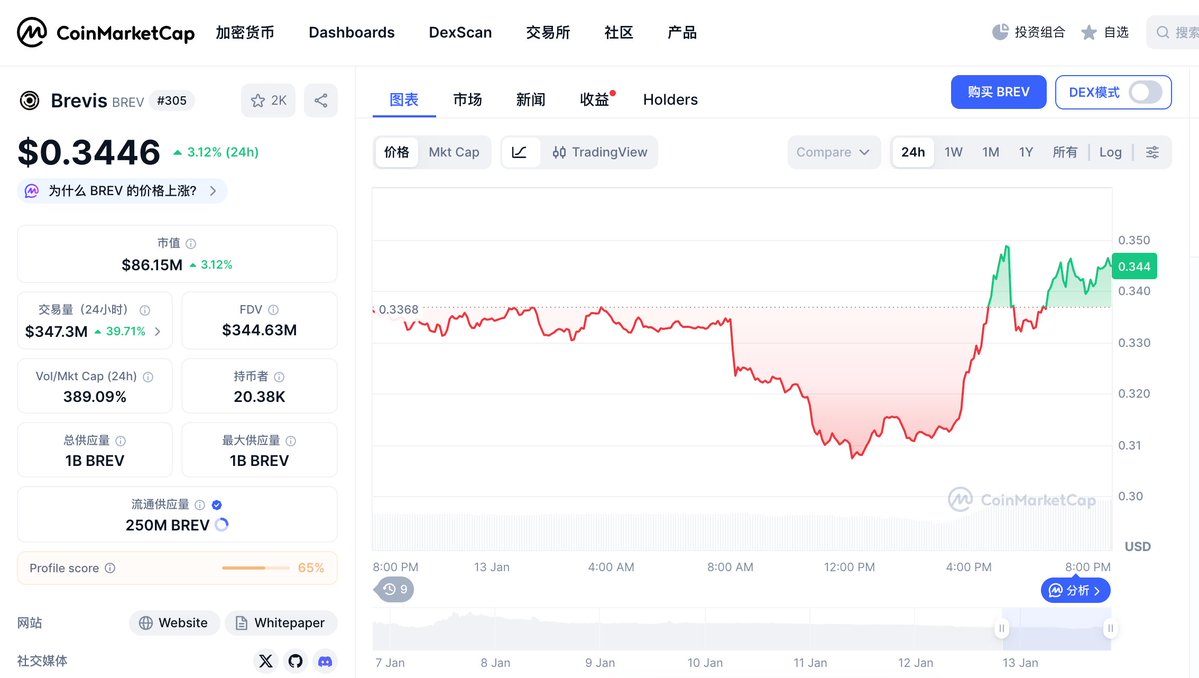
From the K-line perspective, BREV's recent movement is a typical "post-TGE surge—retrace—sideways—second rebound" structure:

It previously surged to around $0.55, then retraced all the way down and formed a bottom range around $0.32–0.34, with the recent rebound looking more like "the first lift after bottom turnover."

Circulation: 250M / 1B (25%), the chips are not extremely tight, but it is also not a fully circulating dump structure.

1) Market cap: $85.8M, FDV: $343M;

2) Key price levels (lines I will watch):

Support zone: $0.32 (recent bottom range), further down is $0.30 (psychological level/stronger defense line);

Resistance zone: $0.36 (first resistance of the rebound), $0.40 (previous midpoint/dense trading), $0.45 (will challenge if it continues to strengthen);

3) Short-term strategy:

Suitable for small positions to make waves, do not chase the rise. More inclined to observe support around $0.32–0.33, if it breaks below $0.30, consider it a sign of structural weakness and withdraw.

If it can stabilize above $0.36 with volume, it would be considered "the second rebound established," and there would be room to continue testing $0.40 above.

4) Mid-term observation:

Focus on two things:

1) After this rebound, can it "hold" above $0.34 to form a higher range;

2) After the trading volume drops, can the price remain stable (volume contraction without a drop is the real strength).

5️⃣ Final words

Many people only took the time to study Brevis after receiving the airdrop.

This "reverse order" path tends to leave behind true long-term participants.

The privacy + ZK line has not ended; it is just changing form; verifiable computation may not immediately become the main character, but once it becomes a "default capability," the value release will be nonlinear;

Brevis has at least reached the step from concept to production-level implementation.

As for the price, the short term is a rhythm issue, the mid-term is a data issue, and the long term is a directional issue.

I prefer to wait for it to provide more real use cases to slowly answer these questions.

Looking forward to better performance in the future!

免责声明:本文章仅代表作者个人观点,不代表本平台的立场和观点。本文章仅供信息分享,不构成对任何人的任何投资建议。用户与作者之间的任何争议,与本平台无关。如网页中刊载的文章或图片涉及侵权,请提供相关的权利证明和身份证明发送邮件到support@aicoin.com,本平台相关工作人员将会进行核查。

Share To
APP

X

Telegram

Facebook

Reddit

CopyLink