Penetrating the "degradation" of Ethereum's clamor: Why the "Ethereum values" are the widest moat?

CN
17 hours ago

In the past period, if you have been continuously following the Ethereum ecosystem, you may have experienced a sense of disconnection.

  • On one side, there are intensive discussions on technical topics such as scaling routes, Rollup architecture, Interop, ZK, PBS, and Slot shortening;
  • On the other side, there are debates surrounding "Is the Ethereum Foundation arrogant?", "Why not be more aggressive?", "Why is the coin price sluggish?", etc., which have even evolved into emotional oppositions;

These discussions actually point repeatedly to a deeper question: What kind of system does Ethereum ultimately want to become?

In fact, many controversies do not stem from technical differences but from different understandings of Ethereum's "value premise." Therefore, we must return to these premises themselves to truly understand why Ethereum has made choices that many consider "untimely."

1. Ethereum's "Ten-Year Itch": Is Ethereum Degrading?

The recent Ethereum community has not been calm.

From reflections on the Rollup-centric route to debates on the concept of "Ethereum Alignment," and comparisons with various high-performance public chains, a subtle yet persistent "Ethereum anxiety" is spreading.

This anxiety is not hard to understand.

While other public chains continuously refresh TPS, TVL, popular narratives, latency, and user experience metrics, Ethereum is repeatedly discussing architectural splits, execution outsourcing, interoperability, and finality issues, which seem neither intuitive nor advantageous.

This has also led to a sharper question surfacing: Is Ethereum "degrading"?

To answer this question, we cannot only look at the technical routes of the past year or two; we must pull back our perspective to a longer time dimension—returning to what Ethereum has truly adhered to over the past decade.

In fact, in recent years, many emerging high-performance public chains have chosen a more direct path: by reducing the number of nodes, raising hardware thresholds, and centralizing ordering and execution rights, to exchange for extreme performance and experience.

From the Ethereum community's perspective, such speed is often at the cost of sacrificing anti-fragility.

A commonly overlooked yet highly illustrative fact is that in nearly a decade of operation, Ethereum has never experienced a network-wide shutdown or rollback event, maintaining uninterrupted operation 7×24×365.

This is not because Ethereum is "luckier" than Solana, Sui, etc., but because it chose from the very beginning to prioritize whether the system can continue to operate under the worst conditions over performance metrics.

In other words, Ethereum appears slow today not because it cannot be faster, but because it is always asking a more difficult question—can this system continue to operate when the network scales larger, more participants join, and the environment becomes less friendly?

From this perspective, the so-called "ten-year itch" is not about Ethereum degrading; rather, it is actively enduring short-term discomfort and questioning for the sake of longer-term survival.

2. Understanding "Ethereum Alignment": It's Not About Taking Sides, But About Boundaries

Because of this, the first step in understanding Ethereum is to accept an unappealing yet crucial fact: Ethereum is not a system with "efficiency maximization" as its sole goal; its core objective is not to run the fastest but to be "trustworthy even under the worst conditions."

Thus, in the context of Ethereum, many seemingly technical questions are essentially value choices: Should we sacrifice decentralization for speed? Should we introduce strong permissioned nodes for throughput? Should we hand over security assumptions to a few for user experience?

Ethereum's answer is often negative.

This also explains why there is an almost instinctive vigilance within the Ethereum community towards shortcuts, where "can it be done" is always subordinate to "should it be done."

It is in this context that "Alignment" has become one of the most controversial concepts recently, with some fearing it may evolve into a moral coercion label or even become a tool for rent-seeking.

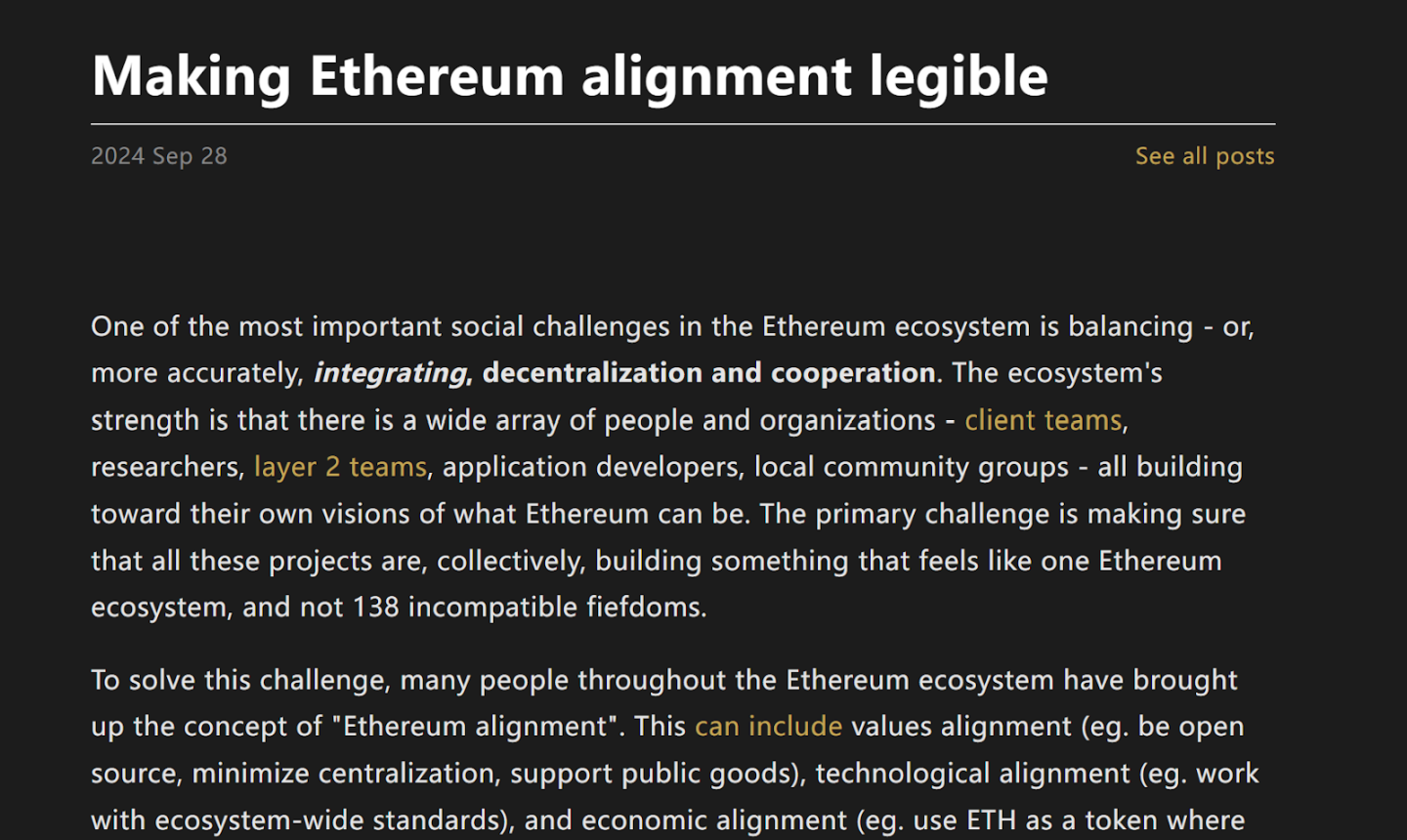
In fact, this concern is not unfounded. As early as September 2024, Vitalik Buterin pointed out this risk in "Making Ethereum alignment legible":

If "alignment" means whether you have the right friends, then the concept itself has already failed.

Vitalik's solution is not to abandon alignment but to make it interpretable, disassemblable, and debatable. In his view, alignment should not be a vague political stance but should be broken down into a set of attributes that can be examined:

  • Technical alignment: Do you use Ethereum's secure consensus? Do you support open source and open standards?
  • Economic alignment: Do you promote ETH's value capture in the long term rather than one-way extraction?
  • Spiritual alignment: Are you pursuing the public good rather than just predatory growth?

From this perspective, alignment is not a loyalty test but a social contract of mutual benefit.

The Ethereum ecosystem allows for chaos, competition, and even intense internal competition among L2s; however, all these activities should ultimately benefit the entity that provides them with security, consensus, and settlement guarantees.

3. The Reflection on "Decentralization" and "Anti-Censorship"

If "alignment" delineates the boundaries of values, then the two pillars that truly support this boundary are the long-standing commitments of Ethereum: decentralization and anti-censorship.

First, in the context of Ethereum, "decentralization" does not mean that more nodes are always better, nor does it mean that everyone must run a node; rather, it means that the system can still operate normally without trusting any single participant.

This means that the protocol should not rely on any single orderer, coordinator, or company; it also means that the cost of running nodes should not be so high that only professional institutions remain, ensuring that ordinary people can still verify whether the system is operating according to the rules.

Because of this, Ethereum maintains long-term restraint on hardware thresholds, bandwidth requirements, and state bloat, even if this slows down certain short-term performance metrics (see further reading "ZK Route 'Dawn Moment': Is Ethereum's Endgame Roadmap Accelerating?").

From Ethereum's perspective, a system that runs very fast but cannot be verified by ordinary people has essentially lost the meaning of "permissionless."

Another frequently misunderstood value is anti-censorship.

Ethereum does not assume that the world is friendly. On the contrary, it has from the very beginning assumed that participants may seek profit, power may concentrate, and external pressures will inevitably arise. Therefore, anti-censorship does not require "no one ever censors," but rather ensures that even if someone attempts to censor, the system will not fail as a result.

This is also why Ethereum places such importance on mechanisms like proposer/builder separation, decentralized construction, and economic game design—not because they are elegant, but because they can continue to operate under the worst conditions.

In many discussions, someone may ask, "Will such extreme situations really happen in reality?"

But frankly, if a system is only safe in an ideal world, then it is not worth entrusting value in the real world.

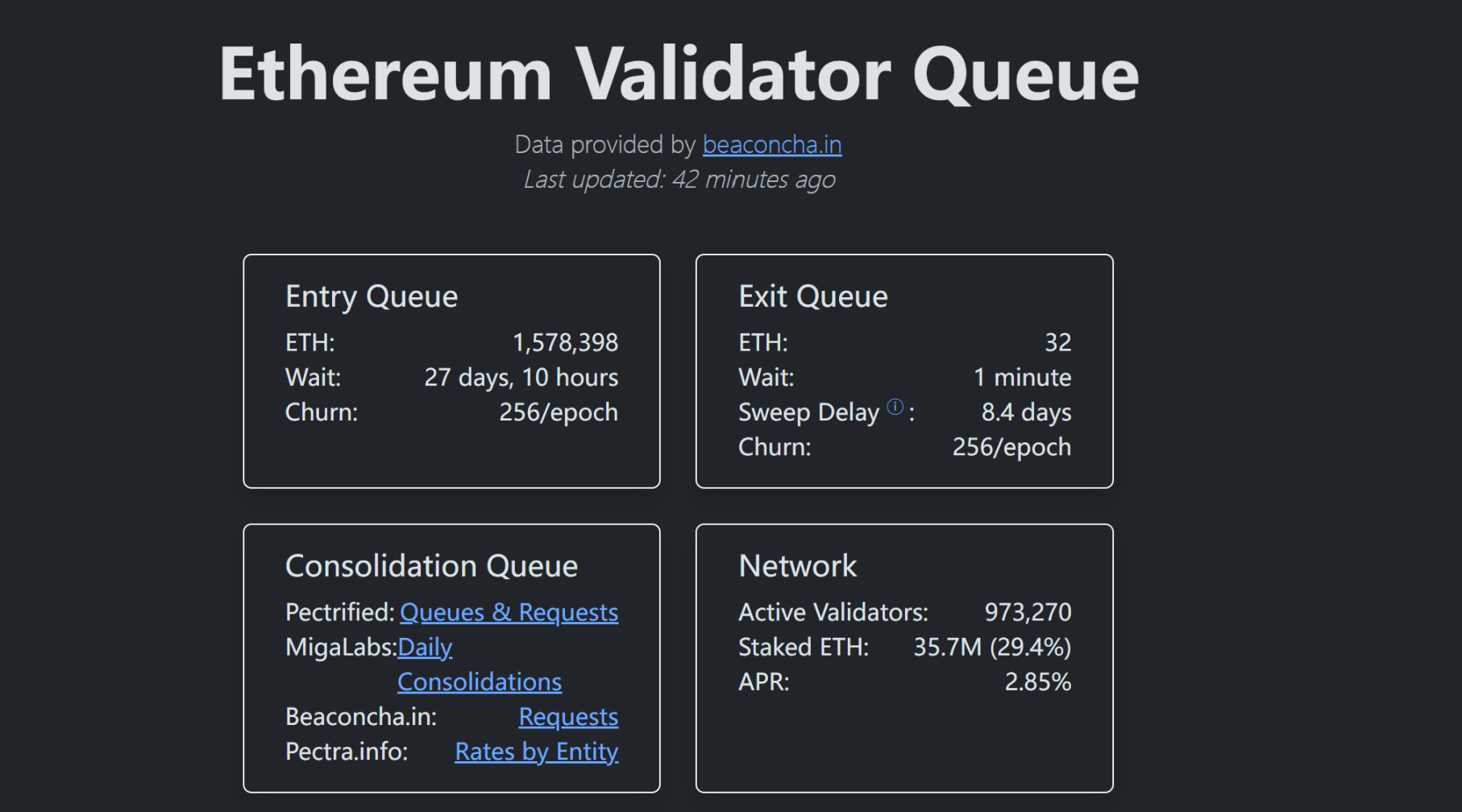
Finally, an interesting piece of data to conclude: the staking exit queue for Ethereum's PoS has almost been cleared, while the queue for entering staking continues to grow (over 1.57 million ETH).

Amidst controversy and skepticism, a large amount of ETH still chooses to be locked into this system for the long term.

This perhaps speaks more than any declaration.

In Conclusion

Many critics say that Ethereum is always "discussing philosophy after others have already started running."

But from another perspective, it is precisely these discussions that have allowed Ethereum to avoid repeatedly starting over—whether it is the Rollup-centric roadmap, the gradual introduction of ZK, or routes like Interop, fast confirmation, and Slot shortening, they all unfold under one premise:

All performance improvements must be able to be incorporated into existing security and value assumptions.

This also explains why Ethereum's evolution often presents a characteristic of "seemingly conservative, yet actually robust." Ultimately, it is not that it does not pursue efficiency, but that it refuses to exchange future systemic risks for current short-term advantages.

And this is the underlying spirit that has supported the Ethereum ecosystem through a decade—also the most scarce and worthy of protection aspect of Web3 in an era that prioritizes "efficiency/TVL."

免责声明:本文章仅代表作者个人观点,不代表本平台的立场和观点。本文章仅供信息分享,不构成对任何人的任何投资建议。用户与作者之间的任何争议,与本平台无关。如网页中刊载的文章或图片涉及侵权,请提供相关的权利证明和身份证明发送邮件到support@aicoin.com,本平台相关工作人员将会进行核查。

Share To
APP

X

Telegram

Facebook

Reddit

CopyLink