Original Author: The Rollup
Translated by: Peggy, BlockBeats
On January 8, Josh Swihart, CEO of Electric Coin Company (ECC), the core developer of Zcash (ZEC), disclosed in a post that the ECC team has recently left its original organizational structure and plans to establish a new company. The reason is that its governing body, Bootstrap (a nonprofit organization responsible for governing ECC and supporting Zcash), has shown a "significant and ongoing deviation" from Zcash's core mission.
ECC believes that the existing nonprofit governance structure has severely constrained project expansion in terms of financing, incentives, and execution efficiency, leading to the decision to collectively leave and continue promoting Zcash-related products in a for-profit manner. The nonprofit board responsible for governance, Bootstrap, believes that this transformation could lead to legal and political risks, which is difficult to accept.
Amid this disagreement, on January 9, former ECC CEO Josh Swihart announced the establishment of a new for-profit startup, CashZ (CashZ.org), focusing on the productization and commercialization of Zcash wallets, attempting to push Zcash towards its envisioned "billion-user scale" through a sustainable profit model.
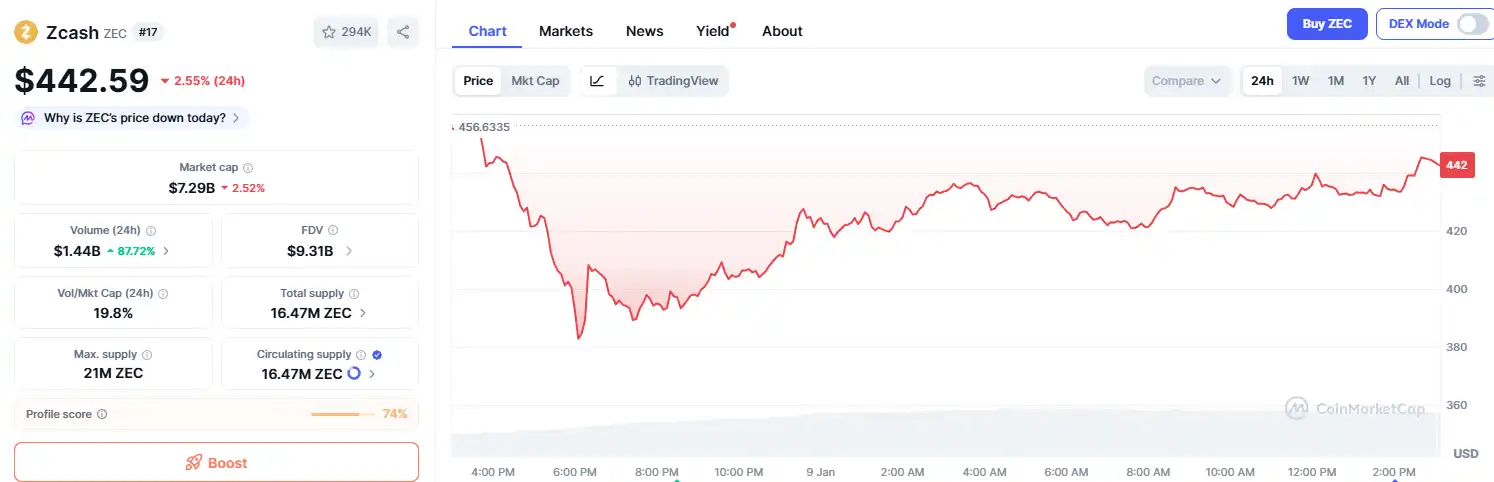
Following the news, the price of Zcash dropped by about 20%, reflecting the market's high anxiety over the collective departure of the core development team.
Regarding this governance controversy, the crypto podcast The Rollup provided a representative industry perspective. Co-founders and hosts Andy and Robbie reviewed the entire process of the ECC team's departure and the rapid establishment of CashZ during a live broadcast, arguing that this is not a project collapse but a structural adjustment that was bound to happen. In their view, the root of the conflict lies not in technology or vision, but in the tension between organizational form and expansion goals: when privacy protocols attempt to achieve large-scale adoption, nonprofit governance structures often become the bottleneck.
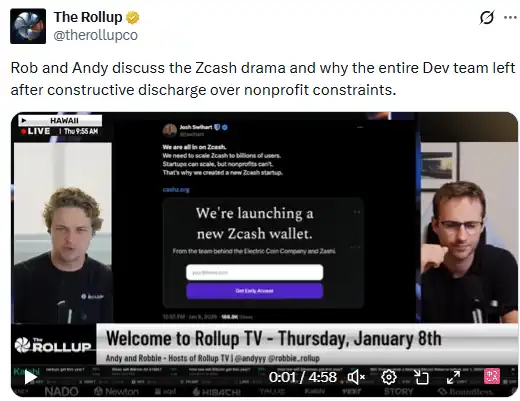
Based on this judgment, Andy and Robbie hold a relatively optimistic view of the establishment of CashZ. They believe that without creating a new public chain or issuing new tokens, but rather continuing to advance wallet products based on the existing Zashi codebase, a for-profit startup may actually provide a more realistic growth path for Zcash. This "departure" seems more like a reorganization focused on execution efficiency and scalability rather than an ecological split.
From a broader perspective, the Zcash controversy once again highlights a recurring industry proposition: when crypto projects enter the "scalable implementation" phase, the conflict between nonprofit foundations and for-profit teams often shifts from ideological disputes to trade-offs between efficiency and risk control. Zcash may just be the latest case.
The Birth of CashZ and Team Departure
Andy: Yes, Josh just posted that tweet. Our position is clear: we are fully committed to Zcash. Zcash must expand to a billion-user scale. Startups can achieve that expansion, but nonprofits cannot. That is precisely why we established the new startup CashZ.
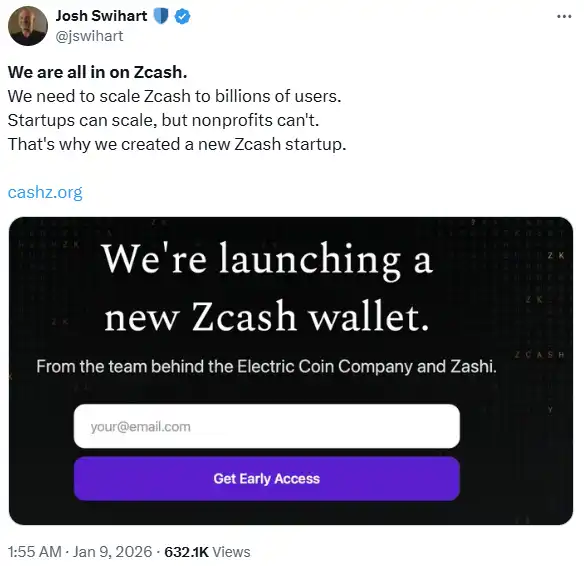
Rob: So they are actually creating an entirely new wallet.
Andy: Yes, but based on the same Zcash codebase, the project is codenamed CashZ. If you are a Zcash user, you just need to join the waiting list.
Josh also mentioned in yesterday's tweet that the situation has become very clear over the past few weeks: the majority of the board members of the 501(c)(3) nonprofit organization Bootstrap, which manages ECC—especially Zaki, Manny, Christina Garman, Allan Fairless, and Michelle Lai—have been named one after another. This situation itself has already become quite uncontrollable.
Mission Misalignment and "Constructive Discharge"
Andy: He pointed out in the tweet that it all stems from a clear misalignment with Zcash's core mission. After being handled by ZCAM (an entity related to Zcash community governance) in a "constructive discharge" manner, the entire ECC team chose to leave collectively.
In simple terms, the employment terms were unilaterally changed, making it impossible for us to fulfill our duties effectively and in accordance with professional ethics. We are indeed establishing a new company, but we are still the same team, carrying the same mission—to build an unstoppable privacy currency. It is important to emphasize that the Zcash protocol itself has not been affected.
Rob: He also included a link explaining what "constructive discharge" is. By definition, it refers to a situation where an employer creates a hostile or intolerable work environment, or uses other forms of pressure and coercion to force an employee to resign; in a legal sense, such resignation may not be considered voluntary.
Andy: Yes, as a result of this news, the price of Zcash has clearly dropped by about 20%.
Community Reaction and Controversy Surrounding Zaki Manian
Rob: Arthur has also started to "mock" the situation. No matter how it is dressed up, this does not look good. Balaji has always emphasized: Zcash can scale, must scale, and will eventually scale.
And now, Zaki is clearly bearing the brunt of the blame. Some even accuse him of having "plundered and destroyed" the Cosmos ecosystem and now messing up the Zcash team.
Andy: Oh my. Zaki has been in this industry for many years and has indeed done a lot of excellent work. At least on this point, I am willing to stand up for Zaki. Honestly, I am not clear about what exactly happened internally.
The Game of Profit vs. Nonprofit (Analogous to OpenAI)
Andy: Zooko has stated that these individuals, including Zaki, Allan, and Christina, all possess high standards of integrity. Clearly, there is a fundamental misalignment in the understanding of Zcash's mission on ethical and moral levels between the two sides.
Rob: This sounds almost like the disagreement that occurred at OpenAI back in the day: one side believes that only for-profit organizations can truly achieve scale and continuously deliver value; while the other side insists that nonprofit structures are the more correct and safer choice.
Andy: Zaki subsequently also released a statement expressing regret over this outcome. From Bootstrap's perspective, the board did discuss the possibility of bringing in external investment and achieving "privatization" through alternative structures, and worked closely with legal advisors throughout the process to ensure that any path complies with U.S. nonprofit law.
But it must be acknowledged that the institutional constraints faced by nonprofits are real, and properly addressing these limitations in a constantly changing environment is extremely complex.
Rob: It sounds like Zaki is also pushing for the establishment of a startup.
The Reasons for the Final Disagreement
Andy: The opposing side believes that under the current version, the proposed transaction plan would introduce new vulnerabilities for politically motivated attacks against Zcash, and could even allow any donor to have grounds for litigation. Therefore, their core goal is to prevent the entire Zcash ecosystem from facing systemic risks. Some proposals initially put forward "for the benefit of everyone" ultimately evolved into a trigger for division.
Rob: This is indeed regrettable, because from the outcome, the positions of both sides are not that far apart. Both sides hope to transform the original nonprofit structure into some form of for-profit entity to continuously generate revenue and build and expand Zcash. The reason they ultimately parted ways is simply that they could never reach an agreement on "how to safely complete this step."
免责声明:本文章仅代表作者个人观点,不代表本平台的立场和观点。本文章仅供信息分享,不构成对任何人的任何投资建议。用户与作者之间的任何争议,与本平台无关。如网页中刊载的文章或图片涉及侵权,请提供相关的权利证明和身份证明发送邮件到support@aicoin.com,本平台相关工作人员将会进行核查。


