# I. Current Status of the Privacy Track: Structural Rebound in 2025
In recent years, privacy has been one of the most controversial and easily misunderstood tracks in the cryptocurrency market. On one hand, the public and transparent nature of blockchain is seen as its core value. On the other hand, the demand for privacy has always existed and has been amplified in financial, commercial, and security aspects. As we enter 2025, with deeper institutional participation, the gradual formation of regulatory frameworks, and the maturity of cryptographic technologies such as zero-knowledge proofs, the privacy track is shifting from early adversarial anonymity to a more systematic, composable, and compliant infrastructure form. The privacy track is becoming a key variable that cannot be ignored in crypto finance.
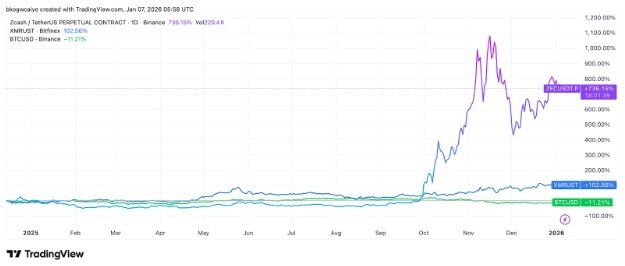
From a market perspective, the second half of 2025 has seen a clear phase of rebound in the privacy track. Traditional privacy assets represented by Zcash and Monero have outperformed the market overall, with Zcash experiencing a peak increase of nearly 1100% within the year, briefly surpassing Monero in market capitalization, reflecting a repricing of optional privacy and compliance flexibility. Unlike previous privacy coins that mainly served as niche hedging assets, this round of rebound more reflects a reassessment of the long-term value of privacy infrastructure.

From a technical and ecological structure perspective, the privacy track is undergoing a paradigm upgrade. Early privacy projects primarily focused on hiding transaction paths, addressing the issue of transfer anonymity, with typical representatives including Monero, early Zcash, and Tornado Cash. This stage can be seen as Privacy 1.0, with the core goal of reducing on-chain traceability, but with limited functionality and compliance flexibility, making it difficult to support complex financial activities. Entering 2024-2025, privacy is beginning to evolve into Privacy 2.0. The new generation of projects no longer merely hides data but attempts to complete computations and collaborations in encrypted states, making privacy a universal capability. For example, Aztec launched Ethereum-native ZK Rollup to support privacy smart contracts. Nillion proposed a blind computing network, emphasizing the use of data without decryption. Namada explores cross-chain privacy asset transfers within the Cosmos ecosystem. These projects collectively point to a trend: privacy is shifting from an asset attribute to an infrastructure attribute.
# II. Why the Privacy Track is Key: Preconditions for Institutionalization and Complex Applications
The resurgence of privacy as a core issue is not due to an ideological shift but rather a result of real-world constraints. From a longer-term perspective, privacy also possesses significant network effects. Once users, assets, and applications gather on a certain privacy infrastructure, the cost of migration will significantly increase, giving privacy protocols the potential "moat" property.
Institutional on-chain activities cannot be separated from privacy infrastructure: in any mature financial system, asset allocation, trading strategies, compensation structures, and business relationships cannot be completely transparent. A fully transparent ledger may have advantages in experimental stages, but after large-scale institutional participation, it can become a hindrance. Privacy does not weaken regulation; rather, it is a technical prerequisite for achieving "selective transparency," allowing compliance disclosures and the protection of business secrets to coexist.
On-chain transparency is bringing real security risks: as on-chain data analysis tools mature, the cost of associating addresses with real identities continues to decline, leading to a noticeable increase in issues such as extortion, fraud, and personal threats arising from wealth exposure in the past two years. This has transformed "financial privacy" from an abstract right into a real security need.
The combination of AI and Web3 raises higher demands for privacy: in scenarios where agents participate in transactions, execute strategies, and collaborate across chains, the system needs to verify compliance while also protecting model parameters, strategy logic, and user preferences. Such demands cannot be met through simple address anonymity and must rely on advanced privacy computing technologies such as zero-knowledge proofs, MPC, and FHE.
# III. Compliance Pathways for the Privacy Track: From Adversarial Regulation to Programmable Compliance
The core constraints facing the privacy track have shifted from uncertain policy risks to highly certain institutional restrictions. Represented by the EU's Anti-Money Laundering Regulation (AMLR), major jurisdictions worldwide are clearly prohibiting financial institutions and cryptocurrency service providers from handling "anonymity-enhanced assets," covering technologies that weaken transaction traceability, such as mixing, ring signatures, and stealth addresses. The regulatory logic does not deny blockchain technology itself but systematically strips away its "anonymous payment" attributes, embedding KYC, transaction tracing, and travel rules into the vast majority of cryptocurrency trading scenarios. Under the constraints of hefty fines, licensing risks, and preventive enforcement mechanisms, centralized channels have nearly zero tolerance for completely anonymous assets, fundamentally changing the survival conditions for privacy coins within the mainstream financial system.
In this context, the privacy track is being reconstructed from "strong anonymous assets" to "compliant privacy infrastructure." Following the Tornado Cash incident, the industry has gradually formed a consensus: completely un-auditable anonymous designs are unsustainable under the global anti-money laundering framework. Starting in 2025, mainstream privacy projects are beginning to shift towards three pathways: optional privacy, reserving compliance interfaces for institutions and exchanges; auditable privacy, achieving selective disclosure through zero-knowledge proofs or view keys; and rule-level compliance, embedding regulatory logic directly into the protocol layer to cryptographically prove compliance rather than retroactively tracing data. Regulatory attitudes have also become more nuanced, shifting from whether to allow privacy to what kind of privacy is permitted, clearly distinguishing between strong anonymous tools and compliant privacy technologies. This shift gives privacy infrastructure a higher long-term certainty compared to traditional privacy coins, evolving the relationship between privacy and regulation from opposition to a technical component of the next generation of verifiable financial systems.
# IV. High-Potential Privacy Track Project Profiles
1. Zcash: A Compliance Model for the Privacy Track
Zcash remains one of the most representative projects in the privacy track, but its positioning has undergone a fundamental change. Compared to Monero's "default strong anonymity," Zcash has adopted an optional privacy architecture since its inception, allowing users to switch between transparent addresses (t-address) and private addresses (z-address). Although this design was questioned by some privacy advocates in the early days, it has become its greatest advantage in the current regulatory environment. In recent years, the Zcash Foundation has continuously promoted upgrades to the underlying cryptography, such as the Halo 2 proof system, significantly reducing the computational costs of zero-knowledge proofs and paving the way for mobile and institutional applications. Meanwhile, wallets, payment tools, and compliance modules surrounding Zcash are also being continuously improved, gradually transforming it from an "anonymous coin" to a "privacy settlement layer."
From an industry perspective, Zcash's significance lies in its provision of a real-world case that demonstrates that privacy and compliance are not entirely opposed. In the context of further deepening institutional participation in the future, Zcash is more likely to serve as a regulatory reference for the privacy track rather than existing as a speculative asset.
2. Aztec Network: The Key Execution Layer for Ethereum Privacy DeFi
Aztec is one of the projects in the privacy track that is closest to being considered "core infrastructure." It chooses Ethereum as its security layer and implements privacy smart contracts through ZK Rollup, enabling the possibility of composable privacy capabilities with DeFi. Unlike traditional privacy protocols, Aztec does not pursue extreme anonymity but emphasizes programmable privacy: developers can define which states are private and which are public at the smart contract level. This design theoretically allows Aztec to support complex financial structures such as privacy lending, privacy trading, and privacy DAO treasuries, rather than being limited to transaction obfuscation.
From a long-term perspective, Aztec's potential value lies not in a single application but in whether it can become the default "privacy execution environment" within the Ethereum ecosystem. Once privacy becomes a necessary condition for institutional DeFi, native ZK privacy Rollups like Aztec will have a strong path dependency advantage.
3. Railgun: Practical Implementation of Protocol-Level Privacy Relay Layer
Railgun's uniqueness lies in the fact that it is not an independent public chain but provides privacy capabilities to existing assets in a protocol form. Users do not need to migrate assets to a new chain but can achieve privacy interactions for ERC-20, NFTs, and other assets through Railgun's shielded pool. This "relay layer privacy" model gives Railgun lower user migration costs and makes it easier to integrate with existing wallets and DeFi protocols. Its rapid growth in transaction volume in 2025 reflects the strong demand from real users for "privacy without changing ecosystems." Notably, Railgun is attempting to introduce interaction methods that align more closely with regulatory expectations, such as restricting sanctioned addresses from entering the privacy pool, indicating that it is not moving towards complete adversarial anonymity but exploring sustainable models under real-world constraints.
4. Nillion / Zama: Privacy Computing as Next-Generation Infrastructure
If Zcash and Aztec still belong to the realm of blockchain privacy, then Nillion and Zama represent a broader concept of privacy computing infrastructure. Nillion's proposed "blind computing" network emphasizes storing and computing data without decryption, aiming not to replace blockchain but to serve as a privacy collaboration layer between data and applications. Zama focuses on fully homomorphic encryption (FHE), attempting to execute logic directly in encrypted states within smart contracts. The potential market for such projects is not limited to DeFi but covers larger-scale application scenarios such as AI inference, enterprise data sharing, and RWA information disclosure. In the medium to long term, they are closer to the "HTTPS layer" of Web3, and once mature, their impact may far exceed that of traditional privacy coins.
5. Arcium: A Joint Brain for Privacy Computing in AI and Finance
While some privacy projects still primarily serve blockchain-native scenarios, Arcium's goal points to a broader data-intensive industry. It is a decentralized parallel privacy computing network that aims to become a "joint brain" for high-sensitivity fields such as AI and finance. Its core innovation lies in not betting on a single technological route but integrating multi-party secure computation (MPC), fully homomorphic encryption (FHE), and zero-knowledge proofs (ZKP) into a unified framework, dynamically scheduling the optimal combination of privacy strength and performance based on different tasks, thus enabling collaborative computing with data in an encrypted state throughout the process. This architecture has garnered official attention from NVIDIA and has been selected for the Inception program, focusing on privacy AI-related scenarios. At the application level, Arcium is building a decentralized trading dark pool, allowing institutional-level large orders to be matched under complete privacy conditions, avoiding front-running and market manipulation. Therefore, Arcium represents the cutting-edge direction of deep integration between the privacy track and real industries such as AI and high-end finance.
6. Umbra: The Invisible Cloak of the DeFi Ecosystem and a Compliance Pioneer
Umbra has a clear and pragmatic positioning, aiming to become an easily integrated privacy payment layer within the mainstream DeFi ecosystem. Initially gaining attention for its "invisible address" mechanism on Ethereum, it has now expanded its focus to high-performance public chains like Solana. By generating disposable, untraceable invisible addresses for recipients, Umbra makes each transfer difficult to trace back to the main wallet, effectively providing a layer of "invisibility" for on-chain payments. Unlike solutions that emphasize absolute anonymity, Umbra actively introduces the concept of "auditable privacy" in its protocol design, reserving technical space for compliance audits, which significantly enhances its potential for institutional adoption. In October 2025, Umbra raised over $150 million through an ICO, validating market recognition of its pathway. Its ecological expansion follows a "Lego-style" strategy, simplifying the SDK to allow wallets and DApps to integrate privacy payment capabilities at low cost. Its long-term key lies in whether it can successfully embed itself into the core application stack of mainstream public chains like Solana, becoming the de facto standard for privacy payments.
7. MagicBlock: A High-Performance Privacy Execution Layer for Solana Based on TEE
MagicBlock is a representative case of transitioning from on-chain gaming tools to high-performance public chain privacy infrastructure. Its core product is the Ephemeral Rollup, based on Trusted Execution Environment (TEE), aimed at providing a low-latency, high-throughput privacy computing layer for the Solana ecosystem. Unlike solutions that rely on complex zero-knowledge proofs, MagicBlock chooses to execute standard Solana transactions directly within hardware security enclaves like Intel TDX, ensuring the confidentiality of computations and data through verifiable "black box" methods, thus achieving performance close to that of the native chain. This engineering-oriented design allows developers to introduce privacy features to DeFi or gaming applications with minimal changes, significantly lowering the development threshold. MagicBlock precisely fills the structural gap in Solana's privacy layer and has thus gained investment support from key figures in the ecosystem. Of course, its solution relies on hardware trust, has limitations in cryptographic purity, and will face long-term competition after the maturity of zero-knowledge technologies. Overall, MagicBlock embodies a realistic approach that emphasizes usability and implementation efficiency in privacy infrastructure, serving as an important sample for observing how the market balances "ease of use" and "technical idealism."
# V. Outlook for the Privacy Track in 2026: From Optional Features to System Defaults
Looking ahead to 2026, the privacy track is unlikely to experience explosive growth characterized by high volatility and strong narratives; instead, it will likely penetrate the market through a slower but more certain path.
On the technical level, the engineering maturity of zero-knowledge proofs, MPC, and FHE will continue to improve, with performance bottlenecks and development thresholds decreasing. Privacy capabilities will no longer exist as "independent protocols" but will be embedded in the form of modules within account abstractions, wallets, Layer 2, and cross-chain systems, becoming default options rather than additional features. On the compliance level, the regulatory frameworks for cryptocurrencies in major economies are stabilizing. As market structure legislation and stablecoin regulations gradually take effect, institutional participation in on-chain finance is expected to significantly increase, directly amplifying the demand for compliant privacy infrastructure. Privacy will shift from being a "risk point" to a "necessary condition for institutional on-chain activities." On the application level, privacy will gradually become "invisible." Users may not be aware that they are using privacy protocols, but their assets, strategies, and identity information will be protected by default. DeFi, AI agents, RWA settlements, and enterprise on-chain collaborations will all assume privacy as a prerequisite rather than a post-factum patch.
From a long-term perspective, the real challenge for the privacy track lies not in "whether to be anonymous," but in whether it can continuously prove the system's trustworthiness and compliance without exposing data. This capability is the last piece of infrastructure that crypto finance must complete to transition from the experimental stage to maturity.
Risk Warning:
The above information is for reference only and should not be considered as advice to buy, sell, or hold any financial assets. All information is provided in good faith. However, we make no express or implied representations or warranties regarding the accuracy, adequacy, effectiveness, reliability, availability, or completeness of such information.
All cryptocurrency investments (including financial management) are inherently highly speculative and carry significant risk of loss. Past performance, hypothetical results, or simulated data do not necessarily represent future results. The value of digital currencies may rise or fall, and buying, selling, holding, or trading digital currencies may involve significant risks. Before trading or holding digital currencies, you should carefully assess whether such investments are suitable for you based on your investment objectives, financial situation, and risk tolerance. BitMart does not provide any investment, legal, or tax advice.
免责声明:本文章仅代表作者个人观点,不代表本平台的立场和观点。本文章仅供信息分享,不构成对任何人的任何投资建议。用户与作者之间的任何争议,与本平台无关。如网页中刊载的文章或图片涉及侵权,请提供相关的权利证明和身份证明发送邮件到support@aicoin.com,本平台相关工作人员将会进行核查。