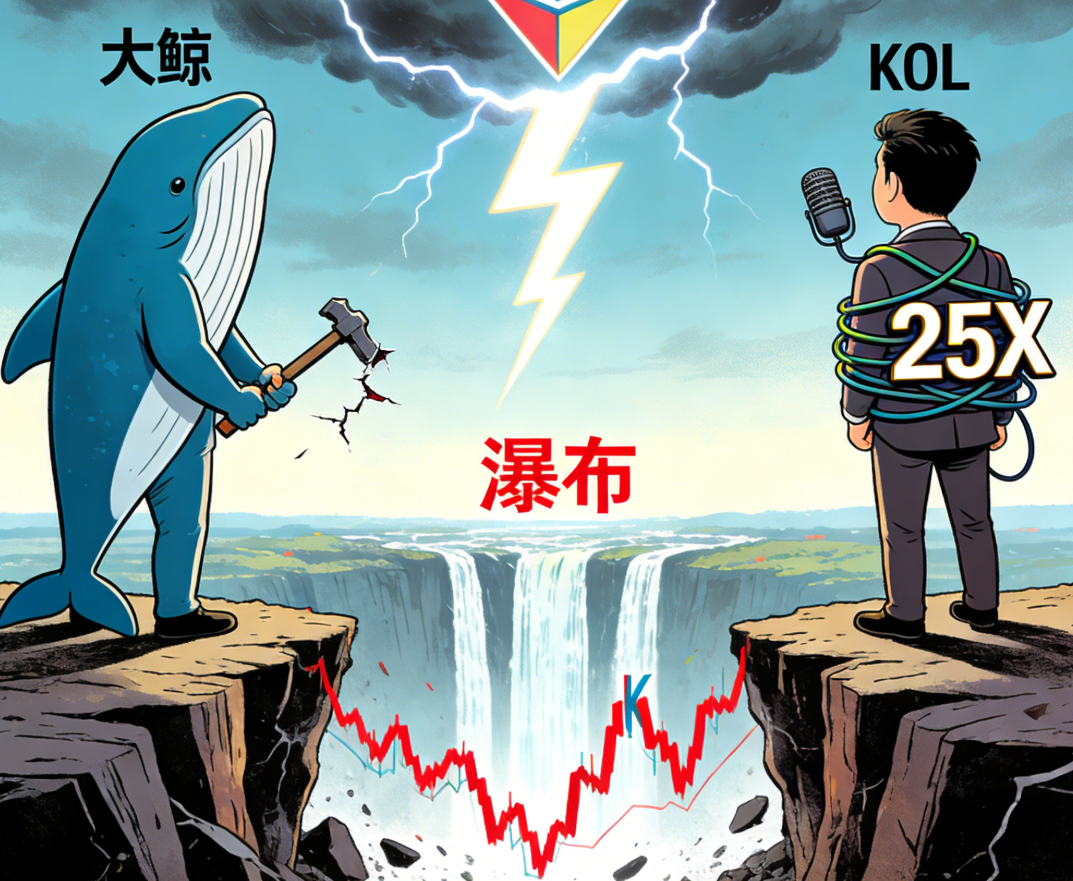
In the Eastern Eight Time Zone this week, the address related to Brother Ma Ji, Huang Licheng, staged a high-leverage emergency stop in the contract market: in the visible positions on platforms like Hyperliquid, he used approximately 25x leverage to go long on 9,700 ETH contract positions, which at one point showed a paper profit of over $1.1 million, but sharply turned into a paper loss of about $97,000 (according to a single source). In stark contrast, during the same market cycle, some established whales chose to steadily trade in spot and low-leverage ways. On-chain monitoring shows that the related address has accumulated profits close to $100 million through multiple wave trades, and another whale continued to increase its holdings by 10,000 ETH during this period, expanding its total position to 40,000 ETH, rolling up profits under relatively mild leverage. Behind this, there has been a directional change in the flow of funds into the U.S. Ethereum spot ETF, while the contract side accelerated speculation in the high-leverage range of 25x, subtly exacerbating the rhythm misalignment between the spot ETF and derivative speculative positions. This article will dissect the asymmetry of risk and return between high-leverage gambling and low-leverage wave trading, focusing on fund volume, leverage structure, and profit and loss fluctuations, and will discuss the potential divergence of high-leverage behavior from mainstream fund rhythms in the current stage in conjunction with ETF and trading volume signals.
Risk Exposure of Rapid Decline in High-Leverage Long Positions
● Position Volume and Leverage Setting: According to on-chain and Hyperliquid-related monitoring, this address used approximately 25x leverage on ETH contracts, corresponding to a nominal long position of 9,700 ETH, translating to a massive single-direction exposure in the Ethereum contract market. At such a multiple, any moderate price fluctuation will be magnified exponentially at the account level.
● Range of Profit and Loss Retreating from High Levels: Statistics from a single data source show that this 25x ETH long position once recorded a paper profit of over $1.1 million at high levels, but as ETH prices corrected, the position turned into a paper loss of about $97,000, resulting in a reversal of over a million dollars in the profit and loss range. This change reflects more the price sensitivity amplified by leverage rather than a "halving" level crash in ETH spot itself.
● Safety Margin Between Liquidation Price and Average Price: Public information indicates that the liquidation price of this long position is around $2,952.48, while the current contract average holding price is about $3,241 (according to a single source). The difference between the two is less than $300, meaning that if ETH dips by a few hundred dollars, the position will approach the forced liquidation range, leaving a very limited buffer window for actual retracement, which is the core systemic danger under high-leverage structures.
● Mismatched Leverage Across Different Assets: Notably, the same address used 10x leverage for the HYPE long position related to the Meme track, which currently still has about $61,000 in paper profit (according to a single source). This creates a representative mismatch scenario: using relatively moderate multiples on high-volatility assets like HYPE remains in the profit zone, while layering 25x leverage on a relatively mature large-cap asset like ETH has already experienced a sharp retreat from significant profits to paper losses.
Leverage Amplification Effect of Over $200,000 per 1% Fluctuation
● Deriving Price Sensitivity: With 25x leverage and a nominal position of 9,700 ETH, if we take the current price range as a reference, every 1% price fluctuation will cause the nominal market value of the position to change by approximately: 9,700 × current price × 1%. If we approximate the price to about $2,500, then a 1% fluctuation corresponds to a nominal market value change of nearly $242,500, which is the source of the approximately $242,500 profit and loss magnitude given for each 1% fluctuation in the research brief, reflecting that under this leverage multiple, even minor market movements can consume a large amount of margin.
● Capital Utilization Rate and Margin Compression: The core of high leverage lies in leveraging a large nominal position with relatively little margin. On the surface, the capital utilization rate is greatly enhanced, but at the same time, the range of price fluctuations that can be tolerated is sharply compressed. Once the underlying price experiences a few percentage points of reverse fluctuation, the floating loss space that the margin can cover will quickly be exhausted, triggering liquidation risks, which can evolve into a cascading liquidation during periods of high volatility.
● Retracement Space Relative to Liquidation Distance: Estimating based on the current average price of $3,241 and the liquidation price of $2,952.48, the allowable downward space is less than $300, meaning that a drop of approximately 8%–10% poses a risk of hitting the liquidation threshold (the specific ratio varies with real-time prices). Any retracement percentage and profit and loss amount derived from this is merely an illustrative explanation of the risk structure and does not equate to precise data from actual positions, nor can it cover slight differences caused by fees, funding rates, or partial reductions.
● Psychological Discrepancy with 10x Leverage Positions: In contrast, the same entity's 10x leverage HYPE position has a theoretical liquidation threshold that is further away in both price space and time dimensions, allowing for greater tolerance of reverse fluctuations, naturally reducing the psychological pressure by one to several levels. Faced with market adjustments, high-leverage positions need to respond intensively to the threat of liquidation lines in a short time, while mid to low-leverage positions have more ample time for risk hedging or gradual reductions.
Contrasting Path of Whales Steadily Accumulating Nearly $100 Million in Profits
Data from on-chain and Hyperliquid platforms indicate that during this market cycle, the differentiation between different fund volumes and trading styles has become increasingly clear. Taking the address related to Brother Ma Ji as an example, monitoring has pointed out that over a longer period, through multiple wave operations of ETH and other assets, it has accumulated profits close to $100 million. This figure comes from a single source but is sufficient to illustrate that without extreme leverage, utilizing trends and volatility for rolling trades can still accumulate considerable profits over a complete cycle. Meanwhile, the brief mentions that another whale chose to continue increasing its holdings by 10,000 ETH during the market volatility phase, raising its total position to 40,000 ETH. This action clearly leans towards long-term positioning in spot or extremely low leverage rather than short-term explosive gains. Compared to the short-term operations of KOLs using 25x or other high leverage on public platforms, the former has advantages in the smoothness of the profit curve and drawdown control, with the profit and loss amplitude of a single trade relatively converging, yet able to continuously accumulate upwards over a longer time. It is important to emphasize that the brief's mention of $1.135 million in paper profit from holding 8,600 ETH on January 7 and the specific holding size of 6,225 ETH on December 10 are marked as content pending verification, so this article does not base any precise profit backtesting or simulation on these points, retaining only the directional conclusion of "accumulated profits close to $100 million" to avoid misleading actuarial impressions in the absence of complete on-chain chronological data.
Rhythm Misalignment Under High Trading Volume and ETF Signals
Recently, the U.S. Ethereum spot ETF has seen changes in the direction of fund inflows and outflows, with funds not continuously pouring in unilaterally but rather showing a phase of entry and exit, with fluctuating sentiment. Against this backdrop, the contract market has continued to increase bets in the high-leverage area of 25x, and the rhythm differences between the spot ETF and on-chain contract speculation have begun to widen. Another aspect of market sentiment is that Bitget has disclosed that its TradFi-related trading volume has exceeded $2 billion (according to a single source), which indirectly confirms that current crypto-related trading activities and risk appetite remain at high levels, with both on-site and off-site funds seeking amplifiers of volatility and leverage. Due to the current lack of complete and authoritative detailed data on the daily net inflows and outflows of the U.S. Ethereum spot ETF, this article can only discuss changes in fund sentiment from a macro perspective, without providing specific values or date distributions to avoid excessive interpretation in the absence of complete information. When trading volumes on traditional platforms significantly increase, off-site funds often partially flow into compliant products like spot ETFs, while some amplify risk exposure through centralized or on-chain derivatives, thus forming structural differentiation between spot ETFs, off-site funds, and high-leverage on-chain positions: the former is more inclined towards medium to long-term allocation and risk diversification, while the latter tends to short-term speculation and maximization of returns. This misalignment, once faced with severe volatility, is often first borne by the leveraged end in terms of liquidation and bloodletting pressure.
The Clash of Meme Losses and High-Leverage Liquidations
As the sentiment in this market cycle has been pushed higher, cases of retail losses in extreme volatility assets have also emerged rapidly. A piece of data circulating in the market indicates that a trader of the Meme coin "114514" experienced a 93.77% evaporation of their principal during this round of volatility (according to a single source), nearly approaching a "zeroing" experience. The high volatility of such assets, combined with unstable on-chain liquidity, means that even slight chasing of highs or delayed stop-losses can lead to extreme retracements. Placing the significant losses of Meme coins alongside the trajectory of Brother Ma Ji's 25x ETH contract turning from high paper profits to paper losses in the same context reveals that within a unified market liquidity pool, different tracks are competing for the same risk capital and emotional premiums: on one side, high-leverage contracts layered on large-cap assets represented by ETH, and on the other, small-cap high-volatility tokens represented by 114514, both absorbing short-term risk appetite funds and synchronously completing the "harvesting" of retail investors when volatility reverses. High-volatility targets and high leverage are amplifiers of tail risk; when combined, if positions are misstepped, the loss curve can rise exponentially. This again emphasizes the importance of strict stop-loss discipline, diversifying positions, and controlling the scale of a single nominal position. In a phase where trading volume and sentiment are overall amplified, retail investors are more easily double amplified by KOL public performance and narratives around hot assets—on one hand, mimicking the "gamble" of high-leverage contracts, and on the other, chasing the "tenfold myth" of Meme and small-cap new coins, ultimately forming a continuous loss chain in a short time.
Insights from Gambling to the Edge of Zero
Looking back at this round, from whales steadily accumulating nearly $100 million in profits through low-leverage spot and wave strategies, to KOLs sliding from million-level paper profits to losses with 25x ETH long positions in the public eye, the two paths outline distinctly different risk-return profiles within the same market cycle. The former uses time and position management to exchange for a smooth and sustainable profit curve, while the latter pre-pays most of the future volatility in the present, resulting in extreme fragility where a single market misalignment can easily consume prior gains. In a phase where the inflow and outflow rhythm of institutional funds like the U.S. Ethereum spot ETF remains unclear and directionally unstable, relying solely on amplified leverage to "chase institutions" is more likely to misalign with mainstream fund rhythms: spot ETFs can choose to observe, reduce positions, and re-enter, while high-leverage contracts may be directly liquidated in the same wave of retracement. For ordinary traders, a more executable approach is to proactively set boundaries in strategy: limit the leverage multiples they can use, control the nominal position size within a proportion that the account can bear, and avoid temporarily changing position rules during emotional peaks due to screenshots of liquidations or profit performances on social media. Looking ahead, if ETH volatility continues to amplify, under the constraints of limited liquidity and margin, high-leverage contracts and small-cap assets are likely to become the first sectors to be liquidated and bloodletted, with funds tending to concentrate from these marginal risk assets to leading spot and more robust tools. Rather than fixating on a single price point for profit-taking, it is better to continuously monitor the shape of one's capital curve—whether the drawdown is controllable, whether the volatility is within the pre-set tolerance range, which often determines whether a trader can survive the complete cycle more than "the next 1,000-point market."
Join our community to discuss and become stronger together!
Official Telegram community: https://t.me/aicoincn
AiCoin Chinese Twitter: https://x.com/AiCoinzh
OKX Benefits Group: https://aicoin.com/link/chat?cid=l61eM4owQ
Binance Benefits Group: https://aicoin.com/link/chat?cid=ynr7d1P6Z
免责声明:本文章仅代表作者个人观点,不代表本平台的立场和观点。本文章仅供信息分享,不构成对任何人的任何投资建议。用户与作者之间的任何争议,与本平台无关。如网页中刊载的文章或图片涉及侵权,请提供相关的权利证明和身份证明发送邮件到support@aicoin.com,本平台相关工作人员将会进行核查。