Dialogue with Blockworks Co-founder: 27 Predictions for 2026

CN
1 day ago

整理 & 编译:深潮 TechFlow

Guest: Mike Ippolito, Co-founder of Blockworks

Host: David Hoffman

Podcast Source: Bankless

Original Title: 27 Crypto Predictions for 2026 (Ethereum Renaissance, BlackRock Chain & More)

Broadcast Date: December 31, 2026

Key Points Summary

image

David Hoffman and Mike Ippolito sit down to discuss why 2025, despite reaching historical highs, felt exceptionally challenging, and why this tension is crucial for 2026. They believe the crypto industry is entering a phase similar to the "2002 Internet"—a period where speculation gradually fades, fundamentals begin to matter, and industry consolidation accelerates.

The conversation covers the reasons Ethereum may experience a renaissance, why Bitcoin sentiment may face challenges, the actual performance of prediction markets and perpetual contracts, and the key areas builders and investors should focus on as the crypto industry shifts from speculation to genuine value creation.

(The video content is based on the 27 predictions proposed by Mike, but does not cover all predictions, focusing instead on selected key points for in-depth discussion.)

image

Highlights

  • I hope cryptocurrency can have a greater positive impact on the world; I am tired of the crypto industry being labeled as the "Wild West" and "scams."
  • Bitcoin's performance in 2026 will not surpass that of gold.
  • 2026 will be a very good year for DeFi.
  • 2026 will be the year of Ethereum, while Bitcoin may have a rough year, Solana will be relatively quiet, and Hyperliquid will face challenges.
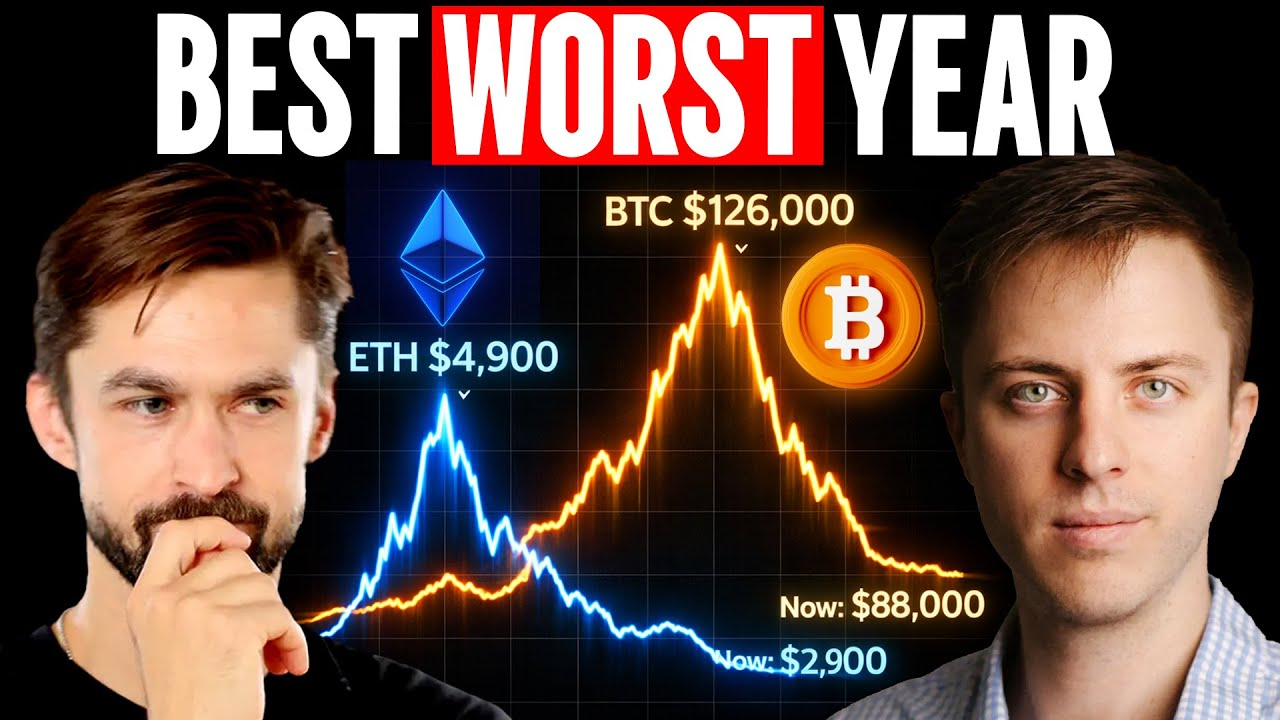
  • 2025 was both the best and worst year; we did not see the price bull market everyone expected.
  • The cryptocurrency market is gradually becoming more rational and fundamentals-based, moving away from its previous Wild West, irrational state.
  • If one can identify projects with compound growth potential and choose the right protocols, there will be good opportunities in 2026 and beyond.
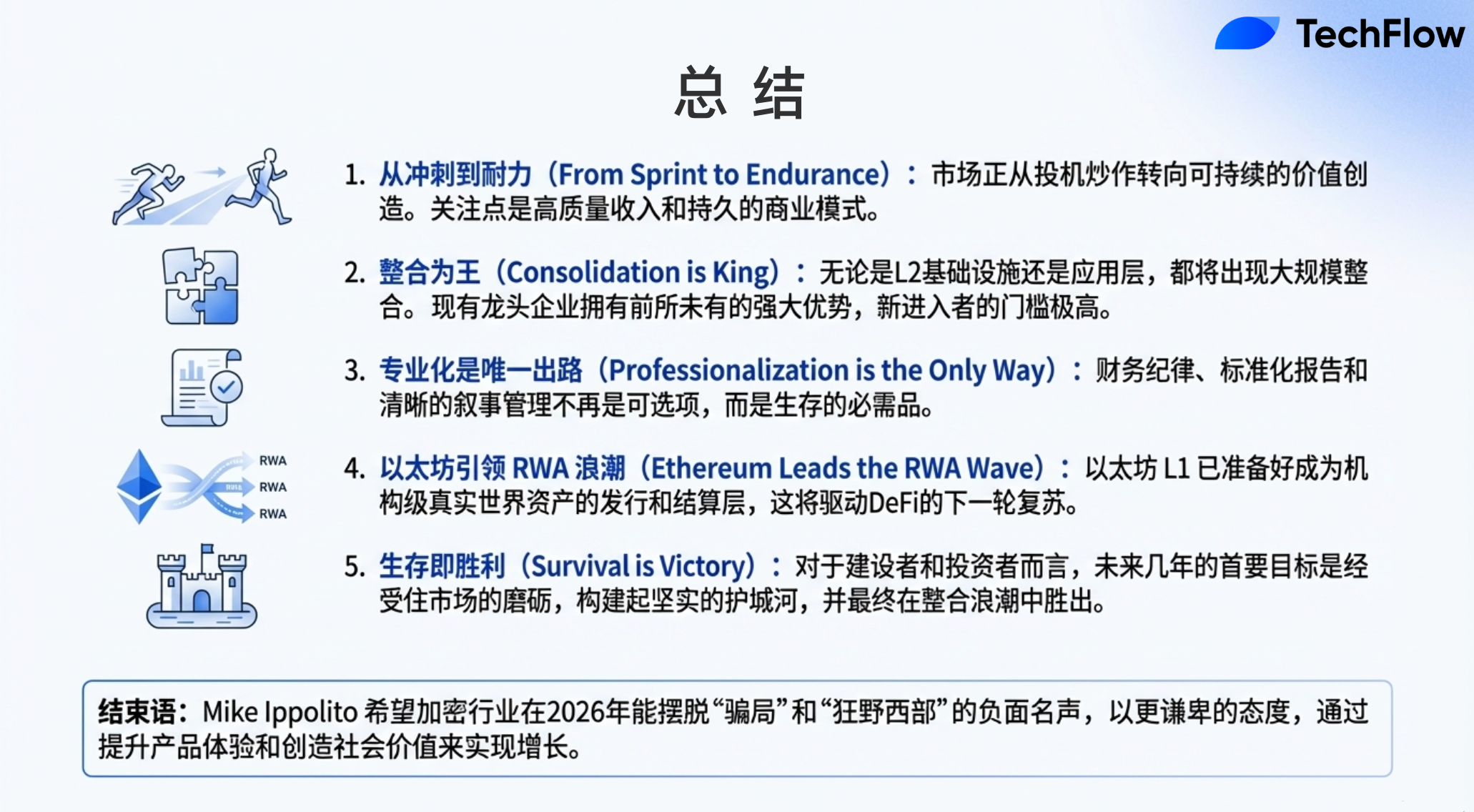
  • In 2026, we may continue to see consolidation trends across multiple key categories. In the next three years, "survival is victory" will become the industry's main theme.
  • Builders need to be prepared to be as creative as possible, think big, and strive to achieve their goals. They will either be acquired or excel in their fields and achieve consolidation.
  • 2025 and 2026 are years for positioning; without the frenzy, no one will suddenly become very wealthy because of cryptocurrency.
  • During cycles, when people feel bored, exhausted, or consumed by the market, it is actually the best time to persist.
  • 2026 will be a year of consolidation across multiple key categories; another theme is the integration of the stock market and cryptocurrency.
  • If there is a DATS worth paying attention to, it might be Tom Lee's.
  • Traders hope to complete all cryptocurrency and stock transactions on the same platform.
  • Ethereum is more like a chain for asset issuance, while Solana is more like a venue for decentralized exchange price discovery.
  • Quantum computing is not just a cryptocurrency issue; it will impact society as a whole.
  • Centralized exchanges will expand downwards or upwards depending on how they build their strategies. We will see more acquisitions in the future, and these launching platforms and centralized exchanges will actively participate.

Reviewing 2025: The Best and Worst Year

David Hoffman: Looking ahead to 2026, how would you evaluate or summarize the state of the cryptocurrency industry in 2025?

Mike Ippolito:

In my view, 2025 was both the best and worst year. The main reason is that we did not see the price bull market everyone expected. While Bitcoin and some major coins reached historical highs, the overall performance was below expectations, especially for investors in marginal altcoins. Most people suffered significant losses unless they were very lucky in selecting a few well-performing coins.

Ethereum and Solana broke historical highs at different points, but the extent was very small, leaving a confusing overall impression. This may have been the most challenging year for cryptocurrency investment, especially for those with a higher risk curve. From a price perspective, this year was filled with chaos and challenges.

I believe the crypto industry is now more meaningful than ever. An important theme this year is "cognitive dissonance." Many people feel this situation is unreasonable: the U.S. regulatory attitude towards cryptocurrency seems to have shifted to a "bear hug," we have seen the birth of many genius projects, and a clearer direction has emerged. Logically, these should drive asset prices up, but the market did not respond as expected.

The reason behind this is that the cryptocurrency market is gradually becoming more rational and fundamentals-based, moving away from its previous Wild West, irrational state. This change was predicted before, but it is only now starting to manifest. Many excellent projects in the market are continuously improving, yet prices keep falling. This phenomenon may become a theme for 2026, as the market shifts from speculative valuations to fundamental valuations.

Although many projects in the market are excellent, their pricing has been consistently poor. I believe this will continue to trouble investors until 2026. However, if one can identify projects with compound growth potential and choose the right protocols, there will be good opportunities in 2026 and beyond.

David Hoffman:

Yes, if you had told people at the beginning of 2025 that both Ethereum and Solana reached historical highs, everyone would have thought a bull market was coming, but in reality, these breakthroughs did not have a meaningful impact. Ethereum only slightly touched its historical high and then quickly fell back, leaving disappointment. Solana's performance lasted a bit longer, but it also lacked significant meaning. The only coin that consistently stayed above its historical high was Bitcoin, but even so, it is currently still 30% to 40% away from its historical high.

So in a sense, while we did see historical highs, the market did not truly feel the atmosphere of a bull market. Additionally, 2025 did not attract new cryptocurrency communities to join. In fact, all cryptocurrency investors have been in this space for at least three years, with the current median being five years. This means that market participants' expectations for the industry have formed, but these expectations were shattered this year.

As you said, we are becoming increasingly mature. Things are no longer the Wild West, and the market's expectations for the Wild West have not been realized, which I believe has led to a lull in market activity.

Mike Ippolito:

I agree, and I want to give the audience an analogy; everyone likes to compare it to the internet industry. I believe we are now in a phase similar to the end of 2001 to early 2002 Web 2.0. During the internet bubble, there were many bold ideas, and everything seemed possible. People envisioned building a complete internet world, and although this vision was ultimately correct, the path dependency and timing planning at that time clearly had issues, leading to excessive infrastructure construction.

Recently, I have heard a lot of discussions about AI-driven topics, especially related to GPU usage. The situation with dark fiber from 2001 to 2002 is exactly the opposite of today's GPU situation. At that time, the scale of submarine cable and bandwidth construction was enormous, and investors were enthusiastic about telecom companies, believing they would own the infrastructure of the internet. But the problem was that this construction was severely excessive, ultimately leading to a massive bear market. At that time, people even thought the internet was dead, and it took years to rebuild confidence.

Meanwhile, a new generation of builders began to enter the market. They recognized the existing infrastructure and built upon it, seeking new creative opportunities to establish businesses that could last for generations. This phenomenon illustrates an important theme—consolidation. In 2026, we may continue to see consolidation trends across multiple key categories. In the next three years, "survival is victory" will become the industry's main theme.

My advice is that builders need to be prepared to be as creative as possible, think big, and strive to achieve their goals. Frankly, as builders, there are basically two strategic options: either be acquired or excel in their fields and achieve consolidation. These are the two most viable strategic paths currently.

Looking Ahead to 2026

David Hoffman: I believe 2025 and 2026 are very important years for positioning, especially on Ethereum. I believe this view also applies to other areas. In terms of Ethereum, I think the L1 protocol performed quite well this year, such as zk EVM; everyone is talking about Ethereum, and its development speed is faster than we expected.

Perhaps we have advanced the timeline for zk EVM by 1 to 2 years, allowing us to significantly reduce block generation speed in 2026. The Ethereum protocol still has a series of technical improvements to build, deliver, and release, and I believe these will be achieved in 2026. By the end of 2026, I expect Ethereum's L1 protocol will be better positioned to capture growth opportunities in tokenization, Wall Street, and other areas. Whatever comes to be on-chain in the future, Ethereum will become a more suitable technical protocol.

Additionally, I think we can talk about the Clarity Act, hoping it will pass in 2026, which will better position the entire cryptocurrency industry to seize the potential of tokenization. Even Solana is worth mentioning. Solana has finally welcomed the integration of Firedancer technology. This technology will take time to truly complete integration and be accepted by the market.

I believe that 2025 and 2026 will be quiet years for positioning, without any frenzy, and no one will suddenly become very wealthy because of cryptocurrency. If someone does become wealthy, it will be an exception. We are collectively working to put all the elements on the table in the right way, preparing for potential value capture in the coming years. I think this is a characteristic of the post-bubble era, and now is the time to realign and build infrastructure correctly for future growth.

Mike Ippolito:

I completely agree, and I think this is a positive signal. Usually, when people talk about these things, there is an atmosphere of inevitability: yes, these things will eventually happen, it is unavoidable. But at the same time, people feel frustrated because they cannot achieve 100x returns on altcoins.

However, what I want to say is that in the long run, building real wealth now may be easier than it was in 1995. Over the past five years, very few people have made money in the cryptocurrency space, even though they may publicly claim to have profited significantly. The reason is that it is a very difficult investment environment, with almost no assets providing stable returns.

Apart from Bitcoin, Ethereum, and Solana, almost all other assets are more like trading tools rather than investment targets. I know there are some exceptions, but overall, I remain very optimistic. I believe we have finally entered an environment where real sustainability can be built, and those who can achieve compound growth will achieve great success.

Therefore, when we talk about the future, this potential pull effect is very exciting, this is the best time for the crypto industry in the past eight years.

David Hoffman:

I think we all know that during cycles, when people feel bored, exhausted, or worn out by the market, it is actually the best time to persist. If you can endure these difficulties, you will be in a favorable position. I remember in 2019, the situation was that everyone involved in the Ethereum ecosystem was basically only focused on Bitcoin and Ethereum. While there were also Cardano and Ripple communities, the Solana community was not as active.

For example, if you stuck it out and Ethereum positioned itself reasonably, you would benefit from the DeFi summer. You just needed to endure the bear markets of 2017, 2018, and 2019 to get there, as others had already left. The result is that opportunities in the market become very abundant because there are not many people competing. I feel that this situation will happen again, as people are being worn down by the market, and the market is not igniting investors' enthusiasm.

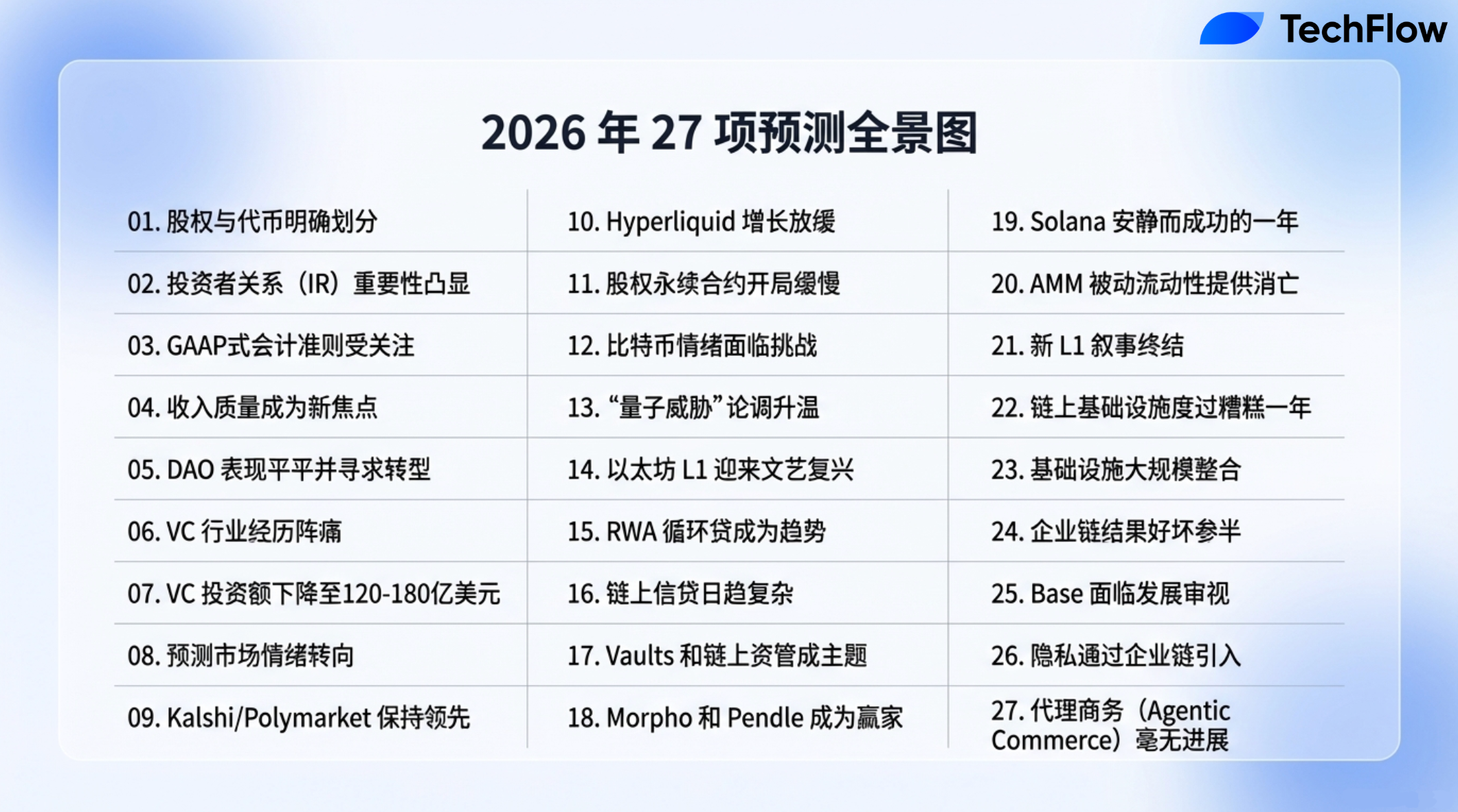
David Hoffman: Your 27 industry predictions cover different ecosystems, and we will try to discuss them one by one. Before we officially start, how do you think we should guide the audience?

Mike Ippolito:

I think we can first focus on some general themes. For example, we will validate or overturn some long-held beliefs in the industry. In the past, the crypto market was a relatively irrational and very early market, where creating real value was not a necessary condition in most cases, so there was no effective feedback mechanism.

It has not been clear which beliefs were correct or incorrect in the past, but I believe that by 2026, many things will have clear determinations. I also think 2026 will be a year of consolidation across multiple key categories. We have seen similar situations in the past. My favorite example is in the major brokerage business area.

Additionally, I think another theme is the integration of the stock market and cryptocurrency. I mean, we may see something similar to equity futures in 2026, although I am skeptical about the practical implementation of this model. But I believe that cryptocurrency will develop in a way that is more based on fundamentals and real value, while the stock market will also borrow some characteristics from cryptocurrency. I think this integration has already begun to happen.

These are my main themes for 2026.

Investor Relations in the Crypto Space

David Hoffman: Let's move on to the first theme. This is a current topic—investor relations will become increasingly important. Investors will demand standardized financial disclosures. While investor relations will borrow some aspects from traditional investor relations, it will also pay more attention to social media and community, ultimately redefining its performance in the stock market. This is exactly what you mentioned, the community management of investor relations may merge with traditional stock markets, and traditional stock markets may also realize this and think, we need to do this too.

Mike Ippolito:

Yes, I think people need to build a mental model. When a business does not have publicly traded financial instruments, it only has one product, which is its business. But once a publicly traded financial instrument, like a token or stock, is launched, the CEO or founder of the business actually has two products: one is the business, and the other is the financial instrument. This means you need to constantly tell the market the story of this asset, so everyone understands it.

You have your business product and your financial instrument. This means you need to continuously tell the market the story of this asset, narrating it to everyone. You need narrative management; businesses cannot expect that "if you build it, they will come." Therefore, in addition to ensuring that your product and business are meaningful to investors, you also need to constantly tell the market the story of this asset. Historically, this narrative management has often been comprehensive and systematic.

However, I have also observed how the stock market operates, and some aspects are done very well, such as the standardized financial reporting system (like GAAP), which provides a unified accounting standard for all U.S. companies. But at the same time, there are some things that seem very outdated, like using old software to get Zoom links and meeting with a group of analysts, etc.

A few years ago, CoinShares was a company that performed well. As a publicly listed company in Europe, they at least used to conduct quarterly earnings releases through Twitter Spaces. And now, we are starting to see some protocols or companies, like Etherfi, also adopting similar approaches. I actually saw Vlad Tenev say a few days ago that they are rethinking Robinhood's investor relations, planning to make it more community-driven while utilizing social media channels, etc. Therefore, I believe the crypto space will borrow certain principles, like standardized processes, and invite analysts to participate. But in the long run, the stock market may realize this and start rethinking their operational methods.

David Hoffman: We have already seen Coinbase and Robinhood hosting product launch events this year similar to Apple's, almost like showcasing their products. This indeed aligns with your point: we need to take control of our narrative. This approach can directly target the audience interested in Robinhood. For Robinhood's investors, they can clearly see: "Yes, we did launch new products this year, and this is our achievement." I remember Coinbase has held at least a few similar events, like the launch of Base, and some recently revealed new products. They directly introduce these contents to their audience and explain why these products are worth investing in.

Mike Ippolito:

I think this is a significant change this year, and I have two related predictions. I believe there will be a lot of discussions about GAAP accounting standards this year.

GAAP, Generally Accepted Accounting Principles. There is an old joke about accountants: a hiring manager is interviewing an accountant, and the first person comes in and is asked, "What are these numbers?" He gives an answer and leaves. Then the second person comes in, and the answer is, "This is what I think these numbers should be." Finally, the third person is asked the same question, and he answers, "What do you want these numbers to be?" So he gets hired.

This joke illustrates that there is a lot of flexibility in accounting treatment. Even among many data providers in the crypto space, the standards are very inconsistent, and the revenue figures reported by different companies vary widely. This calls for a recognized standard to clarify how to handle revenue, how to calculate costs, and how to aggregate this data into cash flow statements.

Of course, there is some flexibility in accounting treatment, but there are also rules that dictate what can and cannot be done. These rules constitute the accounting treatment accepted by publicly traded companies in the U.S. However, for cryptocurrency companies, the burden remains too heavy, and it is very difficult to meet such standards. While some lightweight solutions may emerge, I believe there will be a lot of discussions about GAAP accounting standards this year, but the entire industry is still unable to reach this standard, and the difficulty of improvement is indeed too great.

There has also been a lot of discussion about dual-token equity structures. My long-term prediction is that in 90% of cases, this structure is simply unworkable. It is just a legacy structure that originated from the SEC during Gary Gensler's era, and can even be traced back to before J. Clayton's time at the SEC. Essentially, it is a remnant of an attempt to engage in some regulatory arbitrage. However, many psychological models built on this structure have not worked.

We have already seen many public disputes, like the case of Aave. I believe such disputes will continue to arise. At the same time, I think Uniswap deserves significant praise in this regard. They have taken a very bold and difficult initiative, and I sympathize with that. I am not targeting Aave; this is a very difficult thing because it involves unraveling the results of much work that has already been completed, but the market may need some time to push protocol leaders to take action. I expect these issues will not be fully resolved by 2026. We may start to hear some discussions that certain protocols—especially those with less organizational or governance burden—may quickly follow Uniswap's lead. But I think most protocols may take a delaying attitude toward this.

However, I do believe that investors will begin to publicly question these protocols and may develop negative views toward those that adopt dual equity and token structures.

The Evolution of Revenue Discussions

David Hoffman: Let's continue to discuss the third prediction for 2026. The discussion of revenue will gradually shift towards durability and quality. Companies that can generate more predictable revenue will gain market recognition for the first time. Enterprise software will become popular in the crypto space. Please elaborate on this.

Mike Ippolito:

I am glad to see that our industry has already begun to focus on the discussion of revenue. If you have listened to discussions in the stock market, you will find a viewpoint that I strongly agree with: not all revenue is equal. In the stock market, certain types of revenue are assigned higher multiple valuations, and this is often related to the quality of the revenue.

So, how sticky is the revenue? Is the revenue repeatable? Does 80% of the revenue come from a single customer? Is the revenue highly cyclical? All these different characteristics will be dissected and analyzed to assess the business moat that investors typically care about, as well as the level of risk that the business faces in its revenue structure.

We haven't even talked about the issue of profit margins, but I think there is a similar phenomenon in the crypto industry. In the past, we often made the mistake of annualizing the peak of revenue when we saw revenue charts climbing upward, or assigning overly high valuations to the peak of cyclical revenue. For example, when you focus on cyclical stocks, an intuitive phenomenon is that cyclical stocks are actually the cheapest when they look the most expensive, and the most expensive when they look the cheapest.

This saying was widely circulated, and as an industry, we have often made this mistake in the past, assigning overly high valuations to highly cyclical revenue. I believe investors will gradually stop trusting this unreliable revenue, which is actually a step in the right direction. I think this will drive the entire industry to start paying more attention to sticky revenue and high-quality revenue. You know, in the crypto space, this revenue model is actually very scarce. Although some companies are trying, they have not fully realized it.

These on-chain products may have tokens or other sources of income, but I believe we will see more efforts to drive sticky and high-quality revenue in the future. Because the fact is, not all revenue is equal.

The Future Development of DATS

David Hoffman: We move to the fifth prediction: DATS will essentially be inactive. Some companies may try to make acquisitions in infrastructure and attempt to transform into operating companies, but these efforts will not truly succeed. You predict that DATS will have a weak year in 2026, which I think aligns well with the current state of the industry. But will there be exceptions?

Mike Ippolito:

I am not taking too much risk with this prediction, but I do believe that DATS will face considerable challenges in 2026. However, I think the only possible exception is Tom Lee's DATS. I believe Tom Lee is doing an excellent job in this regard, and he has a very high reputation on Wall Street. I also think this is closely related to the natural rebound of Ethereum's core metrics, which may generate interest from investors.

Please note, this is absolutely not financial advice, and everyone should do their own research. But I believe that if there is a DATS worth paying attention to, it might be Tom Lee's. Additionally, I think you will see some DATS trying to transform into operating companies that provide yields.

However, I think many cryptocurrency companies are experiencing similar situations. Some of the most prominent categories once received huge speculative premiums, but when they try to transform into more fundamental models that can create real value, unfortunately, they must reassess their performance based on new metrics. It can be said that some of these DATS have already undergone this reassessment, as the performance charts of most DATS in the market do not look optimistic.

But I still believe it will take some time for the market to start rewarding this structure. Besides "I am Soul plus a lot of extra Beta ETH plus extra Beta," there is a completely different story that needs to be told. I think this will take a long time, but I do believe you will see some DATS trying to move towards more sustainable structures, such as making acquisitions related to staking or yields.

Investment Trends in Venture Capital (VC)

David Hoffman:

Your sixth prediction is that venture capital (VC) investment will be weak. It is predicted that investment in 2025 will slightly decrease, from $25 billion in 2025 to an estimated $15 billion to $20 billion.

Mike Ippolito:

This is indeed a decline. Looking back to 2020, we peaked at about $30 billion in 2021, so I would say we are now in a downward trend, 2021 was a local maximum. We are still recovering from many excesses of the past. I need to point out that the way venture capital operates in equity financing and the crypto space is not entirely the same as traditional models. Typically, investing in the early stages of a company carries greater risks, right?

Because it can be seen as a churn rate. Only a portion of companies can move from Series C to Series A, and only a portion can move from Series A to Series B. Therefore, the traditional view is that investing in the early stages carries more risk. But in the crypto space, this logic does not necessarily hold, because you can quickly gain liquidity, and very few token projects can generate real long-term value.

In fact, the opposite is true. The earlier you enter, the less risk you take, because you can later flip the tokens at a higher price, sometimes even at a very high price. But I think the current situation is that there are so many tokens that investors have much higher threshold requirements for projects than before.

Frankly, I think speculative funds are shifting to other areas. The responsibility now lies in truly creating value, and traditional risks and pricing models will reassert themselves, winners will continue to win. In major categories, such as prediction markets, exchanges, lending protocols, and decentralized exchanges (DEX), the strategy will shift from "Uniswap took off, and now there are clones of Uniswap on Solana, Avalanche, and Sui, I want to fund these projects and flip these tokens" to "I want to bet on Uniswap because it has a moat, and they will continue to win because competition is becoming more difficult, and entry barriers are rising." This has already begun to manifest on Ethereum and Solana, where the entry barriers are now so high that these victories will continue to compound, and you will start to see growth equity gradually entering this space.

Prediction Markets: The Victory of Existing Enterprises

David Hoffman:

Speaking of prediction markets, Kalshi and PolyMarket will continue to dominate the prediction market, while other decentralized exchanges will try to enter, but no new players will be able to make real progress. Completely in line with what I just said, I believe existing enterprises will win here, and the number of existing enterprises even exceeds Kalshi. If you can call Kalshi an existing enterprise, then Robinhood will capture a large share of the prediction market.

Mike Ippolito:

I have another prediction related to prediction markets, namely that prediction markets will continue to succeed in 2026, but I expect the sentiment to change. I think there will be a lot of accusations regarding sports betting, as a cultural phenomenon, it may receive negative coverage. Nevertheless, overall trading volume will continue to grow.

I see many venture capitalists predicting that the growth of prediction markets will reach tenfold, but I think closer to a twofold growth is more realistic. Part of the reason, frankly, is purely emotional factors. I believe prediction markets face real challenges. So I think we are currently at a local maximum, but I remain optimistic about structural trends.

We had a flawed mental model in the past, thinking, "Hey, we just saw Kalshi and Polymarket define this category and succeed, they have many partners, but I just need to fund a bunch of new protocols that have slightly different mechanisms or trading structures." But I think this strategy does not work.

I believe this year the moats in the crypto space have become very deep. However, there is one prediction I want to make, which is that the concept of a "super app" will become very powerful. I believe Coinbase, Robinhood, Hyper Liquid, and some Asian exchanges are considering this direction. In fact, we have already seen SEC Chairman Paul Atkins mention the "super app" similar to China's Alipay multiple times. I think this will have far-reaching implications. For example, we have seen Robinhood leverage Kel She's advantages, but frankly, in this arrangement, they have far more leverage than Kel She. Additionally, Coinbase has also stated that they plan to enter the prediction market space.

I appreciate Coinbase, but I have also observed Coinbase and Robinhood for a while. I think Robinhood's focus and execution on products are stronger and actually much better.

At the end of the last cycle, Coinbase made many different attempts in multiple directions. Their expansion is very broad, and although Brian and his team have done an excellent job trying to integrate these attempts, there are still some failed projects. For example, they once launched an NFT project similar to OpenSea, but it did not succeed. I think they are indeed trying to converge these attempts and focus, and I am also watching whether Coinbase will continue to try in multiple directions.

That is why I feel slightly less optimistic about Coinbase's prospects in the prediction market space, but I believe Robinhood's capabilities should never be underestimated.

David Hoffman:

Yes, I also think the first thing Coinbase needs to do is completely rebuild their application, including the web and mobile versions. Their interface now seems very cumbersome, gradually becoming complex since 2021, lacking the simplicity of design like Steve Jobs.

Coinbase's most valuable action should be to rebuild their application from scratch to make it as simple as possible, just like Robinhood's app, because Robinhood's app design is very clean and intuitive.

David Hoffman:

Next, we move to the ninth and tenth predictions, and I will discuss these two together. The ninth prediction is that Hyperliquid will continue to perform well, but its growth may slow down, while the perpetual contract market will become extremely competitive. New trading platforms and existing exchanges, such as Coinbase, will successfully capture some market share.

The tenth prediction is that although equity perpetual contracts will receive widespread attention in 2026, their development will be relatively slow. The performance of centralized exchanges is expected to outperform decentralized exchanges, and the trading volume of perpetual contracts is expected not to exceed 5%.

Mike Ippolito:

Yes, I think perpetual contracts are indeed a very hot area, but it is difficult to clearly define what its moat is, and the competition is very fierce. You can see this market remaining highly fragmented for a long time, much longer than almost everyone expected, with DEXs already having very strong existing competitors, such as Binance's advantage in the centralized exchange space.

At the same time, there are many new and old perpetual contract exchanges, such as Lighter, but their moats are not obvious, it feels like these platforms are all competing for the same market share. I think this is a very difficult area, and there is currently no clear market leader. In terms of equity perpetual contracts, although there is a lot of anticipation, I believe its promotion and popularization may take time. I truly believe that this trading method will gradually become a trend in the future. For traders, this method is very intuitive, because they may not want to trade cryptocurrencies and stocks separately on multiple platforms, but rather want to complete all transactions on the same platform.

However, I think changing the behavior of many people is not easy. For example, I personally am not an investor inclined towards trend trading, and I have little desire to change my habitual trading methods. It would take a lot of effort to get me to switch from trading stocks on one platform to trading cryptocurrencies on another. Additionally, frankly speaking, my level of trust in crypto trading platforms is still not as high as my trust in traditional trading platforms. Therefore, I believe the speed of this transition may be much slower than expected. But I believe this is an inevitable trend that will eventually be realized.

However, my prediction is that by 2026, the development in this area will still be in its infancy.

The Revival of Ethereum

David Hoffman: Let's move to the eleventh prediction: Ethereum's Layer 1 will experience a revival in 2026 and dominate the market for real-world asset issuance, such as government bonds and Bitcoin. Trading volume will see slight growth, with more growth coming from government bonds and new types of real-world assets. Why do you think Ethereum L1 will experience a revival?

Mike Ippolito:

Yes, perhaps I can summarize my views on the major ecosystems. Overall, I believe 2026 will be a year for Ethereum, while Bitcoin may experience a bad year, Solana will have a relatively quiet year, and Hyperliquid will face challenges. The reason is that building these ecosystems is indeed very difficult.

I have a personal theory that nothing is truly universal. People used to describe Bitcoin as a universal chain, but now they see it more as a chain focused on monetary applications. I believe we are starting to see a differentiation between Ethereum and Solana, with Ethereum being more like a chain for asset issuance, while Solana is more like a venue for decentralized exchanges' price discovery. Therefore, I think this trend will continue to develop, but it should be noted that each chain has gone through its own ups and downs.

I believe Ethereum has just gone through a very difficult period, but it has successfully emerged from it. This period helped Ethereum shed some participants with different ideas, creating a sense of cohesion and unity, and I think Ethereum has found a use case that truly resonates with the market.

As for Bitcoin, it has always had its advantages, but from a market sentiment perspective, I believe the price may need to adjust here for a while, which will affect the overall market sentiment. However, Bitcoin also faces some real challenges, such as quantum computing. I believe quantum computing will become a significant threat to Bitcoin this year, which may spark a lot of discussions. Although I am not an expert in this field, from a pattern-matching perspective, I believe developers will eventually find solutions. By the end of next year, we may feel that at least there is a clear direction, without falling into existential panic.

I believe Bitcoin's performance this year will be worse than gold because, typically, gold performs better in such economic environments. We are currently facing a trend of depreciation, but this depreciation feels more like an economic slowdown or even stagflation, and gold tends to perform better in such environments than during periods of monetary easing.

Bitcoin's performance in stagflation years may be even worse. The outperformance of gold, the natural adjustment of Bitcoin's price, and the threat of quantum computing may all lead Bitcoin to face a year of low sentiment this year.

As for Ethereum, we have just gone through a period full of uncertainty. I believe Ethereum has made many mistakes in the past few years, but it has still achieved some victories. One thing Ethereum generally does right is that it serves as a foundational layer supporting many modular builds. However, its mistakes lie in path dependency and capacity demands, which ultimately led to a very complex situation, making it difficult for people to determine whether to build on L1 or L2.

Nevertheless, Ethereum still demonstrates strong market fit. Particularly in areas related to real-world assets (RWA), many developers want to build on Ethereum, which gives it very strong market appeal in this important category. I am very optimistic about Ethereum's performance in the coming years, and I believe it will perform exceptionally well. However, I also have a separate prediction about Ethereum's infrastructure, which I believe will face significant challenges.

As for Solana, I think Solana will face some challenges this year, as it has not performed well in the Memecoin space and is facing real competitive pressure from Hyperliquid, which performs better in price discovery. I believe this is a challenge Solana will need to continue to face in 2026. While Solana has some price discovery capability in the Memecoin space, it lacks in price discovery for other assets.

To make DEXs more effective in the internet capital market, Solana needs to reclaim some market share from Hyperliquid and CEXs. I believe some of the technologies they are launching are moving towards returning fees to applications, and I think these technologies will be effective. Therefore, I believe 2026 will be a quiet year of building for Solana, with little publicity and no significant changes. I predict Rev will continue to decline in the first half of this year, but may rebound in the second half of 2026.

As for Hyperliquid, they are not facing a real survival challenge, nor do they need to confront strong competitors like other universal chains. However, I believe they will face some difficulties in the face of well-organized competitors like Robinhood, but they will continue to compete with other projects around the world. Hyperliquid will continue to increase speed and provide more incentives, but maintaining market share will become very difficult.

The Quantum Threat Facing Bitcoin

David Hoffman:

Your 17th prediction is that quantum computing will become a very real threat and spark widespread attention this year, as Bitcoin core developers may delay their response. While the actual threat of quantum computing will take time, we must use all the time we have to adjust Bitcoin's direction. However, this initial view was met with strong resistance from many Bitcoin core developers and influencers. They always try to convince people that Bitcoin is safe, that Bitcoin's price will continue to rise, and that there are no risks.

I believe the discussion around quantum computing has already begun and will become increasingly real. However, I actually think that in the discussions about Bitcoin and quantum computing, we may have reached a local peak last month and in the upcoming month. Because quantum computing is not a direct threat in 2026; the concept of quantum is the potential threat.

As quantum technology progresses, for example, Google may announce that they have found an innovative technology that can increase their number of logical qubits tenfold. At that point, the concept of Bitcoin may face more threats. Nevertheless, some experts believe that the first quantum computer capable of having a real impact on the crypto industry is expected to appear around 2032. This means there are still six years from now. So, I predict we will see a surge in discussions about quantum computing, but the real quantum threat may not manifest until the early 2030s. Just like the titles of certain movies, the real "quantum threat" may not appear until the early 2030s.

Mike Ippolito:

Yes, I think the way this concern manifests is that the market is forward-looking. Even though 2032 is still far away, it is not so distant. From my overall perspective, Bitcoin's price may experience a mean reversion. When price adjustments occur, people usually look for narratives to explain them. Therefore, I think the market may use quantum computing as an excuse.

However, I generally do not worry too much about these long-term threats. Frankly, some technical issues are beyond my understanding. People should look to more specialized sources like Alex Pruden or Nick Carter. Risks almost always come from unexpected places, as there must be unrecognized risks to trigger a market sell-off, and rapid repricing is needed. I believe the market is already very clear about the potential impact of quantum computing, which is why I think any price fluctuations will happen in advance, and also why this issue will remain a challenge this year.

People really should not take these long-term threats lightly, but should seek information from experts who are more qualified than I am.

David Hoffman:

Yes, one of my predictions for 2026, and possibly for the end of this decade, is that quantum computing is not just a cryptocurrency issue; it will have an impact on society as a whole. For example, other fields like the internet can respond to quantum threats through updates. The internet can be updated, right? Centralized websites and companies can directly update their encryption standards to avoid the threat of quantum computing.

Nevertheless, quantum computing remains a societal issue. So it is not just the crypto industry that will pay attention to quantum computing; society as a whole will focus on this issue. Everyone will say that quantum computing is coming, and it may disrupt some things. Moreover, it is not just the crypto industry discussing this issue; society as a whole will pay attention to quantum computing. This will make the topic of quantum computing more significant in the 2030s, which is one of my predictions.

Integration of Blockchain Infrastructure

David Hoffman: Let's jump to the 20th prediction: The trading of new layer chains is finally coming to an end. The network effects of Ethereum and Solana will become increasingly apparent, leading to a reassessment of their valuation multiples, as they are seen as having strong stickiness. Why do you think layer chain trading is dead?

Mike Ippolito:

Yes, perhaps I can elaborate further in the upcoming predictions. I think a general observation is that the current demand for block space is decreasing. This situation has path dependency, but if you consider trying to match fixed supply of block space with market demand, I believe we have overbuilt block space, so the current demand is not that large.

In addition, the barriers to entry have become very high. New universal chains need to pay fees to service providers, block explorers, and various integrations, and these costs are very high, while attracting market attention has also become very difficult. Creating a successful ecosystem requires significant commercial development work. Therefore, observing the current market, I believe that launching these universal ecosystems (whether L1 or L2) has become more challenging than ever before.

Whenever barriers to entry rise, existing businesses benefit, and they typically achieve compound growth. This is also related to the prediction I mentioned earlier, where people will start to become more selective about revenue sources. I believe that as these fees accumulate to token holders through burn mechanisms or staking, the cyclicality of these fee flows will decrease and be viewed as a very durable, high-quality, annuity-like dividend.

I know this may not sound particularly appealing, but you can almost view it as a form of yield on a global market (like GDP). Therefore, I believe these revenue sources will be reassessed and perform well. In terms of competition, I think launching new chains will become more difficult than ever.

I believe what is happening here is very similar to what occurred in 2018 and 2019. At that time, areas like custody, prime brokerage, and decentralized finance lending were filled with hype, valuations soared, but revenues were not actually realized, ultimately leading to consolidation. I think there were many different categories at that time, such as decentralized finance lending, capital introduction, and custody, and later people realized that these should all fall under the umbrella of prime brokerage, leading to consolidation. I believe a similar situation will happen again.

Overall, I think people will tend to believe that these ecosystems should undergo vertical integration and concentrate under one platform. The current market demand is not sufficient to support these organizations operating in a decentralized manner, and integrating them can create many synergies. This trend has already begun to emerge, and I believe those categories that once seemed very different will ultimately be compressed into a unified system.

Furthermore, I believe the operational model of these new vertically integrated entities may resemble the role of Red Hat in the Ethereum ecosystem. The difference is that people may no longer view these new vertically integrated L2s as ecosystems, but more as tools. Developers want to build on Ethereum, but for various reasons, this has become very difficult. Therefore, they will choose to use the full-stack solutions of zkSync, Optimism, or Arbitrum, or other similar platforms. I believe the L2 framework is the natural winner here, but it will be a war of attrition that requires faith and perseverance, as well as the courage to make acquisitions during tough times to survive. Ultimately, this consolidation will create some huge winners.

Based on this, there are two potentially controversial predictions.

First, I believe Base may experience some ups and downs in 2026, even though it is already seen as a potential winner among L2s. However, I think people will continue to question its positioning within the Coinbase business model. For example, if U.S. regulations become clear and you can trade almost anything on centralized exchanges, then why would you want to shift a lot of activity to the Base chain? I think this question will start to be raised. Additionally, Base needs to find a true product-market fit, such as Ethereum focusing on DeFi, while Solana represents DEX trading.

Currently, Base has not formed such market fit, and I believe this is crucial. I respect their attempts. While I have made negative predictions in many areas, I think we can jump to an area I am very optimistic about, which is DeFi. I believe 2026 will be a very good year for DeFi, mainly due to the influx of RWA. I see the Ethereum main chain completely winning this market. From an L1 perspective, I believe 2026 will see the rise of RWA cycles.

I think this will be very similar to a very common strategy in traditional finance, such as leveraging safe assets to achieve higher returns. If you look at the current lending protocols, almost all lending activities revolve around dollar-pegged stablecoins. I believe this trend will extend to government bonds and other high-yield assets.

However, bringing RWA on-chain faces many challenges. Cyclical operations are much more complex than atomic assets. Therefore, I believe some clever protocols will find solutions, but this will be a huge market capable of producing significant winners.

Additionally, I believe that in the DeFi space, Vaults will have a very important year. I think credit funds will become an important part of the story. Credit funds will address several issues. For example, liquidating RWA is a very unique challenge because RWA cannot be traded within a single block like atomic assets. Sometimes it may take a month to complete a redemption, so you need to bear more risk on the ledger, which is more like the domain of credit investors. I believe some credit funds will step in and perform well in this area.

I believe that as more and more stablecoins flood into the blockchain, the demand will be so great that many struggling venture capital firms may launch credit funds in the coming years. I believe all of this will be driven by Vaults. The modular infrastructure developed by Morpho, I believe, is the right direction. I know Avi is working in this direction, along with other challenges, such as Oiler, which I really like, but I believe all of this will ultimately converge in Vaults.

That said, I cannot predict that the asset scale of Vaults will rapidly grow from the current $5 billion to $20 billion, as the current interest rate environment is uncertain and depends on more macroeconomic factors. However, my prediction is that the asset scale of Vaults will grow significantly, but it may not exhibit parabolic growth. Perhaps it will grow from the current $5 billion to $15 billion by the end of next year. This is an area I am very optimistic about. I believe the key factor driving this is the influx of stablecoins onto the chain, seeking higher yields.

David Hoffman: There are many parts worth noting here, and I think they need to be highlighted. First are Ethereum, DeFi, Morpho, modular risk Vaults, which are core elements of DeFi, along with the concept of on-chain yield. Next is the way to enhance actual yields through leverage, as well as tokenization—transforming real-world assets into tokens and placing them in Vaults to generate yield, and finally further enhancing yield through leverage.

So, these are all behavioral patterns we are already familiar with. Perhaps we need some new assets, which is the significance of tokenization. But we have DeFi, on-chain yield, leverage, and tokenization. These are all behaviors that Ethereum Layer 1 truly incentivizes in the crypto market. Perhaps this aligns with your earlier prediction about the revival of Ethereum Layer 1.

Mike Ippolito:

There is another issue that may be worth discussing; I believe the trading volume of stablecoins or the market cap of stablecoins on Ethereum will perform well. But I think the main reason is that I see a lot of product-market fit revolving around bringing new types of yield assets onto the chain.

I believe cryptocurrency can become a very interesting tool. I think the series of events I described will happen on Ethereum, which is part of the reason why Ethereum will have such a successful year.

Enterprise Chains: A Hot Start and a Tepid Finish

David Hoffman: You mentioned that in 2026, enterprise chains will become an important topic, but the outcome may be mixed. For example, the Tempo chain will create a stir and have a good initial performance, but then gradually decline. Circle's Arc chain will basically not gain any adoption, while Robinhood's chain will have a trajectory similar to Base. Additionally, it is expected that four to five new enterprise chains will be announced, including a blockchain launched by BlackRock. Is this true?

Mike Ippolito:

Yes, I believe this is a real prediction. It reminds me of a few years ago when I predicted that Citadel would get involved in MEV; although I was wrong on that prediction, I was correct about Robinhood, so the overall result is mixed. However, the significance of making these predictions lies in taking risks, so this is my bold prediction.

Overall, I believe we have shifted from the assumption that “everything should be modular, and everyone should have their own little stack” to “distribution is the only thing that matters.” Companies that have distribution capabilities will vertically integrate the entire supply chain. I believe we must make this happen.

Therefore, I predict that next year will be an important year for enterprise chains. Robinhood will want to control the entire tech stack, while Tempo will try to launch its own L1 chain. However, in more mature value chains, I believe this mindset will become more popular. Companies at the top of traditional value chains, such as OEMs (original equipment manufacturers), typically do not try to control the entire stack. They are very strategic about internalization and outsourcing.

I believe the crypto space will also undergo a similar process. Therefore, many companies may try to launch their own L1 chains, but will ultimately realize that this is very difficult. They may be unwilling to maintain the entire ecosystem and do not want to keep up with all the dynamic changes in consensus mechanisms and DAOs. Therefore, they will turn to L2 infrastructure. I believe enterprise chains may achieve some success, but they will not become independent L1 chains.

This is also why when I hear that Tempo can technically achieve many great features, I feel that these are not important. If all the value is concentrated in distribution, and settlement and DAOs do not hold much value, then why focus on these? If they are not core business, why not choose to outsource? I believe this logic will play out in the long term, but enterprise chains will still be an important theme this year. Frankly, I think Tempo is a huge variable, and they may have a very hot start.

But in the long run, Tempo will face challenges because their branding issues make them seen as profit maximizers. I think people can look back at the history of Visa to understand how this organization evolved from a DAO-like structure. Visa originally transitioned from a credit card program of American banks because people did not want all activities concentrated under one bank, and I think Tempo may experience a similar situation.

As for Circle, I do not think the concept of the entire stack makes sense for them; I do not see how they will drive activity. I believe USDC should continue to develop on-chain, but I am not sure if they can migrate activity to their own chain. As for Robinhood, frankly, I find it difficult to place a bet on them right now. I think they will try to launch their own chain, but may ultimately make another choice. If Robinhood decides not to build its own chain and continues to operate on Arbitrum, that would be very beneficial for Arbitrum.

Conclusion

David Hoffman: Out of your 27 predictions, we may have discussed about 20 of them. Thank you for sharing these predictions with me. Do you release 27 predictions every year?

Mike Ippolito:

Yes, I try to publish 27 predictions at the end of each year.

David Hoffman: Before we wrap up, the last question is, what are your goals for the crypto industry in 2026? What are your expectations for the future of cryptocurrency?

Mike Ippolito:

I hope cryptocurrency can have a greater positive impact on the world, and I am tired of the crypto industry being labeled as the "Wild West" and "scams." In the past, I always said that people did not understand the potential of cryptocurrency, but now that cryptocurrency has been around for a long time, the negative image of our industry remains strong, and it is time for a change.

I think it is very interesting to observe the development of artificial intelligence alongside cryptocurrency. I am a user of AI, I love it and use it every day, but I cannot say the same for cryptocurrency. Therefore, I believe this is a critical moment; we have gone through a phase of speculative boom, and now we must truly focus on creating value.

The crypto industry has scoffed at some principles of Web 2.0 in the past, but I believe we should no longer do so and need to be more humble. I think we are moving in the right direction, and as an industry, we are taking all the necessary steps. Therefore, I believe we need to maintain this direction.

I think ICOs will slowly revive, and projects like Meta DAO interest me, but I am not sure if this is the final form. I think it is more likely that centralized exchanges will take action. I don’t know if you saw the news about Coinbase acquiring Echo; I think that is a very smart move, and I believe there will be more similar acquisitions in the future.

Centralized exchanges will expand downwards or upwards depending on how they build their strategies. I think we will see more acquisitions in the future, and these launch platforms and centralized exchanges will actively participate.

Original link

免责声明:本文章仅代表作者个人观点,不代表本平台的立场和观点。本文章仅供信息分享,不构成对任何人的任何投资建议。用户与作者之间的任何争议,与本平台无关。如网页中刊载的文章或图片涉及侵权,请提供相关的权利证明和身份证明发送邮件到support@aicoin.com,本平台相关工作人员将会进行核查。

Share To
APP

X

Telegram

Facebook

Reddit

CopyLink