Original Title: Bitcoin is now less volatile than Nvidia, a statistical anomaly that completely changes your risk calculation
Original Author: Gino Matos, CryptoSlate
Original Translation: Saoirse, Foresight News
By the end of 2025, Bitcoin's actual daily volatility dropped to 2.24%, marking the lowest annual figure on record for this asset.
K33 Research's volatility chart dates back to 2012, when Bitcoin's daily volatility was 7.58%. The data shows that in each cycle, Bitcoin's volatility has been steadily declining: 3.34% in 2022, 2.80% in 2024, and down to 2.24% in 2025.
However, there is a discrepancy between market sentiment and the data. In October 2025, Bitcoin's price fell from $126,000 to $80,500, a distressing process; on October 10, a wave of liquidations triggered by tariff policies wiped out $19 billion in leveraged long positions in a single day.
The contradiction lies in the fact that, by traditional standards, Bitcoin's volatility has indeed decreased, but compared to previous cycles, the scale of capital inflow it attracts is larger, and the absolute price fluctuations are also higher.
Low volatility does not mean "the market is in a lull," but rather indicates that the market has matured enough to accommodate institutional-level capital flows without reproducing the "chain reaction" feedback loops seen in earlier cycles.
Today, ETFs, corporate treasuries, and regulated custodians have become the "ballast" of market liquidity, while long-term holders continue to reallocate assets into this infrastructure.
The end result is that Bitcoin's daily returns are becoming more stable, but market cap fluctuations still reach hundreds of billions of dollars—such volatility would have triggered an 80% crash in 2018 or 2021.
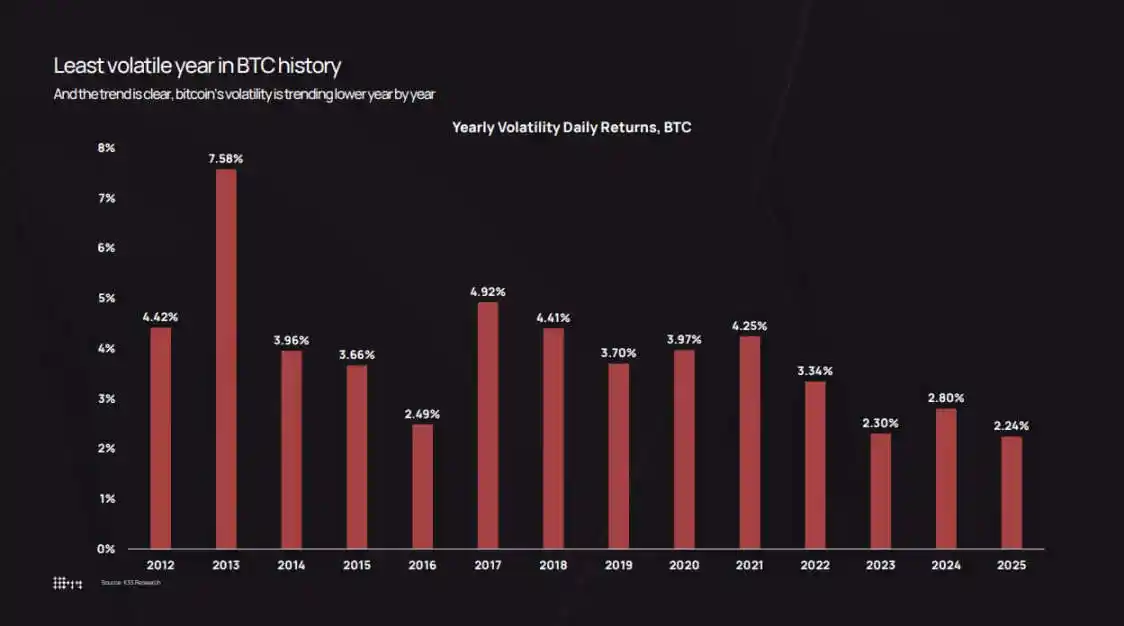
According to K33 Research, Bitcoin's annual volatility has decreased from a peak of 7.58% in 2013 to a historical low of 2.24% in 2025.
Continued Decline in Volatility
K33's annual volatility data records this transformation process.
In 2013, Bitcoin's average daily return was 7.58%, reflecting a market state characterized by thin order books and speculative frenzy. By 2017, this figure had dropped to 4.81%; in 2020, it was 3.98%; and during the pandemic bull market in 2021, it slightly rebounded to 4.13%. In 2022, the collapses of the Luna project, Three Arrows Capital, and the FTX trading platform pushed volatility up to 3.34%.
Since then, volatility has continued to decline: 2.94% in 2023, 2.80% in 2024, and down to 2.24% in 2025.
A logarithmic scale price chart further confirms this trend. From 2022 to 2025, Bitcoin did not experience extreme "sharp rises followed by sharp falls," but instead steadily climbed within an upward channel.
There were pullbacks during this period—prices fell below $50,000 in August 2024 and dropped to $80,500 in October 2025—but there was no "parabolic rise followed by systemic collapse."
Analysis indicates that the 36% drop in October 2025 remains within the normal range of historical Bitcoin retracements. The difference is that previous 36% pullbacks often occurred at the end of high volatility periods around 7%, while this one happened in a low volatility range of 2.2%.
This creates a "cognitive gap": a 36% drop over six weeks feels severe; however, compared to earlier cycles (when daily fluctuations of 10% were common), the volatility in 2025 is relatively mild.
Asset management firm Bitwise points out that Bitcoin's actual volatility has fallen below that of Nvidia, redefining Bitcoin's positioning from a "purely speculative tool" to a "high beta macro asset."
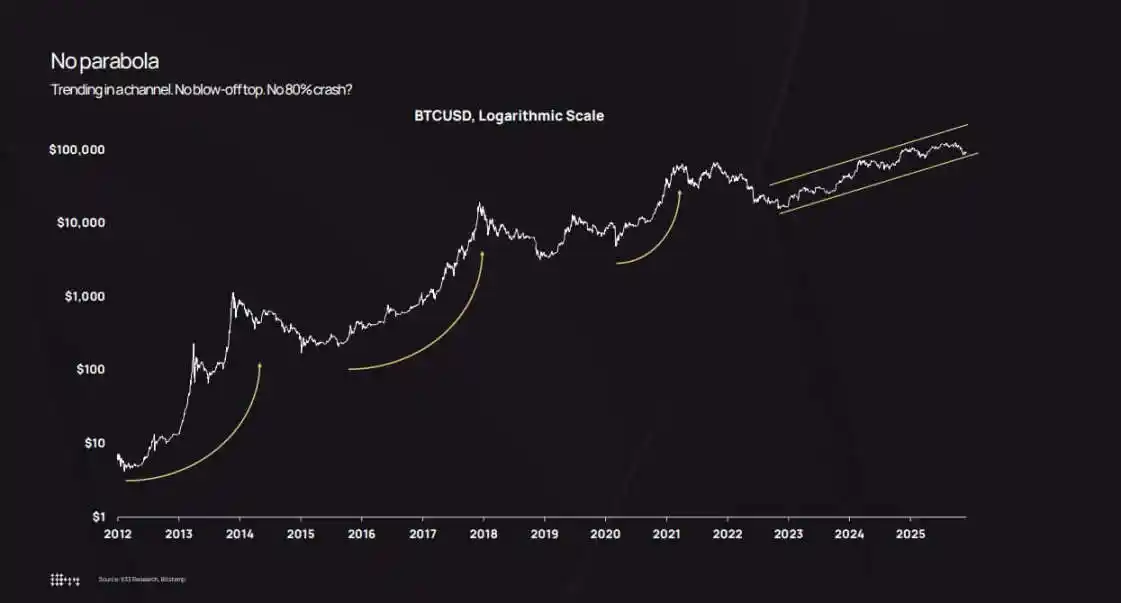
Bitcoin's logarithmic price chart shows that since 2022, its price has been slowly rising within an upward channel, avoiding the parabolic spikes and 80% crashes seen in earlier cycles.
Market Cap Expansion, Institutional Entry, and Asset Redistribution
K33's core view is that the decline in actual volatility is not due to reduced capital inflows, but rather because it now requires a larger scale of capital to drive price movements.
The "Bitcoin market cap three-month change chart" drawn by the institution shows that even during low volatility periods, market cap can still fluctuate by hundreds of billions of dollars.
During the pullback from October to November 2025, Bitcoin's market cap evaporated by about $57 billion, nearly matching the $56.8 billion pullback in July 2021.
The magnitude of fluctuations has not changed; what has changed is the "depth" of the market's ability to absorb these fluctuations.
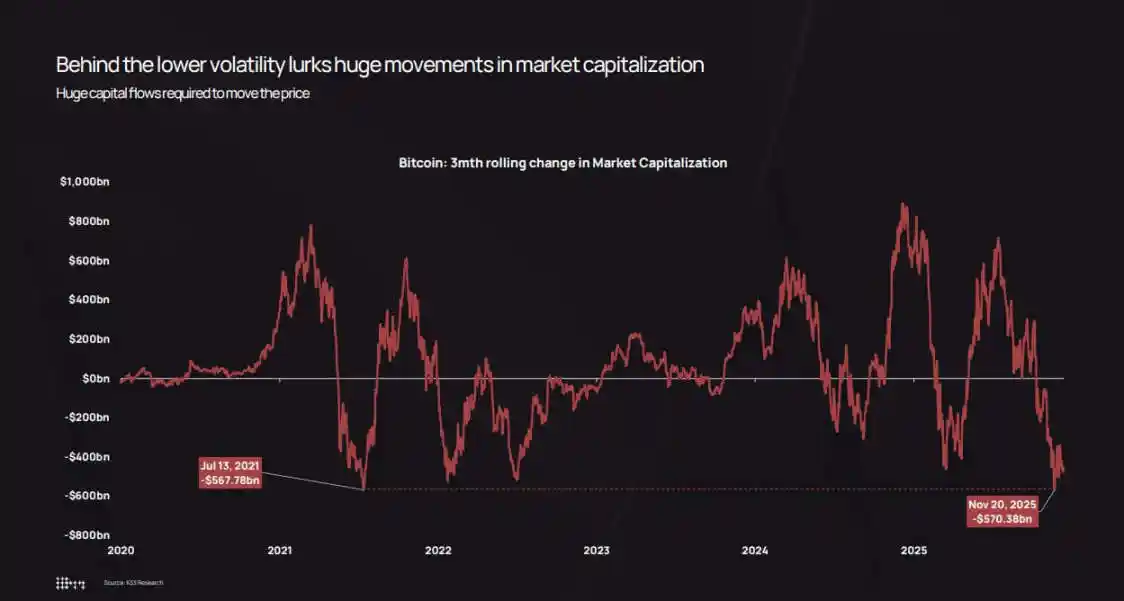
In November 2025, Bitcoin's market cap fluctuation over three months reached $57 billion; despite low volatility, it was comparable to the $56.8 billion drop in July 2021.
Three structural factors have driven the decline in volatility:
First is the "accumulation" effect of ETFs and institutions. K33 statistics show that in 2025, ETFs net purchased about 160,000 Bitcoins (though lower than the 630,000 in 2024, the scale is still considerable). ETFs and corporate treasuries collectively increased their holdings by about 650,000 Bitcoins, accounting for over 3% of the circulating supply. These funds entered the market through "programmatic rebalancing," rather than being driven by retail FOMO.
K33 specifically notes that even if Bitcoin's price drops by about 30%, ETF holdings only decrease by a single-digit percentage, with no panic redemptions or forced liquidations.
Second is corporate treasuries and structural issuance. By the end of 2025, corporate treasuries cumulatively held about 473,000 Bitcoins (with a slowdown in accumulation in the second half of the year). New demand primarily comes from preferred stock and convertible bond issuances, rather than direct cash purchases—because finance teams execute capital structure strategies quarterly, rather than chasing short-term market trends like traders.
Third is the redistribution of assets from early holders to a broader group. K33's "asset holding duration analysis" shows that since early 2023, Bitcoins that had been idle for over two years have begun to be steadily "activated," with about 1.6 million long-held Bitcoins entering circulation over the past two years.
2024 and 2025 are the two years with the largest activation of "sleeping assets." The report mentions that in July 2025, Galaxy Digital sold 80,000 Bitcoins, and Fidelity sold 20,400 Bitcoins.
These sell-offs coincided perfectly with the "structural demand" from ETFs, corporate treasuries, and regulated custodians—who gradually build positions over several months.
This redistribution is crucial: early holders accumulated Bitcoins at prices ranging from $100 to $10,000, with assets concentrated in a few wallets; when they sell, the assets flow to ETF shareholders, corporate balance sheets, and high-net-worth clients who buy in small amounts through diversified portfolios.
The end result is a decrease in Bitcoin holding concentration, an increase in order book thickness, and a weakening of the "chain feedback loop." In earlier cycles, a sell-off of 10,000 Bitcoins in a thinly liquid market could lead to a price drop of 5% to 10%, triggering stop-losses and liquidations; but in 2025, such sell-offs attract buying from multiple institutional channels and may even push prices up by 2% to 3%, weakening the feedback loop and thus reducing daily volatility.
Portfolio Construction, Leverage Impact, and the End of "Parabolic Cycles"
The decline in actual volatility has changed the logic institutions use to calculate "Bitcoin holding sizes."
Modern portfolio theory suggests that asset allocation weights should be based on "risk contribution" rather than "return potential." For the same 4% Bitcoin allocation: if the daily volatility is 7%, its contribution to portfolio risk is much higher than in the case of a 2.2% volatility.
This mathematical fact forces asset allocators to make a choice: either increase the Bitcoin holding ratio or use options and structured products (assuming the underlying asset is more stable).
K33's cross-asset performance table shows that in 2025, Bitcoin ranked near the bottom in asset returns—despite outperforming in previous cycles, it lagged behind gold and stocks in 2025.
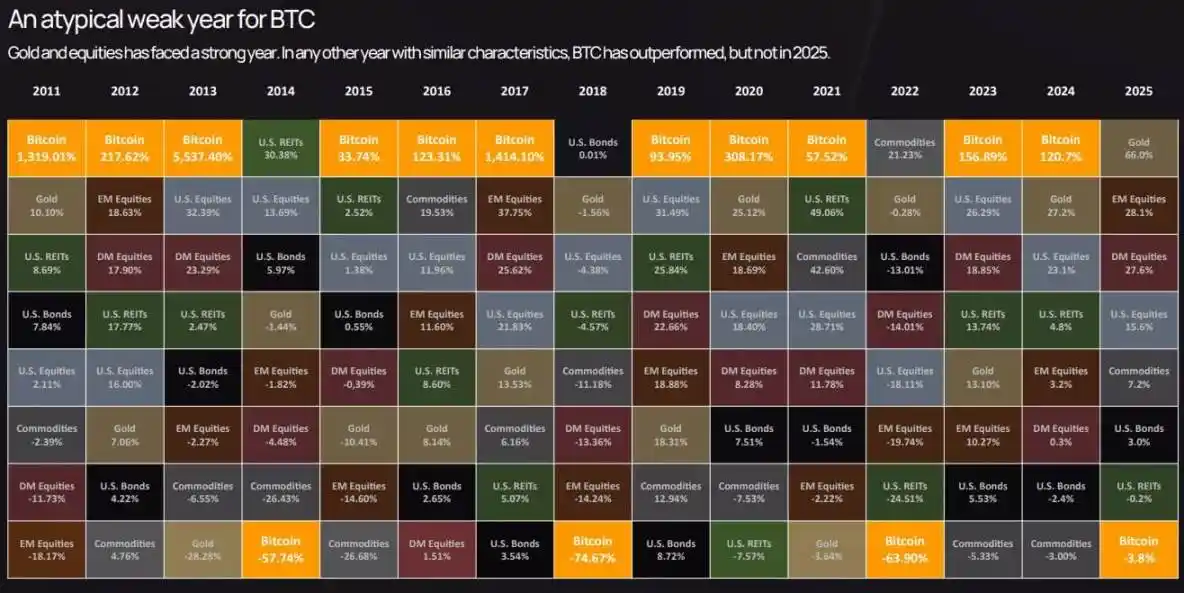
Bitcoin ranked near the bottom in asset performance in 2025, with a decline of 3.8%; in this atypical year for Bitcoin, its performance lagged behind gold and stocks.
This "underperformance," combined with low volatility, has shifted Bitcoin's positioning from a "speculative satellite asset" to a "core macro asset"—with risks similar to stocks, but with return drivers uncorrelated to other assets.
The options market also reflects this shift: recently, the implied volatility of Bitcoin options has decreased in sync with actual volatility, lowering hedging costs and making synthetic structured products more attractive.
Previously, compliance departments often restricted financial advisors from allocating Bitcoin on the grounds of "excessive volatility"; now, advisors have quantitative evidence: in 2025, Bitcoin's volatility is lower than that of Nvidia, lower than many tech stocks, and comparable to high beta stock sectors.
This opens new investment channels for Bitcoin: inclusion in 401(k) retirement plans, allocations by registered investment advisors (RIAs), and investments by insurance company portfolios with strict volatility limits.
K33's forward-looking data predicts that as these channels open, ETF net inflows in 2026 will exceed those in 2025, forming a "self-reinforcing cycle": more institutional capital inflows → lower volatility → unlocking more institutional mandates → more capital inflows.
However, the market's "calm" is conditional. K33's derivatives analysis shows that throughout 2025, Bitcoin perpetual contract open interest steadily rose in a "low volatility, strong upward" environment, ultimately culminating in a liquidation event on October 10—wiping out $19 billion in leveraged longs in a single day.
This sell-off was related to President Trump's tariff announcement and widespread "risk-off sentiment," but the core mechanism remains a derivatives issue: excessive leveraged longs, thin weekend liquidity, and a chain of margin calls.
Even with an actual annual volatility of 2.2%, there may still be "extreme volatility days triggered by leveraged liquidations." The difference now is that such events are resolved within hours rather than lasting for weeks; and due to the "price floor" provided by the spot demand from ETFs and corporate treasuries, the market can recover quickly.
The structural backdrop for 2026 supports the view that "volatility will remain low or further decline": K33 expects that as the two-year Bitcoin supply stabilizes, the sell-offs from early holders will decrease; additionally, there are positive signals from the regulatory front—such as the U.S. CLARITY Act, the comprehensive implementation of the European MiCA, and Morgan Stanley and Bank of America opening 401(k) and wealth management channels.
K33's "Golden Opportunity" data predicts that in 2026, Bitcoin will outperform stock indices and gold—because the impact of regulatory breakthroughs and new capital will outweigh the selling pressure from existing holders.
Whether this prediction will come true remains uncertain, but the mechanisms driving the forecast—liquidity deepening, institutional infrastructure improvement, and regulatory clarity—indeed provide support for low volatility.
Ultimately, the Bitcoin market will move away from the "speculative frontier" characteristics of 2013 or 2017, becoming closer to a "high liquidity, institutionally anchored macro asset."
This does not mean Bitcoin has become "boring" (such as having low returns or lacking narrative), but rather that "the rules of the game have changed": price paths are smoother, the options market and ETF liquidity are more important than retail sentiment, and the core changes in the market are reflected in structure, leverage levels, and the composition of trading parties.
In 2025, despite experiencing the largest regulatory and structural changes in history, Bitcoin has become an "institutionalized stable asset" from a volatility perspective.
The value of understanding this transition lies in recognizing that low actual volatility is not a signal of "asset lifelessness," but rather a sign that "the market is mature enough to absorb institutional-level capital without collapsing."
The cycle has not ended; it has simply made the "cost" of driving market volatility higher.
免责声明:本文章仅代表作者个人观点,不代表本平台的立场和观点。本文章仅供信息分享,不构成对任何人的任何投资建议。用户与作者之间的任何争议,与本平台无关。如网页中刊载的文章或图片涉及侵权,请提供相关的权利证明和身份证明发送邮件到support@aicoin.com,本平台相关工作人员将会进行核查。


