Is Coinbase preparing to launch Lighter, and is it worth paying attention to?

CN
3 hours ago

CoinW Research Institute

Summary

Recently, Lighter has become the focus of discussions in the Perp DEX sector. Lighter is actively trading, its points system is running stably, and Coinbase has included it in its listing roadmap; however, the token issuance timeline and specific details remain unclear, leading to premature market expectations and delayed key information, which has sparked controversy. Unlike projects that solely rely on incentives, Lighter has attracted a large number of long-term users through an efficient matching mechanism and a good trading experience, demonstrating strong product value. This has led the market to begin valuing it using the standards of mature assets, thereby amplifying the divergence. The entire Perp DEX sector is at a critical stage of transitioning from "incentive-driven" to "value-inherent." Designing a token that can effectively incentivize users while reasonably reflecting the platform's real value has become a common challenge faced by the industry. Previous projects' buyback and incentive strategies have varied in focus but generally reflect caution and balance. Lighter's current restraint on the rhythm and function of its token somewhat reflects a rethinking of token positioning within the sector. Whether a token is necessary and how to find a reasonable position between incentives and value carrying remain core issues that need to be addressed. Observing Lighter's development path can help understand the future token design logic and sustainable development direction of the entire Perp DEX ecosystem.

1. Where the Controversy Around Lighter Comes From: The Misalignment of Preceding Expectations and Delayed Information

Recently, discussions about Lighter have significantly increased. On one hand, project-level progress continues to release positive signals: on December 13, Coinbase announced that it would add Lighter to its listing roadmap; at the same time, the platform's trading scale and points-related data have also expanded, making it one of the most closely watched projects in the Perp DEX sector.

However, alongside the rise in data and exposure, there is uncertainty surrounding the TGE and airdrop timeline. The core of the current market controversy regarding Lighter does not lie in whether it "will issue a token," but rather in the fact that market expectations have clearly been brought forward, while the key information that determines valuation has yet to be confirmed. There has been a long-standing expectation in the community that Lighter may conduct its TGE in December this year, but the official team has not provided clear statements regarding the specific timing, rules, or token distribution methods.

From a mechanism perspective, Lighter's points system has entered a stable operating phase. Users can earn points by depositing funds into the LLP (Lighter Liquidity Provider) public fund pool and participating in contract trading. Currently, Season 2 is ongoing, with the official team setting a relatively fixed rhythm for point distribution based on trading behavior while reserving the right to dynamically adjust the rules. However, as of now, the official team has not disclosed how points will be linked to future tokens or TGE, including exchange ratios, distribution structures, or complete Tokenomics design.

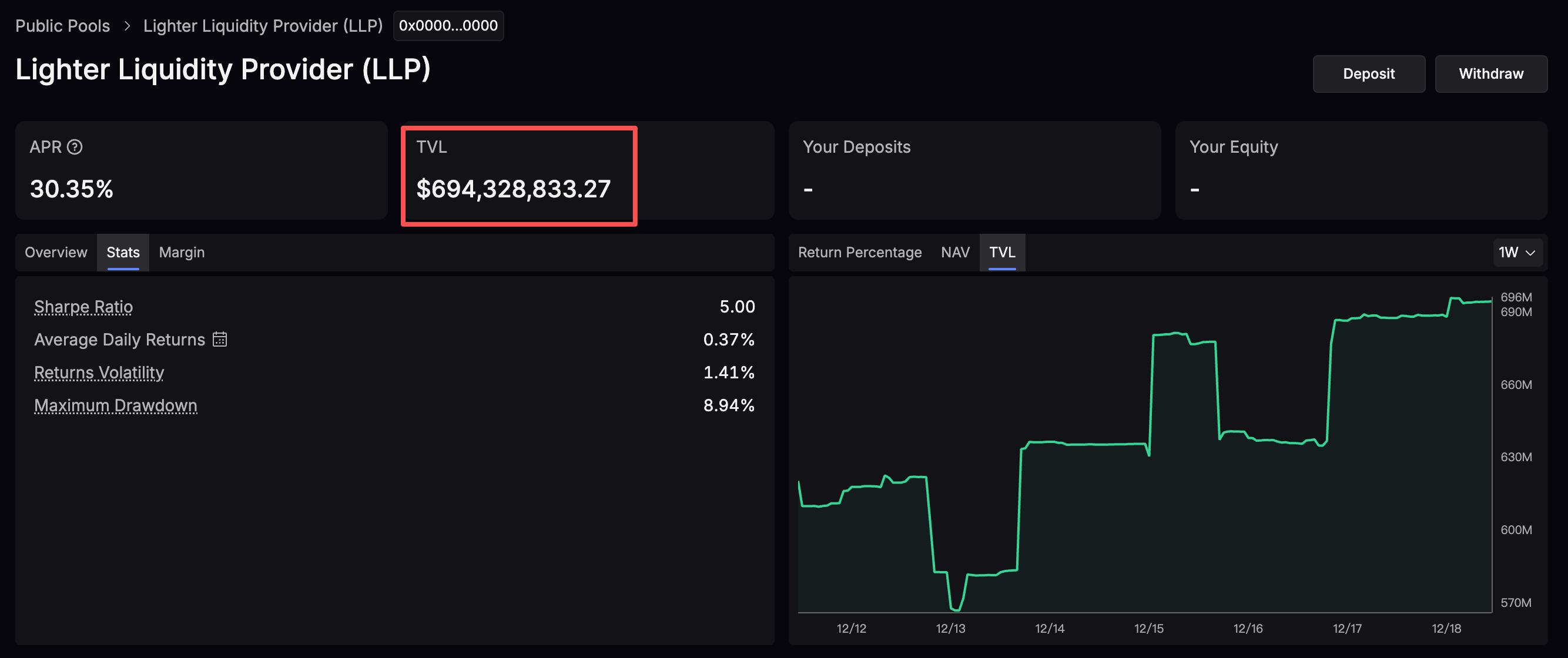
In the actual participation process, although the official team has not provided a final answer, users have generally regarded points as an important reference indicator for potential future earnings. As participation scales up, this expectation has been further reinforced. According to data from the official website, the current Lighter points pool has a TVL of approximately $690 million, indicating that this system has already carried a considerable scale of real funds and trading behavior. Against this backdrop, the uncertainty regarding the token issuance timeline and rules can easily be amplified into uncertain judgments about potential earnings, directly reflecting in the pricing divergence in prediction markets and the noticeable differentiation in participant sentiment.

Figure 1. Lighter points system. Source: https://app.lighter.xyz/public-pools/281474976710654

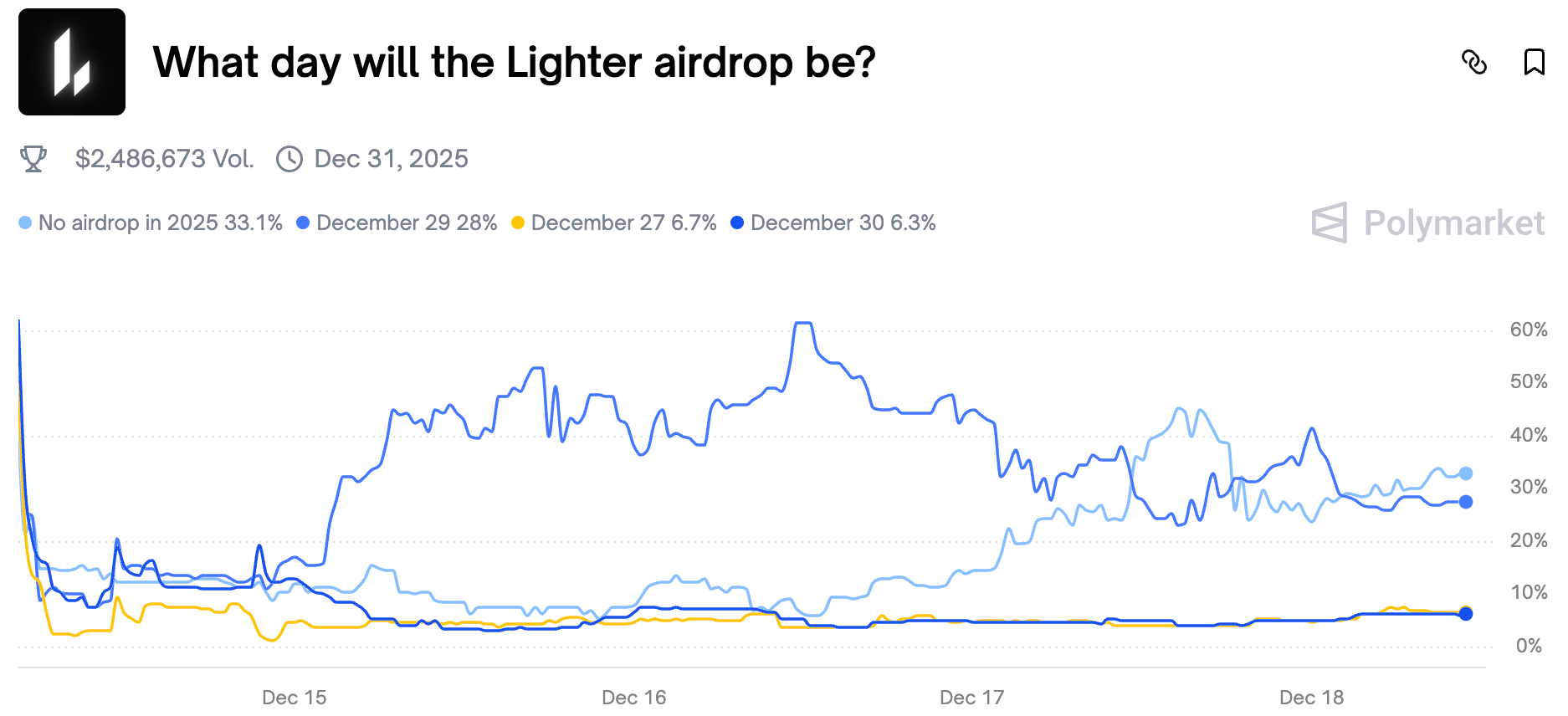
From the data of the prediction market Polymarket, it can be seen that the market has not formed a highly consistent judgment regarding the timing of Lighter's airdrop. For example, the probability of "Lighter airdropping on December 29" is about 28%, while the probability of "not airdropping in 2025" is about 33%, with the probabilities for other dates being relatively dispersed. This structure indicates that the market does not view the airdrop as a certain event but is pricing multiple possible scenarios in parallel.

Figure 2. The prediction on Polymarket for when the Lighter airdrop will be. Source: https://polymarket.com/event/what-day-will-the-lighter-airdrop-be?tid=1766026269827

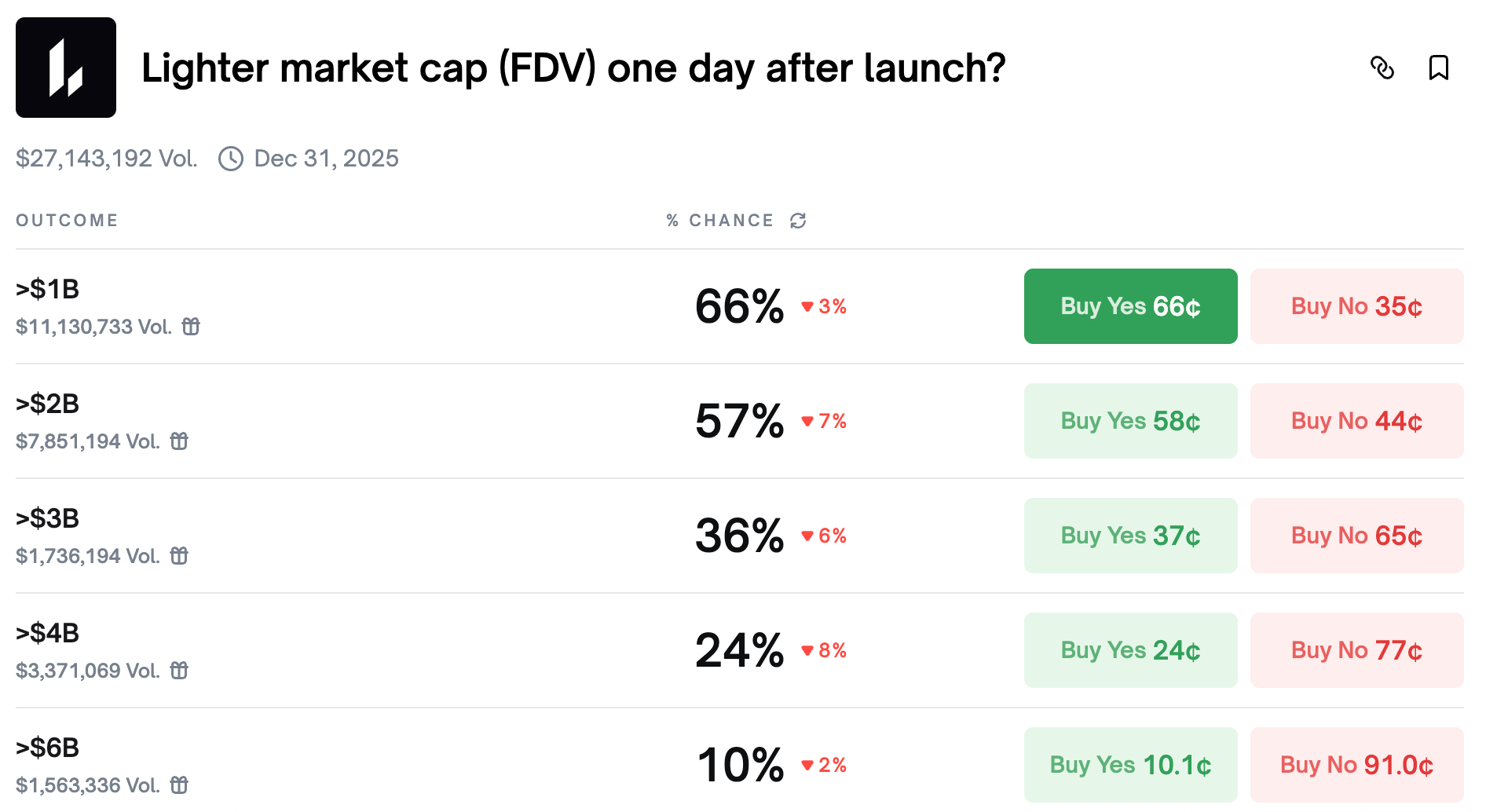
In predictions regarding the valuation after the token launch, the market leans towards a positive judgment that "the FDV will exceed $1 billion the day after launch," but the probability expectations for higher valuation ranges have clearly converged. Overall, the market's attitude towards Lighter is not blindly optimistic; rather, it has engaged in risk-diversified pricing in the face of unresolved uncertainties.

Figure 3. The prediction on Polymarket for Lighter’s market cap (FDV) one day after launch. Source: https://polymarket.com/event/lighter-market-cap-fdv-one-day-after-launch?tid=1766026452011

On a longer-term level, differing views have gradually emerged in the community regarding Lighter's business model and token design. Some opinions suggest that Lighter is currently more focused on the trading product itself, with limited design in staking, governance, or richer ecological layers. If future token functions do not form a clear value loop with platform trading behavior, user activity may face significant pressure to decline after the TGE and airdrop are completed. Such discussions are not a denial of the project's progress but reflect a significant increase in market attention to long-term sustainability against the backdrop of the Perp DEX sector gradually maturing.

2. Early Pricing Under High Exposure: Why Lighter is Considered a "Quasi-Asset"

In the past year, there have been many on-chain Perp DEX projects, but few have been able to maintain a sustained presence in the market's view. Unlike projects that rely on high-intensity incentive mechanisms to maintain data, Lighter has been positioned in a high-exposure spot from the very beginning. The Base app, a super application launched by Coinbase, integrates Lighter's official website page, allowing users to discover and use the product directly within the Coinbase ecosystem. This places it under scrutiny in potential mainstream trading scenarios, which means that the market's evaluation criteria have quickly shifted from "can the mechanism run" to "is it worth being priced long-term."

In this process, Lighter has not provided a complete token narrative in advance, but its trading data and participation have rapidly expanded in a short time. This combination has led the market to begin incorporating it into discussions of valuation and horizontal comparison, even without having all the key information.

More importantly, the timing of Lighter's emergence coincides with a turning point in the overall narrative of the Perp DEX sector. The industry's focus is shifting from early emphasis on mechanism and architectural innovation to a more realistic question: whether there is already sustainable, non-incentive-driven real trading demand. In this context, as long as a project can first prove "there are indeed people using it," even if its business model and token value capture have not completed the entire narrative loop, it is often viewed by the market as a "quasi-asset."

Therefore, the current controversy surrounding Lighter does not entirely stem from the project's own rhythm choices but rather resembles a structural misalignment between market expectations and the project's current stage: when the market begins to measure a product still in the construction phase using the standards applied to mature assets, divergences are naturally amplified.

3. Ignoring TGE, Does Lighter Truly Demonstrate Product Value?

If we temporarily set aside the expectations for TGE and airdrops, whether Lighter still possesses the value to be continuously discussed is key to determining whether this project is worth attention.

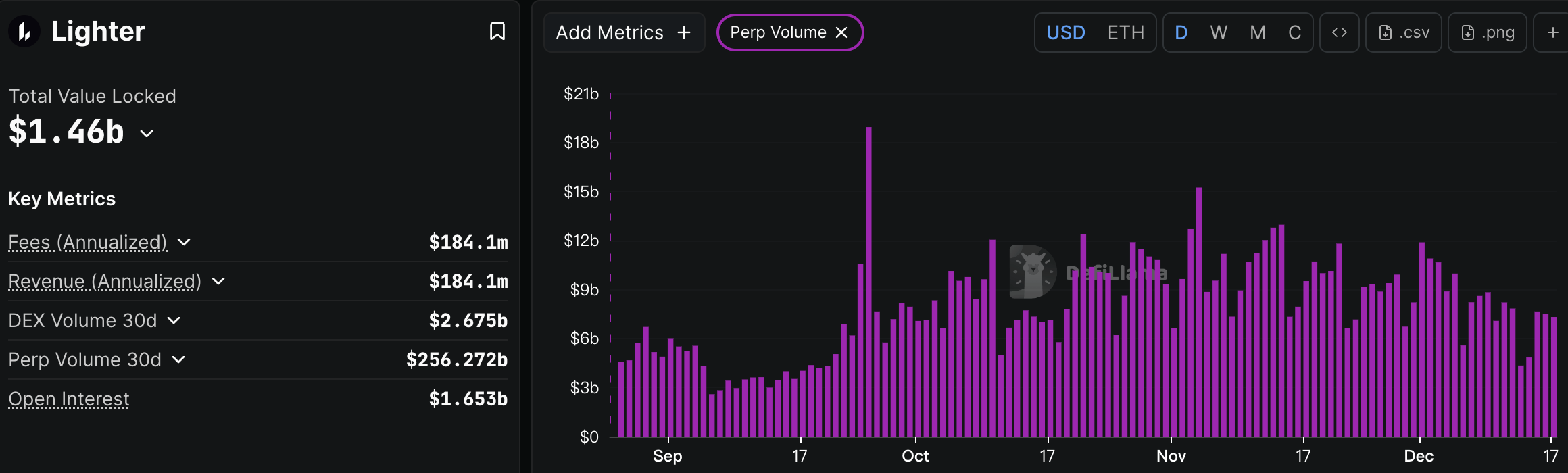
From the disclosed data and actual trading behavior, Lighter has at least demonstrated several key signals that are not easily observed. First, in terms of perpetual contract trading, Lighter has undertaken a considerable scale of market trading activity. According to DefiLlama data, as of December 18, Lighter had a perpetual contract trading volume of approximately $25.627 billion over the past 30 days, with a platform TVL of $1.457 billion, resulting in a trading volume / TVL (equivalent capital occupation) ratio of about 175.88. In comparison, Hyperliquid and Aster had trading volume / TVL ratios of approximately 49.16 ($20.384 billion / $4.146 billion) and 169.6 ($22.100 billion / $1.303 billion), respectively. The trading volume / TVL ratio essentially reflects the turnover intensity of locked capital over a certain period. In the perpetual contract scenario, a higher ratio typically indicates that funds are being rolled over more frequently, with trading behavior leaning towards high-frequency and incentive-driven activities. From this metric, both Lighter and Aster currently exhibit significant high turnover characteristics, indicating strong trading activity, although this may include some trading demand amplified by incentive mechanisms; in contrast, Hyperliquid's trading structure leans more towards capital accumulation and relatively stable risk exposure.

During this time window, Lighter's perpetual contract trading scale has reached a high range within the Perp DEX sector, demonstrating strong competitiveness in trading matching efficiency and system capacity. It is important to note that Lighter's current trading activity may still be influenced by incentive mechanisms and market expectations rather than being entirely driven by natural demand. Nevertheless, being able to sustain such a volume of trading in a high-frequency, high-leverage trading environment constitutes a significant technical and product threshold, laying the foundation for subsequent verification of the sustainability of real trading demand.

Figure 4. Lighter data. Source: https://defillama.com/protocol/lighter?perpVolume=true&tvl=false

Secondly, from a product structure perspective, the order book hybrid matching model employed by Lighter has already been able to support users' continuous use in terms of execution efficiency, slippage control, and trading feedback. This determines that it is not just a product that users try once and leave, but rather one that has been incorporated into the long-term trading paths of some traders. Additionally, the entry-level exposure brought by the integration of the base app official page has not remained at the stage of mere visibility. From the currently observable trading and activity data, at least a portion of the traffic has completed the conversion from "exposure" to "behavior." This sets Lighter apart from many other Perp DEX projects that remain at the narrative and expectation level.

It is precisely because these key links have been successfully navigated that the market has raised higher demands for Lighter. When a project has been proven to possess real use value, the question shifts from "Is there a token?" to whether the token can reasonably capture and amplify the existing value.

4. After Perp DEX Proves Viable, How Can Tokens Be Designed?

Following projects like Hyperliquid and Aster, the Perp DEX sector is reaching a similar phase: when the trading product itself has been validated as feasible, how should tokens "reasonably exist"?

Past project practices have provided different directional attempts. Taking Hyperliquid as an example, its token design has not remained at the governance or incentive level but has focused on how to capture the protocol's real revenue. According to official disclosures and third-party statistics, the platform continuously uses a significant portion of the fees generated from perpetual contracts and other businesses (over 90%) to repurchase HYPE tokens in the secondary market, supporting the token supply side through destruction or removal from circulation. As trading volume and fee scales grow, the intensity of repurchases will also expand, thereby transmitting the protocol's operational results to the token level and forming a relatively clear value loop. This path has very direct requirements for the fundamentals: only when the platform can generate a sufficient scale of real trading revenue in a long-term and stable manner can the repurchase mechanism continue to function. Once trading activity declines, the support for token value will also come under pressure.

In contrast, Aster rapidly expanded its user base and trading activity in the early stages through large-scale airdrops and multi-phase incentives. The official Tokenomics indicates that approximately 53.5% of the total supply of ASTER is allocated for airdrops, trading incentives, and community rewards, aiding liquidity accumulation during the launch phase. In its long-term value design, Aster has introduced phased repurchase and destruction mechanisms, with about half of the repurchased tokens permanently destroyed, while the rest are locked for future incentives. The repurchase funds mainly come from protocol fees and the project treasury, rather than relying entirely on protocol revenue. Unlike Hyperliquid, which continuously uses a significant portion of fees for repurchases, Aster's repurchases are more aimed at stabilizing expectations and adjusting supply and demand, with scale and rhythm not automatically expanding with fee income. This strategy helps to enhance attention and participation in the early stages, but in the medium to long term, if incentives weaken and trading demand is difficult to sustain, the token may face selling pressure.

Under real-world constraints, the token design of Perp DEX projects generally exhibits a form of "conscious restraint": they are aware of the unsustainability of purely incentive-based tokens and remain cautious about the structural complexity and compliance costs brought by income distribution-based tokens. In the absence of a fully validated, scalable, and replicable standard path, delaying commitments and retaining flexibility have become more rational choices.

5. Returning to Lighter: Its "Hesitation" May Be Part of the Answer

If we step away from emotional discussions like "Will there be a TGE?" or "When will the airdrop happen?" and look at Lighter's current state from a relatively calm perspective, it is actually very clear: it is not a project that solely relies on TGE to boost its valuation, but at the same time, it has not provided a sufficiently convincing and market-pricing narrative for its token.

From a product strategy perspective, Lighter has not rapidly accumulated short-term data through high-frequency, overt subsidies, but rather has bound incentives to real trading behavior through its points mechanism. This incentive is deferred in its realization, serving more to continuously guide trading behavior rather than providing a one-time surge. Lighter is using its proven trading volume, active users, and continuously growing data to earn the market's time and patience. In a market environment that is highly accustomed to using TGE as a phase anchor, this restraint is bound to cause discomfort.

As a result, the divergences surrounding Lighter have begun to become more pronounced. For short-term participants, the lack of a clear token timeline and earnings expectations directly weakens participation motivation, naturally raising skepticism; for long-term trading users, as long as the product depth, matching efficiency, and trading experience remain advantageous, whether to issue a token immediately will not affect their usage decisions. The misalignment of focus between these two groups leads to the same project being evaluated very differently from different perspectives, further amplifying market divergences.

From an industry perspective, the controversy surrounding Lighter has transcended the question of "whether to issue a token" itself and has touched on the core proposition of token design for decentralized perpetual trading platforms: in the context where Perp DEX has proven to have real users and trading demand, is a token truly necessary? Should its core functions focus on incentives, governance, or more importantly, value capture and long-term ecological construction?

This reflects that the entire sector is in a transition period from "rapid growth + incentive-driven" to "sustainable value creation." As a project magnified under market scrutiny, Lighter's performance and token strategy will play an important demonstrative role in the token economic model of the entire Perp DEX ecosystem. Regardless of its final token design and issuance rhythm, the ongoing discussion around token positioning will continue to influence the design thinking and market expectations of future projects. For investors and researchers, observing Lighter's path can help gain insights into how this sector achieves a key leap from "incentive-driven traffic" to "value inherent."

References

  1. Hyperliquid Diligence Report. Source: https://messari.io/research/deep-research-reports/hyperliquid-diligence-report-fdf9486f-d978-4a6f-980e-ccadc697b120

  2. 10 Projects Account for 92% of Token Buyback Spend in 2025: https://www.coingecko.com/research/publications/token-buybacks

  3. Lighter points system: https://app.lighter.xyz/public-pools/281474976710654

  4. The prediction on Polymarket for when the Lighter airdrop will be: https://polymarket.com/event/what-day-will-the-lighter-airdrop-be?tid=1766026269827

  5. The prediction on Polymarket for Lighter’s market cap (FDV) one day after launch: https://polymarket.com/event/lighter-market-cap-fdv-one-day-after-launch?tid=1766026452011

  6. Lighter data on Defillama. Source: https://defillama.com/protocol/lighter?perpVolume=true&tvl=false

  7. Aster DEX burns 80 million tokens and unveils 2026 roadmap: Key insights and analysis: https://investx.fr/en/crypto-news/aster-dex-burns-80-million-tokens-unveils-2026-roadmap-key-insights-analysis/

  8. Aster PERP-DEX Investment Memo: https://insights.blockbase.co/aster-perp-dex-investment-memo

  9. Aster Updates ASTER Token Buyback and Airdrop to Boost Token Value: https://www.mexc.co/en-IN/news/149436

免责声明:本文章仅代表作者个人观点,不代表本平台的立场和观点。本文章仅供信息分享,不构成对任何人的任何投资建议。用户与作者之间的任何争议,与本平台无关。如网页中刊载的文章或图片涉及侵权,请提供相关的权利证明和身份证明发送邮件到support@aicoin.com,本平台相关工作人员将会进行核查。

Share To
APP

X

Telegram

Facebook

Reddit

CopyLink