Original / Odaily Planet Daily (@OdailyChina)

AI is consuming the world at an unprecedented speed, but the world line has quietly unfolded into two distinct paths.
One path is the expansion of the AI landscape under the monopoly of tech giants: Nvidia has become the world's first publicly traded company with a market value of $5 trillion thanks to its chip and graphics card resources; Google and Amazon have successively entered the chip manufacturing sector, striving to occupy advantageous positions; AI giants like OpenAI and Anthropic have seen their valuations soar to hundreds of billions of dollars. The other path is the rapid development at the micro level of the AI industry: the "AI Agent is expected to become the next robotics industry, with an industry scale reaching trillions of dollars," mentioned by Nvidia founder Jensen Huang at CES 2025 earlier this year, is gradually being realized, with tens of millions of AI Agents gradually permeating all aspects of human society. This also means that tech giants are gradually becoming the key players "holding the key to the AI world." Based on the development history of the previous internet industry, many may wonder: Is AI about to become "another game for tech giants?"
In response, Sentient answers — "No."
As an open-source AI platform adhering to internet fundamentalism, it previously secured $85 million in seed funding, led by several star institutions including Peter Thiel's Founders Fund, Pantera Capital, and Framework Ventures. On the inevitable path of AI consuming the world, Sentient has chosen a path that is completely different from that of the giant companies. This is precisely the "Prologue to Open Source AGI" that Odaily Planet Daily will systematically dissect today.
Exploring Sentient: Raising the Banner of Open Source AI, Facing Off Against Billion-Dollar Monopolies
In July last year, Sentient announced the completion of $85 million in seed funding, backed by a luxurious array of investment institutions — led by Peter Thiel's Founders Fund, Pantera Capital, and Framework Ventures; with participation from Ethereal Ventures, Robot Ventures, Symbolic Capital, Delphi Ventures, Hack VC, Arrington Capital, HashKey Capital, Canonical Crypto, LD Capital, and Foresight Ventures, among other well-known VC firms in the crypto industry.
It is worth noting that very few crypto projects have been able to secure such a figure in seed funding, let alone the strong backing from a series of star capital behind this investment. Previously, only a handful of top-tier L1 public chain projects have received such powerful support. In no time, "What has Sentient done to gain such favor from capital?" became one of the hot topics in the crypto circle. Soon, this question was answered.
Targeting OpenAI, Sentient Team Faces Giant Competition Head-On
In subsequent media interviews, several partners from the leading investment institutions provided their answers —
Founders Fund partner Joey Krug stated that the main reason for investing in Sentient lies in its team, praising the technical acumen of co-founders Sandeep (founder of Polygon) and Pramod (a Princeton University professor); Pantera Capital managing partner Paul Veradittakit expressed that if AI development remains closed-source, many critical aspects of society will be susceptible to the concentrated effects of censorship and rent-seeking. Sentient's open, monetizable, and loyal (OML) AI model "has tremendous potential to disrupt the AI development industry"; Framework Ventures partner Brandon Potts also highly praised the team and technology, stating that "the Sentient team is the most capable of solving the economic issues of open-source AI."
In Sentient's impressive seed funding round, the golden rule of "investing is investing in people" was vividly demonstrated, and the team members behind the Sentient project can indeed be described as a "dream team" (compiled from Grok) —

Sentient's Four Co-Founders
More importantly, during this interview, Sentient's ambition was once again emphasized — to compete head-on with AI giants and the company behind ChatGPT, OpenAI, with its main competitive strategy being to build open-source AI models through community contributions.
The Universal Value of Open Source AI: Decentralization, Anti-Censorship, and Monetization
Unlike the closed-source models of AI giants like OpenAI, Anthropic, and Google, Sentient has chosen a "difficult yet correct" path for AGI development — an open-source AI platform.
To illustrate with an analogy, the AI models and applications provided by commercial companies like OpenAI and Anthropic are akin to a "centralized AI platform" that puts blindfolds on passengers; as users, they do not know the route taken, nor whether the charges are reasonable, and everything is left to the "black box arrangements" of commercial companies; in contrast, Sentient's open-source AI route chooses to lay out the driving route, specific costs, and diverse options before users, allowing them to choose freely, and even enabling users to "join the platform" to provide corresponding "solutions" for more users. Specifically, compared to existing products from AI monopolies in the market, Sentient's open-source AI platform has the following advantages:
Ensures the diversity and interoperability of AI products. Unlike the single AI models of various giant companies, the Sentient platform offers users a wider selection of AI models, and various AI models can generate certain collaborative effects, providing users with a one-stop AI experience.
Avoids issues of centralized AI applications and model failures and malfeasance. Previously, OpenAI's model corpus had involved issues such as copyright infringement in news media, and it is an undeniable fact that AI models avoid sensitive information from the developing companies and centralized censorship mechanisms. The recent Cloudflare outage that caused ChatGPT to go offline also indirectly reflected the "vulnerability" of centralized AI models. In these aspects, Sentient's open-source AI can provide certain technical guarantees for the anti-censorship and safety redundancy of produced content, ensuring stable service.
Decentralization and efficiency improvement in the AI field. The main advantage of the open-source AI platform comes from "from the masses, to the masses," where the decentralized architecture builds a multi-party network that can directly connect developers and users, matching supply and demand more efficiently, allowing AI models to truly serve real market needs.
Monetization platform tools for AI applications and development processes. Sentient's OML (Open, Monetizable, Loyalty) AI model and the already launched open-source AGI network GRID can help AI models and applications leverage the SENT token economy for development rewards, ecological feedback, and quantitative growth. Based on ensuring ownership, control, and consistency, Sentient has thus established a monetization platform network that balances AI development and commercial operations.
Based on these unique advantages, to date, Sentient has already established a mature open-source AI ecological network.
Entering Sentient: Starting from Applications, Not Just Applications, Using Ecology to Boost Network Growth
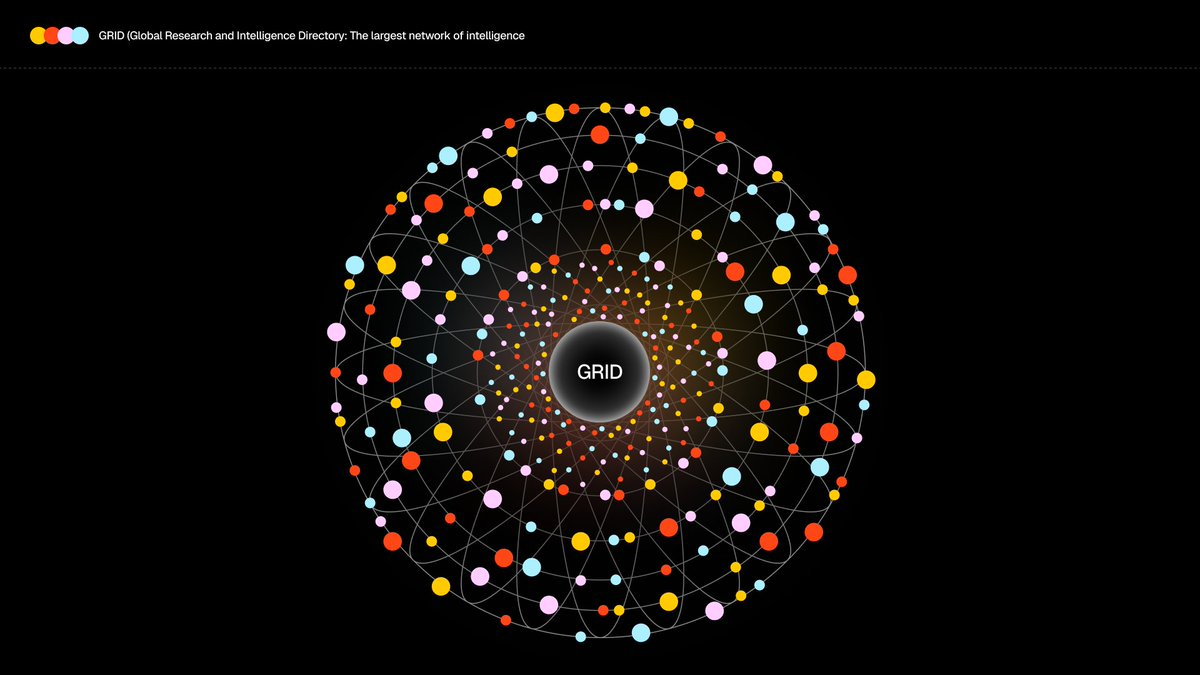
After about a year of development, Sentient has successively launched a series of self-developed products including Dobby, Model Fingerprinting, Open Deep Search, the open-source AGI network GRID (Global Research and Intelligence Directory), ROMA (Recursive Open Meta AI Agent), and open-source AI research agent SERA-Crypto, among various network applications.
Moreover, the emergence of GRID and the construction and gradual improvement of the SENT token economic model have also led to the rapid enhancement of the "AI ecological map" established around the Sentient open-source AI platform.

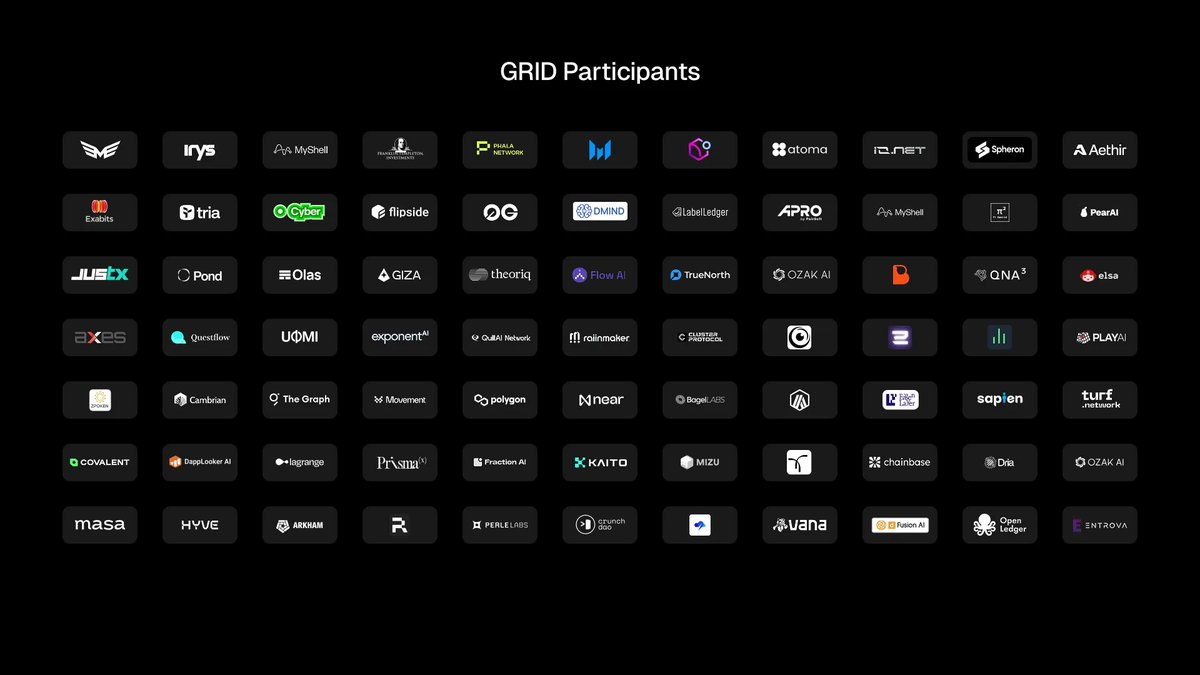
According to official news, the open-source AGI network GRID now includes over 110 partners, including
- Over 50 professional AI agents;
- Over 50 professional data providers;
- 6 AI models;
- Over 10 computing and verifiable AI infrastructure suppliers.

Overview of GRID Network Partners
Representative partners include the following projects: AI chart generation project Napkin, LLM (large language model) search engine Exa, AI-driven character search platform Caldo, on-chain data tracking platform Arkham, enterprise-level decentralized computing power platform Aethir, crypto social data platform Kaito, crypto insight agency platform Messari Co-Pilot, blockchain indexing data platform The Graph, cryptocurrency exchange Crypto.com, Polygon public chain, and Dobby Judge AI arbitration system EigenLayer network, among others. Based on the development of ecological synergy, Sentient's value as an open-source AI platform mainly lies in its ability to attract builders such as developers, computing power, and data to participate in ecological construction; and through token incentives and staking models, it feeds back into the development of the open-source AI ecosystem, especially vertical AI models and applications closely related to the cryptocurrency industry are expected to experience a surge.
The recently launched open-source AI research agent SERA Crypto is a prime example. It is necessary to elaborate on this — the integration of AI with cryptocurrency market trends to assist trading decisions has been a genuine need for countless individuals and a direction of research for many developers. However, due to the hallucinations of large models, the difficulty in real-time updating of market data, and the complexity of on-chain state queries and wallet operations, the "AI Agent born for crypto research" has always been in a state of absence.
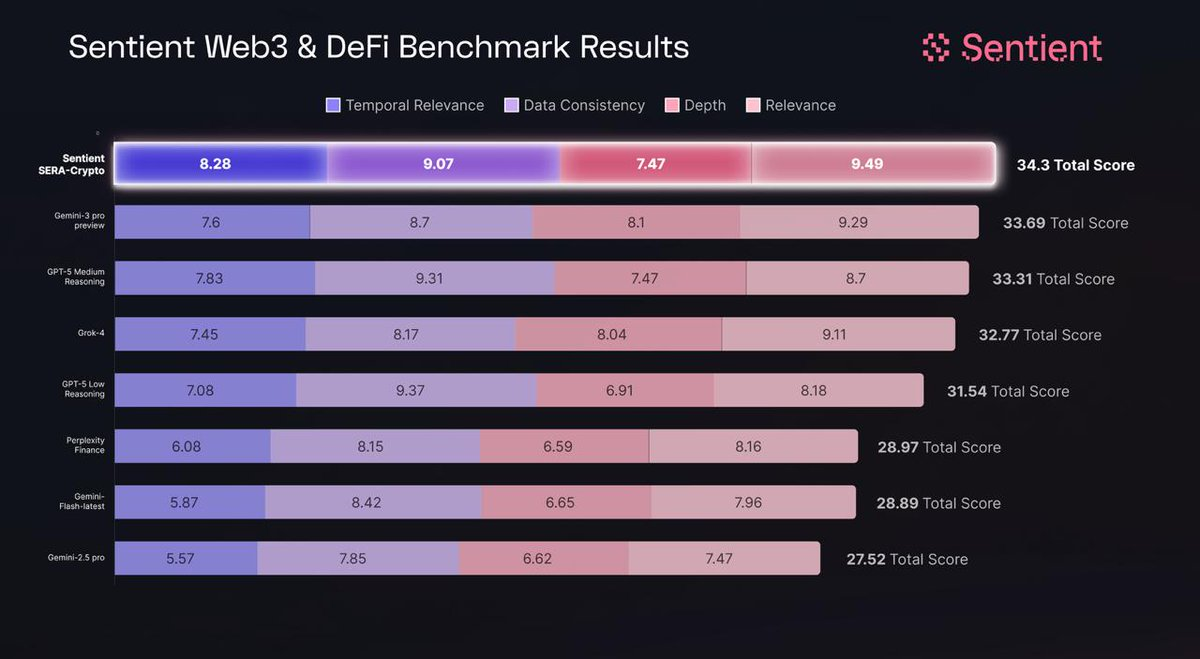
SERA Crypto was thus born, and this AI agent, which focuses on "semantic embedding and reasoning agent architecture," immediately won the title of "the number one open-source agent on DMind"; in real-time crypto benchmarks that include time relevance, data consistency, research depth, and correlation, SERA Crypto ranked first with a score of 34.3, outperforming mainstream AI models such as GPT-5, Grok 4, Gemini 3 Pro, and Perplexity Finance, with all operations completed within 45 seconds.
By integrating advantages such as routing definition, clear data, architectural optimization, and structural reasoning, SERA was able to filter out real-time, usable, and guiding reasoning information from the flood of "big but useless" and "small but false" information. As a result, the Sentient team successfully created an "AI Agent that understands cryptocurrency better," rather than the previous rigid machine-like assistants that lacked thinking ability and could only summarize. Of course, the emergence of SERA also owes much to the nearly 300,000 users in the Sentient community and over 22 million user queries.

SERA Crypto Model Overall Performance Ranked First
From now on, users can access various AI applications (including various platform agent units) through the Sentient open-source platform using SNET tokens, meeting their genuine AI application reasoning needs; Sentient ecosystem developers can receive SENT token incentives through user payments; in addition, the SENT token staking model can ensure the stable operation of the economic circulation system within the ecosystem to a certain extent.

Schematic Diagram of GRID Network and Sentient Community Ecological Flywheel
Ultimately, the monetized AI ecological economy built on the Sentient open-source AI platform has been fully formed, and the subsequent optimization direction has evolved into — better AI models and applications attracting more AI users and developers to participate and join, which in turn further spawns the creation of more high-quality AI models and applications, collectively building a "user-token-developer-product" four-in-one development flywheel.
Introduction to SENT Token: The "Core Energy" Driving the Operation of the Open Source AI Platform
As the "engine energy" supporting the continuous operation of the vast Sentient ecosystem, the role of the SENT token is crucial.
Previously, the SENT token was launched on OKX Pre-market and Binance Futures; on December 6, Coinbase officially announced the addition of SENT to its listing roadmap, thus achieving the milestone of "landing on 3 major CEXs" as the core token of the Sentient ecosystem.
Earlier, Sentient officially announced the end of the first season of activities on November 17, when the token airdrop was mainly aimed at Sentient community members (including Discord community members), AI chat users, crypto KOLs, open-source researchers, and others. On November 18, its official airdrop registration link was officially opened, with the original deadline set for November 29. Subsequently, the official extended the registration deadline to December 5.
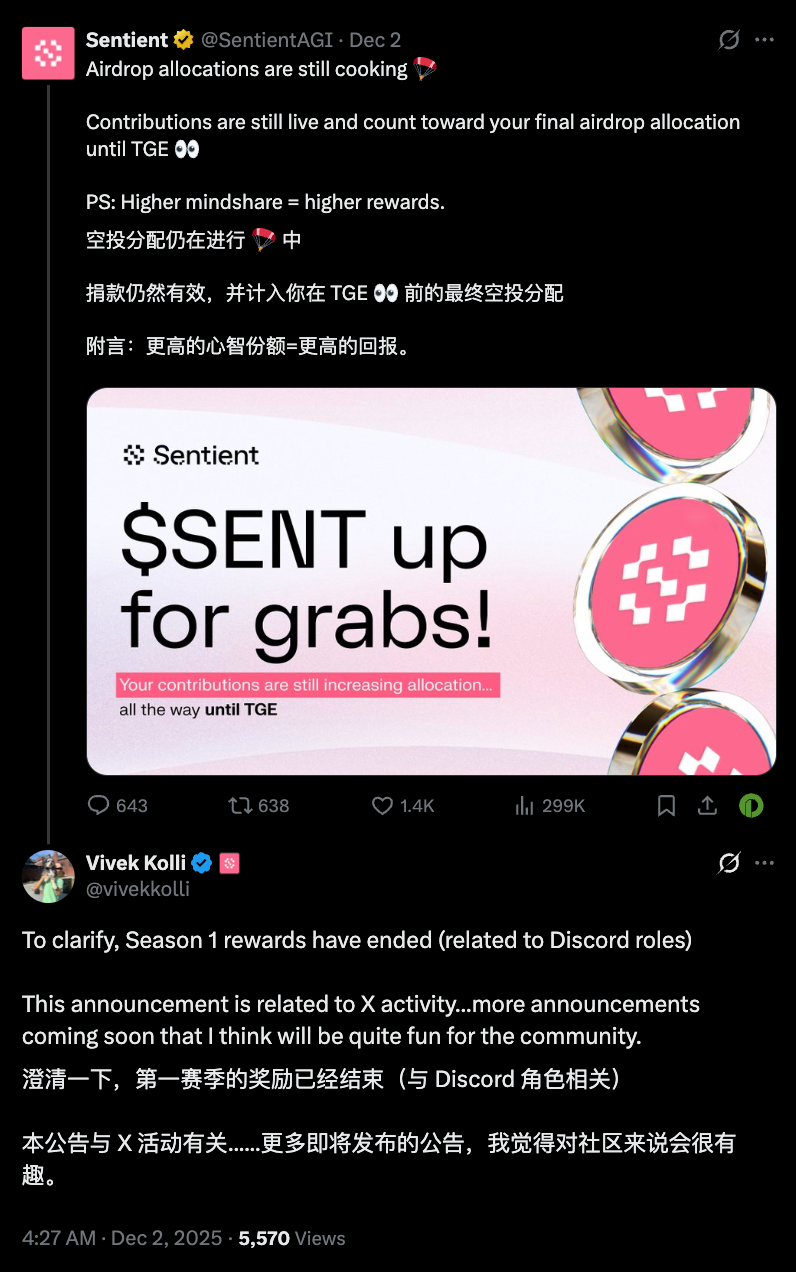
According to official subsequent information and official personnel news, more SENT token incentives for the community will be closely related to content contributions on social media platforms like X and the AI mental share on crypto social data platforms like Kaito.
In addition to the usual paths of participating in the Sentient Chat platform and application usage, AI model, AI Agent, and application development, helping to expand the publicity and marketing of the Sentient ecosystem may be the main line of the SNET token's second season airdrop activity. For more detailed information, you can follow the official X account or visit the official website for more information.

Official personnel hinting at the announcement
Conclusion: The Self-Evolution Limits of Open Source AI Far Exceed Human Imagination
As the development of closed-source AI large models gradually falls into a homogenization deadlock, open-source AI may become an important force driving artificial intelligence into deeper waters, just as the open-source nature of the Android system led to the rapid development of smartphone devices and the advent of the mobile internet. The open-source AI platform represented by Sentient is not just an AI chat application, but a complete open-source AI ecosystem — encompassing underlying protocols, system architecture, as well as specific models and AI Agent applications.
More importantly, unlike the closed-door development of closed-source AI models and applications, open-source AI can achieve a certain degree of "self-evolution," which was the direction determined by Sentient from the very beginning when it chose this "difficult yet correct path."
While OpenAI is still struggling with the endless stream of new products from competitors and is forced to shut down Sora, Sentient is determined to carve out a more universal AI development path that aligns with the pursuits of the open-source community. In the prelude era where carbon-based life guides silicon-based life, the open-source AI platform brings not only the dawn of an AGI network but also a more loyalty-focused, monetization-incentivized, consistent service, and a less "AI hallucination" open-source AI ecological network.
免责声明:本文章仅代表作者个人观点,不代表本平台的立场和观点。本文章仅供信息分享,不构成对任何人的任何投资建议。用户与作者之间的任何争议,与本平台无关。如网页中刊载的文章或图片涉及侵权,请提供相关的权利证明和身份证明发送邮件到support@aicoin.com,本平台相关工作人员将会进行核查。