Recently, the market has not been performing well, and I have plenty of time to watch interviews with outstanding investment institutions. This time, I saw an interview with Marc Andreessen, the founder of a16z, where he mentioned a viewpoint: "The biggest risk in investing is not loss, but mediocrity," which deeply shocked me.
Marc Andreessen is currently the co-founder and partner of the top venture capital firm a16z, overseeing its growth investments. As a leading figure in late-stage investments in Silicon Valley, he built a16z's growth investment business from scratch. He has led key rounds of investment in billion-dollar tech giants such as Databricks, Stripe, Figma, Coinbase, and SpaceX.
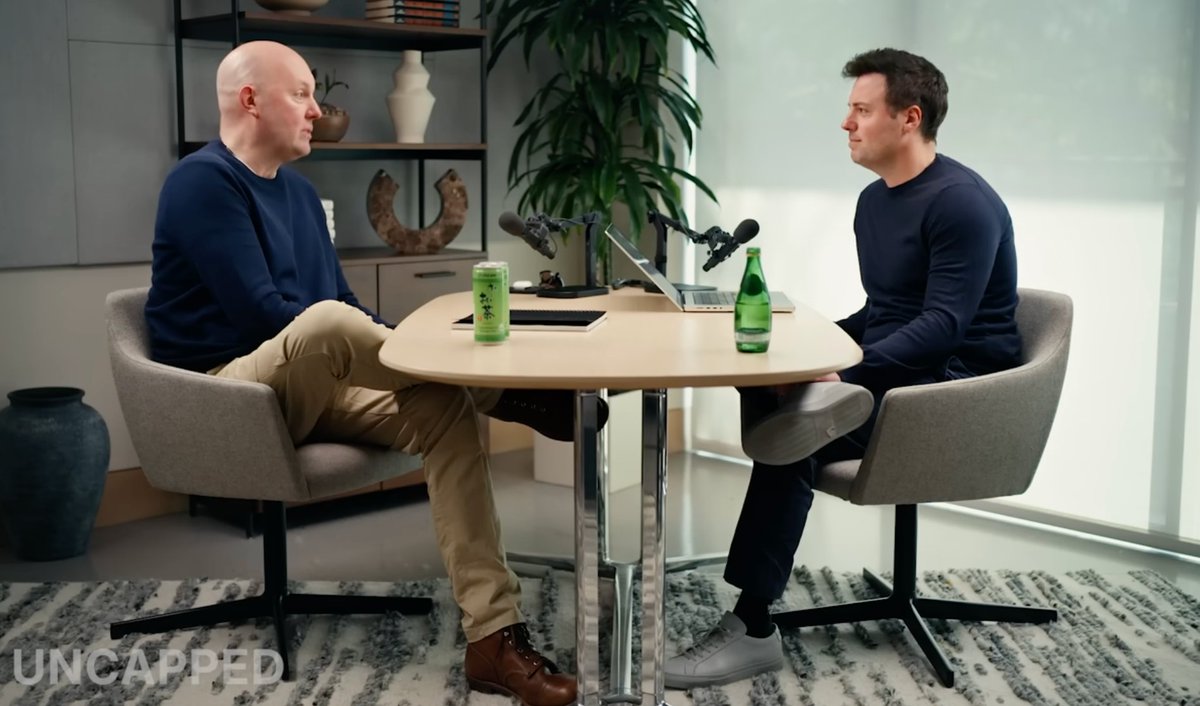
Not long ago, Marc was interviewed on a well-known podcast, where he discussed a16z's valuation philosophy and its current #AI layout. Here are some highlights from the interview.
1️⃣ Anti-consensus Growth Investment Strategy
Host: I want to start with a macro observation. Over the past decade, growth equity investment has become overcrowded. Any fund with money has been pouring it into tech companies.
To combat risk, most funds' strategy is to "cast a wide net," building a diversified portfolio that includes 30, 40, or even 50 companies, trying to capture the overall growth of the tech industry (Beta).
But a16z's growth fund seems completely different; your holdings are extremely concentrated. In a late-stage market full of uncertainty, why adopt such a seemingly low-margin-for-error strategy?
Marc: That's a core question. It relates to our understanding of the "nature of returns in the tech industry."
First, you need to understand that the distribution of investment returns in the tech industry is not a normal distribution but an extreme power law distribution. If you look at historical data, not only in early-stage venture capital but even in growth and late stages, the greatest company of that generation in a given year often generates returns that exceed the total of all the "pretty good" companies combined.
This brings a brutal mathematical fact: if you buy a bunch of second- or third-tier companies for so-called "safety" (the so-called "casting a wide net"), your returns will be severely diluted, and ultimately, you will only achieve a mediocre market average return.
As venture capitalists, if we want to provide alpha to our LPs, we cannot act like "index funds." Therefore, our strategy is "precision fishing," not "trawling."
Host: "Precision fishing" sounds very appealing, but in execution, it means you must accurately find that one unique company among thousands. How do you filter? What does your funnel look like?
Marc: Our funnel is very narrow and very deep. We look at hundreds of companies, but we may only deeply track about 20 of them, ultimately investing in only 2 to 3 companies in a year. Our core criterion is not "Is this a good company?" but "Is this the company that defines the category?"
For example, in the early days of cloud computing, you could invest in many companies, but only by investing in AWS or later Snowflake or Databricks did you truly capture the value. In the design field, you could invest in many tools, but only Figma took most of the chips off the table.
We are looking for companies with inevitability. Once they establish network effects or technological barriers, their growth is not just linear but predatory—they will siphon off the vast majority of the profit pool in the industry.
Host: That's interesting. But the problem is, when this "kingly aura" becomes apparent, it is usually already in the D round, E round, or even Pre-IPO, and the valuation is very high, with competitors lining up. How can you invest at that point?
Marc: Good question. This is one of the sources of "alpha"—arbitrage of time and relationships.
Many people think growth investment is a "checkbook war," where whoever offers the highest valuation wins. This is wrong.
If you wait until a company officially starts fundraising, and Morgan Stanley sends the PPT to your inbox, and then you start your research, you have already lost. At that point, you are just a price taker.
Our approach is to build a "shadow portfolio." For those companies we believe may become "kings," we start tracking them two, three, or even longer before we actually invest.
What does this mean? It means that when the founders don't need money at all, we visit them. We help introduce clients, assist in hiring, and clarify strategies—completely for free.
We build trust through this long-term, unpaid value delivery.
When the market window opens, or when the founder suddenly decides, "I want to raise funds," who is the first person they think of calling? Is it the stranger who just showed up with a checkbook, or is it the old friend who has been running alongside them for three years and understands every detail of their business?
Therefore, many of our deals never even enter the public bidding process. This is the only way we maintain an advantage in an extremely crowded market.
2️⃣ "The Market Has Made a Duration Mistake"
Host: Let's talk about price. This is perhaps the most tangled issue for value investors. Companies like Stripe, SpaceX, or Databricks often have terrifying valuation multiples, such as 50 times or even 100 times ARR (Annual Recurring Revenue).
As a rational investor, how do you convince yourself to accept such a premium? Is the market crazy?
Marc: The market is not crazy, but there is indeed a huge, systemic blind spot in the market. This blind spot is called duration mismatch.
Wall Street analysts and most hedge funds are very good at building financial models for the next 12 to 24 months. Their EPS forecasts for the next quarter may be much more accurate than mine.
However, when they face truly great, disruptive tech companies, they often severely underestimate the durability of growth.
Traditional financial theory posits that high growth will eventually mean-revert. A company that grows 100% this year may only grow 50% next year and 20% the year after.
But in the digital economy era, for companies with strong network effects or platform effects (like Stripe or Facebook), this decay rate is much slower than people imagine. They may maintain 30%-40% growth for a decade, even at a massive scale.
Host: Can you provide a specific mental model?
Marc: Sure. Let's assume there are two companies.
Company A: Valuation is cheap, 10 times revenue, but growth is mediocre, growing 15% per year, and facing fierce competition.
Company B: Valuation is expensive, 50 times revenue, but it is a market monopolist growing 40% per year, and this growth can last for 10 years.
Most people are afraid to buy Company B because they fear a valuation correction. They worry that if the multiple drops from 50 times to 25 times, the stock price will be halved.
But math tells us that if Company B can maintain compound growth, even if its valuation multiple is halved, ten years later, its stock price will still far exceed that of Company A.
The power of growth compounding will ultimately overwhelm the contraction of valuation multiples. We are not betting on the next quarter's earnings report exceeding expectations; we are betting that the market has underestimated this company's ability to dominate the industry over the next decade.
Of course, this also brings risks. If you judge incorrectly and buy not the "king" but the "runner-up," you will face a "double whammy": underperformance and loss of valuation. This is why I emphasized how important "precision fishing" is. It's okay to buy at a high price; buying the wrong company is a disaster.
3️⃣ Full-stack AI Layout
Host: Now everyone's attention is on #AI. a16z is undoubtedly one of the most aggressive institutions in this wave. But I hear a voice saying this is just another SaaS cycle, or like the mobile internet of the past. What do you think? What is fundamentally different this time?
Marc: No, this time is completely different. If you see AI merely as "smarter software," you underestimate the magnitude of this transformation.
We are experiencing a paradigm shift from SaaS (Software as a Service) to Service as Software. This is not just a reversal of word order; it is a dimensional reduction of the business model.
Host: Please elaborate on this; where is the distinction?
Marc: In the SaaS era (like Salesforce, Workday), software was a tool. You sold software to enterprises to improve employee efficiency. As investors, we earned a portion of the enterprise IT budget through this model. Typically, the IT budget only accounts for about 5% of total enterprise revenue.
But in the AI era, especially generative AI, software is no longer just a tool; it begins to deliver results directly. For example, the AI we invested in, Harvey (legal AI) or Cursor (programming AI).
When a law firm uses Harvey, it is not just making lawyers type faster; it is actually completing the work of junior lawyers drafting contracts and retrieving legal provisions.
When programmers use Cursor, the AI is actually writing code, not just completing it.
What does this mean? It means that these AI companies are no longer cutting into that 5% of the IT budget but into the massive budget that originally belonged to salaries, which is the largest cost item for enterprises, typically accounting for 30% to 50% of revenue.
The TAM (Total Addressable Market) is instantly magnified by ten times. This is no longer about "software sales"; it is about "labor replacement" and "zero marginal cost of intelligence."
Host: This perspective is very grand. So how do you operate in specific layouts? Is everyone rushing to invest in foundational models, is that the only path?
Marc: We divide AI investments into three layers, similar to the logic of the gold rush:
- Infrastructure Layer: This is the most certain bet. Regardless of which model wins or which application becomes popular, they all need computing power and data processing.
So we have heavily invested in Databricks. It is the data lake warehouse of the AI era, the foundation for all AI applications. We have also invested in CoreWeave (computing power cloud). This is the "selling shovels" logic, stable and huge.
- Model Layer: This layer is the most competitive and capital-intensive. There are only a few winners here.
We supported OpenAI and Mistral early on. We believe that at this level, technological leadership will translate into huge platform effects.
- Application Layer: This is currently the deep water area and also the place with the greatest future alpha. Many people say, "Foundational models will swallow the value of the application layer," but I disagree. The real value lies in the reconstruction of workflows.
Companies like Cursor do not simply wrap a GPT-4 shell around their product. They deeply understand the programmer's workflow and seamlessly integrate AI into the IDE, creating a whole new development experience.
This "user experience + vertical domain data" moat is very difficult for foundational model vendors to breach.
4️⃣ American Vitality
Host: Besides pure software and AI, I noticed that a16z has recently been vigorously promoting a concept called "American Vitality," investing in many hardware, military, and aerospace companies. This was an absolute taboo in the past venture capital circle. Why this shift?
Marc: This is a call of the times. For the past 20 years, Silicon Valley has been too obsessed with "bits"—we have created better social software, better advertising algorithms, and better delivery platforms. This is good, but it is not enough.
If you look at the real world, there are mountains of problems at the "atomic" level: the hollowing out of American manufacturing, the fragility of the defense industrial supply chain, and aging infrastructure.
We believe the next wave of huge opportunities lies in using software-defined hardware to solve national-level problems.
Look at SpaceX. Elon Musk has proven that using Silicon Valley's iterative thinking to build rockets can reduce costs by an order of magnitude, leaving the national teams far behind.
Look at Anduril (defense technology). Palmer Luckey has proven that modern defense needs not more expensive tanks, but intelligent drone swarms and software systems.
Host: But these types of investments are very difficult. They have long cycles, are capital-intensive, and come with government regulatory risks. How do you manage these risks?
Marc: It is indeed difficult, which is why there are no "tourists" here. We have also learned a lot from investing in autonomous driving. These companies do not have linear ARR growth every quarter like SaaS companies. They often appear to be burning money for long periods with no output.
But precisely because it is difficult, the moats can be terrifyingly deep.
Once SpaceX's Starlink network is established, and once Waymo's data flywheel starts turning, it will be nearly impossible for latecomers to catch up.
We are willing to take on the initial technological risks and long cycles for the sake of this ultimate monopoly position. This is why we retain a portion of "hard tech" bets in our portfolio construction.
5️⃣ Win Like the Yankees
Host: Finally, I want to talk about people. a16z's growth fund is massive, but I hear your operating method is quite special, especially since you have eliminated the traditional "investment committee" voting system. Why?
Marc: This is a profound observation I have about organizational behavior: group decision-making tends to be mediocre.
If you put a radical, non-consensus investment opportunity on the table and let 10 people vote, the usual result is that people will vote against it due to some obvious risks.
What ultimately gets approved by the IC are often those mediocre cases that "don’t have major flaws" but also lack huge potential.
But in venture capital, the biggest risk is not failure, but mediocrity.
So, we implement a "single decision-maker system." If you are responsible for looking at this case, you have done all the due diligence, and you have built a relationship with the founder, then you have the power to decide whether to invest. You don’t need to convince me or other partners. However, this is key: you must take full responsibility for the outcome.
Host: That sounds like a lot of pressure. What if the investment fails?
Marc: This is another side of our culture. I often compare our team to the New York Yankees.
We provide the best resources: the best brand, the strongest post-investment service team (talent recruitment, marketing, policy lobbying), and top compensation.
In exchange, we expect you to deliver a world-class track record.
If you cannot produce good deals for several consecutive years, or if your judgment continues to be wrong, then this may not be the right place for you.
This sounds harsh, but these are the rules of the top competitive arena. We do not want a "communal pot" partner culture; we want hungry, independent-minded hunters who think like lone wolves but have the backing of an aircraft carrier.
Host: This explains why you can maintain such aggressiveness. This conversation has been very informative. If you had to condense today’s discussion into one sentence for the audience, what would it be?
Marc: I would say, "Don’t be distracted by the noise of the market, don’t be scared off by short-term valuations. Seek out those truly inevitable futures, then go all in and stick with them. Mediocrity is the greatest enemy." 🧐
免责声明:本文章仅代表作者个人观点,不代表本平台的立场和观点。本文章仅供信息分享,不构成对任何人的任何投资建议。用户与作者之间的任何争议,与本平台无关。如网页中刊载的文章或图片涉及侵权,请提供相关的权利证明和身份证明发送邮件到support@aicoin.com,本平台相关工作人员将会进行核查。


