Original Title: "Twenty One Plummets Nearly 20% on First Day of Trading, The Valuation Mystery of the Third Largest BTC DAT"
Original Author: Dingdang, Odaily Planet Daily
The "Bitcoin Asset Reserve Company" Twenty One Capital (NYSE: XXI), backed by stablecoin giant Tether and Japanese conglomerate SoftBank Group, officially debuted on the New York Stock Exchange on December 9. However, in stark contrast to its "heavy asset" and "strong endorsement" resource advantages, the stock price fell sharply after opening, with an intraday drop of nearly 20%, indicating that the capital market's initial response was not friendly.
Founded in early 2025 and led by Strike founder and CEO Jack Mallers, Twenty One is positioned as a company focused on Bitcoin as its core asset allocation. It has strong support from stablecoin issuer Tether, Japan's SoftBank Group, and Wall Street investment bank Cantor Fitzgerald.
It is important to note that Twenty One did not adopt a traditional IPO; instead, it completed a reverse merger with Cantor Equity Partners (SPAC) and officially listed on the NYSE on December 9. Cantor Equity Partners is an important platform under Cantor Fitzgerald, led by Brandon Lutnick, the son of the U.S. Secretary of Commerce. He personally led this merger and emphasized in the announcement that Cantor's partnerships were key to facilitating the involvement of innovative players like Tether and SoftBank. This relationship added "institutional prestige" to Twenty One Capital, especially in the crypto-friendly policy environment promised by the Trump administration.
However, the sentiment in the capital market is evidently more complex. Initially, the company traded under the CEP code, and after the announcement, the stock price surged from $10.2 to a high of $59.6, nearly a 6-fold increase, reflecting the market's initial enthusiasm for the "Bitcoin Reserve Company" narrative. But as speculative sentiment waned, the stock price quickly retreated and is now hovering around $11.4, almost erasing most of the premium.
This stands in stark contrast to its substantial Bitcoin assets. As of its listing, Twenty One held 43,514 BTC, with a market value of approximately $4.03 billion, ranking third in the global corporate cryptocurrency holdings, only behind Strategy and MARA Holdings.
Valuation Puzzle: Causes Behind Extreme Discount
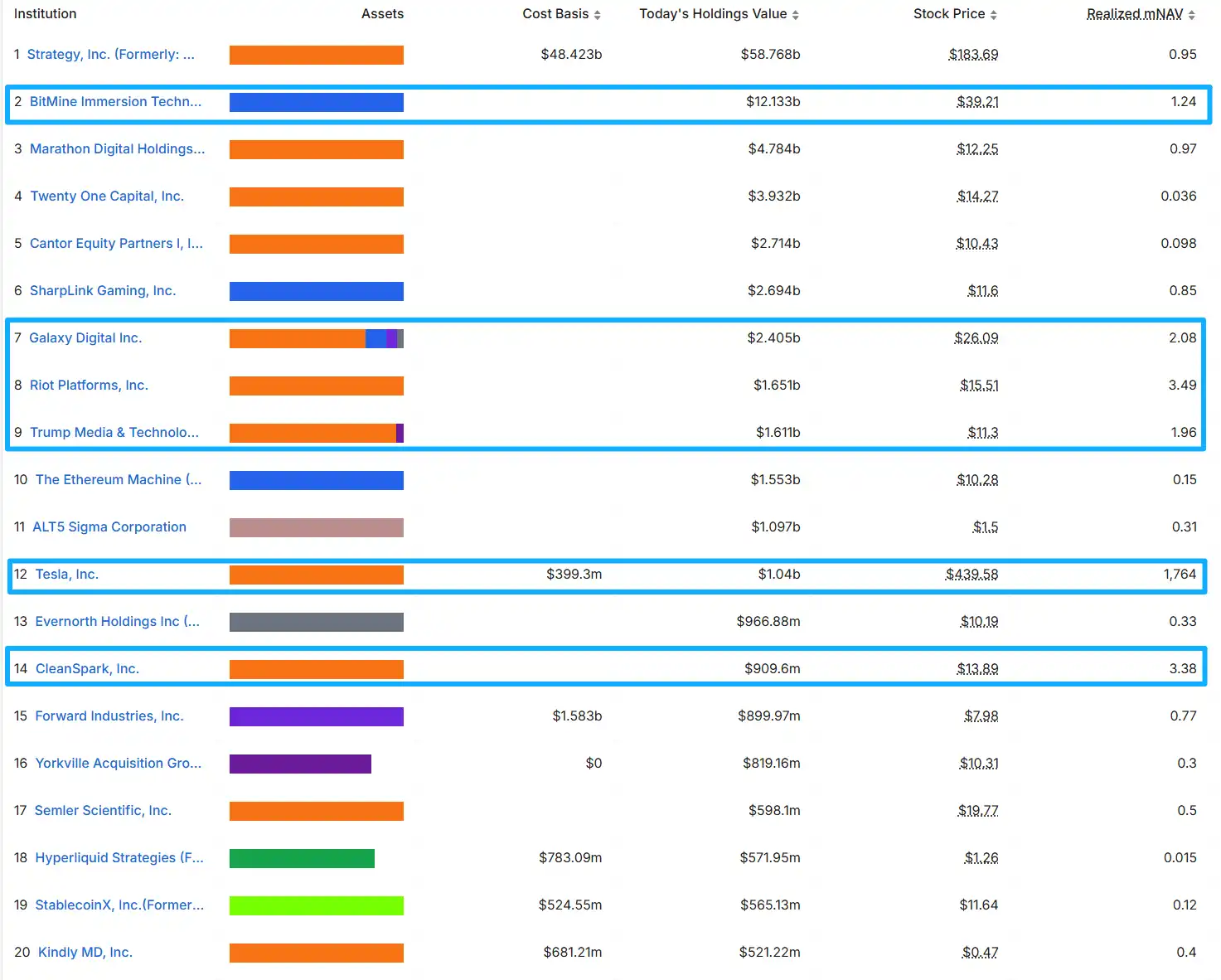
What truly confuses the market is its valuation structure. At the current stock price level, Twenty One's overall market value is only about $186 million, with a market multiple (mNAV) as low as 0.046. This means that the capital market is only willing to assign a pricing of about 4.6% of the book value of its Bitcoin assets. Why is there such an extreme discount?
A deeper analysis of its asset acquisition method reveals that Twenty One's Bitcoin reserves were not primarily formed through long-term purchases in the open market, but rather heavily relied on a "shareholder blood transfusion" model: its initial reserve of about 42,000 BTC came from direct investment by Tether. Subsequently, on May 14, 2025, the company acquired an additional 4,812 BTC through Tether, costing approximately $458.7 million at that time, corresponding to a per-unit cost of about $95,300; and before its listing, it completed an additional acquisition plan of about 5,800 BTC through PIPE financing and convertible bond mechanisms.
The advantage of this model lies in its high efficiency, allowing for large-scale reserves to be completed in a short time without going through a lengthy secondary market accumulation process; however, the cost is also evident: the assets are highly concentrated from a few related parties, making it difficult for investors to fully penetrate its internal trading structure, custody forms, and potential contractual constraints, leading to transparency and sustainability becoming important discount factors in market pricing.
The Collective Dilemma of the "Digital Asset Reserve Company" Model
From an industry perspective, Twenty One's issues are not an isolated case. According to data from defillama.com, there are currently over 70 "coin stock companies" (i.e., publicly listed companies holding crypto assets) globally. Among the top 20 holders, most companies have seen their mNAV drop below 1, including Strategy, which pioneered this model.

With the overall pullback in the current crypto market, these "coin stock companies" have gradually retreated from being the narrative core to becoming marginal assets in risk control models, and the current market valuation of these crypto asset reserve companies has generally shifted to a cautious stance.
However, there is a significant difference in scale between Strategy and Twenty One. Strategy currently holds about 660,600 BTC, accounting for approximately 3% of the total Bitcoin supply, which is more than 15 times that of Twenty One. This scale not only gives it stronger market influence but also symbolizes a certain "systemic anchoring." When Strategy's mNAV drops below 1, the market naturally raises deeper questions: Will it be forced to sell Bitcoin? Will its debt structure lead to a cascading effect? Has the DAT model lost its logical foundation in the face of macro cycles?
In fact, with the significant pullback in the crypto market in 2025, the DAT model is facing severe tests. The core of this model is to accumulate Bitcoin through debt and equity financing, viewing it as the "ultimate asset" to hedge against inflation and currency devaluation. However, when Bitcoin's price volatility significantly amplifies, the stability of this model begins to waver. Some companies, despite holding large amounts of BTC, face valuation pressure due to operational costs and market sentiment. The extreme discount of Twenty One, while related to its asset acquisition method, also reflects the market's concentrated pricing of the risks associated with the entire DAT model.
Conclusion: The Narrative Continues, but the Market Needs Time
At the Binance Blockchain Week on December 4, Michael Saylor provided a broader perspective. In his talk titled "Why Bitcoin is Still the Ultimate Asset: The Next Chapter of Bitcoin," he reiterated his core judgment on Bitcoin's future over the next decade: Bitcoin is transitioning from an investment asset to the "base capital" of the global digital economy, and the rise of the digital credit system will reshape the traditional $300 trillion credit market. From policy shifts, changes in bank attitudes, to the institutional adoption of ETFs, and the explosive growth of digital credit tools, Saylor paints a picture of a new financial order that is accelerating: digital capital provides energy, digital credit provides structure, and Bitcoin will become the underlying asset supporting all of this.
From this perspective, companies like Twenty One indeed possess a potential for "long-term correctness"—if Bitcoin ultimately completes its transition from a high-risk asset to the identity of "digital gold," then these enterprises may become core vehicles in this migration process.
However, the issue is that "long-term correctness" does not automatically equate to "currently reasonable pricing." The market still needs time to verify Bitcoin's true role in the macro system and to reassess the DAT model's resilience in different cyclical environments.
免责声明:本文章仅代表作者个人观点,不代表本平台的立场和观点。本文章仅供信息分享,不构成对任何人的任何投资建议。用户与作者之间的任何争议,与本平台无关。如网页中刊载的文章或图片涉及侵权,请提供相关的权利证明和身份证明发送邮件到support@aicoin.com,本平台相关工作人员将会进行核查。