Sui proved how fast blockchains can be.
Now it's building the stack for real world products.
Unlike most blockchains that use accounts, Sui starts from objects. This design choice allows parallelism to come naturally, fee markets to localize, and higher layers to treat identity, storage, and policy as integrated components.
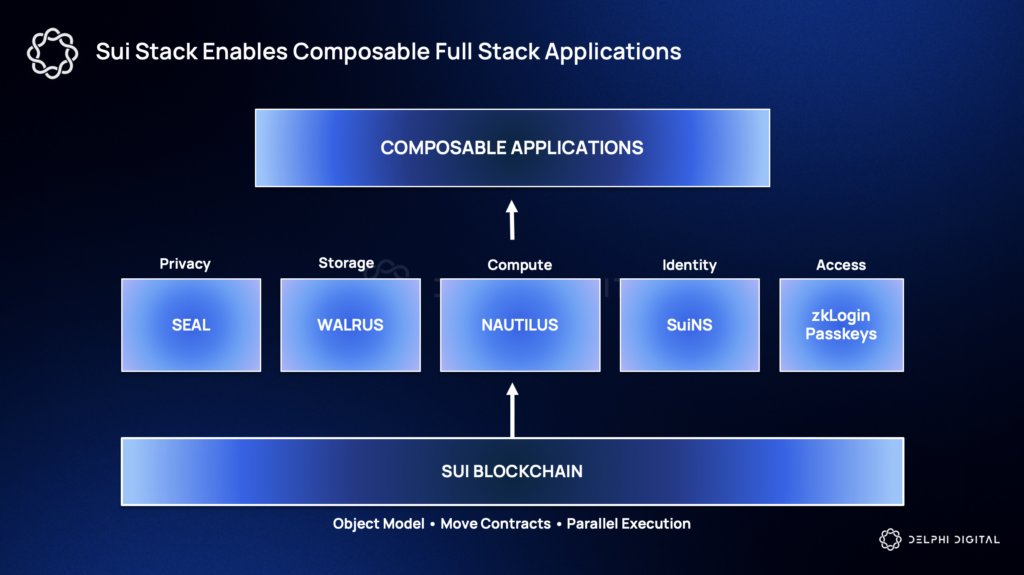
With that foundation, Sui is building a complete infrastructure layer on top. Seal provides privacy. Walrus stores data. Nautilus runs compute. SuiNS manages identity. zkLogin and Passkeys control access. These pieces work together as a single framework. Privacy, data ownership, and identity are built into the default developer toolkit.
New design spaces open up with privacy and access controls. A marketplace chat can link a wallet to a private thread, encrypt the stream with Seal, store attachments on Walrus, and bring the conversation under a Move policy that defines who can read and when.
A content creator could publish encrypted content to Walrus and set a policy that unlocks it only for token holders after a delay or automatically refunds if access conditions are not met. Nautilus extends this to computation by running code inside a trusted enclave, returning an attestation, and letting Move verify it before updating state or releasing a key.
This setup enables sealed bid auctions, private credit checks, or agents that compute routes and encrypt results while leaving a verifiable trail.
Now that throughput has been solved, Sui is building infrastructure most chains still lack. Seal, Walrus, Nautilus, SuiNS, and zkLogin give developers control over who can access what, how it's proven, and where it persists.
免责声明:本文章仅代表作者个人观点,不代表本平台的立场和观点。本文章仅供信息分享,不构成对任何人的任何投资建议。用户与作者之间的任何争议,与本平台无关。如网页中刊载的文章或图片涉及侵权,请提供相关的权利证明和身份证明发送邮件到support@aicoin.com,本平台相关工作人员将会进行核查。


