Written by: Carl Agnelli (Author's detailed background at the end)
Translated by: GaryMa Wu Says Blockchain
Imagine your family being kidnapped from your home, or you being forced into a car by armed assailants, or even having your finger cut off by criminals demanding ransom. These scenarios are unsettling, even cruel, but they are not hypothetical. These events have happened — and are happening to some individuals in the cryptocurrency space.
I want to share some practical lessons to help cryptocurrency founders, operators, and investors stay safe in this increasingly dangerous world. I will focus on two core areas of security: daily habits and the unique violent crimes in the crypto industry. But first, I will start with some basic principles and a few real-life cases.
Why take the time to discuss this? Founders, operators, and engineers are focused on building their companies, while investors are busy managing their portfolios. But if you don’t consider security — personal safety — everything else is irrelevant. This is not just about your own safety; it’s about your team, your family, and your work. Security must become part of your operating system.
I have worked in the security field for 35 years, spending 25 years with the U.S. Secret Service, holding various positions, including protecting every living U.S. president. I have also protected foreign heads of state (even those I do not agree with). The rule is simple: no one is allowed to die on U.S. soil.
But the Secret Service is not just about protection. It is the only agency in the U.S. government with both protective and investigative missions. Many of the world’s top cyber investigators come from here. I have participated in global multinational investigations, surveilled others, and been surveilled myself. You learn many skills in the process, becoming a master at observing human nature, interpreting others, spotting weaknesses, and identifying risks before threats occur.
1. Basic Principles of Personal Safety
Here are some guiding principles:
Avoid conflict whenever possible: If someone is acting strangely, leave the scene. Switch to another train car, cross the street. Don’t let your pride get in the way; your arrogance won’t save you.
Trust your instincts: That uneasy feeling doesn’t come from nowhere. It’s your autonomic nervous system warning you — increased heart rate, rapid breathing, sweating. This is your body trying to protect you. Listen to it.
Anticipate the unexpected: We call them "Murphy moments." When things go wrong, they often escalate quickly. You can’t predict every scenario, but you can mentally rehearse. "What if something happens?" is your best defense.
Invest in security: We spend two hours reading Amazon reviews to choose a water bottle. Spend five minutes learning how to secure your home when you leave.
2. Situational Awareness: Stay in the "Yellow State":
In the Secret Service, we use color coding to describe the attention state of a target (that is, you) in public:
White: Unaware, distracted — like walking with headphones on. Vulnerable.
Yellow: Relaxed alertness. Stay vigilant but not overly tense. This is the state you should maintain.
Orange: High alert — used for active threat scenarios.
Black: Panic, paralysis. You never want to enter this state.
In the Secret Service, we often say "lean into the yellow," meaning to maintain a relaxed alert state. Train yourself to live in the yellow state. You don’t need to be paranoid, just attentive.
You might notice someone on the train talking to themselves or wearing a heavy coat in 30-degree weather. You wouldn’t panic, but you would choose to leave. You don’t want to be in a white state — completely distracted, wearing earbuds, engrossed in your phone. Even worse, you don’t want to enter a black state — paralyzed by panic.
Stay in the yellow state.
3. Learning from Lessons: Two Personal Safety Cases
Case One: "Loose Lips" in Public
Last year, I attended a Formula 1 event in Miami. After the race, I went to a bar, not to party, just to grab a burger and a Diet Coke. I sat at a table alone and noticed a man a few feet away. He was with three women, clearly having a good time and noticeably a bit drunk.
He was loud, speaking with a bit of college charm. But more importantly, he was rambling. In less than a minute (I wasn’t eavesdropping on purpose, just sitting close), I knew his first name. A minute later, I heard his last name. The women talked about family backgrounds, and he mentioned his Irish heritage; someone made a spelling joke, and he corrected them. Just like that, I knew his full name.
He was wearing a polo shirt embroidered with a company logo from a racing team. He also loudly mentioned his job: what he did and who he worked for. Now I knew his employer and position.
Then the topic turned to birthdays. One of the women was celebrating her birthday, and he chimed in that his birthday had just passed. She asked, "What day is it?" He told her. "You don’t look 50," one woman joked. "Come on, I look good for 50," he replied. So now I knew his complete birth date: month, day, year. My burger hadn’t even arrived yet.
The conversation shifted to where they were staying. He casually mentioned they were all at the same hotel. Then they talked about the view from their rooms: one woman could see the pool, another could see the street. He added, "We’re all on the 18th floor, right?" They laughed about being so close. Someone asked him what room he was in, and he told them directly.
At this point, without even talking to him, I had gathered detailed information: full name, employer and job function, birth date, hotel, floor, room number.
If I were a malicious person, I could confidently walk up to the front desk, employ a bit of social engineering: "Hey, I locked myself out of room XXX, my ID is upstairs, you can call my phone to confirm…" I could easily get the key. In the best-case scenario, I rob his room; in the worst case, he comes back while I’m in there.
Now, amplify this situation by 100 times. What if I were someone intentionally targeting him? What if I followed him from a public speaking event or industry conference, or simply searched for him online because he was somewhat known in the crypto space? All the information he freely leaked was the fatal point that exposed him to risk.
He just wanted to make a good impression on a few people at the bar. But he revealed almost all the information a company might use to verify identity: birth date, name, workplace, room number. This information makes you extremely vulnerable.
Lesson: Assume there’s always someone like me eavesdropping. Just don’t worry about someone like me — because unlike me, those eavesdroppers might actually want to harm you. They are listening, looking for the next easy target. Don’t let yourself become that target.
Case Two: Carl at a Hockey Game
I don’t want to just critique that drunken stranger in Miami. Let me share a story where I ignored all safety common sense myself.
I went to New Jersey with friends to watch the Boston Bruins playoff game. I was wearing a brand-new Bruins jersey, underneath which I had my work attire — a licensed handgun on my hip. We were loud, having a great time, and probably saying things we shouldn’t have. The Bruins won. After the game, I strutted through the parking lot like an early Conor McGregor.
I looked around and realized: my friends were gone. I was surrounded by a sea of red Devils fans, all staring at me. I thought I should head back to the arena.
But I didn’t. I kept walking.
A guy — out of his red jersey, furious — walked straight toward me. He scanned the area, looking around, just like we would do before an operation in the Secret Service. He was checking for police and exits. I recognized these signals; I saw every one of them. But I ignored them.
This guy walked right up to me and punched me in the face. I fell to the ground, and he broke my nose. I wrestled with him, worried he would grab my gun, concerned his friends would come over and stomp me. I remember thinking at that moment, "Is this how it ends for me? In a parking lot in East Rutherford, New Jersey?"
Suddenly, my buddies showed up. It was chaos. They pulled me out. I was bloodied, my nose a mess. They asked, "How did you get beat up like this?"
It was simple. I put myself in danger, ignoring all the signals. Lesson: This can happen to anyone — even those who think they know how to protect themselves.
4. Daily Habits to Stay Safe
Many habits for staying safe aren’t glamorous. They aren’t tactical gear or Secret Service convoys. They are basic, even somewhat boring habits. If you can develop these habits correctly, you will be much safer than most people.
Here are some specific practices:
Don’t walk alone after drinking: If you must walk alone, tell someone your plan. It’s simple, but people often mess it up. You go out drinking, have a few, and leave without saying goodbye to your friends. This happens all the time. If you drink, fine — but make sure someone knows where you’re going, how you’re getting there, and when you’ll arrive. Text a friend, share your location, use your phone’s tracking feature or a dedicated tracking app. Do everything possible to ensure your safety.
Carry non-lethal deterrent tools — but keep them in hand: For example, buy a flashlight with a strobe function. This is a real deterrent — but only if you’re holding it. Pepper spray is the same. If it’s buried in your bag, it’s useless. You need to have it in hand, ready to use, and know how to use it. Walking alone at night? Keep the deterrent tool in your hand.
Reduce distractions: If I had malicious intent, I could rob half the people on a New York train. With earbuds in, looking down at a screen, backpack open, completely zoned out. This is the white state — a complete lack of awareness. You need to "stay in the yellow state." Take one earbud out, look up, stay alert. As long as you look like an aware person, you’re less likely to become a target than most.
Try the Bond app for non-emergency situations: There’s a big gap between "just feeling scared" and calling 911. The Bond app fills that gap. If you’re in a rideshare and the driver or fellow passenger feels off? Walking home late at night feels unsafe? Open the app, and within seconds, you can talk to a real person trained in conflict de-escalation. You can have them silently accompany you on your journey; they’ll stay on the line. They can track your route and contact emergency services if necessary. This is a game-changing tool I recommend to every partner. There may be other similar services, but this is the one I use.
Practice stairwell drills — know your exits: After I check into a hotel, I don’t just drop my luggage and relax. I find the emergency stairwell and walk through it myself. Why? Because in a fire or emergency, elevators are not available, and people panic. You don’t want to discover during an emergency that the stairwell leads to an unexpected place — or worse, that the door won’t open. We always hear about exit locations on planes, look for signs — why not do the same in other places where we spend more time? I’ve been in that situation. Don’t take it for granted. Know your exits.
Establish a backup plan — meeting points when separated: This method has saved my life. I took my daughter to a crowded Baltimore Orioles game. She was young and wanted ice cream. We walked to buy it, and when I turned around — she was gone. There were 40,000 people in the stadium. Panic set in quickly. But before we left, I told her, "If we get separated, wait for me by the statue." Sure enough, there she was, hugging her little teddy bear. You should have the same plan when going out with friends or family: "If something goes wrong, let’s meet here." It’s that simple.
Check the mirrors in hotel rooms: This is a bit niche, but it is indeed a concern. When I travel — especially abroad — I always check the mirrors. Press a pen or sharp object against the glass. If there’s a gap between the pen tip and the reflection, you’re fine. If there’s no gap? It could be a two-way mirror. I’ve encountered this twice, both in high-risk countries. If there’s an issue with the mirror, request a room change.
Store essentials in the hotel safe: Have you ever forgotten your passport or wallet in the hotel safe when checking out? This happens often. My trick is to put something I absolutely need in the safe — like a shoe. The next morning when I’m getting dressed and realize I’m missing a shoe, I’ll immediately remember the safe.
These are not complex strategies, just smart habits. If you stick to them, you’ll be ten steps ahead of most people.
Five, Unique Threats in Cryptocurrency
The daily habits mentioned above are practices everyone should follow. But let’s not sugarcoat reality: if you’re in the cryptocurrency industry, you are a target. Founders, engineers, early employees — if someone believes you might hold digital assets or have influence over protocols, they may come after you. These individuals are not petty thieves; they are often organized, sophisticated criminals. Many times, they are also violent.
This is not a theory; it’s a real threat you must be vigilant about.
These are not random robberies — they are meticulously planned brutal actions
Not long ago, a cryptocurrency founder in the UK was robbed at gunpoint (in a country where gun crime is rare). The attackers did not choose him randomly. They had a plan, tracked him, studied him, and then struck.
Another case involved a co-founder of a cryptocurrency wallet company. He and his wife were being watched. The attackers followed them, waited for the right moment, and then kidnapped them. They took the founder to another location, cut off one of his fingers, and sent a video to his co-founder to prove their seriousness. This was not just robbery; it was terror.
There was also a case in Toronto involving the CEO of an international crypto asset platform. On the night after the U.S. elections — when Bitcoin prices soared — he was grabbed off the street. The attackers had observed his daily activities and planned meticulously. In the end, he handed over cryptocurrency worth millions.
These are just documented cases. There are many more you will never hear about.
Not just celebrities become targets
It’s not always the CEO or protocol founder who gets attacked. Sometimes, the attackers target those who boast online.
There was a young man in Portland — not famous and without protection. He liked to brag on Twitter about how much cryptocurrency he had, what he bought, and where he was going. A gang from Florida saw these posts, flew to Portland, kidnapped him, took everything, and left him tied to a fence.
He wasn’t even on anyone’s radar before. Just by boasting loudly, he made himself a target.
Why Cryptocurrency is Particularly Vulnerable
Why is this the case?
External perception: People think that if you’re in the crypto industry, you must be wealthy. Whether that’s true or not, it’s enough for criminals to believe it.
Lack of infrastructure: Early-stage startups often lack security teams. You might be managing millions of dollars in assets and building protocols, but your lifestyle still resembles that of a college student. This is a problem.
Criminals don’t understand cryptocurrency: They don’t know that wallets can be traced and funds can be frozen. They just think that if they get your keys, they’ve won.
No "undo" button: If criminals get your mnemonic phrase, enough shares of your multi-signature keys, or the password and access to your hardware wallet? It’s all over. There’s no hotline, no fraud department.
These attacks do not happen overnight. Criminal operations have their processes:
Identify the target: Usually through public channels — podcasts, social media, conferences, or even guest lists from parties.
Build a profile: They start gathering everything: your name, habits, digital footprint. Who you live with, who you work with.
Leverage those around you: Housekeepers, contractors, rideshare drivers — anyone who can get close to you.
Study your daily routine: This is called "lifestyle" surveillance. When you leave home, which route you take, where you eat, your alone time.
Choose the location: Usually your home, because they know the layout, can control the environment, and buy time.
This kind of operation requires effort. But that’s why, as long as you stay vigilant, you can detect it.
Six, What You Can Do
Set up a secondary wallet: You may know this ironic fact: you spent years building impenetrable crypto technology, only for a guy to threaten you with a $5 wrench to hand over your seed phrase.
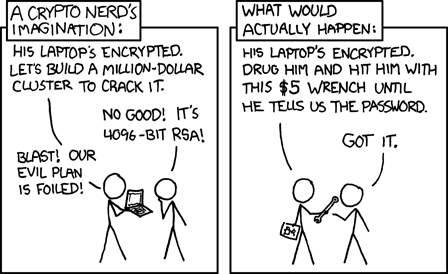
The harsh reality: If someone has you, crypto technology won’t save you. Your cold storage laptop won’t save you. Your multi-signature setup is great, but if someone attacks you, it’s all useless.
So, I tell every founder I work with: set up a secondary wallet. Make it look real, put some funds in it, give it transaction history, make it seem genuine. If things get dire, hand over this wallet. It’s not the real vault, just enough to pass for one.
How much to put in? That’s up to you. 10%? 5%? Make it painful enough to hand over, but not fatal.
Because if someone has spent weeks planning to kidnap you, they won’t leave empty-handed. But if they get something, they are more likely to walk away directly. They want to get out as quickly as you do. You don’t want to get into a standoff. You want to give them what they want and end it quickly.
If they know — or even suspect — you have more? That makes things worse.
Delete your online traces: You don’t need to be paranoid, but you need to stay low-key. We recommend using services like DeleteMe to reduce your digital footprint. Use trusts when buying property. Don’t give attackers a map.
Install home security cameras and motion lights: You don’t need to spend tens of thousands of dollars. Basic setups — motion lights and Ring cameras at front and back doors — can make a huge difference. No one can approach your house without triggering an alarm. Motion lights buy you time, and cameras increase your awareness. If someone is casing the place and sees these setups, they are likely to turn to someone else. Most people will choose the easier target over the difficult one. This is basic protection. If you’re in the crypto industry, you should already have these.
Diversify your funds: Use different platforms, don’t link everything. Too many people put all their assets in one place. Worse, they manage multiple accounts with the same email, device, or recovery protocol. This is a disaster. If someone breaches one account and can trace other accounts, you’re done. Cut the connections. Use different services, diversify wallets, platforms, devices — everything. The harder it is to map the connections, the safer you are.
Practice "what if" scenarios: This is very useful. I do this often. When I walk into a restaurant, I think, "If someone with a gun comes in right now, where would I go? What could I use?" On a plane, I imagine, "What if something goes wrong?" In the Secret Service, we always trained this way. Visualization is key. Ask yourself, "If someone bursts in right now, what’s my first move? Where’s cover? Where’s a hiding spot? Can I get out?" You never want to be thinking about these things for the first time when it happens.
Know your exits, familiarize yourself with stairwells, prepare an "emergency outfit": In an emergency, hotels can be chaotic. The fire alarm goes off, people are in bathrobes, barefoot, panicking with laptops. Don’t be that person. After I check into a hotel, I immediately find the emergency stairwell and walk through it. I want to know not just where it is, but where it leads. You’d be surprised to find that some stairwells don’t lead where you expect. I also prepare an "emergency outfit" — I keep workout clothes and shoes ready for quick wear. If a fire alarm goes off in the middle of the night, I can be dressed and out the door in 30 seconds instead of fumbling around.
Don’t rely on your phone to reconnect: Establish a separation plan. Phones can die, signals can drop, especially in a disaster. You can’t rely on your phone as your only lifeline. When going out with a partner, team, or friends, you need a separation plan. Say it out loud before you leave: "If something goes wrong and we get separated, let’s meet here." It doesn’t need to be complicated. My three-year-old daughter can do it at a baseball game, and so can you. Make a plan every time.
Seven, Conclusion
If you do get caught, it will be too late to regret not considering these things. That’s why situational awareness is crucial. Your best defense is prevention. Stay in the yellow state, develop good habits, and be prepared.
P.S.: Carl Agnelli is the Head of Security at a16z crypto, responsible for the safety and protection of a16z crypto employees, facilities, and events globally. Before joining a16z, Carl Agnelli served as the Chief Security Officer at Citigroup. Previously, he served as a special agent with the U.S. Secret Service for 25 years. In Washington, D.C., he was responsible for global security operations and provided personal protection for Presidents Bill Clinton and George W. Bush. Carl Agnelli also served as the head of the U.S. Secret Service in the Northeast, overseeing security measures for large events involving the U.S. President and visiting foreign heads of state.
免责声明:本文章仅代表作者个人观点,不代表本平台的立场和观点。本文章仅供信息分享,不构成对任何人的任何投资建议。用户与作者之间的任何争议,与本平台无关。如网页中刊载的文章或图片涉及侵权,请提供相关的权利证明和身份证明发送邮件到support@aicoin.com,本平台相关工作人员将会进行核查。


