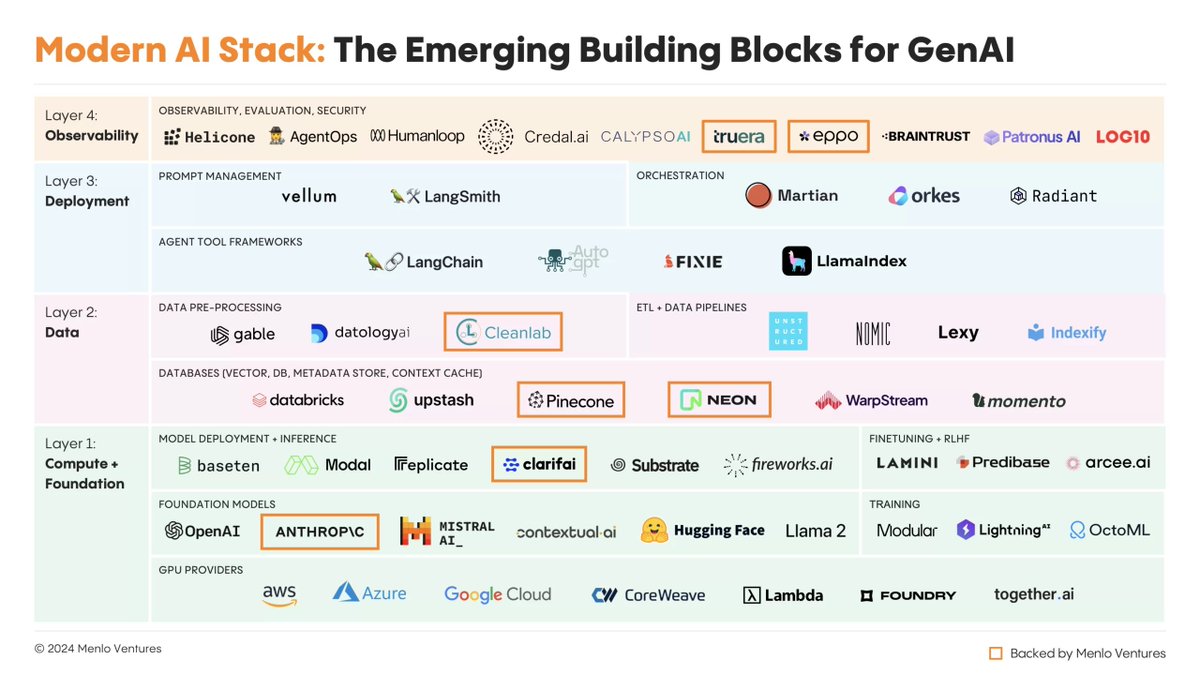
Recently, I have been looking at a lot of AI projects and have been thinking about which #AI+ #Web3 projects are genuine propositions and which are not, and how to distinguish between them. I recently read an article titled "The Modern AI Stack: Design Principles for the Future of Enterprise AI Architectures," which has given me a lot of inspiration.
In this insightful article, Menlo Ventures comprehensively outlines the modern AI stack and its evolution.
I. Key insights:
AI, like our Web3 modular solution, is also layered, with a total of 4 layers defining the entire AI stack: the computation and basic model layer, the data layer, the deployment layer, and the observable evaluation layer. Each layer contains necessary infrastructure components, similar to SDKs, enabling enterprises to efficiently build and deploy AI applications.
The maturity of AI has been increasing, gradually evolving towards the application layer, and there will be more specialized vertical AI applications emerging (such as those specifically targeting finance, legal, and investment analysis). From the perspective of Web3 entrepreneurial thinking, it is better to shift from building underlying models or infrastructure to developing products. Recently, I have also come across some Web3 projects that focus on product applications, such as: @AlvaApp @ScopeProtocol, as well as those focusing on AI for stocks, such as: @finchat_io. They are doing quite well. If token economics are integrated and user traffic is obtained, their valuations will surpass those focusing on computing power and data ownership, which have lower valuations.
Modular construction of AI has become increasingly mature, and the completeness of AI infrastructure in the Web2 domain is already high, eliminating the need to reinvent the wheel in Web3, especially at the computational model level. Currently, teams without machine learning expertise can deploy and develop AI applications effectively. This shift has led to new building block solutions appearing at each stage and addressing each pain point in the maturity curve of AI, serving as the fundamental infrastructure for producing AI systems.
Currently, the majority of AI spending is used for inference rather than training, with almost 95% of AI spending used for runtime rather than pre-training. This trend highlights the importance of efficient and scalable inference infrastructure in the modern AI stack. In terms of machine reasoning, human reasoning is significantly superior to AI (e.g., in autonomous driving), especially in the field of error correction in reasoning results. Integrating Web3 tokenization to address this area is actually a good direction.
More and more enterprises are adopting a multi-model approach, using multiple models to achieve higher performance. This approach eliminates reliance on a single model, provides higher controllability, and reduces costs. @opentensor is already doing this, and I believe there will be more and more Web3+AI projects to address the high cost of AI models.
Retrieval-Augmented Generation (RAG) has become the primary architectural method for endowing AI basic models with enterprise-specific "memory." This technology has surpassed other custom technologies in today's production, such as fine-tuning, low-rank adaptation, or adapters. RAG solutions are extremely suitable for many Web3+AI data scenarios and have good application prospects.
The rise of the modern AI stack has democratized AI development, enabling mainstream developers to complete tasks that previously required years of basic research and complex machine learning expertise in a matter of days or weeks. The second half of AI will likely be the era of "fat applications," with numerous AI applications in various fields emerging. For example, as shown in the figure below, an AI dating coach built on ChatGPT generates a monthly income of $190,000 and has been downloaded 330,000 times per month, without any new technology, just a secondary packaging on top of ChatGPT.
With the continuous development of the modern AI stack, we can expect to see the emergence of next-generation AI applications that will utilize more advanced RAG technology, fine-tuning, task-specific model surges, and the development of new tools for observability and model evaluation.
II. Notable data:
In 2023, enterprise spending on the modern AI stack will exceed $11 billion, making it the largest new market for AI generation and a huge opportunity for startups.
There are 30 million developers and 300,000 ML engineers worldwide, but only 30,000 ML researchers. For those innovating at the forefront of ML, the author estimates that there may be only 50 researchers in the world who know how to build GPT-4 or Claude 2 level systems.
Nearly 70% of AI adopters use manual review outputs as their primary evaluation technique, highlighting the demand for new tools in observability and evaluation, which can be excellently addressed through Web3 tokenization, including early data labeling and later AI evaluation. Data labeling outsourcing companies such as Infolks, iMerit, and Playment are turning India into the "data backend" for global AI companies, which can be fully tokenized through Web3.
III. Some shallow suggestions for AI+Web3 entrepreneurship:
Focus on the data layer: As AI development shifts towards retrieval-augmented generation (RAG) as the primary architectural method, Web3+AI projects that provide robust data layer infrastructure (such as vector databases, data preprocessing engines, and ETL pipelines) will have a perfect narrative and imaginative space.
Embrace the multi-model paradigm: AI+Web3 infrastructure and platforms enable projects to easily integrate and coordinate multiple models, providing standardized API interfaces to route prompts to the best-performing model for each use case, solving the democratization challenge through Web3 tokenization.
Innovate in observability and evaluation: As enterprises increasingly adopt AI, the demand for tools to monitor and evaluate the performance of their AI systems is growing. Web3 projects that can provide novel solutions in this area will have great opportunities.
Prepare for serverless: As the modern AI stack moves towards serverless architecture, Web3 projects that can provide serverless solutions for various components of the stack (such as vector databases, caching, and inference) will be able to meet the current narrative needs of AI very well. Web3 has a natural advantage in this area.
Explore advanced RAG technology: AI projects that can develop and commercialize next-generation RAG technology (such as idea-chain reasoning, idea-tree reasoning, reflection, and rule-based retrieval) will be at the forefront of the next stage of evolution in the modern AI stack.
Finally, thanks to Menlo Ventures for the excellent AI article and research.
Original article link: The Modern AI Stack: Design Principles for the Future of Enterprise AI Architectures

免责声明:本文章仅代表作者个人观点,不代表本平台的立场和观点。本文章仅供信息分享,不构成对任何人的任何投资建议。用户与作者之间的任何争议,与本平台无关。如网页中刊载的文章或图片涉及侵权,请提供相关的权利证明和身份证明发送邮件到support@aicoin.com,本平台相关工作人员将会进行核查。