Original author: @DodoResearch
Tired of the battles in the secondary market of centralized exchanges? You might want to take a look at the rarely visited on-chain strategies. Compared to the large user base and trading volume of centralized exchanges, the relatively fewer players on-chain may be a better solution in the current market situation. There are many sources of on-chain income, but most users are still stuck in interactive airdrops, following project activities to stake and accumulate points, and the early stages of participating in new projects.
In this issue of #HottestCoin, we will reveal the on-chain income strategies from several aspects, teaching you how to earn relatively stable and efficient passive income on-chain, outperforming the majority of asset management income levels, and in the following issues, we will provide detailed explanations of several popular projects.
There are many sources of on-chain income. In the current market environment, chains, DApps, and narratives are important, but they are not particularly directly related to the strategy itself. For example, in the EVM ecosystem, there are long-term stable yield opportunities, currently only available on the mainnet, Arbitrum, and BNB Chain. Some EVM L2 platforms have high initial staking yield expectations, but there are very few that can form stable income sources after the ecosystem stabilizes. In terms of DApps, it mainly includes DEX, lending, stablecoins, yield market Pendle, and various individual projects.
Taking well-known projects like LRT and LSD as examples, following the project rules to stake and earn points during the peak of the narrative is a good strategy, and the final airdrop redemption can yield relatively good returns. However, in the current situation where the project's airdrop rules are unclear, liquidity is poor, and there is a lack of secondary market support, simply staking to earn points is obviously not a particularly good strategy.
If the project itself supports @pendle_fi, then earning a passive income of 20-40% annually is obviously much more attractive. There may also be better strategies, such as providing liquidity in DEX, where in concentrated liquidity pools, you can sometimes earn over 40% annualized returns. Due to the staking lock-up, it is a distant prospect to withdraw ETH from the project, and many users actually exit directly through swapping, and some projects have relatively small liquidity pools, which presents relatively high income opportunities.
Following this, how should DEX select pools? Is it simply based on APR, the higher the better? Not necessarily. The liquidity provided by DEX is generally influenced by three factors: transaction fees, token incentives, and costs incurred by impermanent loss. Some DEX's transaction fee yield includes the token incentives, but this does not affect our separate analysis.
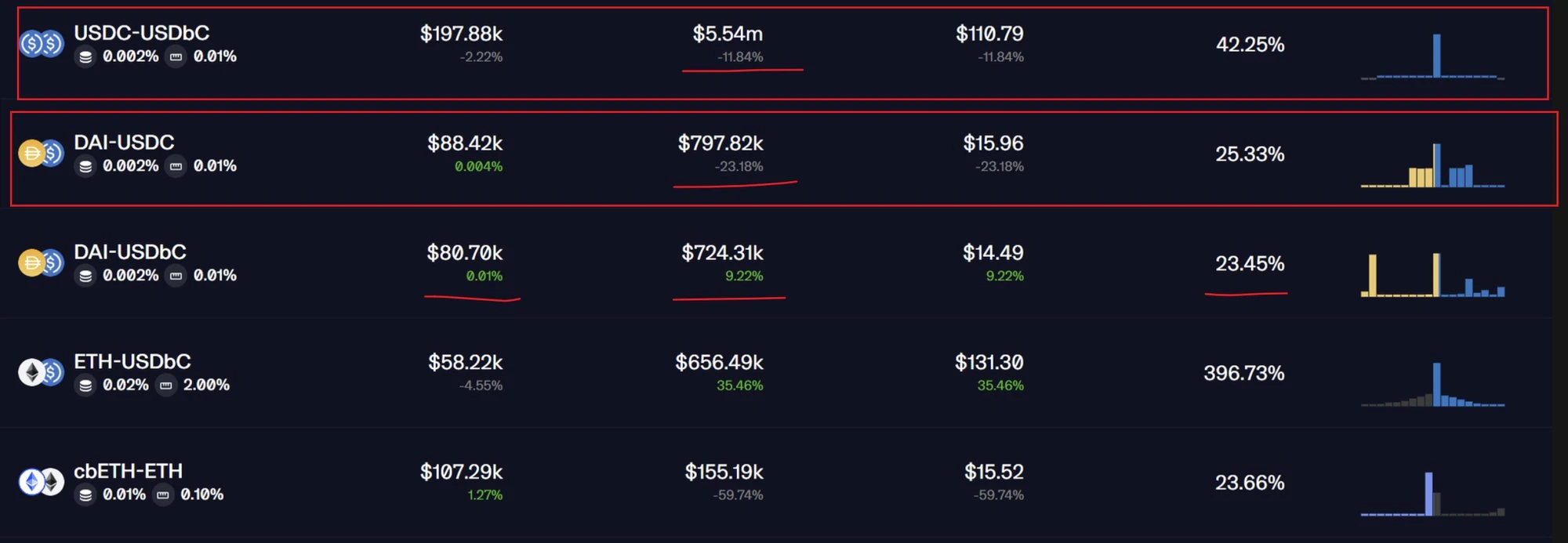
Pools suitable for retail investors include various stablecoin pools and LRT/LST pools. It is important to select concentrated liquidity pools, which can improve market-making efficiency and make it easy to achieve yields higher than those of asset management. There is no need to worry about the risk of impermanent loss, and there is no operational threshold for frequent switching, as long as the pool is selected appropriately.
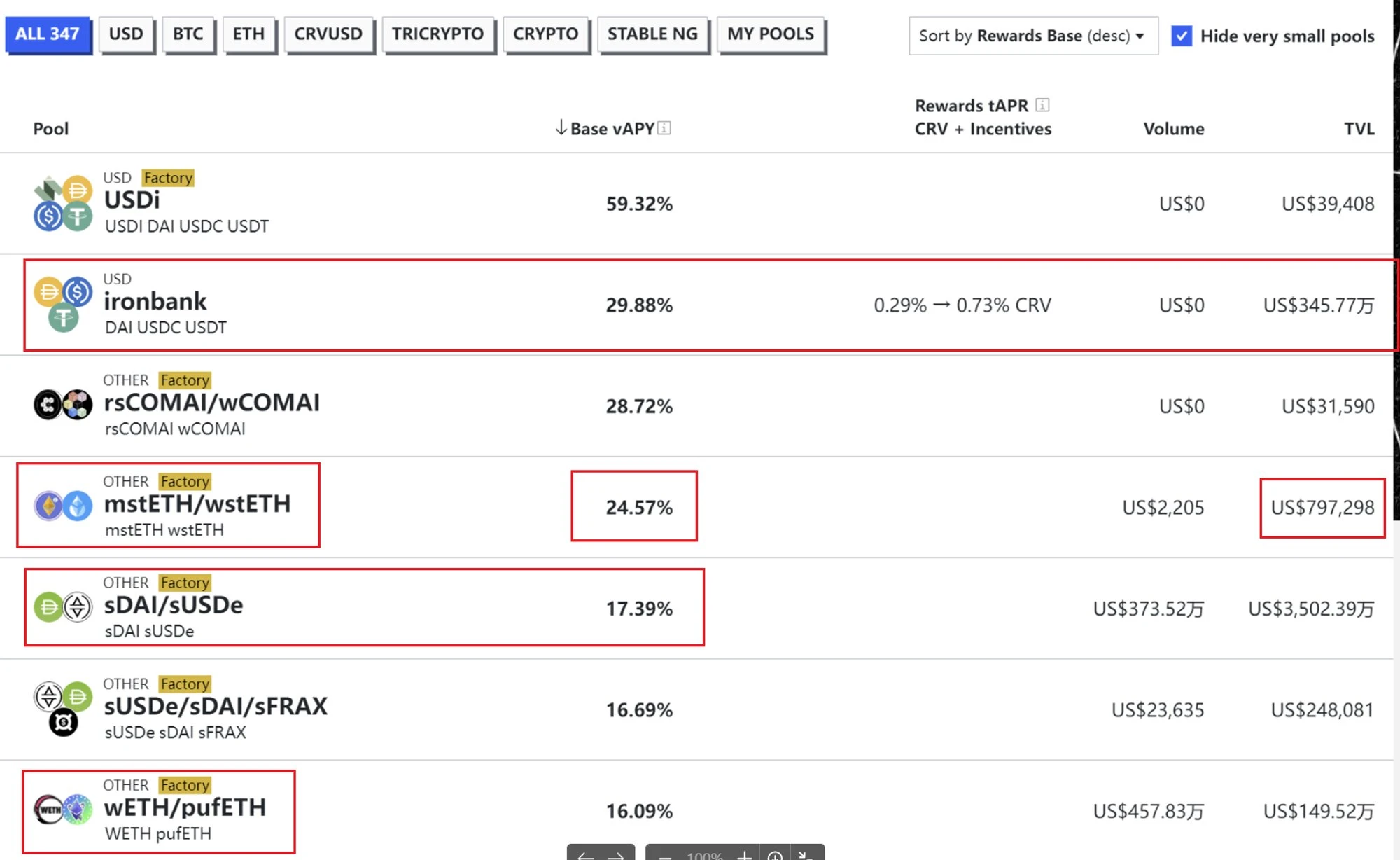
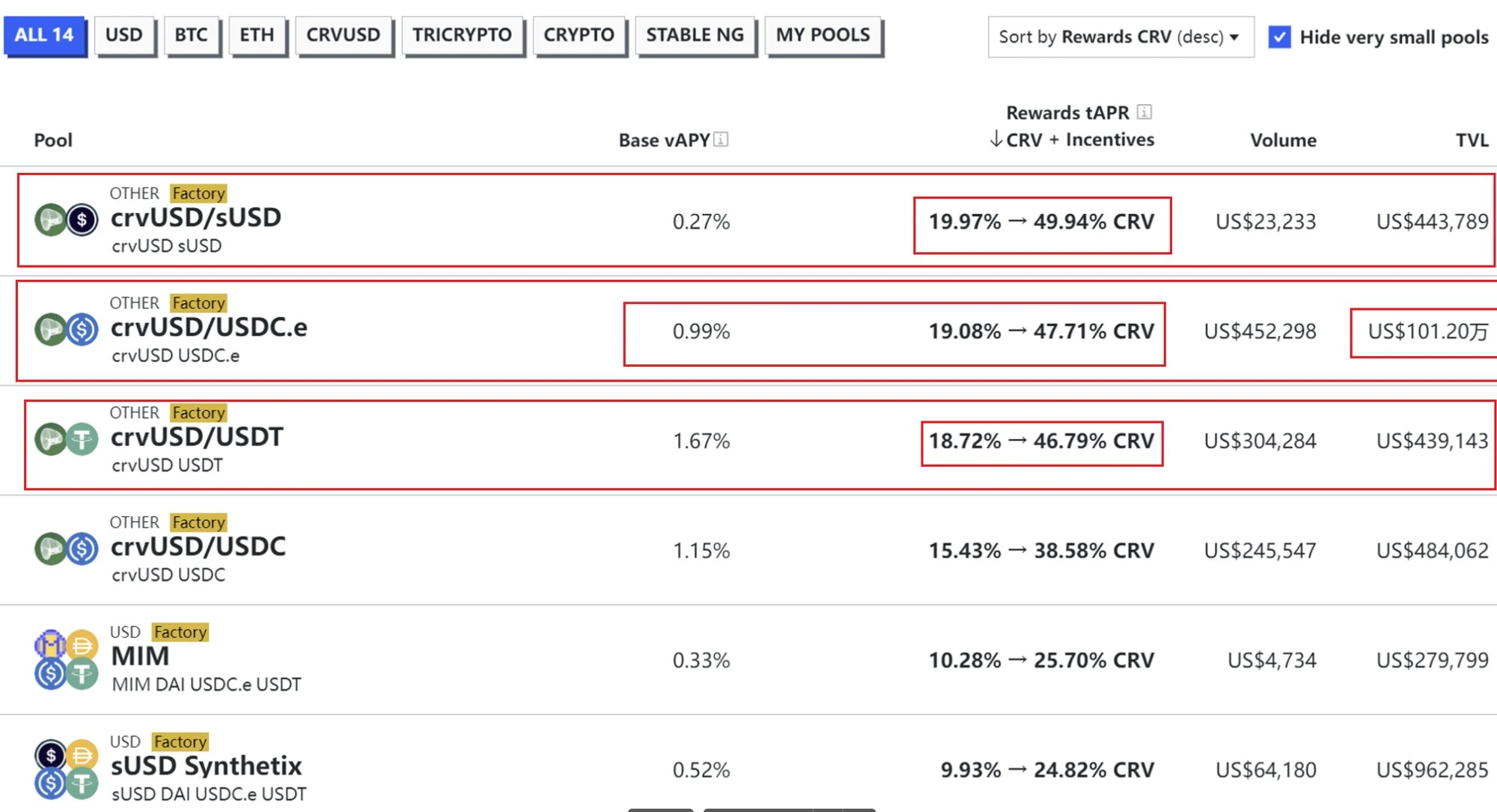
For example, the three pools on Curve have relatively high yields.
Pools like WETH/pufETH and mstETH/wstETH can also yield over 15%, and the mining yield related to crvUSD exceeds 20%, and can be withdrawn at any time, which is more attractive than simply locking up assets.


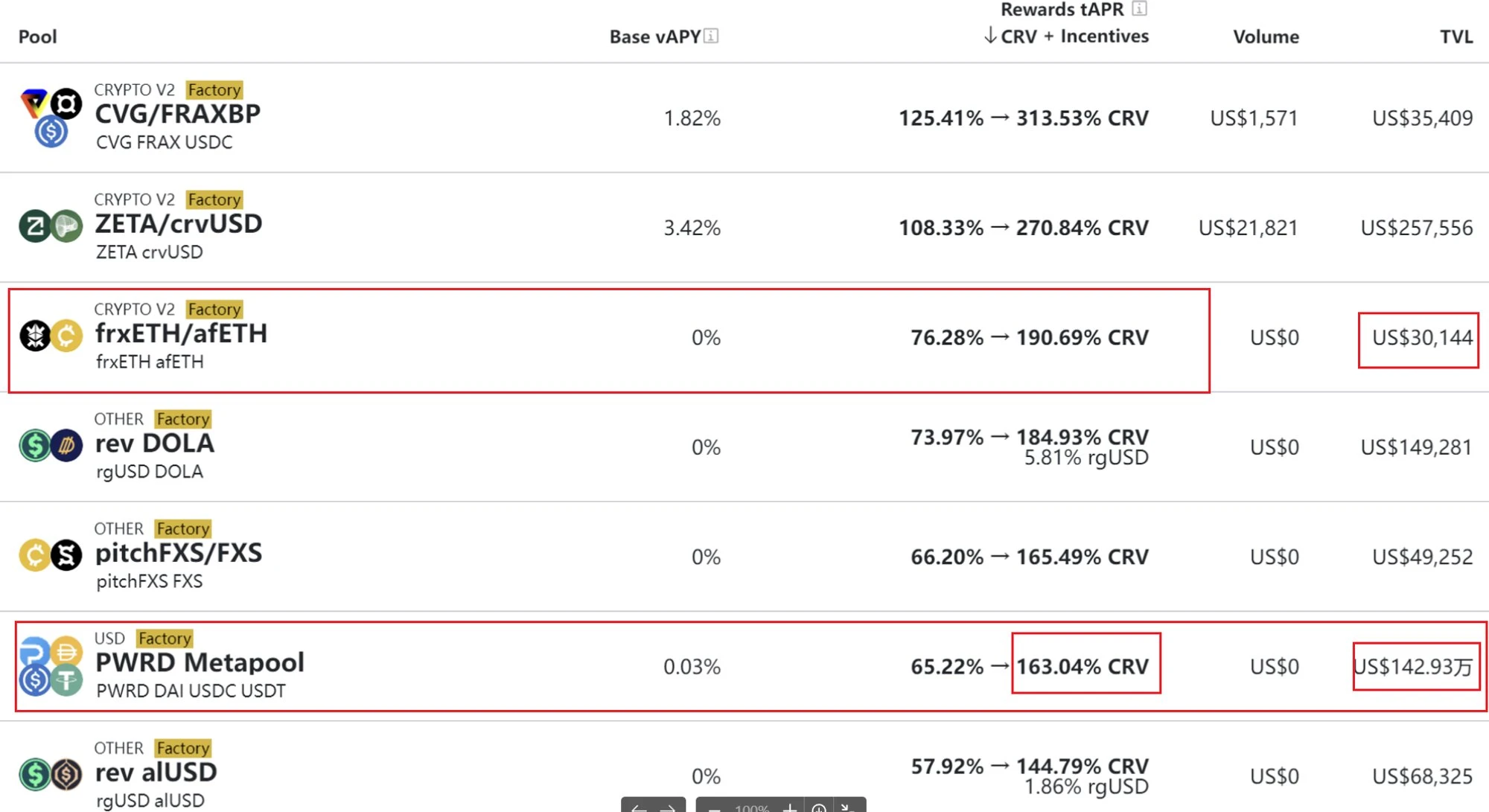
For example, the stablecoin PWRD Metapool four-pool on Curve, with high token incentives and deep liquidity, is one of the optional pools.

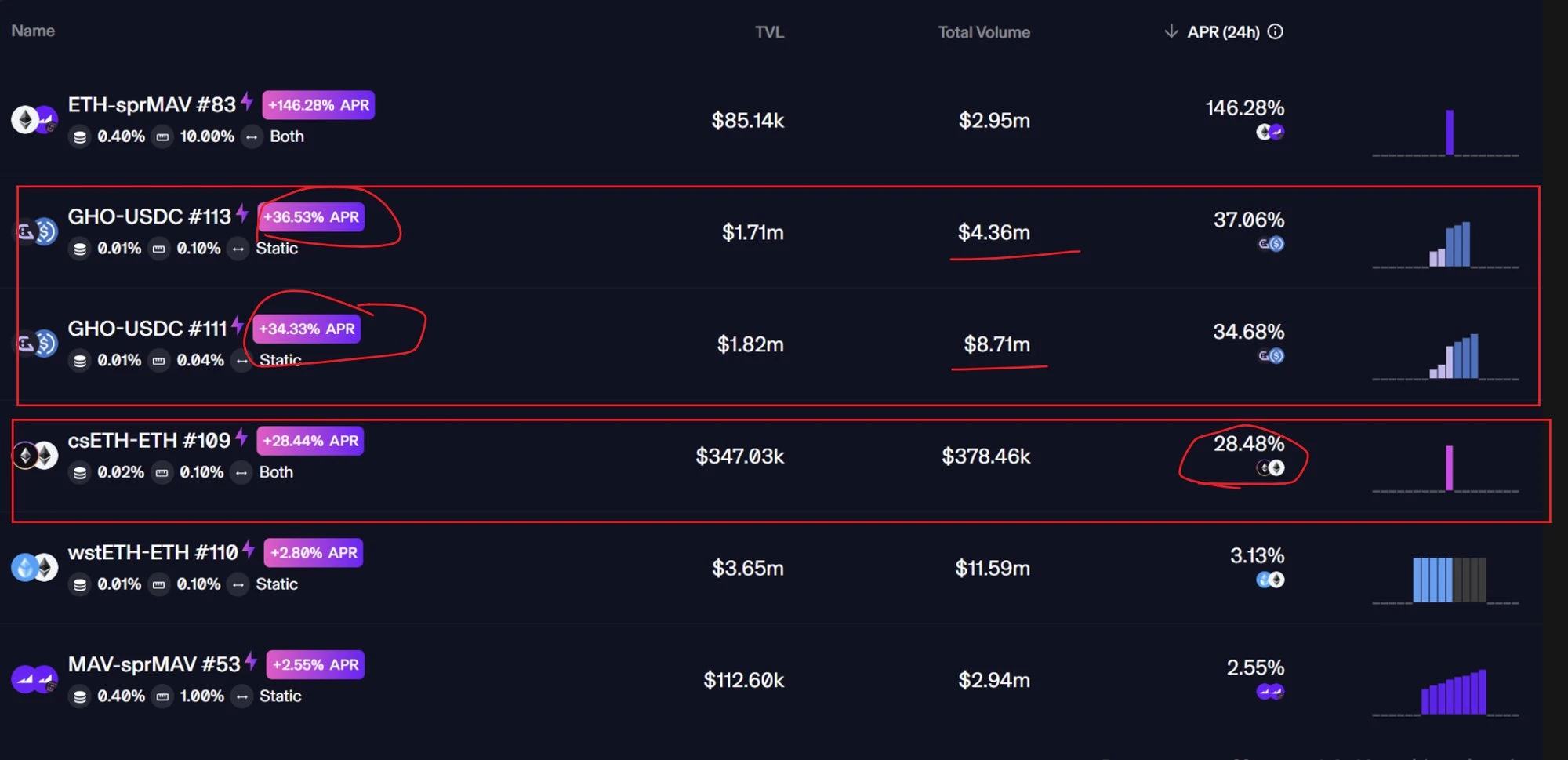
@mavprotocol is also a typical DEX with concentrated liquidity. The GHO stablecoin-related pools have high liquidity depth and strong incentives, making it suitable for retail investors.


免责声明:本文章仅代表作者个人观点,不代表本平台的立场和观点。本文章仅供信息分享,不构成对任何人的任何投资建议。用户与作者之间的任何争议,与本平台无关。如网页中刊载的文章或图片涉及侵权,请提供相关的权利证明和身份证明发送邮件到support@aicoin.com,本平台相关工作人员将会进行核查。