【Chain Abstract Upgrade】

CN
1 year ago

【Upgrading Chain Abstraction, Discussing the Potential of Intent-Based Trading Leader dappOS】

@dappOS_com is the first intent-centric operating protocol, based on account abstraction/chain interoperability as the technical foundation, upgraded to a practical solution to address the user-unfriendliness of Web3, reduce the usage threshold, and lay the foundation for large-scale applications.

What does "intent-centric" mean? Let's take a practical scenario:

1) You cross-chain 1000 USDT from the BNB chain to Arbitrum. Is cross-chain your purpose? No! Your intent is to use USDT to purchase GMX on Arbitrum.

2) You authorize your wallet's USDC and WBTC on Uniswap. Is authorization your purpose? No! You intend to create the USDC-WBTC LP, and creating LP is not your purpose either. Your intent is to participate in their liquidity mining.

Being "intent-centric" is like what "The 7 Habits of Highly Effective People" says, "begin with the end in mind," with the user's ultimate goal as the task objective. What dappOS does is to efficiently achieve the user's ultimate goal and simplify the process. Currently, users face two major challenges.

1) The first challenge is that using Dapps is very complex. For example, in liquidity mining, new users need to interact with contracts five times, including authorizing two tokens, forming LP liquidity pairs, authorizing LP pairs, and depositing LP, etc. If funds are distributed on the BNB Chain and Arbitrum, or the ETH chain, they either need to cross-chain the funds or operate on different chains.

2) The second major challenge is Web3 wallets. Everything in the wallet is controlled by the mnemonic/private key, and once lost, everything is lost and cannot be recovered. Moreover, in the multi-chain era, EVM, Uniswap, and Solana have their own mnemonics and wallets. Even if the EVM wallets are the same, assets on different chains become fragmented, making management and operation more cumbersome.

In the field of chain abstraction/chain interoperability, there are infrastructure such as LayerZero, Wormhole, and Polyhedra. As I have discussed in other articles, due to the advancement of blockchain's large-scale application and the improvement of modular infrastructure, the emergence of a large number of public chains is an inevitable trend. Therefore, infrastructure such as chain abstraction/chain interoperability is extremely important and in great demand.

However, as mentioned earlier, cross-chain is not the user's purpose, but something they have to do. Users may want to purchase assets on other chains, etc. The advantage of dappOS is to start directly from the ultimate goal. The dappOS network is based on abstract accounts and cross-chain protocols, providing a unified wallet for all chains and unified asset operations, as well as simple operational solutions.

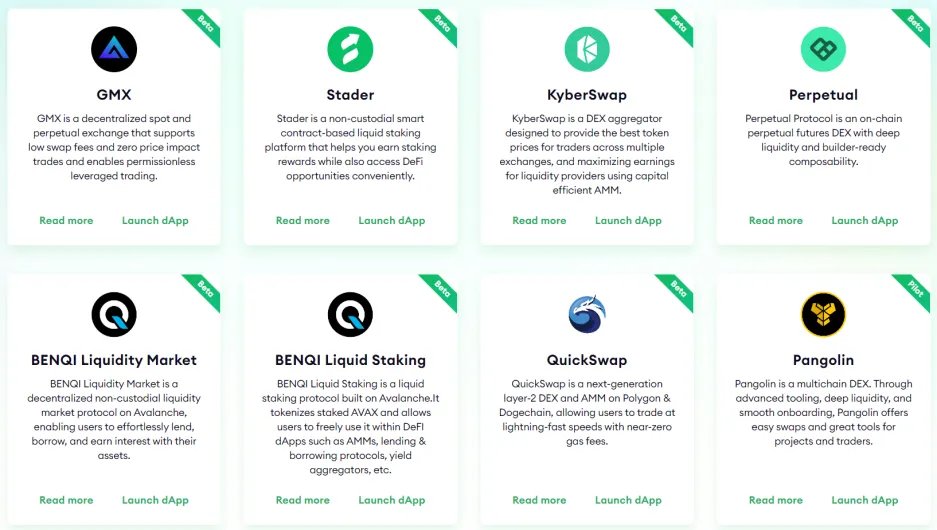
dappOS's solution has been highly welcomed by many projects. It is currently in the V2 beta stage and has already cooperated with well-known projects such as GMX, Stader, KyberSwap, Perpetual, BENQI, QuickSwap, etc. The effect is also immediate.

Taking GMX as an example, users can manage their assets in different chains, such as having 50 USDC on Arbitrum and 100 USDC on Avalanche, without the need for cross-chain operations. dappOS can directly use 150 USDC for GMX, without needing to consider the GAS issues on different chains. With the support provided by dappOS V2, the simplified workflow has optimized the execution time by 90% and reduced the execution cost by up to 20%. Since integrating GMX V2 two months ago, GMX V2 has gained 30,596 new users.

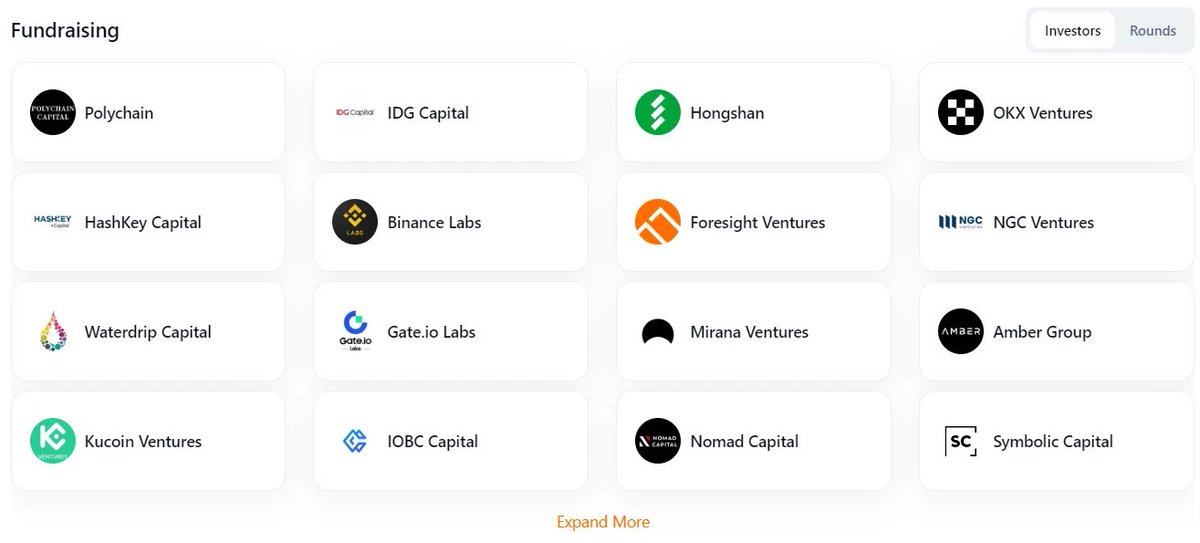
dappOS has also gained recognition from investors. After receiving exclusive angel round financing from Binance Lab last year, it received seed round investment led by IDG Capital and Sequoia Capital, and recently received Series A financing led by Polychain.

  1. Introduction to dappOS Network

dappOS consists mainly of two parts: dappOS Account and dappOS Network.

dappOS Account:

dappOS is an intelligent contract wallet with "account abstraction," also known as an intelligent wallet or AA wallet in many places. Vitalik has also stood for account abstraction multiple times, believing that account abstraction makes encrypted wallets as simple as email. It is one of the infrastructures for the large-scale application of blockchain. Compared to the EOA wallets created with private keys/mnemonics that we commonly use now, dappOS has the following advantages:

1) No need for mnemonics; social accounts can be used as address accounts.

2) Can pay gas fees on behalf of others, enabling the simultaneous payment of gas fees on multiple chains.

3) Programmable, upgradeable, and customizable.

4) Lost wallets can be recovered and private keys can be replaced. DappOS supports users to set up guardian email addresses to reset the main key through domain key identification (DKIM) verification. Users only need to send an email from the preset email account to reset the main key.

dappOS Network:

dappOS is a decentralized network that achieves "intent" transactions using dappOS accounts. There are two types of nodes in the dappOS network: super nodes and server nodes. Super nodes are responsible for allocating tasks to server nodes upon receiving user requests. They also need to supervise server nodes to ensure task completion and penalize them if problems arise.

Server nodes mainly fulfill user order requests. dappOS allows server nodes to deposit mainstream tokens such as USDT/USDC/BTC/ETH as collateral, which can be used for most cryptocurrency orders.

The dappOS network has two basic functions:

1) Cross-chain asset transfer, equivalent to the functionality of other cross-chain bridges.

2) Executing on-chain transactions for dappOS accounts. It should allow users to pay gas fees using tokens from different chains, assets from CEX, or even fiat currency.

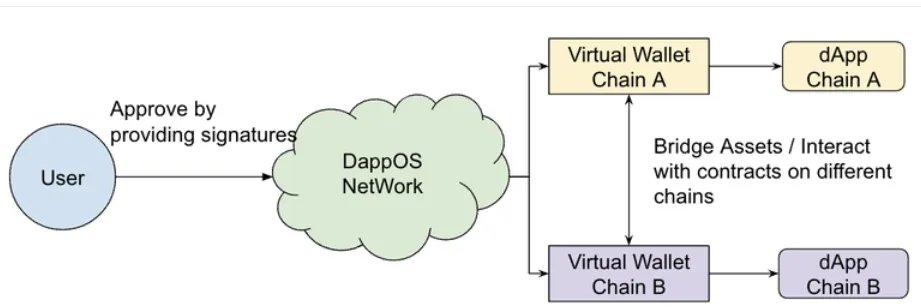
In the dappOS network, a single dApp interaction is considered an order, which may contain one or more services. The following two examples show one or more services in an order:

  • Execute transactions from a virtual wallet on Optimism and pay fees in USDT on the BNB chain.
  • Bridge 100 USDT from the BNB chain to a virtual wallet on Optimism, triggering a transaction and paying fees in BTC on the BNB chain.

The typical process follows these steps:

  1. Users create orders by signing to confirm the entire workflow, including chain interactions on one or more chains, bridging assets, and using dappOS network fees.

  2. The dApp sends the order to the dappOS network via JSON-RPC.

  3. The dappOS network delegates the order to one of its permissionless nodes and ensures that the order is executed well, or the node compensates the user's losses.

  4. With incentives, the selected node executes the entire workflow, including bridging assets and on-chain transactions (from the user's virtual wallet to the dApp contract).

  5. Current Status of the Project

dappOS recently launched the V2 Beta version, and has already partnered with many well-known projects. These include GMX, Stader, KyberSwap, Perpetual, BENQI, QuickSwap, Pangolin, etc. However, during the beta testing phase, the amount is limited to within 500 USDT.

After integrating with dappOS, the steps for new users to purchase GLP or GM have been reduced from 9 to 3, and the time has been reduced from 15 minutes to 1 minute. The execution cost has been reduced by 20%. Users can deploy the total balance of their assets, confirm complex and interdependent transactions across different chains with a single signature, and pay gas fees with any token. Since integrating GMX V2 two months ago, GMX V2 has gained 30,596 new users, and 15% of the TVL added in the past 30 days comes from dappOS users. In addition, in a joint activity with GMX, 100,000 ARB tokens were distributed to users as interaction airdrop rewards.

Pendle's Yield Booster Equilibria has integrated with dappOS, allowing users to seamlessly deposit aUSDC and rETH pools from any chain with an intent-centric user experience, increasing their yield by up to 28%. Users can directly deposit ETH into the rETH pool without the need to mint or purchase rETH on a decentralized exchange.

  1. Investment Institutions

dappOS has a strong lineup of investors, including…

In June 2023, dappOS received pre-seed financing from Binance Lab.

In July 2023, it received seed round financing led by IDG Capital and Sequoia China, with a valuation of $50 million. Other investors include OKX Ventures, HashKey Capital, KuCoin Ventures, and others.

In March 2024, dappOS received Series A financing of $15.3 million led by Polychain, with a valuation of $300 million. Other institutions include Nomad Capital, IDG, Flow Traders, IOBC, NGC, Amber Group.

In summary, dappOS's advantage lies in starting from user intent. The dappOS network is based on abstract accounts and cross-chain protocols, providing a unified wallet for all chains, unified asset operations, and simple operational solutions. Through cooperation with project partners, it has greatly reduced the usage process and time for Dapp users, achieving good results.

Image 1 Image 2 Image 3 Image 4

免责声明:本文章仅代表作者个人观点,不代表本平台的立场和观点。本文章仅供信息分享,不构成对任何人的任何投资建议。用户与作者之间的任何争议,与本平台无关。如网页中刊载的文章或图片涉及侵权,请提供相关的权利证明和身份证明发送邮件到support@aicoin.com,本平台相关工作人员将会进行核查。

Share To
APP

X

Telegram

Facebook

Reddit

CopyLink