【B² and Babylon join forces to become the most core modular infrastructure for BTC】
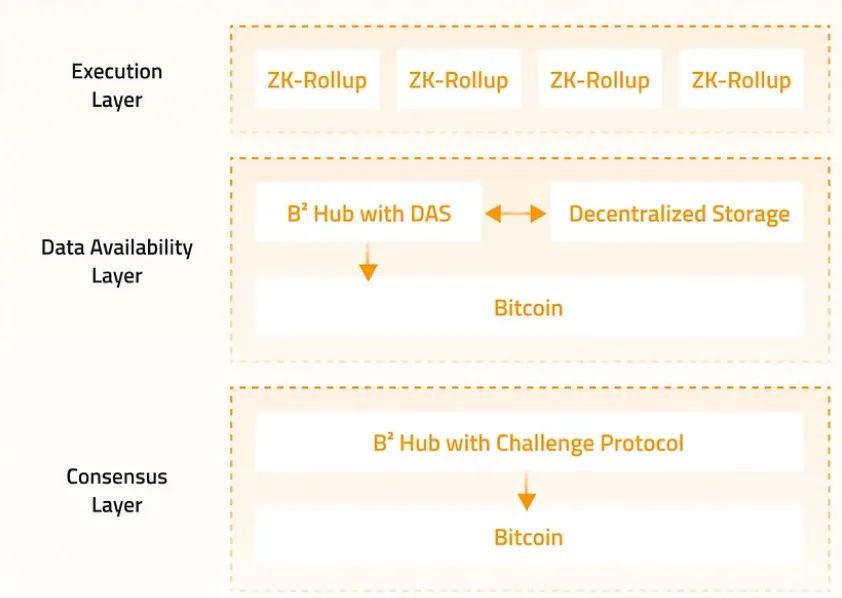
The B² Network is already the second-ranked BTC layer2 in terms of TVL, and has recently strategically launched the B² Hub, which will provide services for other zk rollups and offer Data Availability (DA) functionality. The B² Network will evolve into the modular core infrastructure for Op Stack and Celestia.
In this strategic partnership between B² Hub @BSquaredNetwork and @babylon_chain, two major benefits will be brought about:
1) BTC Stake function, using native BTC assets for staking to ensure the same level of security for the layer2 network as the BTC mainnet
2) Implementation of BTC Restaking and LSD functions, similar to Eigenlayer functionality, activating use cases for BTC assets
1 Modular infrastructure for BTC
As a Layer1, BTC's performance is even worse than ETH. Bitcoin emphasizes decentralization and security, choosing a relatively simple but secure scripting language, which limits Bitcoin's smart contract and complex verification capabilities.
Therefore, only Layer2 can realize the explosive growth of BTC's ecosystem. Currently, the development of layer2 is in a state of competition, much like the development of Ethereum's layer2 in 2021. Now that Ethereum's modular infrastructure has been perfected, the launch of layer2 has become simple and efficient.
B² Network has launched the B² Hub, which, together with BTC, has realized the core functions of ETH. In the future, numerous ZK-Rollups services can achieve rapid and simple implementation of BTC's layer2. This will truly bring about the prosperity of the BTC ecosystem. Therefore, B² Network is not only a layer2 for BTC, but also a modular infrastructure like Op Stack and Celestia.
First of all, B² Network is the first Bitcoin rollup to verify zero-knowledge proof commitments. The current Bitcoin zk rollup solutions only upload zk proofs to the Bitcoin blockchain in plaintext. However, this lacks the crucial verification process on the Bitcoin network, and cannot enjoy the security of the Bitcoin network. The solution implemented by B² Network is to transform the verification commitment of zk proofs into main root taproots, submit the taproots to the Bitcoin network, and accept challenges from challengers. This way, zk proofs can be verified on the BTC network. Based on innovative Rollup technology, B² Network has become a public chain capable of running Turing-complete smart contracts, while ensuring transaction privacy and security during the Bitcoin confirmation process.
Secondly, there is the B² Hub, which has multiple functions. It sorts the transaction data of Rollup Layer2 and compiles the aggregated batch and proof data into Tapscript, submits the zk proof verification commitment to Bitcoin, and allows challengers to challenge based on the commitment. On the other hand, it also stores Rollup transactions and data.
The B² Hub of B² Network will be implemented in two phases. In the first phase, B² Network will implement Zk-Rollup on its own, running on the Bitcoin network through the B² Hub.
In the second phase, B² Hub will support modular services and support other Zk-Rollup public chains. B² Hub will aggregate all Rollup data, form zk proof data, submit it to the Bitcoin network's commitment, and support challenges.
2 BTC's DA layer
A very important function of the B² Hub is to serve as the DA layer for BTC, not only for B² Network's own DA layer, but also for other Rollup's DA layers that connect to the B² Hub. The DA data availability layer includes decentralized storage, B² nodes, and the Bitcoin network. It is responsible for permanently storing copies of Rollup data, verifying zk proofs, and ultimately confirming them on the Bitcoin network. Rollup can be stored in the DAS protocol of B² Hub, or choose to be stored in decentralized storage protocols such as filecoin.
With the explosion of user demand comes the surge in demand for BTC's DA. For example, the popularity of plaintext in 2023 stored a huge amount of data on Bitcoin, causing the BTC network to be overwhelmed. Ethereum can undergo the Cancun upgrade, and in the future, continue to increase the number and capacity of blobs. There have also been huge DA layers, such as Celestia and Avail. However, BTC finds it difficult to expand its data capacity on its own. In fact, historically, there have been major disagreements over increasing BTC's capacity, resulting in the forked coins BCH, BSV, and others, which have become historical footnotes. Therefore, at the time of the BTC ecosystem's explosion, BTC needs a modular DA layer more than ETH.
B² Network has its advantages as a DA layer, not only in terms of technological accumulation, but also as a one-stop modular service. Rollup in B² can directly implement the settlement layer and DA layer, and enjoy the security guarantee provided by Babylon.
3 Babylon provides security guarantees
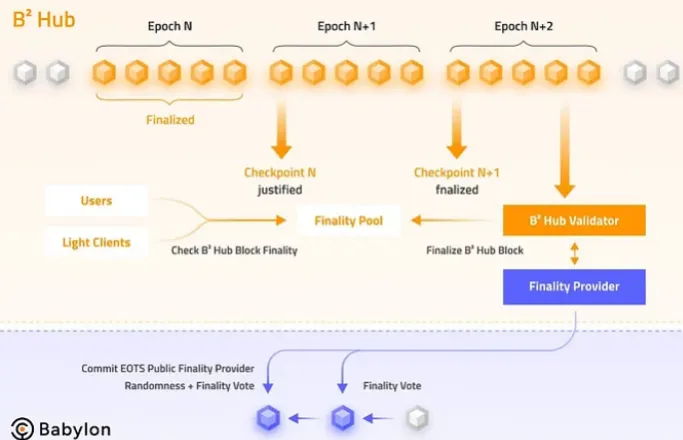
The functionality of the B² Network is so powerful, but there is still a core issue, which is security. ETH's layer2 is guaranteed security by Ethereum, but BTC does not have this function. Therefore, security is provided by Babylon. Babylon is a Bitcoin security network using the PoS mechanism. Babylon has developed two security sharing mechanisms: one is the native Bitcoin PoS staking protocol, and the other is the Bitcoin timestamp protocol.
Most existing decentralized projects basically use the PoS mechanism, which provides security by staking native tokens. BTC is the largest digital asset in the cryptocurrency world, surpassing the total of all PoS assets. Babylon has innovatively developed the BTC Staking mechanism, which can extract BTC security and share it with the entire BTC network.
However, another issue that the existing PoS mechanism needs to address is the Long Range Attack. In simple terms, when a node unstakes, it has already received a reward. But it can go back to earlier blocks and initiate a forked chain. Because from the perspective of earlier blocks, this node is still legitimate. To address this issue, Babylon has developed the Bitcoin timestamp protocol. Babylon stores the history of the POS chain on the BTC chain, and this stored record will have a timestamp from the BTC main chain. Even if someone maliciously forks a POS chain later, the forked chain will have a later timestamp from the BTC chain, making it easy for other nodes to identify the problem. Unless there is a consensus across the BTC network, this is almost impossible.
Therefore, strategic cooperation with Babylon is a win-win cooperation, which will bring security based on the BTC mainnet to B² Network, and activate a large number of use cases for BTC.
免责声明:本文章仅代表作者个人观点,不代表本平台的立场和观点。本文章仅供信息分享,不构成对任何人的任何投资建议。用户与作者之间的任何争议,与本平台无关。如网页中刊载的文章或图片涉及侵权,请提供相关的权利证明和身份证明发送邮件到support@aicoin.com,本平台相关工作人员将会进行核查。