On March 13th, the Ethereum Cancun upgrade was officially launched, which not only signifies a significant leap in network functionality and performance, but also anticipates explosive growth in the Layer 2 track and the entry into a low-fee era. All of this is not only due to the improvement in Ethereum's own performance, but also benefits from lower transaction costs and higher processing speeds after the upgrade. However, the diversification and complexity of Layer 2 solutions also bring unprecedented opportunities and challenges to the Layer 2 track, which may completely reshape the landscape of the DeFi field.
I. Overview of Ethereum Layer 2 Track
As the world's largest decentralized application platform, Ethereum's network congestion and high transaction costs have become increasingly prominent, becoming the main bottleneck restricting its further development. In order to solve these problems, Layer 2 technology emerged, aiming to improve transaction speed and reduce costs by building additional layers on top of Ethereum without changing the security and decentralization characteristics of Layer 1. Specifically, Layer 2 technology is a collective term for a series of solutions aimed at expanding Ethereum's main chain capacity and processing speed, including state channels, sidechains, Rollups, and other forms.
- State Channels
State channels allow participants to conduct multiple transactions off-chain, only submitting state updates to the main chain at the beginning and end. The advantage of this method is the significant reduction in on-chain transactions, thereby reducing overall transaction fees and increasing network throughput. The most famous example of state channels is the Lightning Network, which is mainly used in the Bitcoin network, but the same concept is also applied to Ethereum, such as the Raiden Network. State channels are suitable for applications with fixed participants and frequent transactions, such as payment networks and games.
- Sidechains
Sidechains are blockchains that operate independently of the main chain and exchange assets with the main chain through a two-way anchoring mechanism. Sidechains can have their own consensus mechanism and block parameters, thereby ensuring security while increasing transaction processing speed. Sidechain technology provides a scalable solution for the Ethereum network, allowing developers to create independent blockchains with specific functions while maintaining compatibility with the Ethereum ecosystem. Well-known sidechain projects include Polygon (formerly Matic Network) and xDAI Chain. Sidechains provide greater flexibility and customizability, suitable for DApp development with specific rules or performance requirements.
- Rollups
Rollups are currently one of the most prominent Layer 2 scaling technologies, processing transactions off-chain and ultimately submitting transaction data (rather than the execution results of all transactions) to the main chain, significantly increasing the network's processing capacity. Due to their high compatibility and scalability, Rollups have become the preferred solution for various Ethereum applications, especially for DeFi and NFT markets that require high throughput and low transaction costs. Rollups are divided into Optimistic Rollups and ZK Rollups:
Optimistic Rollups: This approach assumes that all transactions are valid by default and only verifies them when challenged. They reduce on-chain computation by delaying transaction finality, thereby achieving scalability. Optimism, Arbitrum, and Blast are well-known Optimistic Rollups projects.
ZK Rollups: ZK Rollups use zero-knowledge proofs to verify transaction validity, allowing instant confirmation of transactions without waiting for a challenge window. By moving computation and state storage off-chain and storing verification information on-chain, they effectively reduce the burden on the main chain. Starknet and zkSync are representative of ZK Rollups technology.
Hybrid Rollups is a new Rollup solution proposed by Metis, which adopts a technical framework that combines OP Rollup and ZKPs Rollup. It efficiently processes transactions while using ZKP technology to reduce the risk of fraud and erroneous transactions.
II. Current Development of Ethereum Layer 2 Track
Currently, multiple Layer 2 projects have entered the practical application stage. Optimism and Arbitrum, as representatives of Optimistic Rollups solutions, and Starknet and zkSync, as representatives of ZK Rollups solutions, have attracted a large number of developers and users. The market's strong demand for these Layer 2 solutions, along with the rapid development of these projects, is leading to an unprecedented expansion of the Ethereum ecosystem.
With the launch of the Cancun upgrade, on March 14th, zkSync announced that it became the first L2 to use Blob, and more projects will follow in the coming days. Before using Blob, the cost of zkSync Era sequencer using Calldata was around 0.11 ETH, and after using Blob, the cost decreased to around 0.013 ETH, a reduction of approximately 88%. Subsequently, Starknet also announced support for blob transactions, reducing actual Gas fees to $0.01.
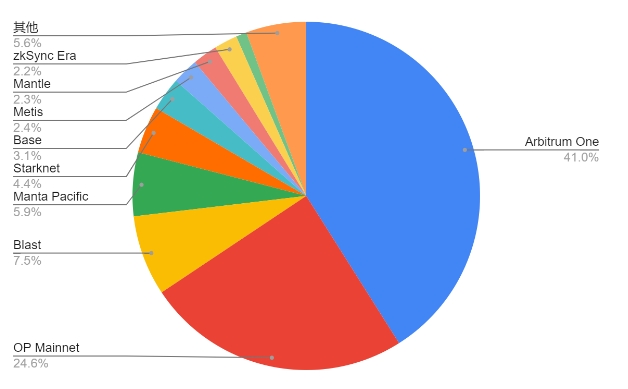
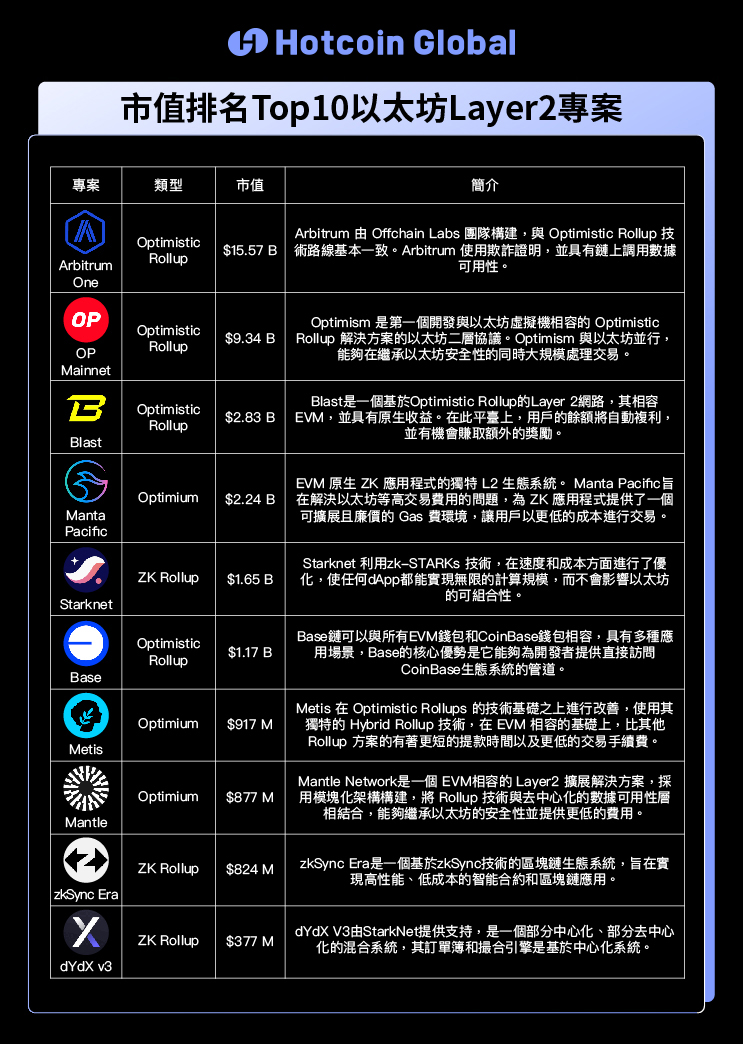
According to L2 BEAT data, as of March 14, 2024, the market value of Ethereum Layer 2 has reached $39 billion. Among them, the two major OP Rollup solutions, Optimism and Arbitrum, account for over 65% of the market share, and only three projects, Starknet, zkSync Era, and dYdX v3, are ZK Rollups in the top 10 projects, indicating that OP Rollup is still the mainstream choice in the current market.

Market Value Ranking Top 10 Ethereum Layer 2 Projects

III. Investment Opportunities in the Layer 2 Track Under the Background of the Cancun Upgrade
With the progress of the Ethereum Cancun upgrade, investment opportunities are expected to emerge for the leading Layer 2 projects and their applications, Optimism forks, ZK Rollup projects, and projects shifting to ZK technology such as Polygon.
Layer 2 Leaders: Arbitrum and Optimism, as the platforms with the highest total value locked (TVL) and the most users, have strong first-mover advantages and ecological legitimacy. These two platforms have built a relatively solid ecological moat and are the core targets of the Cancun upgrade. The success of Arbitrum and Optimism lies not only in their technical strength but also in their ability to attract a large number of developers and projects, forming a good ecological cycle.
Leading Applications: GMX, RDNT, and Magic, as important applications in the Arbitrum ecosystem, and Velo and Snx, as key projects in the Optimism ecosystem, have received support from their respective L2 platforms. These applications will drive the growth of their own ecosystems during the L2 explosion. Especially in the DeFi and NFT fields, with the increase in users and transaction volume, rapid development is expected.
Polygon: Although Polygon primarily exists as a sidechain and has its own independent consensus, it has also introduced several Layer 2 solutions based on ZK technology, such as Polygon ZKEVM. This shift by Polygon demonstrates its embrace of the Ethereum L2 ecosystem, showcasing strong technical capabilities and market driving force.
ZK Rollup Applications: StarkNet is a ZK Rollup protocol released by StarkWare Ltd, not EVM compatible, and uses its own Cairo as the development language. Starknet launched its token on February 20th, becoming the first core project to issue coins in the ZK track, with a strong impact and currently the fastest-growing network in Layer 2. In addition, Loopring and Immutable X, as earlier projects, also have a certain level of market recognition and user base.
Optimism Forks: The Blast network can provide users with native income in ETH and stablecoins, as well as a social fractal mechanism for airdrop rewards and invitation-based incentives, which other L2 networks do not have. Metis is the earliest fork project of Optimism, with the highlight being the first successful implementation of a decentralized sequencer for Optimistic Rollup.
IV. Risks and Challenges of the Ethereum Layer 2 Track
Despite the enormous potential and opportunities provided by Layer 2 technology, it still faces a series of challenges and investment risks. When considering investing in Layer 2 projects, investors need to comprehensively assess these risk factors.
Poor User Experience: Optimistic Rollup users may need to wait up to a week to withdraw funds from Layer 2 back to the Ethereum mainnet, severely impacting user experience. While ZK networks have shorter withdrawal times, they still face stability issues and higher usage costs due to the early stage of the technology.
Centralization Risk: In order to improve efficiency, Layer 2 solutions sometimes sacrifice decentralization principles, especially when using centralized sequencer nodes at the transaction execution layer, leading to concerns about review and intervention.
Scalability and Network Stability Challenges: With the growing demand for DeFi efficiency and scalability, the rapid expansion of the Layer 2 ecosystem has brought challenges in network stability and processing capacity.
Uneven Market Share Distribution: Although Arbitrum and Optimism occupy a large market share, emerging projects such as Blast and Manta are gradually increasing their market share, intensifying market competition.
Security and Privacy Protection Needs: It is essential to ensure that Layer 2 solutions do not compromise the security and privacy of users while sharing security with Ethereum and improving transaction efficiency.
V. Prospects for the Ethereum Layer 2 Track
In the future, with the gradual advancement of Ethereum 2.0 and continuous innovation in Layer 2 technology, the Layer 2 track is expected to have a broader development space, not only providing a stronger foundation for existing DeFi and NFT fields but also opening up new possibilities for future crypto applications.
Technological Upgrades and Layer 2 Diversification: With the advancement of the Cancun upgrade and the proposal of EIP-4844, Layer 2 technology is experiencing significant development opportunities, directly promoting the diversification and development of Layer 2 solutions. Key focus areas include pioneers in Optimistic Rollups and ZK Rollups, such as Optimism, Arbitrum, zkSync, and StarkWare, as well as the development of innovative solutions.
Capital Market Attention: Capital attention and investment are crucial for the growth of Layer 2 projects, and many investors and venture capitalists are actively seeking potential Layer 2 projects for investment. Projects such as Metis, Boba, Aztec, zkSwap, and zkSpace are benefiting from their ability to provide lower on-chain fees and a richer ecosystem, becoming the focus of investors.
Further Expansion of DeFi and NFT: The maturity of Layer 2 technology will provide more efficient and cost-effective solutions for fields such as DeFi and NFT, attracting more users. This not only means that existing DeFi and NFT projects will have greater development space but also provides a platform for new creativity and innovation. For example, Layer 2 technology can enable games and social applications to operate in a decentralized environment in unprecedented ways, creating new user experiences and business models.
New Opportunities for Data Availability Layer (DA Layer): The short-term storage limitations of Blob data and the demand for historical data retrieval will drive the development of decentralized storage protocols to support Layer 2 scaling solutions. This means that investors should pay attention to projects that are strategically positioned on decentralized storage solutions such as IPFS, Arweave, and Filecoin, as they will play an increasingly important role in data availability.
Competition and Cooperation in the RaaS Track: Customized Rollup-as-a-Service (RaaS) provides a market full of opportunities. ZK-based RaaS may have a long-term competitive advantage due to its low cost and high customization. At the same time, OP-based RaaS such as Optimism and Arbitrum have attracted a large number of developers and users in the short term due to their ability to quickly build ecosystems. Investors should pay attention to the competitive dynamics within this area and how each project leverages technological advancements such as EIP-4844 to enhance their services and products.
Overall, despite facing challenges and investment risks, the future of the Ethereum Layer 2 track is widely optimistic. With technological maturity, project advancement, and ecosystem construction, Layer 2 is expected to bring more efficient, secure, and scalable solutions to Ethereum and the entire cryptocurrency world in the near future.
免责声明:本文章仅代表作者个人观点,不代表本平台的立场和观点。本文章仅供信息分享,不构成对任何人的任何投资建议。用户与作者之间的任何争议,与本平台无关。如网页中刊载的文章或图片涉及侵权,请提供相关的权利证明和身份证明发送邮件到support@aicoin.com,本平台相关工作人员将会进行核查。