ERC-404 is a new Ethereum token standard aimed at bringing innovation and possibilities to the cryptocurrency market. It originated from a project called Pandora launched by an anonymous team on February 2, and has attracted widespread attention and discussion in the cryptocurrency market. The name "404" of ERC-404 is inspired by the internet error code "404 Not Found," implying that it is an "unknown" and exploratory new token standard.
I. Overview of ERC-404
Pandora was inspired by Uniswap Emerald (EMERALD). Emerald introduced an improved token standard to address NFT liquidity issues, directly building liquidity on Uniswap. When investors buy $EMERAID on Uniswap, they not only get tokens but also receive NFT. However, due to contract vulnerabilities being exploited, Emerald is currently being urgently repaired. The founder of Pandora optimized the Emerald contract into the current ERC-404 token standard, attempting to bridge the gap between traditional ERC-20 and ERC-721.
ERC-404 is a token that combines the ERC-20 and ERC-721 standards. Under this standard, any user holding an ERC-404 token will automatically receive an associated non-fungible token (NFT). This is different from traditional token standards, where NFTs are usually acquired through independent transactions or operations. In ERC-404, token holders can directly own an NFT associated with the token without additional operations. Additionally, when tokens are transferred or destroyed, the corresponding NFT will also undergo corresponding changes.
The core secret of this design lies in the use of lossy encoding, cleverly allowing the quantity information of fungible tokens and the ID identification of non-fungible tokens to share the same data structure for storage, while ensuring their distinctiveness. Another highlight brought by ERC-404 is the mapping mechanism, which allows for natural conversion between fungible tokens and their mapped non-fungible tokens, thereby increasing the liquidity of NFTs.
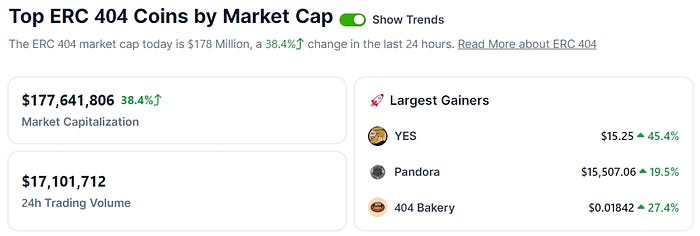
Pandora is the first token based on the ERC-404 token standard and has achieved tremendous success shortly after its launch. According to CoinGecko data, as of February 20, the market value of ERC-404 tokens has exceeded $170 million, with Pandora's market value exceeding $160 million.
II. Innovative Features of ERC-404
By combining the advantages of ERC-20 and ERC-721, ERC-404 breaks the one-to-one relationship of traditional NFTs, creating a fragmented NFT collection and bringing more possibilities and opportunities to the digital asset market. The features of ERC-404 are as follows:
Combination of ERC-20 and ERC-721 standards: The design of ERC-404 is inspired by the ERC-20 and ERC-721 token standards. ERC-20 tokens are homogeneous tokens on Ethereum with the same attributes and value, usually used to represent digital currencies, points, etc. ERC-721 tokens, on the other hand, are non-fungible tokens, with each token being unique and typically used to represent artworks, game props, etc. By combining the characteristics of these two standards, ERC-404 creates a new type of token that enjoys the convenience of fungible tokens and the uniqueness of non-fungible tokens.
Fragmented NFT collection: The main principle of ERC-404 is to create a fragmented NFT collection, allowing users to obtain random NFTs by holding ERC-404 tokens. Typically, NFTs exist as one-to-one assets, but the innovation of ERC-404 lies in allowing multiple users to share the same NFT and dynamically generate new NFTs based on token holdings. This fragmented feature causes the value and scarcity of NFTs to change with token transfers, bringing more possibilities and opportunities to the market.
Interaction between tokens and NFTs: In ERC-404, users automatically receive an associated NFT when holding ERC-404 tokens, and this process is automated. Multiple NFTs can be dynamically generated based on the token holding amount. Additionally, when users transfer or destroy tokens, the corresponding NFTs will also be transferred or destroyed. This interaction between tokens and NFTs allows users to manage and utilize their digital assets more flexibly, while also bringing more liquidity and vitality to the NFT market.
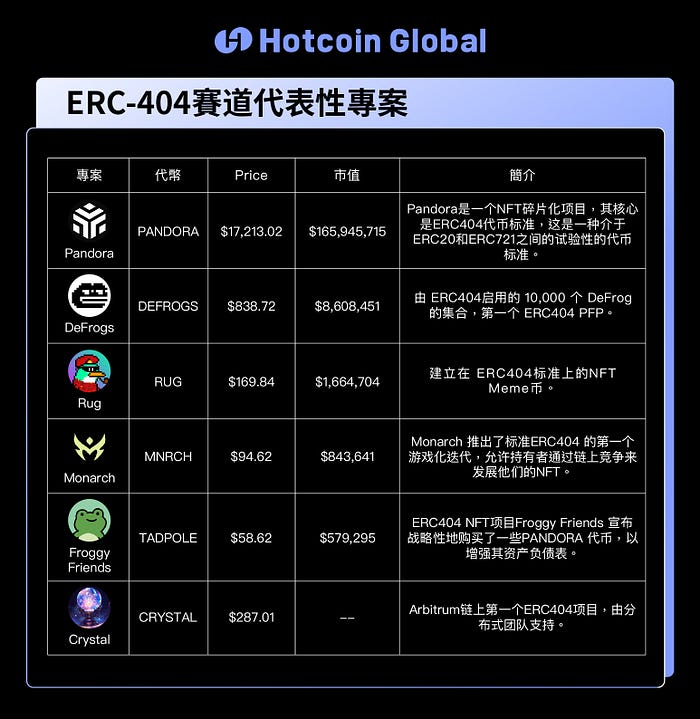
III. Representative Projects in the ERC-404 Track
IV. Investment Value Analysis of the ERC-404 Track
The introduction of the ERC-404 standard has sparked widespread attention in the cryptocurrency market, and its unique design concept has brought new possibilities and opportunities to the digital asset market.
Innovative design: The innovative design of the ERC-404 standard allows for the fusion of fungible tokens (ERC-20) and non-fungible tokens (NFT, ERC-721), bringing more possibilities and innovation.
Improved NFT liquidity: The introduction of the ERC-404 standard greatly improves the liquidity of NFTs. Traditionally, NFTs are relatively illiquid assets, but through the ERC-404 standard, users holding ERC-404 tokens can automatically receive associated NFTs and can transfer or destroy tokens at any time, thereby increasing the liquidity of NFTs.
Market attractiveness: With more and more projects adopting the ERC-404 standard and trading on decentralized exchanges and NFT markets, the market potential of ERC-404 tokens is continuously increasing. Projects like Pandora have demonstrated significant market attractiveness, rapidly increasing their market value and attracting a large number of investors' attention.
V. Risk Analysis of the ERC-404 Track
The introduction of the ERC-404 standard has sparked a frenzy in the cryptocurrency market, but it also comes with certain risks.
Technical risk: As an emerging standard, ERC-404 has not undergone sufficient auditing and testing. This means that there may be undiscovered security vulnerabilities and technical flaws, which could lead to attacks on token contracts or user fund losses. Investors need to be aware of the technical risks associated with investing in projects that have not undergone auditing and take appropriate precautions, such as only investing in trustworthy and compliant audited tokens.
Uncertainty of market acceptance: The market acceptance of the ERC-404 standard is not yet clear, posing a certain market risk. Although some projects have shown significant market attractiveness, market reactions are uncertain and may be influenced by market sentiment, competitive pressure, and regulatory factors. Investors need to closely monitor market dynamics, adjust investment strategies in a timely manner, and be prepared to face market fluctuations.
Trading risk: The ERC-404 frenzy has raised concerns among investors about "rug pulls" and high gas fees. With the increasing number of projects and market participants, some malicious behaviors may occur, including market manipulation or sudden exits by project parties, leading to losses for investors. In addition, trading ERC-404 tokens may incur high gas fees, resulting in additional transaction costs and inconvenience for investors.
Project-related risks: Investing in ERC-404 projects also entails risks related to the project parties. Some projects may actually be meme coins disguised under the ERC-404 standard, lacking long-term value potential. Investors need to understand the background, team, and project plans to reduce investment risks.
VI. Prospects of the ERC-404 Track
The innovative design and structural innovation of the ERC-404 standard have made it stand out in the cryptocurrency market, bringing unprecedented possibilities to the digital asset field.
First, the introduction of the ERC-404 standard has injected new vitality into the digital asset market, providing investors with more diversified investment options. By combining the characteristics of the ERC-20 and ERC-721 standards, ERC-404 has successfully broken the one-to-one relationship of traditional NFTs, creating a fragmented NFT collection. This fragmented feature brings more possibilities to the digital art, gaming, and virtual asset fields, enhancing the liquidity and practicality of NFTs.
Second, the ERC-404 track has attracted the attention of many project parties, driving the emergence of more innovative projects. Early adopters of the ERC-404 standard such as Pandora have demonstrated their potential in the market, sparking more interest from developers and teams. This indicates that there will be more ERC-404-based projects emerging in the future, covering a wider range of industries and application scenarios.
Furthermore, the market heat of ERC-404 is expected to further enhance the liquidity of NFTs. By designing the association between tokens and NFTs, ERC-404 endows digital assets with greater liquidity, allowing users to more flexibly manage and utilize their digital assets. This will attract more investors and users to participate, further driving the development of the entire market.
In conclusion, the emergence of ERC-404 has opened up new ideas for solving NFT liquidity issues and successfully bridged the gap between ERC-20 and ERC-721. As an experimental standard, it has not only brought new opportunities to the digital asset field but also provided a broad space for future innovative exploration. However, as an unofficial standard, it also carries certain security risks, and the market's acceptance of it is not yet clear. Investors need to carefully assess the risks and conduct thorough research.
Hotcoin Community
Official Chinese Group: https://t.me/hotcoinglobalcn
Official English Group: https://t.me/HotcoinEX
Official Korean Group: https://t.me/hotcoinkorea
Discord: https://discord.gg/NwYqKWkcZn
Facebook: https://www.facebook.com/HotcoinExchange
Twitter: https://twitter.com/HotcoinGlobal
Hotcoin Official Website: https://www.hotcoin.com
免责声明:本文章仅代表作者个人观点,不代表本平台的立场和观点。本文章仅供信息分享,不构成对任何人的任何投资建议。用户与作者之间的任何争议,与本平台无关。如网页中刊载的文章或图片涉及侵权,请提供相关的权利证明和身份证明发送邮件到support@aicoin.com,本平台相关工作人员将会进行核查。


