Analyzing and Prospecting the Next Wave of DeFi Trend: Restaking Track

CN
Hotcoin
Follow
2 years ago

Restaking Trend and Development in the Crypto World

The encrypted world is witnessing a wave of Restaking frenzy. With the increasing importance of Ethereum liquidity staking and capital efficiency, the expected launch of EigenLayer, the airdrop activities of AltLayer, and the financing news of Renzo have directly ignited the flames of the Restaking battle. Currently, the airdrop point plans of Ethereum LRT projects such as Renzo, ether.fi, Kelp DAO, Eigenpie, Swell, and Puffer Finance are driving the market's FOMO sentiment.

1. Introduction to Restaking

Restaking refers to the activity of staking token assets (such as stETH) used for validation on other networks or blockchain platforms. The concept of Restaking was first proposed by EigenLayer founder Sreeram Kannan, allowing assets already staked on Ethereum to be restaked on other consensus protocols, achieving shared economic security of Ethereum and ensuring its own secure initiation and operation. This mechanism maximizes the utilization of liquidity staking and provides possibilities for the development of multiple applications.

The characteristics of Restaking include:

  • Liquidity release function: Provides an increase in fund utilization, equivalent to splitting a sum of money for multiple uses.
  • Increased earnings: By staking the same asset on different networks, stakers can earn double or even more returns.
  • Enhanced network security: With more assets staked, the network's value increases, security is enhanced, and its ability to resist attacks is strengthened.
  • Reduced selling risk: Restaking makes the original tokens more useful, reducing selling behavior and protecting the value of the project and its investors.

2. Principles of Restaking Mechanism

The Restaking mechanism is a method of restaking assets already staked on the Ethereum network on other consensus protocols. Its core principle lies in re-staking the originally staked assets on other consensus networks to support these networks and receive corresponding rewards, while still enjoying the economic security of the Ethereum network.

The implementation of this mechanism mainly relies on the smart contract technology of the Ethereum network. Users need to lock their originally staked assets on Ethereum through smart contracts and generate corresponding tokens or proof of stake. Subsequently, users can choose to transfer these tokens or proof of stake to other consensus networks that support Restaking, such as PoS (Proof of Stake) or DPoS (Delegated Proof of Stake) networks.

On the new consensus network, these tokens or proof of stake will be used for verifying and confirming transactions, while also contributing to the security and operation of the network. In return, users will receive tokens issued by the network or other rewards, which can circulate within the network or be exchanged for other digital assets.

At the same time, the originally staked assets on Ethereum will not be idle but continue to participate in securing the Ethereum network. This way, users can enjoy the benefits of other consensus networks while maintaining support for the Ethereum network, maximizing the utilization of assets and returns.

In summary, the Restaking mechanism, through smart contract technology, realizes the multiple staking and liquidity of assets, providing users with a flexible and efficient way of asset management and earning returns. It also promotes interconnection between different consensus networks, driving the development and prosperity of the entire blockchain ecosystem.

3. Current Development Status of Restaking Track

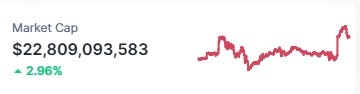
Currently, the development of the Restaking track presents a thriving trend, attracting the attention of numerous project parties and investors. Projects such as Eigenlayer, which promote the landing of the Restaking concept, provide users with flexible and diverse participation methods through their support for multiple staking coins and restaking point mechanisms. Additionally, airdrop plans of projects like Renzo, ether.fi, and Kelp DAO further accelerate market enthusiasm, providing users with more motivation to participate. Furthermore, projects such as Swell and Puffer Finance's innovative explorations in different fields enrich the Restaking ecosystem, offering users more choices. With the continuous emergence of more projects and the maturation of the industry, the Restaking track is expected to further expand the types of assets, strengthen the development of the debt market, and integrate with other networks for cross-chain integration, promoting further development of the DeFi ecosystem. As of the 26th, the market value of Restaking track tokens has exceeded $22.8 billion.

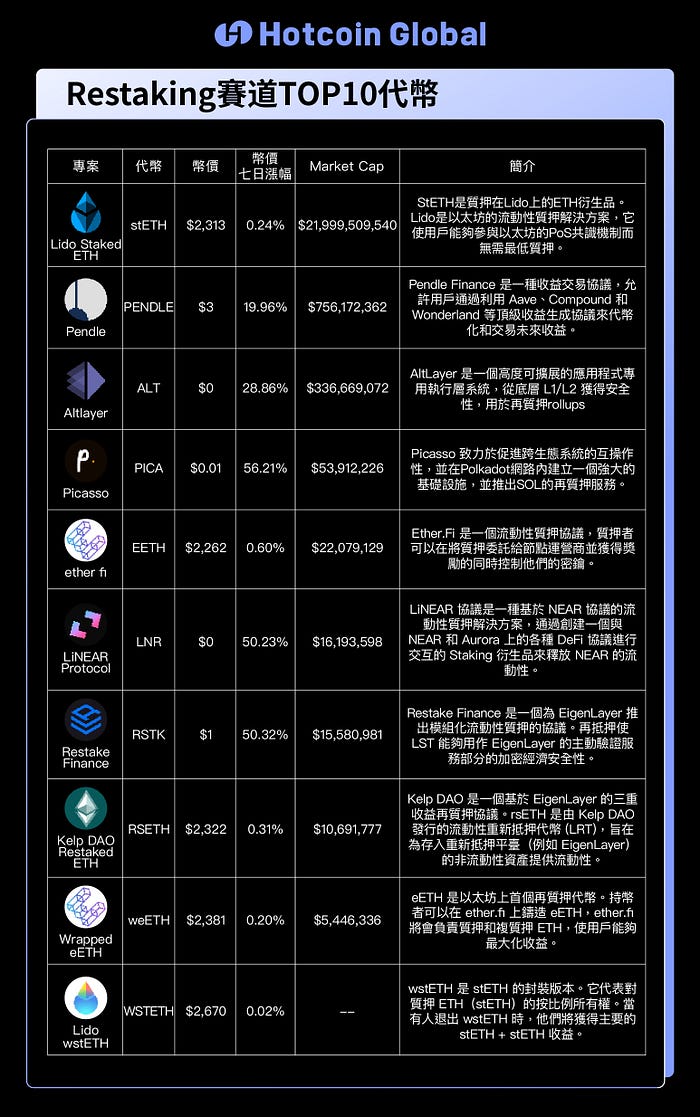
Restaking Track TOP10 Tokens

4. Analysis of Investment Risks in the Restaking Track

Although projects using liquidity staking generally have relatively low risks and stable expected returns, they also come with certain investment risks:

  • Asset bubble: With the increasing number of Restaking projects and layer upon layer of nested arrangements, the market may experience a bubble. The inflation of market value through new Wrap Tokens or the doubling of token values may lead to the market value no longer reflecting its true value. In addition to platforms, the continued use of assets representing value locked in validators to mint stablecoins increases the risk, making the original assets vulnerable to liquidity.

  • Chain reaction risk: The mechanism of Restaking creates speculative leverage through token mapping and equity locking, resulting in multiple derivative certificates of assets. Each protocol is interconnected through liquidity, forming interdependent relationships. Once a protocol encounters problems, it may trigger a chain reaction, leading to the collapse of the entire system.

  • Complexity and technical risks of LRT system: The introduction of liquidity restaking tokens (LRT) solves the problem of liquidity lock-in in restaking but also increases the complexity and operational risks of the system. The mechanism of multiple layers of nesting provides investors with more financial operation opportunities but also increases technical risks.

  • Improper node behavior: Improper node behavior in Restaking projects may result in partial or complete misappropriation or fines of investors' assets. Improper behavior by node participants may involve tampering with transaction records, illegal asset transfers, etc. In the event of such situations, investors may face significant asset losses.

  • Smart contract risks: Vulnerabilities in smart contracts may be exploited to obtain illegal benefits or lead to asset losses. In addition, hacker attacks may be carried out through various means, such as code injection, replay attacks, etc.

5. Prospects for the Development of the Restaking Track

Against the backdrop of Ethereum's renewed attention, the introduction of Restaking has become a new narrative to address the capital efficiency issues in restaking. This mechanism provides Ethereum with more capital utilization paths and as an important branch of the DeFi field, the continued vigorous development of the Restaking track can be foreseen:

  1. Expansion of asset types: With the development of Restaking projects, more types of assets may be introduced, such as Bitcoin (BTC), stablecoins (USDT), etc. Diversification of assets will increase network stability and security, provide more choices for investors, and promote the effective utilization of capital.

  2. Development of the debt market: The rise of Restaking projects may bring about the rise of the debt market. The debt market will provide investors with new opportunities for debt trading and related services, injecting more liquidity into the market, further promoting the development of the DeFi ecosystem.

  3. Cross-chain integration: Restaking projects may integrate with other blockchain networks to achieve asset liquidity and interoperability, promoting further development of the DeFi ecosystem.

  4. Strengthening of community governance: With the development of the Restaking track, community governance for projects will become more important. More extensive participants will be involved in decision-making and governance processes, promoting transparency and sustainable development of projects, establishing a healthier and more stable ecosystem, and enhancing the project's risk resistance.

Restaking Track TOP10 Tokens

  1. Emergence of Innovative Financial Products: More innovative financial products and services may emerge. These products and services will better meet the needs of users, expand the boundaries of the DeFi ecosystem, provide users with more diversified and personalized investment options, and drive the advancement of the entire industry.

While the Restaking track injects more liquidity into the market, it also comes with complex mechanisms and potential risks. Investors should carefully assess the risks when participating, understand the characteristics and governance structures of each protocol, choose suitable projects to participate in, and closely monitor the industry's development dynamics to seize investment opportunities. In the future, the Restaking track will continue to play an important role and contribute to the prosperity of the DeFi ecosystem.

Hotcoin Community

Official Chinese Group: https://t.me/hotcoinglobalcn

Official English Group: https://t.me/HotcoinEX

Official Korean Group: https://t.me/hotcoinkorea

Discord: https://discord.gg/NwYqKWkcZn

Facebook: https://www.facebook.com/HotcoinExchange

Twitter: https://twitter.com/HotcoinGlobal

Hotcoin Official Website: https://www.hotcoin.com

免责声明:本文章仅代表作者个人观点,不代表本平台的立场和观点。本文章仅供信息分享,不构成对任何人的任何投资建议。用户与作者之间的任何争议,与本平台无关。如网页中刊载的文章或图片涉及侵权,请提供相关的权利证明和身份证明发送邮件到support@aicoin.com,本平台相关工作人员将会进行核查。

Share To
APP

X

Telegram

Facebook

Reddit

CopyLink