On December 10th, Ordinals expansion protocol Veda announced in X that the launch of the protocol would be indefinitely postponed due to force majeure, and Veda-core and Veda-bvm would be open-sourced. The purpose of the Veda protocol is to address the lack of L1 layer smart contracts in Bitcoin without changing the core consensus of Bitcoin. Surprisingly, just 2 hours before announcing the postponement, Veda had announced its imminent launch and had already formulated its token economics and token standards, and had been establishing indexes for its Ordinals service. Subsequently, detailed personal information of the project's founder was publicly disclosed within the community.
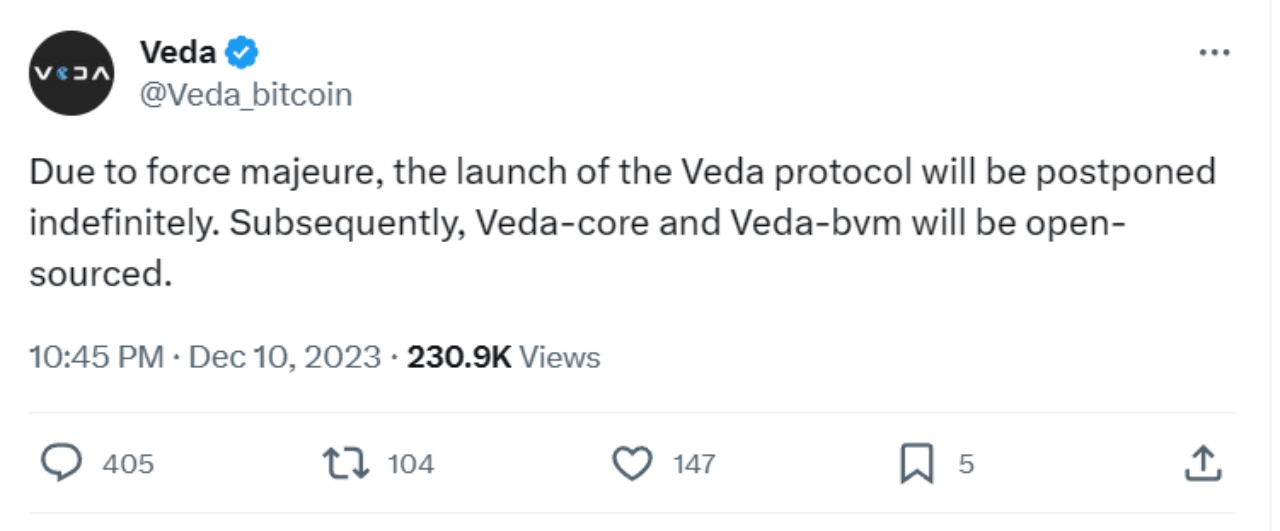
Previous articles mentioned the controversy over the surge in Ordinals transactions causing congestion on the BTC network. After experiencing several months of fervor, Ordinals now seems to be entering a new wave of turmoil, and the open-sourcing of Veda is a part of this wave. Dashjr's labeling of Ordinals as a "vulnerability" is at the center of this wave. This series of events has left the community full of uncertainty about the development of Ordinals, further fueling more concerns. In this article, TrendX Research Institute will delve into these events and their subsequent impact on Ordinals.
Is Ordinals a "Vulnerability"?
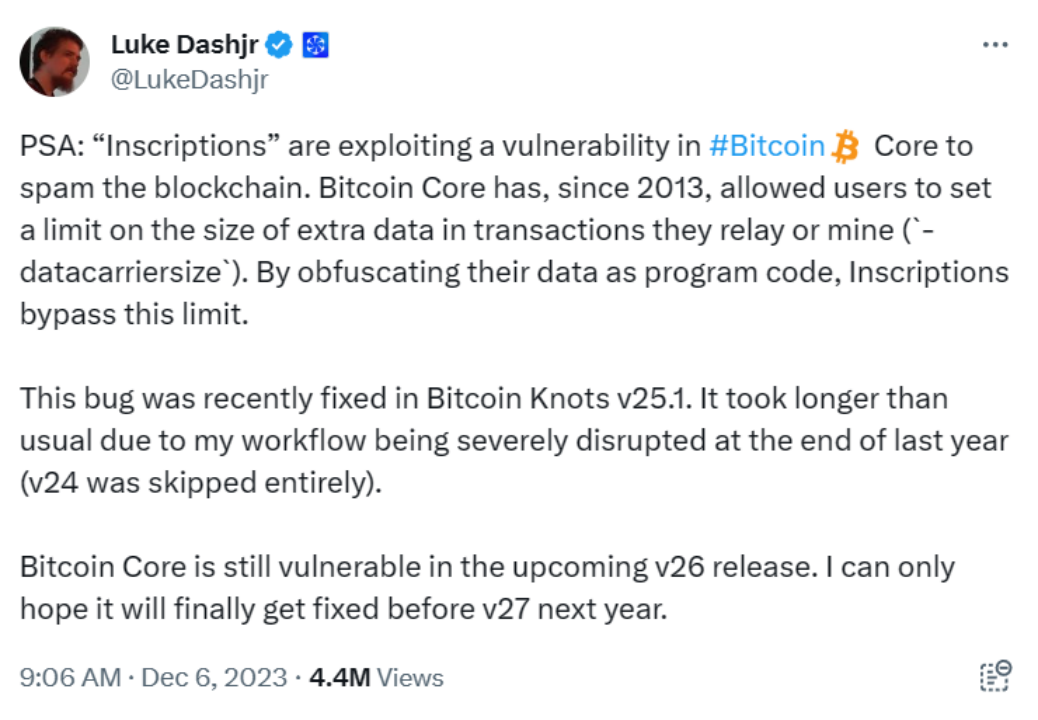
On December 6th, Bitcoin developer and co-founder of the Ocean mining pool, Luke Dashjr, launched a lengthy criticism of Ordinals and BRC-20 tokens and other inscriptions, claiming that they are exploiting a BTC vulnerability through SPAM attacks. According to Dashjr, since 2013, the Bitcoin core code has allowed users to set limits on the size of additional data in transactions; however, inscriptions bypass this limit by disguising their data as program code, making them a "vulnerability."
Dashjr stated that the Bitcoin core code is still susceptible to "SPAM attacks" in the upcoming v26 version, and developers hope to finally resolve this issue before v27 next year. Dashjr also stated that if the vulnerability is resolved, although existing inscriptions will continue to exist, Ordinals and BRC-20 tokens will be discontinued. On the same day, Dashjr, serving as the Chief Technology Officer of the decentralized mining protocol Ocean, announced on X that the Bitcoin Knots upgrade "fixed the vulnerability that long-term SPAM attackers have been exploiting." Dashjr later revealed that this vulnerability issue had been entered into the U.S. National Vulnerability Database as CVE-2023-50428.
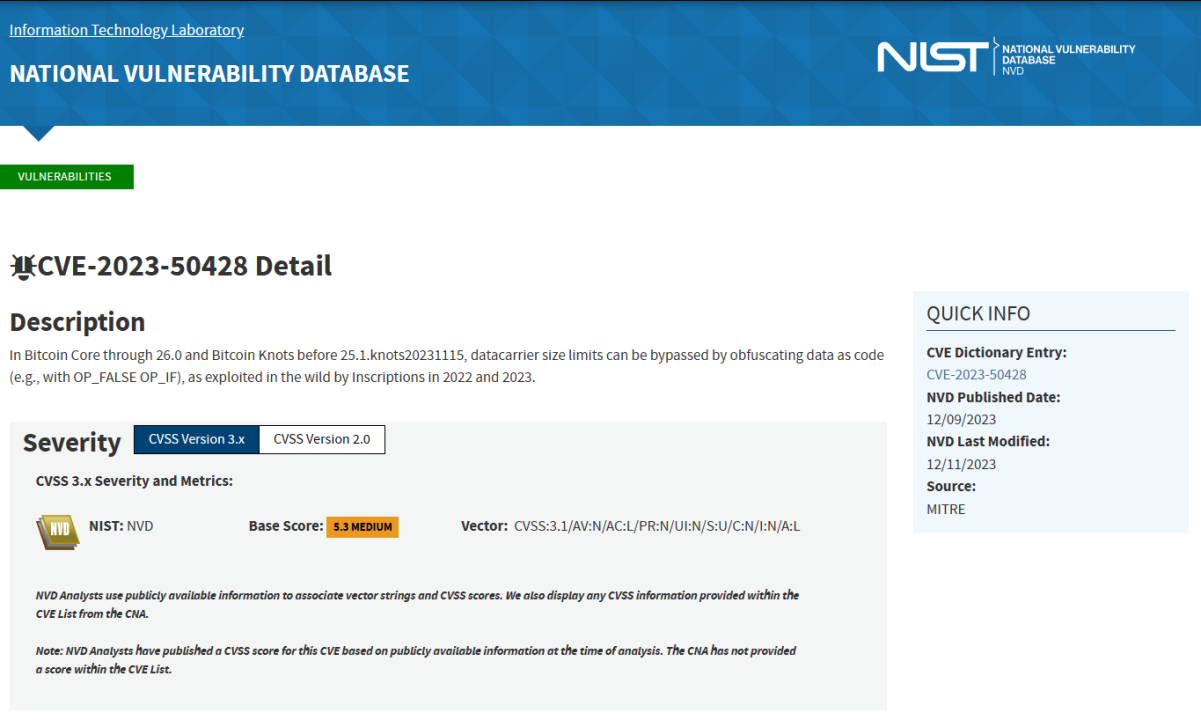
The inscription entry was included in the U.S. National Vulnerability Database
Controversy Surrounding Ordinals
Controversy surrounding Ordinals has always existed, and Dashjr's remarks have escalated these debates. On the Bitcointalk forum, there have been many discussions about resisting "attacks on Bitcoin," with some claiming that these are the actions of malicious BSV developers. There are also discussions about implementing a soft fork to enforce strict Taproot verification script sizes, and how the protocol filters what they consider to be "SPAM attacks," and even considering a hard fork to revoke Taproot.
Bob Bodily, co-founder and CEO of Bioniq, the market for Ordinals, disagrees with this view. He believes, "Due to Ordinals, the demand for Bitcoin block space has increased this year, with these transactions paying over $100 million in network fees. Miners want more income, and Ordinals has brought about a renaissance of Bitcoin, with a huge demand for block space." Bodily also stated that this move would undermine many of the benefits brought by the Taproot and Segwit upgrades and eliminate effective use cases for Bitcoin. Even with restrictions in place, Bodily believes that there will still be demand for protocol transactions such as Bitcoin Ordinals.
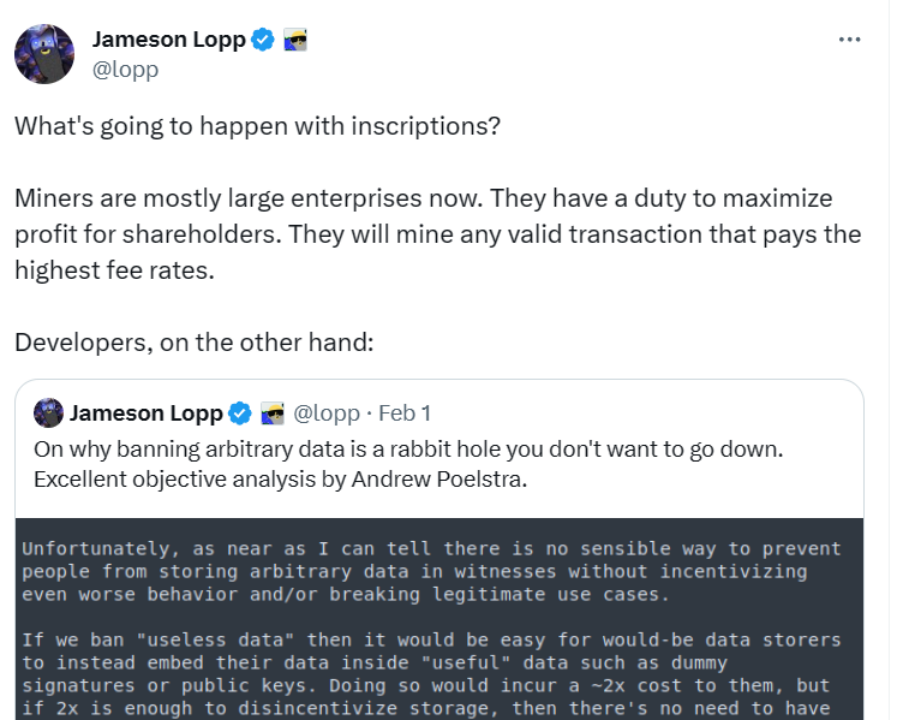
Similarly, Jameson Lopp, Chief Technology Officer of Casa, expects economic rationality to prevail. He explained on X that most miners are now large enterprises with a responsibility to maximize profits for shareholders, so they will mine any valid transactions that pay the highest fees. He also stated that few people agree with classifying inscriptions as vulnerabilities, and Dashjr's classification of them as SPAM attacks is subjective.
Hass McCook, a former member of the Bitcoin Mining Council and a staunch believer in Bitcoin, does not like Ordinals, but he also believes that "getting rid of" Ordinals is not a good thing. He said, "The most important thing outside of Bitcoin is freedom. My overall view is that I personally don't like it (Ordinals), and I don't see its value. But I don't want to censor it. I think this could lead to a very dark path."
Future Direction of Ordinals
Luke Dashjr's proposal does not mean it will be ultimately implemented. He does not have the authority to modify the Bitcoin code, and upgrades require a vote from miners.
Unlike Ethereum, where developers' words are not decisive, code upgrades in Bitcoin must be voted on by miners, and opposition will prevent the upgrade from proceeding. Even if developers insist on the upgrade, miners still have the right to choose to fork; however, the possibility of forking is quite low at a critical moment for the approval of a Bitcoin spot ETF.
Removing high-value transactions from the memory pool will reduce miners' income, and Bitcoin miners are unlikely to engage in a "moral struggle" over this issue. Even if Bitcoin community members intend to maintain the value of Bitcoin, it cannot be denied that Ordinals' surge has also brought about positive developments in the BTC ecosystem, despite the increasing gas fees and BTC network congestion.
Renowned podcaster Peter McCormack stated that these assets (Ordinals) do not benefit those who use Bitcoin for payments, as they only create a high-fee environment. It is clear that the outbreak of Ordinals has resulted in losses for some Bitcoin holders, which is at the heart of the debate between supporters and opponents of Ordinals.
Conclusion
The debate about Ordinals is far from over. The emergence of Ordinals has left a profound impact on the Bitcoin ecosystem, sparking discussions about gas fees, block space demand, and other aspects. As for the contradictions between supporters and opponents, as well as the impact on the Bitcoin network, there may be more appropriate protocols or methods to address these issues in the future. The Bitcoin community is facing the challenge of how to handle Ordinals, but overall, the likely direction of the community vote seems to lean towards supporting Ordinals, with a relatively low possibility of forking. After all, for miners and supporters of Ordinals, as long as at least one Bitcoin mining pool includes inscription transactions, they are unlikely to disappear.
Reference: https://nvd.nist.gov/vuln/detail/CVE-2023-50428
Follow Us
TrendX is an AI-driven one-stop platform for Web3 trend tracking and intelligent trading, using large language models and AI technology to identify market trends and seamlessly integrate with intelligent trading, aiming to become the next generation AI trading platform for the future 1 billion users to enter Web3 to search for projects, find hotspots, view trends, primary investment, and secondary trading.
Website: https://app.trendx.tech/
Twitter: https://twitter.com/TrendX_tech
Investment carries risks, and the project is for reference only. Please bear the risks!
免责声明:本文章仅代表作者个人观点,不代表本平台的立场和观点。本文章仅供信息分享,不构成对任何人的任何投资建议。用户与作者之间的任何争议,与本平台无关。如网页中刊载的文章或图片涉及侵权,请提供相关的权利证明和身份证明发送邮件到support@aicoin.com,本平台相关工作人员将会进行核查。


