Original Author: Badbrothers, Crypto KOL
Original Compilation: Leo, BlockBeats
Today, the U.S. Department of the Treasury's Office of Foreign Assets Control (OFAC) imposed sanctions on Roman Semenov, one of the three founders of Tornado Cash, a virtual currency mixer, on the grounds that he provided substantial support to Tornado Cash and the Lazarus Group, a state-sponsored hacking organization supported by North Korea. The U.S. Department of the Treasury stated that since its founding in 2019, Tornado Cash has been used for money laundering by criminals, including covering up the theft of hundreds of millions of dollars in virtual currency by the Lazarus Group hackers.
However, the problem with this sanction is that it bypasses user privacy and directly targets the protocol layer, raising the question of whether protocol freedom should be subject to regulation. This action has once again sparked a conflict between cryptocurrency regulation and protocol technology. Crypto KOL Badbrothers commented on the event, and BlockBeats compiled the following:
"Code is Speech"
Today, the United States once again imposed sanctions on cryptocurrency. Tornado Cash's founder, Roman Storm, and Roman Semenov have become political prisoners of the U.S. government for writing code. However, this sanction not only involves an attack on cryptocurrency, but also an attack on speech itself.
Let's look back to the 1990s, when the Bernstein v. United States case occurred. This was one of the first major legal victories for the Electronic Frontier Foundation (EFF) in establishing the "code is speech" principle.
"BlockBeats Note: In 2015, the Electronic Frontier Foundation (EFF), a U.S. nonprofit organization, celebrated its 25th anniversary. The EFF website published an article reviewing a significant legal victory, the "Bernstein v. United States" case, which was a landmark case that established the principle of code as speech and changed U.S. export control regulations for encryption software. At the time, Daniel J. Bernstein, a mathematics doctoral student at Berkeley, wanted to publish the encryption algorithm he developed, run the source code of the algorithm, and a mathematical paper describing and explaining the algorithm. Due to the U.S. government's laws and regulations at the time, Bernstein had to submit his ideas, register as an arms dealer, and then apply for an export license. However, the U.S. State Department warned him that even if he applied for a license, it would be officially rejected because his encryption technology was too secure. Subsequently, the EFF assembled a strong legal team and, in February 1995, represented Bernstein in suing the U.S. government. On April 15, 1996, Judge Marilyn Hall Patel of the Northern District of California issued a crucial first ruling, recognizing that code is speech and therefore protected by the First Amendment."
The case roughly described the U.S. restrictions and regulations on encryption software. In the early 1990s, for national security reasons, the U.S. government classified encryption software as "munitions" and imposed strict restrictions and regulations on it. Bernstein fought for and won the legitimacy of "code is speech," preventing the U.S. from restricting the export of encryption software and promoting the struggle for the flourishing of e-commerce.
Since the birth of encryption technology, the U.S. government has been cracking down on encryption technology, from previous attempts to install backdoor chips on every electronic device to recent attempts to compel companies like Apple to install software backdoors for "national security" reasons.
But what about encountering viruses and the like?
Let's review the content not covered by freedom of speech. The often-repeated falsehood that "you can't shout fire in a crowded theater" comes from the 1919 Schenck v. United States case, a very poor ruling against bad speech laws at the time.
Of course, this case has nothing to do with fires or crowded theaters. Instead, under the recently passed Espionage Act, it was used to imprison anti-war protesters distributing anti-draft (slavery) pamphlets during World War I. Woodrow Wilson (the 28th President of the United States) was the worst.
This loophole was eventually overturned by the Brandenburg v. Ohio case, which also laid the groundwork for the situation in the U.S. today, that "advocacy of illegal action is protected by the First Amendment unless the advocacy is directed to inciting or producing imminent lawless action."
For example, this is like saying "we want to kill all people who like pineapple pizza," but the person in the blue shirt likes pineapple on pizza, so we want to kill him. The mistake is not Tornado Cash, the person who likes pineapple.
Applying this logic to code would mean creating viruses/malware, intending to infect users' systems and cause harm, which is illegal. However, simply creating one for testing/experimentation in a closed network is not.
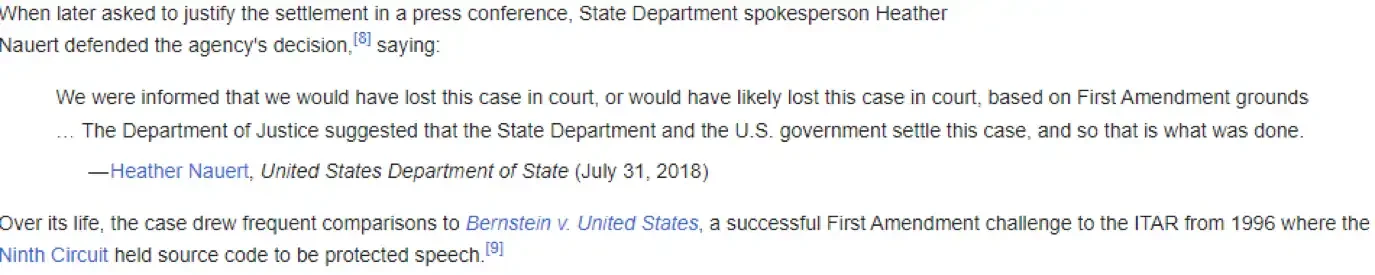
Another notable similar case is the legal battle between Cody Wilson (an American crypto-anarchist) and the U.S. State Department over the legality of 3D-printed gun code, where they attempted to sue under the International Traffic in Arms Regulations (ITAR).
3D printing's contribution to the right to self-defense, like the internet's contribution to freedom of speech, and Bitcoin's contribution to freedom of transactions. In my opinion, Cody and Satoshi Nakamoto will be immortalized as heroes defending freedom.
Cody is a crypto-anarchist and a staunch supporter of Bitcoin. In 2013, he released the files for the first 3D-printed gun, "The Liberator," and the U.S. claimed that this act of releasing 3D-printed gun code was equivalent to exporting weapons to Mexico.
ITAR regulations were also used to investigate Phil Zimmermann, the founder of PGP, but due to the Bernstein case, ITAR eventually abandoned the investigation. However, the case between Cody and the U.S. State Department regarding 3D-printed guns concluded in 2018 with an out-of-court settlement. The U.S. Department of Justice ruled that as of August 1, 2018, owning or publishing 3D-printed gun designs in the U.S. would be considered legal. Defense Distributed (the organization Cody created) also received a $40,000 legal settlement from the U.S. government.
Looking back at the Tornado Cash case, we have established the long-term legitimacy of "code is speech." Tornado Cash's statement indicates that the project has no direct connection to the hacker organizations using it, but is merely being exploited by them.
The argument of this case boils down to "by not implementing KYC or AML procedures, Tornado Cash intentionally assists criminals in money laundering," which means a direct attack on cryptocurrency and freedom of speech. The authorities state that "creating privacy protocols for criminals to use is a criminal act."
Tornado Cash is not a CEX. Tornado Cash is an Ethereum zero-knowledge proof privacy solution: a smart contract that accepts Ethereum transactions, allowing assets to be withdrawn in the future without referencing the original transaction.
This case also signifies an escalation in the struggle between "privacy, freedom of speech, cryptocurrency, and our fundamental natural rights" and "regulation." Now, the founders of Tornado Cash have been added to the list of countless other political prisoners in the U.S., similar to previous cases involving Ross Ulbricht (founder of the dark web Silk Road) and Julian Assange (founder of WikiLeaks).
Now we must stand up to express support for these founders, which is also the significance of Bitcoin and blockchain from the beginning to the present.
Finally, if Roman is convicted under these absurd legal standards, I believe the U.S. may also prosecute Satoshi Nakamoto for similar reasons and logic, as well as anyone contributing to Monero or anyone attempting to place a privacy layer on top of Bitcoin. They would all face the same risks.
免责声明:本文章仅代表作者个人观点,不代表本平台的立场和观点。本文章仅供信息分享,不构成对任何人的任何投资建议。用户与作者之间的任何争议,与本平台无关。如网页中刊载的文章或图片涉及侵权,请提供相关的权利证明和身份证明发送邮件到support@aicoin.com,本平台相关工作人员将会进行核查。


