"Weekly Editors' Picks" is a "functional" section of the Odaily Planet Daily. In addition to covering a large amount of real-time information every week, the Planet Daily also publishes many high-quality in-depth analysis content, which may be hidden in the information flow and hot news, passing by you.
Therefore, our editorial department will select some high-quality articles worth reading and collecting from the content published in the past 7 days every Saturday, bringing new inspiration to you in the encrypted world from the perspectives of data analysis, industry judgment, and opinion output.
Now, let's read together:

Investment and Entrepreneurship
We need to master the various stages of the bull market to maximize profits and avoid the most common pitfalls.
During the accumulation stage, accumulate good projects, save ammunition, avoid over-trading, fill knowledge gaps, and monitor liquidity; in the early stage of the bull market, reduce losing positions, increase profitable positions, take profits on the way up, be cautious of high risks, observe market sentiment, and stay focused; at the peak of the bull market, consider exit plans; in the downturn stage, believe that there will be another Crypto bull market.
Narrative Prelude: A Guide to Profit and Survival
Our goal is to invest funds in a liquid asset during the bear market and achieve better returns than in early-stage risk investment trading in that narrative.
Narratives are poised at the beginning of a bull market, usually triggered by technological developments. Early participants in specific areas have gained excess returns as narratives and usage scale simultaneously expand. Compound, UniSwap, and BoredApes are examples of narratives and product usage combined, bringing excess returns to investors.
The challenge is that you must invest in narratives that may disappear before they attract enough users. The market usually prices narratives in the short term. Given the liquidity nature of Web3 investments, liquid assets may exit within a quarter.
Given the illiquidity nature of risk investments, when products go online, startups may not have a market to leverage because products need time to develop. This often means slow death and gambling on user return. Products actually become bets on "bull returns." For founders, this is a survival memo.
If a product-market fit cannot be found within a meaningful time frame, ending the business makes sense.
Exploring the African Crypto Market: Fond of Stablecoins, Eager for Success Amidst Shortcomings
- In Africa, cryptocurrency payments have become a convenient way to obtain US dollars.
- Due to early expansion and peer-to-peer market promotion, Binance is very popular in Africa.
- Africans hope to earn income based on ability rather than geographical location, and they have the perseverance to pursue it.
- The long-term goal should be to reduce the differences between Europeans and Africans in the digital field.
- Africans face many challenges, including lack of regulatory support, inability to travel, difficulty in complying with KYC/AML regulations, almost no venture capital network, and no time to try new ideas.
- More importantly, almost all Nigerians admit that they have missed opportunities because people do not trust them.
- The education program of Web3 Bridge is doing important work, and the next step is for Western countries to assist in conducting summer schools.
DeFi
The full-chain LSD protocols Entangle Protocol and Tenet Protocol both come from the Cosmos ecosystem.
Entangle is a full-chain LSD application chain centered around native oracles and EVM compatibility. Its "full-chain" attribute is reflected in its ability to create cross-chain LSD for LPs supported on any chain, thereby achieving multi-chain benefits. Entangle provides a full-chain application scenario for LP-LSD, while Tenet provides specific application scenarios for full-chain LSD (Tenet chain staking). The former is similar to a mesh structure, while the latter is more like a convergent structure. Tenet is also built on the Cosmos SDK with EVM compatibility, deeply integrating the LayerZero full-chain interoperability infrastructure to empower LSD assets at the chain level.
The core focus of Entangle is on LP-LSD, providing cross-chain LSD services for LP assets; Tenet focuses on DiPoS, supporting diversified LSD asset participation in staking consensus. The relationship between the two seems to be more cooperative than competitive.
CeFi
Conversation with PayPal: Will PYUSD Take Market Share from Tether and Circle?
PayPal's overall vision has always been to bridge fiat and Web3, bringing mainstream applications to the payment system. PayPal hopes to release platform products, and then developers will develop on top of it.
Stablecoins are currently the killer application of blockchain, very close to the payment market and with significant advantages in settlement time. In the B2B payment field, PayPal sees an increasing number of stablecoins being adopted.
PYUSD is the only stablecoin accepted by the PayPal ecosystem, including the current PayPal and soon Venmo, as well as its bilateral network. Therefore, millions of consumers and merchants will be able to access it and use it as a funding tool for PayPal transactions. PayPal leverages the banking resources built over many years. Users can transfer PYUSD, sell it, and then withdraw it to a bank account. PYUSD also has compliance and regulatory advantages. PayPal charges transaction fees, but there are no fees for stablecoins, and the only cost for users is Ethereum gas fees.
Business models that may win out in the medium term for sovereign debt RWA projects:
Underlying assets: Using government bond ETFs may be a relatively clever way, leaving liquidity management and other issues to traditional financial giants. If directly purchasing US bonds or mixed assets, it tests the project's ability to select cooperation partners.
Business architecture: There are relatively mature models that can be applied, and it is best if they are highly scalable, making it easier to expand scale more quickly and incorporate new asset classes in the future.
User end: In the medium term, projects with a broad user base that do not require KYC and have no capital threshold requirements may be more widespread. In the future, if regulations require mandatory KYC, lightweight KYC projects may become more mainstream solutions.
Profit distribution: To make investors in sovereign debt RWA have a more stable and confident expectation of returns, the best solution is for the project's user returns to be consistent with government bond yields.
Composability: Before regulations restrict access to on-chain RWA assets, expanding the usage scenarios of user sovereign debt RWA tokens as much as possible is an important factor for each project to gain a larger business volume in the medium to long term.
In the medium to long term, due to increasingly deep regulatory intervention, some lightweight KYC projects may have greater opportunities.
NFT, GameFi, and Metaverse
A Review of 7 Popular Full-Chain Games
The article provides detailed introductions to Dark Forest, Loot Survivor, Treaty, Isaac, Mithraeum, Influence, and Wolf Game from four aspects: development team, project background, full-chain technology, and economic model.
Paradigm: The Unique Value and Open Issues of Full-Chain Games
The two main sources of UGC—mods (such as Minecraft) and open economies (such as EVE)—are breakthrough directions that full-chain games may achieve.
The most compelling reason to put games entirely on the blockchain is the combinable modifications and permissionless open economy. The combination of combinable mods and permissionless economies may produce large-scale on-chain game worlds. In addition, composability inherently has financial characteristics, and full-chain games need to find out how to use financial pressures without being consumed by them. Research directions include anti-fragile design, permission settings, and order flow auctions.
There are four research directions for the future of full-chain games: TEE, MACI (used to enhance the anti-collusion ability of on-chain voting systems), custom rollups, and using ZKP to enable private states.
Ethereum and Scalability
The Past and Present of LSD: Evolutionary Paths, Race Overview, and Interest Returns
One way to measure the size of the staking market is to add the market value of all PoS-based chains. This number is approximately $318 billion, with 72% being Ethereum. Ethereum has one of the lowest staking ratios in the network. Ethereum is the only network that offsets a portion of the daily issuance through burning fees. The fees burned on Ethereum are proportional to the network's usage.

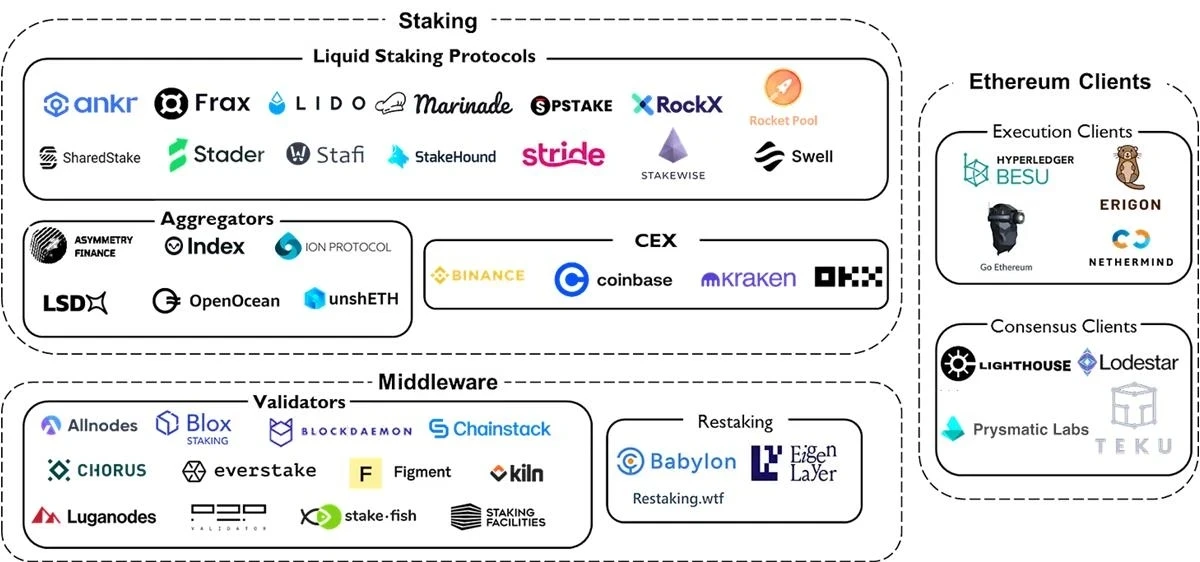
A panoramic view of the staking race.
Liquidity Staking Derivatives (LSD) brings the following benefits: Firstly, it allows retail participants to invest without losing access to their staked assets. Users can withdraw their earnings at any time. Secondly, even with a smaller amount of ETH, people can participate in staking. Lido is one of the few crypto projects that can profit on a large scale from idle assets. Approximately $15 billion worth of ETH is staked on Lido. As long as ETH can generate income and funds do not flow out, liquidity staking investment enterprises will be in good shape. Additionally, unlike Uniswap or Aave, Lido is less affected by market fluctuations. Lido takes advantage of people's laziness.
EigenLayer is one of the leading middleware that supports re-collateralization. Block space is a decentralized trust product provided by nodes or validators below it. The greater the value of decentralized trust, the higher the price of block space. The re-collateralization mechanism allows us to delve into the decentralized stack and create a market for decentralized trust. EigenLayer allows Ethereum validators to reuse their trust and benefit new blockchains from the same trust.
Not every chain needs to establish its own security. This is because not every chain is trying to become a global settlement network like Ethereum, Bitcoin, or SWIFT. There is no absolute security in public blockchains. Blocks are probabilistic (rolling back one or two blocks is not uncommon), and security is a range. When teams focus on building applications, they may be more concerned with users. Achieving security to the extent that it can compete with chains with huge network effects is slow and painful. And if the project is a chain specific to applications, users do not care about security as long as it is sufficient for the application provided.
Binance Research Institute L2 Market Report Interpretation: Evolution Trends and Players in the Race
L2 has evolved new trends, including Superchain, L3, and Hyperchain. These advancements are expected to become the cornerstone of the next generation of Ethereum expansion, simplifying the development process, enhancing security, and establishing greater interoperability in the ecosystem.
Optimism's OP stack is moving towards the superchain, with high interoperability. The Bedrock upgrade represents another step towards their vision.
Arbitrum is also at the forefront of Ethereum expansion, developing the L3 network through Arbitrum Orbit, providing a permissionless framework for deploying custom chains on Arbitrum L2.
zkSync proposes Hyperchain, a set of customizable trustless linked blockchains, achieving super scalability, improved composability, and enhanced security.
StarkWare is developing a multi-layer solution, exploring L3 for custom expansion and utilizing L2 for general expansion.
Polygon 2.0 aims to create an "Internet of Value" by unifying its L2 solution suite, including Polygon PoS, Supernets, and zkEVM.
Mint Ventures: Layout of Cancun Upgrade, OP and ARB, Who is the Better Choice?
The profit model of L2 is clear and simple, namely, on the one hand, purchasing storage space from a trusted DA (Data Availability) layer to back up their L2 data (so that when there are problems with L2 operation, they can restore it through backup data), and on the other hand, providing cheaper block space services to users and charging based on this, with profits coming from: L2 fees (base fees + MEV income) - costs paid to DA service providers.
The fee collection of L2 and cost payment of L1 are both executed by the sequencer of L2, and the profits also belong to the sequencer. Currently, both OP and ARB sequencers are operated by the official party, and the profits also belong to the official treasury. Of course, centralized sequencers mean extremely high single-point risk, and both ARB and OP have long-term commitments to decentralize the sequencer. At that time, ARB and OP tokens will gain economic value empowerment in addition to pure governance.
The service targets of previous L2 projects were users using their own block space, while Superchain and OP stack have expanded the definition of users to L2 operators, transforming from a 2C (here, defining L2 developers as C) business to a 2 B2C business, which has built new sources of value and moats for OP: multi-chain network effects, economies of scale, and community of interests.
Corresponding to the rapidly rising business data of OP, the valuation of the OP main chain is becoming more and more attractive compared to ARB. Although Arbitrum one, as a single-chain L2, still maintains a slight lead in business data compared to other L2s, its share of users in the entire L2 market is actually rapidly declining, as a large number of new and old users are flowing to the OP series and mixed series L2. After the Cancun upgrade, the lower the ratio of L2 users benefiting from the significantly reduced costs of L2, the higher the L2 operating profit. The higher the ratio of increased transfer activity brought about by the reduction in L2 fees, the higher the L2 operating profit.
Risks to watch for OP include: ARB choosing to open its own L2 license, competing for the total network population of L2 in a way similar to OP; intense competition in the overall L2 service market; the overall development of the Superchain ecosystem, whether the value can be transmitted to the OP Foundation and OP tokens; valuation risk (whether expectations have been priced in).
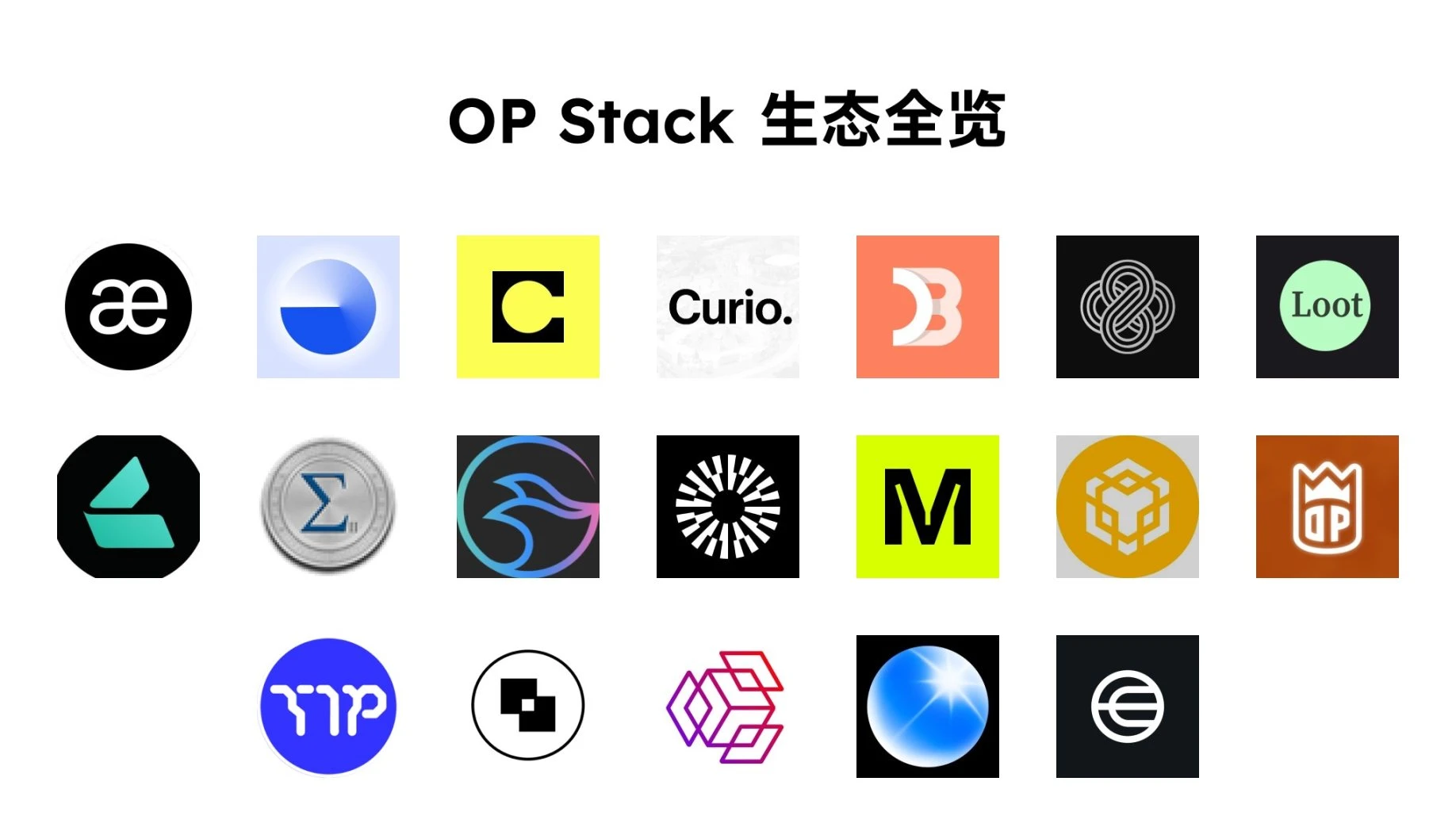
"Crazy Growth", an Overview of OPStack Ecosystem Projects
SpaceX wrote down $373 million worth of Bitcoin last week, and the crypto market experienced a significant decline. Coinbase has been approved to offer compliant cryptocurrency futures trading to eligible US customers. The first spot Bitcoin ETF in Europe has been launched. Sei has announced the token economy: 3% for airdrops, 20% for early contributors, and has started the airdrop. Celsius plans to shut down its application within 90 days and distribute $2.03 billion in crypto assets. PayPal has been selected to distribute BTC, and PayPal will launch a cryptocurrency center for specific users, allowing them to trade cryptocurrencies. ARK Invest has submitted a new application for a digital asset and blockchain ETF ($ARKD).
Additionally, in terms of policies and macro markets, the Monetary Authority of Singapore has finalized the regulatory framework for stablecoins, with issuers needing to meet disclosure requirements (details can be found here). Secretary for Financial Services and the Treasury of Hong Kong, Christopher Hui, has emphasized the government's focus on the development of financial technology and Web 3.0 (source).
In terms of opinions and voices, 1confirmation co-founder predicts that the prediction market will be the next market to attract mainstream attention (source). ArkStream Capital believes that the market may not only be about L2, and new public chains should not be ignored (source). Vitalik Buterin suggests that the note-taking feature in the X platform community may be the closest example of "cryptographic value" in the mainstream world (source). Vitalik also discusses AI, stating that we should not worry about being replaced, as we will eventually adapt to new technological waves (source). He also mentioned that XRP is completely centralized, sparking dissatisfaction in the XRP community (source). A PayPal executive stated that the company plans to integrate with the DeFi ecosystem through PYUSD and ensure its quick integration with CEX (source). The founder of Wintermute stated that the "YFI loan and CRV plan" aims to achieve a win-win situation and does not involve market manipulation (source). The founder of Aave mentioned that after introducing stability modules and other improvements in the coming months, GHO will resume anchoring (source).
In terms of institutions, large companies, and leading projects, Visa is testing a method to support credit or debit card payments in fiat currency for on-chain gas fees (source). Kraken has surpassed Coinbase to become the most liquid altcoin trading market in the United States (source). CyberConnect has opened the distribution of airdrops (source). The Aave community has proposed an "aCRV OTC trading" plan, using 2 million aUSDT from the Aave DAO treasury to strategically purchase 5 million aCRV tokens (source). The Immutable zkEVM testnet has been launched, with the mainnet expected to be released in the fourth quarter (source). Unibot has launched the unified trading terminal Unibot X (source). Shiba Inu's L2 solution, Shibarium, has gone live on the mainnet (source). friend.tech will airdrop reward points to test users (source).
In the NFT and GameFi fields, DeGods experienced a sudden drop (source), and Finny, co-founder of DeGods, will resign but still has high hopes for DeGods and y00ts (source). Coca-Cola has issued a series of NFTs on the Base chain as part of the OnchainSummer event brand (source)… Well, it's been another eventful week.
Attached is the "Weekly Editors' Picks" series link.
Until next time~
免责声明:本文章仅代表作者个人观点,不代表本平台的立场和观点。本文章仅供信息分享,不构成对任何人的任何投资建议。用户与作者之间的任何争议,与本平台无关。如网页中刊载的文章或图片涉及侵权,请提供相关的权利证明和身份证明发送邮件到support@aicoin.com,本平台相关工作人员将会进行核查。